
Recent from talks
Mixed climbing
Knowledge base stats:
Talk channels stats:
Members stats:
Mixed climbing
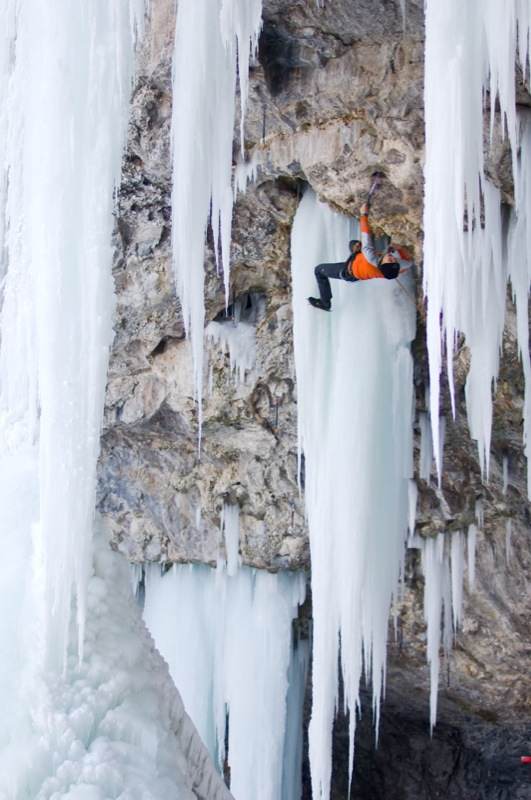
Mixed climbing is an ice climbing discipline used on climbing routes that do not have enough ice to be regular ice climbs, but are also not dry enough to be regular rock climbs. To ascend the route, the mixed-climber uses normal ice-climbing equipment throughout (e.g. double ice tools or ice axes in their hands, and crampons on their feet), but to protect the route, they use both ice and rock equipment. Mixed climbing varies from routes with sections of thick layers of ice interspersed with sections of bare rock, to routes that are mostly rock but which are "iced-up" in a thin layer of ice and/or snow.
While alpinists have used mixed climbing techniques for decades on alpine routes (most north-facing alpine routes are iced or snow-covered), mixed climbing as a standalone sport came to wider prominence with Jeff Lowe's ascent of the partially bolted Octopussy (WI6, M8 R) in 1994. Mixed climbing also led to the sport of dry-tooling, which is mixed climbing on routes that are completely free of all ice or snow. The equipment used — the lengths of ice tools and the use of heel spurs and ice axe leashes — has become more regulated to avoid concerns of being more like aid climbing than free climbing.
Mixed climbing routes are graded for difficulty on an M-grade system, and the development of specialized mixed climbing techniques (e.g. stein pulls and figure-four moves), and specialised equipment (e.g. fruit boots, heel spurs, and advanced ergo ice axes), led to dramatic increases in mixed climbing grade milestones, particularly from 1994 to 2003, and have also been credited with pushing standards in the wider field of alpine climbing. Many modern mixed routes are now bolted like sport climbing routes, but some mixed climbing routes still use traditional climbing-type protection—particuarly on multi-pitch routes.
Mixed climbing involves using ice climbing equipment (e.g. double ice axes and crampons) on routes that are not sufficiently covered in ice to be pure ice climbs and have a WI-grade. Mixed climbing routes have significant elements that are pure rock, which in some cases may be completely dry (e.g. as found on some North American mixed climbing routes), but in many cases is covered in a thin layer of ice and snow (e.g. as found in Scottish mixed climbing), thus making pure rock or ice climbing techniques impossible.
The mixed climber uses their ice axe and crampons to advance up the route by inserting them into small cracks and edges on the iced-up rock. They use the equipment of a traditional climbing rock climber for climbing protection, as there will be limited possibilities to use ice screws to protect the route. It has also become common to find single-pitch mixed climbs that are fully bolted in the manner of sport climbing routes. Mixed climbing can also be done as free solo climbing, which is an even risker undertaking.
Mixed climbing is closely related to alpine climbing, as many alpine climbing routes have large sections of iced and snow-covered rock that can neither be rock climbed (i.e. too slippery) nor climbed as a pure ice climb (i.e. not enough ice). Mixed climbing is also closely related to the sport of dry-tooling, which was developed by mixed climbers doing routes with no snow or ice, but still using the tools and techniques of mixed climbing; mixed climbs that have no ice are sometimes given a "D" prefix instead of an "M" prefix in their grade.
There has been debate as to whether mixed climbing is more akin to aid climbing, rather than the more desirable style of free climbing, due to its use of mechanical tools on natural rock. This has led to increased oversight on allowable tools (e.g. use of heel spurs, length of axes, and use of leashes for resting or to help with upward momentum, etc.); and most ice climbing competitions no longer allow leashes and regulate the use of heel spurs (e.g. if allowed at all, they cannot be used for resting).
Mixed climbing routes can cover a broad range of types. Some mixed climbing routes are combinations of an ice climbing route (i.e. a large frozen icicle, frozen alpine couloirs, or frozen water cascade) and a dry-tooling route (i.e. need to pass a rock overhang or rock roof to get to the frozen ice part); these routes have both a full mixed climbing grade (M-grade) and a full ice climbing grade (WI-grade). Examples of such routes are the American mixed climbing route, Octopussy (WI6, M8), Silent Memories (WI6, M9) in Italy, or French Reality (M7-, WI6+) in Canada.
Hub AI
Mixed climbing AI simulator
(@Mixed climbing_simulator)
Mixed climbing
Mixed climbing is an ice climbing discipline used on climbing routes that do not have enough ice to be regular ice climbs, but are also not dry enough to be regular rock climbs. To ascend the route, the mixed-climber uses normal ice-climbing equipment throughout (e.g. double ice tools or ice axes in their hands, and crampons on their feet), but to protect the route, they use both ice and rock equipment. Mixed climbing varies from routes with sections of thick layers of ice interspersed with sections of bare rock, to routes that are mostly rock but which are "iced-up" in a thin layer of ice and/or snow.
While alpinists have used mixed climbing techniques for decades on alpine routes (most north-facing alpine routes are iced or snow-covered), mixed climbing as a standalone sport came to wider prominence with Jeff Lowe's ascent of the partially bolted Octopussy (WI6, M8 R) in 1994. Mixed climbing also led to the sport of dry-tooling, which is mixed climbing on routes that are completely free of all ice or snow. The equipment used — the lengths of ice tools and the use of heel spurs and ice axe leashes — has become more regulated to avoid concerns of being more like aid climbing than free climbing.
Mixed climbing routes are graded for difficulty on an M-grade system, and the development of specialized mixed climbing techniques (e.g. stein pulls and figure-four moves), and specialised equipment (e.g. fruit boots, heel spurs, and advanced ergo ice axes), led to dramatic increases in mixed climbing grade milestones, particularly from 1994 to 2003, and have also been credited with pushing standards in the wider field of alpine climbing. Many modern mixed routes are now bolted like sport climbing routes, but some mixed climbing routes still use traditional climbing-type protection—particuarly on multi-pitch routes.
Mixed climbing involves using ice climbing equipment (e.g. double ice axes and crampons) on routes that are not sufficiently covered in ice to be pure ice climbs and have a WI-grade. Mixed climbing routes have significant elements that are pure rock, which in some cases may be completely dry (e.g. as found on some North American mixed climbing routes), but in many cases is covered in a thin layer of ice and snow (e.g. as found in Scottish mixed climbing), thus making pure rock or ice climbing techniques impossible.
The mixed climber uses their ice axe and crampons to advance up the route by inserting them into small cracks and edges on the iced-up rock. They use the equipment of a traditional climbing rock climber for climbing protection, as there will be limited possibilities to use ice screws to protect the route. It has also become common to find single-pitch mixed climbs that are fully bolted in the manner of sport climbing routes. Mixed climbing can also be done as free solo climbing, which is an even risker undertaking.
Mixed climbing is closely related to alpine climbing, as many alpine climbing routes have large sections of iced and snow-covered rock that can neither be rock climbed (i.e. too slippery) nor climbed as a pure ice climb (i.e. not enough ice). Mixed climbing is also closely related to the sport of dry-tooling, which was developed by mixed climbers doing routes with no snow or ice, but still using the tools and techniques of mixed climbing; mixed climbs that have no ice are sometimes given a "D" prefix instead of an "M" prefix in their grade.
There has been debate as to whether mixed climbing is more akin to aid climbing, rather than the more desirable style of free climbing, due to its use of mechanical tools on natural rock. This has led to increased oversight on allowable tools (e.g. use of heel spurs, length of axes, and use of leashes for resting or to help with upward momentum, etc.); and most ice climbing competitions no longer allow leashes and regulate the use of heel spurs (e.g. if allowed at all, they cannot be used for resting).
Mixed climbing routes can cover a broad range of types. Some mixed climbing routes are combinations of an ice climbing route (i.e. a large frozen icicle, frozen alpine couloirs, or frozen water cascade) and a dry-tooling route (i.e. need to pass a rock overhang or rock roof to get to the frozen ice part); these routes have both a full mixed climbing grade (M-grade) and a full ice climbing grade (WI-grade). Examples of such routes are the American mixed climbing route, Octopussy (WI6, M8), Silent Memories (WI6, M9) in Italy, or French Reality (M7-, WI6+) in Canada.
Recent media