
Recent from talks
Aid climbing
Knowledge base stats:
Talk channels stats:
Members stats:
Aid climbing
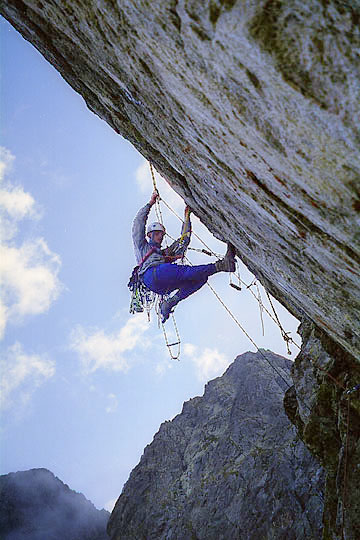
Aid climbing is a form of rock climbing that uses mechanical devices and equipment, such as aiders (also called 'ladders'), to assist in generating upward momentum. Aid climbing is contrasted with free climbing (in both its traditional or sport free-climbing formats), which can use mechanical equipment only for climbing protection, not to assist in any upward momentum. Aid climbing can involve hammering in permanent pitons and bolts, into which the aiders are clipped, but there is also 'clean aid climbing', which avoids any hammering and uses only temporary removable placements such as spring-loaded camming devices.
While aid climbing traces its origins to the start of all climbing when ladders and pitons were common, its use in single-pitch climbing waned in the early 20th century with the rise of free climbing. At the same time, the Dolomites saw the start of modern "big wall aid climbing", where pioneers like Emilio Comici developed new tools and techniques. Aid climbing's "golden age" was in the 1960s and 1970s on Yosemite's granite big walls led by pioneers such as Royal Robbins and Warren Harding, and later Jim Bridwell, and was where Robbins' ethos of minimal-aid, and Yvon Chouinard's ethos of clean aid climbing, became dominant.
In the 1990s, the traditional A-grade system for rating aid climbing routes was expanded at Yosemite into a more detailed "new wave" system, and with the development and growth in clean aid climbing, the A-grade system became the C-grade system. The grading of aid-climbing routes is complex as successive repeats of the route can substantially change the nature of the challenge through the continuous hammering and also the build-up of large amounts of in-situ fixed placements from each ascending party. It is not untypical for a new A5-graded aid-climbing route, to migrate to an A3-graded route over time.
Aid climbing is still used on large big wall climbing and alpine climbing routes to overcome sections of extreme difficulty that are beyond the difficulties of the rest of the route. A famous big wall climb such as The Nose on El Capitan is accessible to strong climbers as a partial-aid route graded VI 5.9 (5c) C2, but only a tiny handful can handle its 5.14a (8b+) grade as a free climbed route. Aid is also used to develop "next generation" big wall routes (e.g. Riders on the Storm on Cordillera Paine, or the Grand Voyage on Trango Towers). Extreme C5-graded aid-only routes are also still being established, such as Nightmare on California Street on El Capitan.
Aid climbing is a form of rock climbing that uses mechanical devices and equipment for upward momentum. Like traditional and sport climbing, aid climbing is typically done in pairs with a lead climber making the "placements" into which ladders (known as aiders) are clipped, thus enabling them to ascend. After the lead climber has reached the top, the second climber (or belayer) then removes the placements as they jumar up the rope.
Traditional aid climbing relied on fixed placements, which were mainly metal pitons that the lead climber hammered into the rock as they ascended. These placements remained permanently fixed on the route (and in such cases, the second (or belayer) didn't have to take any placement out and just jumared up on a fixed rope). Clean aid climbing avoids any hammering and uses the temporary protection of traditional climbing (e.g. spring-loaded camming devices) for placements; these are then removed by the second climber as they make their own ascent. This method therefore avoids the damage of repeated hammering of metal to aid routes, and has been advocated as useful training and building up of experience in the placing of traditional climbing protection.
While the sport of aid climbing has waned as the free climbing movement has grown, elements of aid climbing are still a regular feature of many major big wall climbing and alpine climbing routes. These routes are long multi-pitch climbs where it is possible to find specific sections that are considerably above the difficulty level of the rest of the route. For such sections, aid climbing techniques are accepted even by free climbers. For example, the renowned big wall climbing route The Nose on El Capitan is a 31-pitch 870-metre graded partial clean aid climb at VI 5.9 (5c) C2, but as a fully free climb with no aid, it is graded VI 5.14a (8b+), which is beyond the skills of all but a very small group of elite free climbers.
Aid climbing traces its origins to the start of all climbing, with ladders used on historic ascents such as the 1492 ascent of Mont Aiguille, the 1786 ascent of Mont Blanc, or the 1893 ascent of Devils Tower, and with drilled bolts on historic ascents such as the 1875 first ascent of Half Dome. By the start of the 20th century, the widespread use of aid (e.g. ladders and pitons) was challenged by the free climbing movement led by Paul Preuss. While the use of aid diminished on single-pitch routes, big wall climbers in the Dolomites, such as Tita Piaz, further developed aid climbing techniques. The legacy of the Dolomites as the birthplace of big-wall and modern aid climbing was cemented by pioneer Emilio Comici who developed the multi-step aider (or ladder). In 1933, Comici used these aid climbing techniques to climb the overhanging north face of the Cima Grande, then the world's hardest big wall aid route. Comici's aid techniques were used by the leading European big wall and alpine climbers such as Riccardo Cassin on famous routes across the European Alps.
Hub AI
Aid climbing AI simulator
(@Aid climbing_simulator)
Aid climbing
Aid climbing is a form of rock climbing that uses mechanical devices and equipment, such as aiders (also called 'ladders'), to assist in generating upward momentum. Aid climbing is contrasted with free climbing (in both its traditional or sport free-climbing formats), which can use mechanical equipment only for climbing protection, not to assist in any upward momentum. Aid climbing can involve hammering in permanent pitons and bolts, into which the aiders are clipped, but there is also 'clean aid climbing', which avoids any hammering and uses only temporary removable placements such as spring-loaded camming devices.
While aid climbing traces its origins to the start of all climbing when ladders and pitons were common, its use in single-pitch climbing waned in the early 20th century with the rise of free climbing. At the same time, the Dolomites saw the start of modern "big wall aid climbing", where pioneers like Emilio Comici developed new tools and techniques. Aid climbing's "golden age" was in the 1960s and 1970s on Yosemite's granite big walls led by pioneers such as Royal Robbins and Warren Harding, and later Jim Bridwell, and was where Robbins' ethos of minimal-aid, and Yvon Chouinard's ethos of clean aid climbing, became dominant.
In the 1990s, the traditional A-grade system for rating aid climbing routes was expanded at Yosemite into a more detailed "new wave" system, and with the development and growth in clean aid climbing, the A-grade system became the C-grade system. The grading of aid-climbing routes is complex as successive repeats of the route can substantially change the nature of the challenge through the continuous hammering and also the build-up of large amounts of in-situ fixed placements from each ascending party. It is not untypical for a new A5-graded aid-climbing route, to migrate to an A3-graded route over time.
Aid climbing is still used on large big wall climbing and alpine climbing routes to overcome sections of extreme difficulty that are beyond the difficulties of the rest of the route. A famous big wall climb such as The Nose on El Capitan is accessible to strong climbers as a partial-aid route graded VI 5.9 (5c) C2, but only a tiny handful can handle its 5.14a (8b+) grade as a free climbed route. Aid is also used to develop "next generation" big wall routes (e.g. Riders on the Storm on Cordillera Paine, or the Grand Voyage on Trango Towers). Extreme C5-graded aid-only routes are also still being established, such as Nightmare on California Street on El Capitan.
Aid climbing is a form of rock climbing that uses mechanical devices and equipment for upward momentum. Like traditional and sport climbing, aid climbing is typically done in pairs with a lead climber making the "placements" into which ladders (known as aiders) are clipped, thus enabling them to ascend. After the lead climber has reached the top, the second climber (or belayer) then removes the placements as they jumar up the rope.
Traditional aid climbing relied on fixed placements, which were mainly metal pitons that the lead climber hammered into the rock as they ascended. These placements remained permanently fixed on the route (and in such cases, the second (or belayer) didn't have to take any placement out and just jumared up on a fixed rope). Clean aid climbing avoids any hammering and uses the temporary protection of traditional climbing (e.g. spring-loaded camming devices) for placements; these are then removed by the second climber as they make their own ascent. This method therefore avoids the damage of repeated hammering of metal to aid routes, and has been advocated as useful training and building up of experience in the placing of traditional climbing protection.
While the sport of aid climbing has waned as the free climbing movement has grown, elements of aid climbing are still a regular feature of many major big wall climbing and alpine climbing routes. These routes are long multi-pitch climbs where it is possible to find specific sections that are considerably above the difficulty level of the rest of the route. For such sections, aid climbing techniques are accepted even by free climbers. For example, the renowned big wall climbing route The Nose on El Capitan is a 31-pitch 870-metre graded partial clean aid climb at VI 5.9 (5c) C2, but as a fully free climb with no aid, it is graded VI 5.14a (8b+), which is beyond the skills of all but a very small group of elite free climbers.
Aid climbing traces its origins to the start of all climbing, with ladders used on historic ascents such as the 1492 ascent of Mont Aiguille, the 1786 ascent of Mont Blanc, or the 1893 ascent of Devils Tower, and with drilled bolts on historic ascents such as the 1875 first ascent of Half Dome. By the start of the 20th century, the widespread use of aid (e.g. ladders and pitons) was challenged by the free climbing movement led by Paul Preuss. While the use of aid diminished on single-pitch routes, big wall climbers in the Dolomites, such as Tita Piaz, further developed aid climbing techniques. The legacy of the Dolomites as the birthplace of big-wall and modern aid climbing was cemented by pioneer Emilio Comici who developed the multi-step aider (or ladder). In 1933, Comici used these aid climbing techniques to climb the overhanging north face of the Cima Grande, then the world's hardest big wall aid route. Comici's aid techniques were used by the leading European big wall and alpine climbers such as Riccardo Cassin on famous routes across the European Alps.
Recent media