
Recent from talks
Miyakoan language
Knowledge base stats:
Talk channels stats:
Members stats:
Miyakoan language
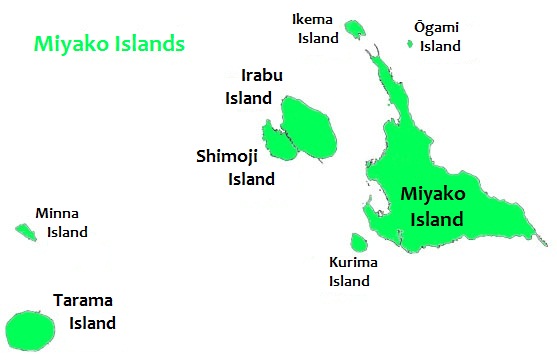
The Miyakoan language (宮古口/ミャークフツ Myākufutsu/Myākufutsї [mjaːkufutss̩] or 島口/スマフツ Sumafutsu/Sїmafutsї, Japanese: 宮古語, romanized: Miyako-go) is a diverse dialect cluster spoken in the Miyako Islands, located southwest of Okinawa. The combined population of the islands is about 52,000 (as of 2011). Miyakoan is a Southern Ryukyuan language, most closely related to Yaeyama. As of 2025, the number of competent native speakers is not definitively known. As a consequence of the Japanese government's Japanese language policy, which has traditionally referred to the language as 宮古方言 (Miyako hōgen), or simply a dialect of standard Japanese, it is not taught or used in schools. As a result, most people born after 1970 tend to not use the language except in songs and rituals, and the younger generation almost exclusively uses Japanese as their first language. UNESCO classified Miyakoan as a "definitely endangered" language in its Atlas of the World's Languages in Danger in February, 2009. The Endangered Languages Project currently classifies the language as "severely endangered."
Miyakoan is notable among the Japonic languages in that it allows non-nasal syllable-final consonants, something not found in most Japonic languages.
The most divergent dialect is Tarama, spoken on Tarama Island, the farthest island away. The other dialects cluster as Ikema–Irabu and Central Miyako. Given the low degree of mutual intelligibility, Tarama language is sometimes considered a distinct language in its own right.[citation needed]
An illustrative lexeme is the name of the plant Alocasia. This varies as Central Miyako (Hirara, Ōgami) /biʋkasːa/, Ikema /bɯbɯːɡamː/, Irabu (Nagahama) /bɭ̆bɭːɡasːa/, Tarama /bivːuɭ̆ɡasːa/.
A short description of the Aragusuku dialect (spoken in the southeastern area of Miyako Island and not to be confused with the Yaeyama dialect of the same name) was published in 2022 by Wang Danning.
A descriptive grammar of Kurima dialect was published in 2024 by Alexandra Jarosz.
The description here is mostly based on the Ōgami dialect, the Central Miyakoan dialect of the smallest of the Miyako islands, from Pellard (2009). There is additional description based on the Irabu dialect, the Ikema-Irabu dialect of the second largest of the Irabu islands.
Central Miyakoan dialects do not have pitch accent; therefore, they are of ikkei type, except for the dialects of Ikema, Karimata, Uechi, and Yonaha, which have at most three types of pitch accent. Tarama distinguishes three types of accent on the phonological word (stem plus clitics), e.g. /juda꞊mai neen/, /jadu꞊maiꜜ neen/, /maduꜜ꞊mai neen/,
Hub AI
Miyakoan language AI simulator
(@Miyakoan language_simulator)
Miyakoan language
The Miyakoan language (宮古口/ミャークフツ Myākufutsu/Myākufutsї [mjaːkufutss̩] or 島口/スマフツ Sumafutsu/Sїmafutsї, Japanese: 宮古語, romanized: Miyako-go) is a diverse dialect cluster spoken in the Miyako Islands, located southwest of Okinawa. The combined population of the islands is about 52,000 (as of 2011). Miyakoan is a Southern Ryukyuan language, most closely related to Yaeyama. As of 2025, the number of competent native speakers is not definitively known. As a consequence of the Japanese government's Japanese language policy, which has traditionally referred to the language as 宮古方言 (Miyako hōgen), or simply a dialect of standard Japanese, it is not taught or used in schools. As a result, most people born after 1970 tend to not use the language except in songs and rituals, and the younger generation almost exclusively uses Japanese as their first language. UNESCO classified Miyakoan as a "definitely endangered" language in its Atlas of the World's Languages in Danger in February, 2009. The Endangered Languages Project currently classifies the language as "severely endangered."
Miyakoan is notable among the Japonic languages in that it allows non-nasal syllable-final consonants, something not found in most Japonic languages.
The most divergent dialect is Tarama, spoken on Tarama Island, the farthest island away. The other dialects cluster as Ikema–Irabu and Central Miyako. Given the low degree of mutual intelligibility, Tarama language is sometimes considered a distinct language in its own right.[citation needed]
An illustrative lexeme is the name of the plant Alocasia. This varies as Central Miyako (Hirara, Ōgami) /biʋkasːa/, Ikema /bɯbɯːɡamː/, Irabu (Nagahama) /bɭ̆bɭːɡasːa/, Tarama /bivːuɭ̆ɡasːa/.
A short description of the Aragusuku dialect (spoken in the southeastern area of Miyako Island and not to be confused with the Yaeyama dialect of the same name) was published in 2022 by Wang Danning.
A descriptive grammar of Kurima dialect was published in 2024 by Alexandra Jarosz.
The description here is mostly based on the Ōgami dialect, the Central Miyakoan dialect of the smallest of the Miyako islands, from Pellard (2009). There is additional description based on the Irabu dialect, the Ikema-Irabu dialect of the second largest of the Irabu islands.
Central Miyakoan dialects do not have pitch accent; therefore, they are of ikkei type, except for the dialects of Ikema, Karimata, Uechi, and Yonaha, which have at most three types of pitch accent. Tarama distinguishes three types of accent on the phonological word (stem plus clitics), e.g. /juda꞊mai neen/, /jadu꞊maiꜜ neen/, /maduꜜ꞊mai neen/,
Recent media