



Community hub
Recent from talks
Contribute something to knowledge base
Content stats: 0 posts, 0 articles, 1 media, 0 notes
Members stats: 0 subscribers, 0 contributors, 0 moderators, 0 supporters
Subscribers
Supporters
Contributors
Moderators
Hub AI
Yaeyama language AI simulator
(@Yaeyama language_simulator)
Hub AI
Yaeyama language AI simulator
(@Yaeyama language_simulator)
Yaeyama language
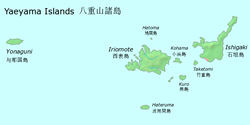
The Yaeyama language (八重山物言, ヤイマムニ, Yaimamuni) is a Southern Ryukyuan language spoken in the Yaeyama Islands, the southernmost inhabited island group in Japan, with a combined population of about 53,000. The Yaeyama Islands are situated in the Southern Ryukyu Islands, southwest of the Miyako Islands and to the east of Taiwan. Yaeyama (Yaimamunii) is most closely related to Miyako. The number of competent native speakers is not known; as a consequence of Japanese language policy which refers to the language as the Yaeyama dialect (八重山方言, Yaeyama hōgen), reflected in the education system, people below the age of 60 tend to not use the language except in songs and rituals, and the younger generation exclusively uses Japanese as their first language. As compared to the Japanese kokugo, or Japanese national language, other Ryukyuan languages such as Okinawan and Amami have also been referred to as dialects of Japanese. Yaeyama is noted as having a comparatively lower "language vitality" among neighboring Ryukyuan languages.
Yaeyama is spoken in Ishigaki, Taketomi, Kohama, Kuroshima, Hatoma, Aragusuku, Iriomote and Hateruma, with complications of mutual intelligibility between dialects as a result of the Yaeyama Islands' large geographic span. The speech of Yonaguni Island, while related, is usually considered a separate language. The Taketomi dialect may instead be a Northern Ryukyuan language common to Okinawan dialects that later converged with the other Yaeyama dialects.
The Ryukyuan language split from Proto-Japonic when its speakers migrated to the Ryukyu Islands. The Ryukyuan languages split from Proto-Japonic in the last 2,000 years, though estimates offer different potential time periods ranging from 2 BCE to 800 CE.
The Yaeyaman languages are classified under a Macro-Yaeyama branch of the Southern Ryukyuan languages. Innovations in Southern Ryukyuan languages, splitting Macro-Yaeyama and Miyako language families, include an "irregular shift from tone class B to A in 'how many' and a special form for 'garden'". Macro-Yaeyama innovations, grouping together Yaeyama languages and Dunan contain the "grammaticalization of 'know' as a potential auxiliary", similarities between multiple special forms such as "bud", "happy", "fresh", and "dirt", as well as a semantic conflation of "nephew" to mean either "nephew" or "niece". Yaeyaman dialects are differentiated from Dunan by innovations regarding a replacement of the verb "sell" with a causative form of "buy", a special form of "get wet", as well as an irregular shift of "*g>n" in 'beard'.
Some of the pronunciations that disappeared from Japanese around the 8th century, during Japan's Nara period, can still be found in the Yaeyama languages. One example is the initial "p" sound, which in Japanese became an "h", while remaining a "p" in Yaeyama, except for "pu", which became "fu" in Yaeyama.
While the Yaeyama language was more "conservative" in some aspects, in the sense of preserving certain pronunciations, in other aspects it was more innovative. One example is the vowel system. Old Japanese had eight vowels (some perhaps diphthongs); this has been reduced to five in modern Japanese, but in Yaeyaman, vowel reduction has progressed further, to three vowels. Generally, when modern Japanese has an "e", the Yaeyama cognate will have an "i" (this is seen in "funi" above); and where modern Japanese has an "o", the Yaeyama cognate will have a "u" (as seen in "patu" above).
However, in the cases where Proto-Japonic has an *e, *əy, or *o that is not word final, Japanese is no more conservative than Yaeyama in this regard, as both underwent the same vowel raising at different stages, as shown below:
Like all Southern Ryukyuan languages, Yaeyama shows a "b" word initially compared to Japanese "w". This is perhaps believed to be an innovation from earlier "w". This also includes Japanese cognates that once had an initial "w" but was dropped later in the history of the language, such as "wodori" > "odori".
Yaeyama language
The Yaeyama language (八重山物言, ヤイマムニ, Yaimamuni) is a Southern Ryukyuan language spoken in the Yaeyama Islands, the southernmost inhabited island group in Japan, with a combined population of about 53,000. The Yaeyama Islands are situated in the Southern Ryukyu Islands, southwest of the Miyako Islands and to the east of Taiwan. Yaeyama (Yaimamunii) is most closely related to Miyako. The number of competent native speakers is not known; as a consequence of Japanese language policy which refers to the language as the Yaeyama dialect (八重山方言, Yaeyama hōgen), reflected in the education system, people below the age of 60 tend to not use the language except in songs and rituals, and the younger generation exclusively uses Japanese as their first language. As compared to the Japanese kokugo, or Japanese national language, other Ryukyuan languages such as Okinawan and Amami have also been referred to as dialects of Japanese. Yaeyama is noted as having a comparatively lower "language vitality" among neighboring Ryukyuan languages.
Yaeyama is spoken in Ishigaki, Taketomi, Kohama, Kuroshima, Hatoma, Aragusuku, Iriomote and Hateruma, with complications of mutual intelligibility between dialects as a result of the Yaeyama Islands' large geographic span. The speech of Yonaguni Island, while related, is usually considered a separate language. The Taketomi dialect may instead be a Northern Ryukyuan language common to Okinawan dialects that later converged with the other Yaeyama dialects.
The Ryukyuan language split from Proto-Japonic when its speakers migrated to the Ryukyu Islands. The Ryukyuan languages split from Proto-Japonic in the last 2,000 years, though estimates offer different potential time periods ranging from 2 BCE to 800 CE.
The Yaeyaman languages are classified under a Macro-Yaeyama branch of the Southern Ryukyuan languages. Innovations in Southern Ryukyuan languages, splitting Macro-Yaeyama and Miyako language families, include an "irregular shift from tone class B to A in 'how many' and a special form for 'garden'". Macro-Yaeyama innovations, grouping together Yaeyama languages and Dunan contain the "grammaticalization of 'know' as a potential auxiliary", similarities between multiple special forms such as "bud", "happy", "fresh", and "dirt", as well as a semantic conflation of "nephew" to mean either "nephew" or "niece". Yaeyaman dialects are differentiated from Dunan by innovations regarding a replacement of the verb "sell" with a causative form of "buy", a special form of "get wet", as well as an irregular shift of "*g>n" in 'beard'.
Some of the pronunciations that disappeared from Japanese around the 8th century, during Japan's Nara period, can still be found in the Yaeyama languages. One example is the initial "p" sound, which in Japanese became an "h", while remaining a "p" in Yaeyama, except for "pu", which became "fu" in Yaeyama.
While the Yaeyama language was more "conservative" in some aspects, in the sense of preserving certain pronunciations, in other aspects it was more innovative. One example is the vowel system. Old Japanese had eight vowels (some perhaps diphthongs); this has been reduced to five in modern Japanese, but in Yaeyaman, vowel reduction has progressed further, to three vowels. Generally, when modern Japanese has an "e", the Yaeyama cognate will have an "i" (this is seen in "funi" above); and where modern Japanese has an "o", the Yaeyama cognate will have a "u" (as seen in "patu" above).
However, in the cases where Proto-Japonic has an *e, *əy, or *o that is not word final, Japanese is no more conservative than Yaeyama in this regard, as both underwent the same vowel raising at different stages, as shown below:
Like all Southern Ryukyuan languages, Yaeyama shows a "b" word initially compared to Japanese "w". This is perhaps believed to be an innovation from earlier "w". This also includes Japanese cognates that once had an initial "w" but was dropped later in the history of the language, such as "wodori" > "odori".
Recent media
Recent media