
Recent from talks
Mobile browser
Knowledge base stats:
Talk channels stats:
Members stats:
Mobile browser
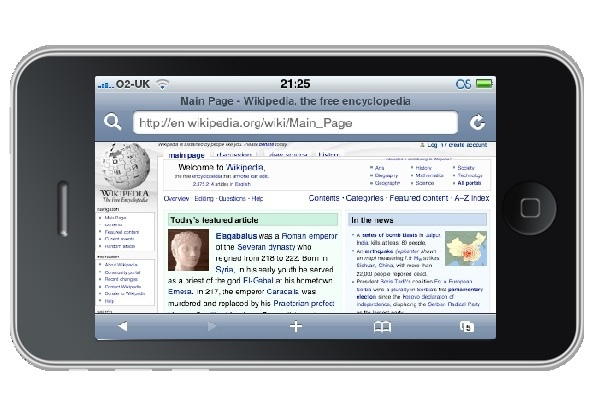
A mobile browser is a web browser designed for use on a mobile device such as a mobile phone, PDA, smartphone, or tablet. Mobile browsers are optimized to display web content most effectively on small screens on portable devices. Some mobile browsers, especially older versions, are designed to be small and efficient to accommodate the low memory capacity and low bandwidth of certain wireless handheld devices. Traditional smaller feature phones use stripped-down mobile web browsers; however, most current smartphones have full-fledged browsers that can handle the latest web technologies, such as CSS 3, JavaScript, and Ajax.
Websites designed to be usable in mobile browsers may be collectively referred to as the mobile web. Today, over 75% of websites are "mobile friendly",[citation needed] by detecting when a request comes from a mobile device and automatically creating a "mobile" version of the page, designed to fit the device's screen and be usable with a touch interface.
The mobile browser usually connects via the cellular network, or increasingly via Wireless LAN, using standard HTTP over TCP/IP and displays web pages written in HTML. Historically, early feature phones were restricted to only displaying pages specifically designed for mobile use, written in XHTML Mobile Profile (WAP 2.0), or WML (which evolved from HDML). WML and HDML are stripped-down formats suitable for transmission across limited bandwidth, and wireless data connection called WAP. In Japan, DoCoMo defined the i-mode service based on i-mode HTML, which is an extension of Compact HTML (C-HTML), a simple subset of HTML.
WAP 2.0 specifies XHTML Mobile Profile plus WAP CSS, subsets of the W3C's standard XHTML and CSS with minor mobile extensions.
Smartphone mobile browsers are full-featured Web browsers capable of HTML, CSS, ECMAScript, as well as mobile technologies such as WML, i-mode HTML, or cHTML. To accommodate small screens, they use Post-WIMP interfaces.
The first mobile browser for a PDA was PocketWeb for the Apple Newton created at TecO in 1994, followed by the first commercial product NetHopper released in August 1996.
The so-called "microbrowser" technologies such as WAP, NTTDocomo's i-mode platform and Openwave's HDML platform fueled the first wave of interest in wireless data services.
The first deployment of a mobile browser on a mobile phone was probably in 1997 when Unwired Planet (later to become Openwave) put their "UP.Browser" on AT&T handsets to give users access to HDML content.
Hub AI
Mobile browser AI simulator
(@Mobile browser_simulator)
Mobile browser
A mobile browser is a web browser designed for use on a mobile device such as a mobile phone, PDA, smartphone, or tablet. Mobile browsers are optimized to display web content most effectively on small screens on portable devices. Some mobile browsers, especially older versions, are designed to be small and efficient to accommodate the low memory capacity and low bandwidth of certain wireless handheld devices. Traditional smaller feature phones use stripped-down mobile web browsers; however, most current smartphones have full-fledged browsers that can handle the latest web technologies, such as CSS 3, JavaScript, and Ajax.
Websites designed to be usable in mobile browsers may be collectively referred to as the mobile web. Today, over 75% of websites are "mobile friendly",[citation needed] by detecting when a request comes from a mobile device and automatically creating a "mobile" version of the page, designed to fit the device's screen and be usable with a touch interface.
The mobile browser usually connects via the cellular network, or increasingly via Wireless LAN, using standard HTTP over TCP/IP and displays web pages written in HTML. Historically, early feature phones were restricted to only displaying pages specifically designed for mobile use, written in XHTML Mobile Profile (WAP 2.0), or WML (which evolved from HDML). WML and HDML are stripped-down formats suitable for transmission across limited bandwidth, and wireless data connection called WAP. In Japan, DoCoMo defined the i-mode service based on i-mode HTML, which is an extension of Compact HTML (C-HTML), a simple subset of HTML.
WAP 2.0 specifies XHTML Mobile Profile plus WAP CSS, subsets of the W3C's standard XHTML and CSS with minor mobile extensions.
Smartphone mobile browsers are full-featured Web browsers capable of HTML, CSS, ECMAScript, as well as mobile technologies such as WML, i-mode HTML, or cHTML. To accommodate small screens, they use Post-WIMP interfaces.
The first mobile browser for a PDA was PocketWeb for the Apple Newton created at TecO in 1994, followed by the first commercial product NetHopper released in August 1996.
The so-called "microbrowser" technologies such as WAP, NTTDocomo's i-mode platform and Openwave's HDML platform fueled the first wave of interest in wireless data services.
The first deployment of a mobile browser on a mobile phone was probably in 1997 when Unwired Planet (later to become Openwave) put their "UP.Browser" on AT&T handsets to give users access to HDML content.
Recent media