
Recent from talks
Mongol conquest of Western Xia
Knowledge base stats:
Talk channels stats:
Members stats:
Mongol conquest of Western Xia
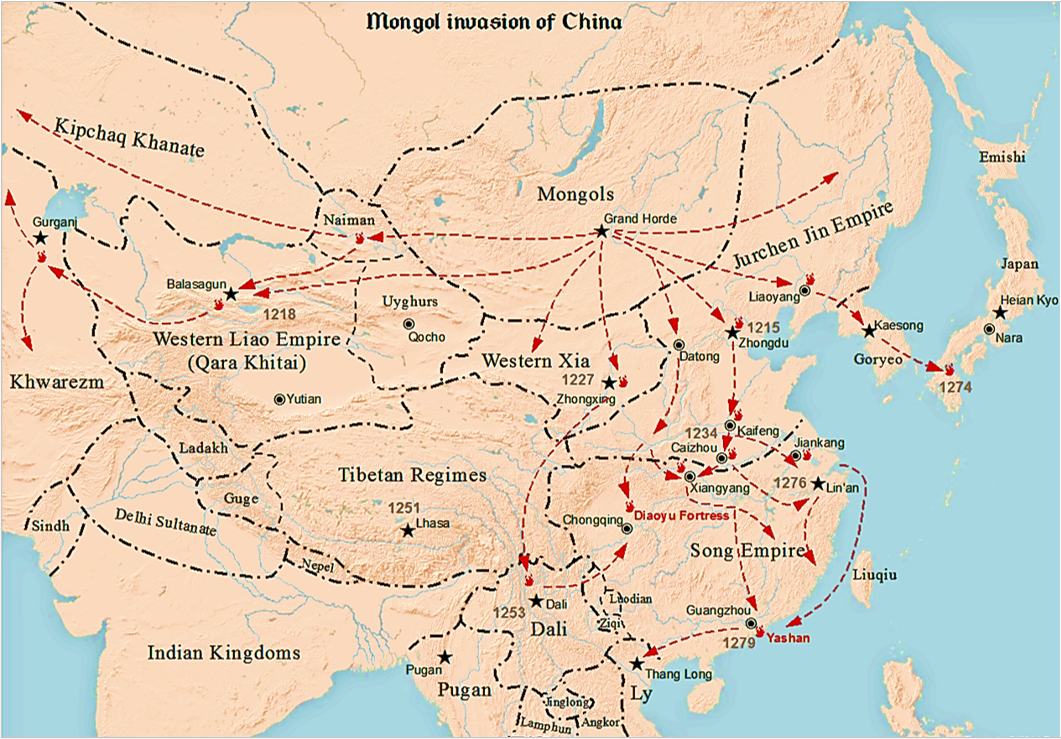
Between 1205 and 1210, and again in 1225-1227, the Mongol Empire embarked on a series of military campaigns that ultimately led to the destruction of the Tangut-led Western Xia dynasty in northwestern China. Hoping to both to plunder and acquire vassalage, Genghis Khan commanded some initial raids against the Western Xia before launching a full-scale invasion in 1209. This was the first major invasion conducted by Genghis, and his first major incursion into China.
The Mongols began a siege of the Western Xia capital Yinchuan that lasted nearly a year, during which the Mongols tried to divert a river to flood the city, but accidentally flooded their own camp instead. Ultimately, Emperor Xiangzong of Western Xia surrendered to the Mongols in January 1210, marking the beginning of a decade of Western Xia vassalage under the Mongols, where they provided support for the Mongol conquest of the Jin dynasty. However, when Genghis invaded the Islamic Khwarazmian Empire in 1219, the Western Xia attempted to break away from Mongol vassalage and form alliances with the Jin and Song dynasties. Angered by the betrayal of the Western Xia, Genghis Khan began a second campaign against them, sending a punitive expedition into Western Xia in 1225. Genghis intended to annihilate the entire Western Xia culture: he methodically destroyed their cities and countryside, and began besieging Yinchuan in 1227. In December, near the end of the siege, Genghis Khan died of unknown causes, which has been presented by some accounts as being the result of wounds he had suffered against the Western Xia. Following Genghis's death, Yinchuan fell to the Mongols, and most of its population was massacred.
The Western Xia dynasty emerged in 1038—also called "Xi Xia", the "Tangut Empire", or "Minya"—and eventually controlled what are now the northwestern provinces of Ningxia, Gansu, eastern Qinghai, northern Shaanxi, northeastern Xinjiang, southwest Inner Mongolia, and southernmost Outer Mongolia. A fairly small state, Western Xia struggled against its larger and more powerful neighbors, the Liao dynasty to the east and northeast, and the Song dynasty to the southeast. When the Jin dynasty emerged in 1115 and displaced the Liao, Western Xia eventually accepted vassal status to the new Jin empire. Aiding Jin in their wars against the Song, Western Xia gained thousands of square miles of former Song territory. However, over many years the relations between Western Xia and Jin gradually declined.
Upon the death of its fourth ruler, Emperor Renzong, Emperor Huanzong took the throne and Western Xia's power began to fail. Though militarily inferior to neighboring Jin, the Western Xia still exerted a significant influence upon the northern steppes. The state often welcomed deposed Kerait leaders because of close trade connections to the steppes and because of the possibility of using the refugees as pawns in the Mongolian Plateau. In the late 1190s and early 1200s, Temüjin, soon to be Genghis Khan, began consolidating his power in Mongolia. Following the death of the Keraites leader Ong Khan to Temüjin's emerging Mongol Empire in 1203, Keriat leader Nilqa Senggum led a small band of followers into Western Xia. However, after his adherents took to plundering the locals, Nilqa Senggum was expelled from Western Xia territory.
Using his rival Nilga Senggum's temporary refuge in Western Xia as a pretext, Temüjin launched a raid against the state in 1205 in the Edsin region. The Mongols plundered border settlements and one local Western Xia noble accepted Mongol supremacy. During a raid on Ganzhou (present-day Zhangye), the Mongols captured the son of the city's commander. This young boy joined Mongol service and took a Mongol name, Chagaan, and eventually rose through the ranks to become commander of Temüjin's personal guard. The next year, 1206, Temüjin was formally proclaimed Genghis Khan, ruler of all the Mongols, marking the official start of the Mongol Empire, while Li Anquan killed Huanzong of Western Xia in a coup d'état and installed himself as Emperor Xiangzong. In 1207, Genghis led another raid into Western Xia, invading the Ordos Plateau and sacking Wuhai, the main garrison along the Yellow River, before withdrawing in 1208. Genghis then began preparing for a full-scale invasion. By invading Western Xia, he would gain a tribute-paying vassal, and also would take control of caravan routes along the Silk Road and provide the Mongols with valuable revenue. Furthermore, from Western Xia he could launch raids into the even more wealthy Jin dynasty.
In 1209, Genghis undertook his campaign to actually conquer Western Xia. Emperor Xiangzong requested aid from the Jin dynasty, but the new Jin emperor Wanyan Yongji refused to send aid, stating that "It is to our advantage when our enemies attack each other. Wherein lies the danger to us?" After defeating a force led by Gao Lianghui outside Wulahai, Genghis captured the city and pushed up along the Yellow River, defeating several cities as he went, until he reached the fortress Kiemen which guarded the only pass through the Helan Mountains to the capital, Yinchuan. Containing an army of up to 70,000, plus 50,000 reinforcements, the fortress proved too difficult to capture, and after a two-month stand-off the Mongols feinted a retreat, luring the garrison, led by Weiming Linggong, out onto the field where it was easily destroyed. His path now open, Genghis advanced to the capital. Well fortified, Yinchuan held about 150,000 soldiers, nearly twice the size of the Mongol army. One of their first endeavors at siege warfare, the Mongols lacked the proper equipment and experience to take the city. They arrived at the city in May, but by October were still unsuccessful at breaking through. Genghis attempted to flood the capital by diverting the river and its network of irrigation canals into the city, and by January 1210 the walls of Yinchuan were nearly breached. However, the dike used to divert the river broke, and the ensuing flood wiped out the Mongol camp, forcing the Mongols to take the higher ground. Despite this setback, the Mongols still posed a threat to Western Xia, and with the state's crops destroyed and no relief coming from the Jin, Emperor Xiangzong agreed to submit to Mongol rule, demonstrating his loyalty by giving a daughter, Chaka, in marriage to Genghis and paying a tribute of camels, falcons, and textiles.
In 1210, Western Xia attacked the Jin dynasty as punishment for their refusal to aid them against the Mongols. The following year, the Mongols joined Western Xia and began a 23-year-long war against Jin. The same year Li Anquan abdicated the throne, and subsequently died, after Emperor Shenzong seized power.
However, despite aiding the Mongols against Jin, in 1217 when Genghis Khan requested help for his Central Asian campaigns, Western Xia refused to commit troops, and as a warning the Mongols besieged the capital before withdrawing. In 1219, Genghis Khan launched his campaign against the Khwarazmian dynasty in Central Asia, and requested military aid from Western Xia. However, the emperor and his military commander Asha refused to take part in the campaign, stating that if Genghis had too few troops to attack the Khwarazmian dynasty, then he had no claim to supreme power. Infuriated, Genghis swore vengeance and left to invade Khwarazm, while Western Xia attempted alliances with the Jin and Song dynasties against the Mongols.
Hub AI
Mongol conquest of Western Xia AI simulator
(@Mongol conquest of Western Xia_simulator)
Mongol conquest of Western Xia
Between 1205 and 1210, and again in 1225-1227, the Mongol Empire embarked on a series of military campaigns that ultimately led to the destruction of the Tangut-led Western Xia dynasty in northwestern China. Hoping to both to plunder and acquire vassalage, Genghis Khan commanded some initial raids against the Western Xia before launching a full-scale invasion in 1209. This was the first major invasion conducted by Genghis, and his first major incursion into China.
The Mongols began a siege of the Western Xia capital Yinchuan that lasted nearly a year, during which the Mongols tried to divert a river to flood the city, but accidentally flooded their own camp instead. Ultimately, Emperor Xiangzong of Western Xia surrendered to the Mongols in January 1210, marking the beginning of a decade of Western Xia vassalage under the Mongols, where they provided support for the Mongol conquest of the Jin dynasty. However, when Genghis invaded the Islamic Khwarazmian Empire in 1219, the Western Xia attempted to break away from Mongol vassalage and form alliances with the Jin and Song dynasties. Angered by the betrayal of the Western Xia, Genghis Khan began a second campaign against them, sending a punitive expedition into Western Xia in 1225. Genghis intended to annihilate the entire Western Xia culture: he methodically destroyed their cities and countryside, and began besieging Yinchuan in 1227. In December, near the end of the siege, Genghis Khan died of unknown causes, which has been presented by some accounts as being the result of wounds he had suffered against the Western Xia. Following Genghis's death, Yinchuan fell to the Mongols, and most of its population was massacred.
The Western Xia dynasty emerged in 1038—also called "Xi Xia", the "Tangut Empire", or "Minya"—and eventually controlled what are now the northwestern provinces of Ningxia, Gansu, eastern Qinghai, northern Shaanxi, northeastern Xinjiang, southwest Inner Mongolia, and southernmost Outer Mongolia. A fairly small state, Western Xia struggled against its larger and more powerful neighbors, the Liao dynasty to the east and northeast, and the Song dynasty to the southeast. When the Jin dynasty emerged in 1115 and displaced the Liao, Western Xia eventually accepted vassal status to the new Jin empire. Aiding Jin in their wars against the Song, Western Xia gained thousands of square miles of former Song territory. However, over many years the relations between Western Xia and Jin gradually declined.
Upon the death of its fourth ruler, Emperor Renzong, Emperor Huanzong took the throne and Western Xia's power began to fail. Though militarily inferior to neighboring Jin, the Western Xia still exerted a significant influence upon the northern steppes. The state often welcomed deposed Kerait leaders because of close trade connections to the steppes and because of the possibility of using the refugees as pawns in the Mongolian Plateau. In the late 1190s and early 1200s, Temüjin, soon to be Genghis Khan, began consolidating his power in Mongolia. Following the death of the Keraites leader Ong Khan to Temüjin's emerging Mongol Empire in 1203, Keriat leader Nilqa Senggum led a small band of followers into Western Xia. However, after his adherents took to plundering the locals, Nilqa Senggum was expelled from Western Xia territory.
Using his rival Nilga Senggum's temporary refuge in Western Xia as a pretext, Temüjin launched a raid against the state in 1205 in the Edsin region. The Mongols plundered border settlements and one local Western Xia noble accepted Mongol supremacy. During a raid on Ganzhou (present-day Zhangye), the Mongols captured the son of the city's commander. This young boy joined Mongol service and took a Mongol name, Chagaan, and eventually rose through the ranks to become commander of Temüjin's personal guard. The next year, 1206, Temüjin was formally proclaimed Genghis Khan, ruler of all the Mongols, marking the official start of the Mongol Empire, while Li Anquan killed Huanzong of Western Xia in a coup d'état and installed himself as Emperor Xiangzong. In 1207, Genghis led another raid into Western Xia, invading the Ordos Plateau and sacking Wuhai, the main garrison along the Yellow River, before withdrawing in 1208. Genghis then began preparing for a full-scale invasion. By invading Western Xia, he would gain a tribute-paying vassal, and also would take control of caravan routes along the Silk Road and provide the Mongols with valuable revenue. Furthermore, from Western Xia he could launch raids into the even more wealthy Jin dynasty.
In 1209, Genghis undertook his campaign to actually conquer Western Xia. Emperor Xiangzong requested aid from the Jin dynasty, but the new Jin emperor Wanyan Yongji refused to send aid, stating that "It is to our advantage when our enemies attack each other. Wherein lies the danger to us?" After defeating a force led by Gao Lianghui outside Wulahai, Genghis captured the city and pushed up along the Yellow River, defeating several cities as he went, until he reached the fortress Kiemen which guarded the only pass through the Helan Mountains to the capital, Yinchuan. Containing an army of up to 70,000, plus 50,000 reinforcements, the fortress proved too difficult to capture, and after a two-month stand-off the Mongols feinted a retreat, luring the garrison, led by Weiming Linggong, out onto the field where it was easily destroyed. His path now open, Genghis advanced to the capital. Well fortified, Yinchuan held about 150,000 soldiers, nearly twice the size of the Mongol army. One of their first endeavors at siege warfare, the Mongols lacked the proper equipment and experience to take the city. They arrived at the city in May, but by October were still unsuccessful at breaking through. Genghis attempted to flood the capital by diverting the river and its network of irrigation canals into the city, and by January 1210 the walls of Yinchuan were nearly breached. However, the dike used to divert the river broke, and the ensuing flood wiped out the Mongol camp, forcing the Mongols to take the higher ground. Despite this setback, the Mongols still posed a threat to Western Xia, and with the state's crops destroyed and no relief coming from the Jin, Emperor Xiangzong agreed to submit to Mongol rule, demonstrating his loyalty by giving a daughter, Chaka, in marriage to Genghis and paying a tribute of camels, falcons, and textiles.
In 1210, Western Xia attacked the Jin dynasty as punishment for their refusal to aid them against the Mongols. The following year, the Mongols joined Western Xia and began a 23-year-long war against Jin. The same year Li Anquan abdicated the throne, and subsequently died, after Emperor Shenzong seized power.
However, despite aiding the Mongols against Jin, in 1217 when Genghis Khan requested help for his Central Asian campaigns, Western Xia refused to commit troops, and as a warning the Mongols besieged the capital before withdrawing. In 1219, Genghis Khan launched his campaign against the Khwarazmian dynasty in Central Asia, and requested military aid from Western Xia. However, the emperor and his military commander Asha refused to take part in the campaign, stating that if Genghis had too few troops to attack the Khwarazmian dynasty, then he had no claim to supreme power. Infuriated, Genghis swore vengeance and left to invade Khwarazm, while Western Xia attempted alliances with the Jin and Song dynasties against the Mongols.
Recent media