



Community hub
Recent from talks
Knowledge base stats:
Talk channels stats:
Members stats:
Monopolistic competition
Monopolistic competition is a type of imperfect competition such that there are many producers competing against each other but selling products that are differentiated from one another (e.g., branding, quality) and hence not perfect substitutes. For monopolistic competition, a company takes the prices charged by its rivals as given and ignores the effect of its own prices on the prices of other companies. If this happens in the presence of a coercive government, monopolistic competition may evolve into government-granted monopoly. Unlike perfect competition, the company may maintain spare capacity. Models of monopolistic competition are often used to model industries. Textbook examples of industries with market structures similar to monopolistic competition include restaurants, cereals, clothing, shoes, and service industries in large cities. The earliest developer of the theory of monopolistic competition is Edward Hastings Chamberlin, who wrote a pioneering book on the subject, Theory of Monopolistic Competition (1933). Joan Robinson's book The Economics of Imperfect Competition presents a comparable theme of distinguishing perfect from imperfect competition. Further work on monopolistic competition was performed by Dixit and Stiglitz who created the Dixit-Stiglitz model which has proved applicable used in the subtopics of international trade theory, macroeconomics and economic geography.
Monopolistically competitive markets have the following characteristics:
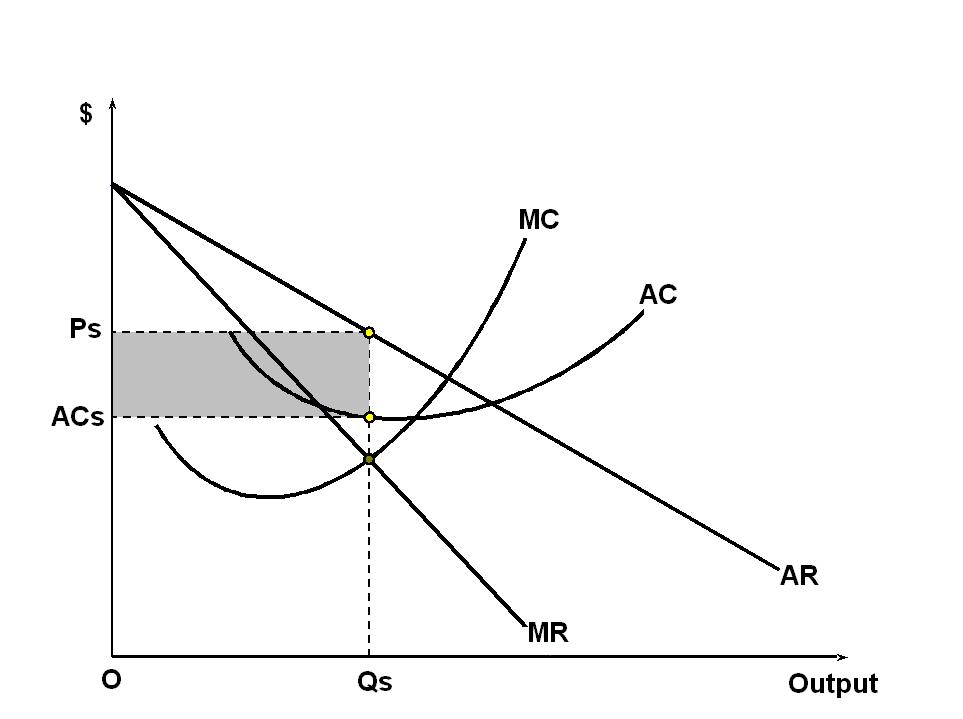
The long-run characteristics of a monopolistically competitive market are almost the same as a perfectly competitive market. Two differences between the two are that monopolistic competition produces heterogeneous products and that monopolistic competition involves a great deal of non-price competition, which is based on subtle product differentiation. A company making profits in the short run will nonetheless only break even in the long run because demand will decrease and average total cost will increase, meaning that in the long run, a monopolistically competitive company will make zero economic profit. This illustrates the amount of influence the company has over the market; because of brand loyalty, it can raise its prices without losing all of its customers. This means that an individual company's demand curve is downward sloping, in contrast to perfect competition, which has a perfectly elastic demand schedule.
There are eight characteristics of monopolistic competition (MC):
MC companies sell products that have real or perceived non-price differences. Examples of these differences could include physical aspects of the product, location from which it sells the product or intangible aspects of the product, among others. However, the differences are not so great as to eliminate other goods as substitutes. In technical terms, the cross price elasticity of demand between goods in such a market is large and positive. MC goods are best described as close but imperfect substitutes. The goods perform the same basic functions but have differences in qualities such as type, style, quality, reputation, appearance, and location that tend to distinguish them from each other. For example, the basic function of motor vehicles is the same—to move people and objects from point to point in reasonable comfort and safety. Yet there are many different types of motor vehicles such as motor scooters, motor cycles, trucks and cars, and many variations even within these categories.
There are many companies in each MC product group and many companies on the side lines prepared to enter the market. A product group is a "collection of similar products". The fact that there are "many companies" means that each company has a small market share. This gives each MC company the freedom to set prices without engaging in strategic decision making regarding the prices of other companies (no mutual dependence) and each company's actions effect the market negligibly. For example, a company could reduce prices and increase sales without fear that its actions will prompt retaliatory responses from competitors.
The number of companies that an MC market structure will support at market equilibrium depends on factors such as fixed costs, economies of scale, and the degree of product differentiation. For example, the greater the fixed costs, the fewer companies the market will support.
Like perfect competition, with monopolistic competition also, the companies can enter or exit freely. The companies will enter when the existing companies are making super-normal profits. With the entry of new companies, the supply would increase which would reduce the price and hence the existing companies will be left only with normal profits. Similarly, if the existing companies are sustaining losses, some of the marginal companies will quit. It will reduce the supply due to which price would rise and the existing companies will be left only with normal profit.
Hub AI
Monopolistic competition AI simulator
(@Monopolistic competition_simulator)
Monopolistic competition
Monopolistic competition is a type of imperfect competition such that there are many producers competing against each other but selling products that are differentiated from one another (e.g., branding, quality) and hence not perfect substitutes. For monopolistic competition, a company takes the prices charged by its rivals as given and ignores the effect of its own prices on the prices of other companies. If this happens in the presence of a coercive government, monopolistic competition may evolve into government-granted monopoly. Unlike perfect competition, the company may maintain spare capacity. Models of monopolistic competition are often used to model industries. Textbook examples of industries with market structures similar to monopolistic competition include restaurants, cereals, clothing, shoes, and service industries in large cities. The earliest developer of the theory of monopolistic competition is Edward Hastings Chamberlin, who wrote a pioneering book on the subject, Theory of Monopolistic Competition (1933). Joan Robinson's book The Economics of Imperfect Competition presents a comparable theme of distinguishing perfect from imperfect competition. Further work on monopolistic competition was performed by Dixit and Stiglitz who created the Dixit-Stiglitz model which has proved applicable used in the subtopics of international trade theory, macroeconomics and economic geography.
Monopolistically competitive markets have the following characteristics:
The long-run characteristics of a monopolistically competitive market are almost the same as a perfectly competitive market. Two differences between the two are that monopolistic competition produces heterogeneous products and that monopolistic competition involves a great deal of non-price competition, which is based on subtle product differentiation. A company making profits in the short run will nonetheless only break even in the long run because demand will decrease and average total cost will increase, meaning that in the long run, a monopolistically competitive company will make zero economic profit. This illustrates the amount of influence the company has over the market; because of brand loyalty, it can raise its prices without losing all of its customers. This means that an individual company's demand curve is downward sloping, in contrast to perfect competition, which has a perfectly elastic demand schedule.
There are eight characteristics of monopolistic competition (MC):
MC companies sell products that have real or perceived non-price differences. Examples of these differences could include physical aspects of the product, location from which it sells the product or intangible aspects of the product, among others. However, the differences are not so great as to eliminate other goods as substitutes. In technical terms, the cross price elasticity of demand between goods in such a market is large and positive. MC goods are best described as close but imperfect substitutes. The goods perform the same basic functions but have differences in qualities such as type, style, quality, reputation, appearance, and location that tend to distinguish them from each other. For example, the basic function of motor vehicles is the same—to move people and objects from point to point in reasonable comfort and safety. Yet there are many different types of motor vehicles such as motor scooters, motor cycles, trucks and cars, and many variations even within these categories.
There are many companies in each MC product group and many companies on the side lines prepared to enter the market. A product group is a "collection of similar products". The fact that there are "many companies" means that each company has a small market share. This gives each MC company the freedom to set prices without engaging in strategic decision making regarding the prices of other companies (no mutual dependence) and each company's actions effect the market negligibly. For example, a company could reduce prices and increase sales without fear that its actions will prompt retaliatory responses from competitors.
The number of companies that an MC market structure will support at market equilibrium depends on factors such as fixed costs, economies of scale, and the degree of product differentiation. For example, the greater the fixed costs, the fewer companies the market will support.
Like perfect competition, with monopolistic competition also, the companies can enter or exit freely. The companies will enter when the existing companies are making super-normal profits. With the entry of new companies, the supply would increase which would reduce the price and hence the existing companies will be left only with normal profits. Similarly, if the existing companies are sustaining losses, some of the marginal companies will quit. It will reduce the supply due to which price would rise and the existing companies will be left only with normal profit.