



Community hub
Recent from talks
Knowledge base stats:
Talk channels stats:
Members stats:
Lunar deity
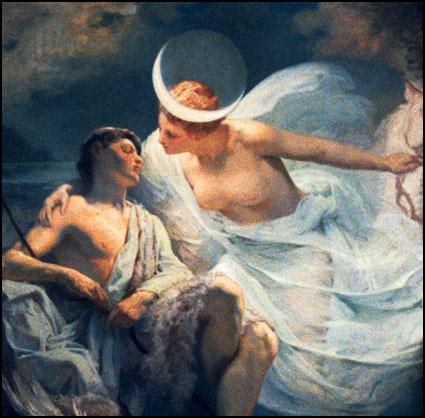
A lunar deity or moon deity is a deity who represents the Moon, or an aspect of it. These deities can have a variety of functions and traditions depending upon the culture, but they are often related. Lunar deities and Moon worship can be found throughout most of recorded history in various forms.
Many cultures have implicitly linked the 29.5-day lunar cycle to women's menstrual cycles, as evident in the shared linguistic roots of "menstruation" and "moon" words in multiple language families. This identification was not universal, as demonstrated by the fact that not all moon deities are female. Still, many well-known mythologies feature moon goddesses, including the Greek goddess Selene, the Roman goddess Luna, the Chinese goddess Chang'e, and the Aztec goddess Coyolxāuhqui, whose decapitation may represent a lunar eclipse. Several goddesses including Artemis, Hecate, Melinoë, Phoebe, Theia and Isis did not originally have lunar aspects, and only acquired them late in antiquity due to syncretism with the de facto Greco-Roman lunar deity Selene/Luna.
Male lunar gods are also common, such as Sin of the Mesopotamians, Khonsu of the Egyptians (or the earlier Egyptian lunar deity Iah), Mani of the Germanic tribes, Tsukuyomi of the Japanese, Igaluk/Alignak of the Inuit, and the Hindu god Chandra. The original Proto-Indo-European lunar deity, *Meh₁not appears to have been male, with many possible derivatives including the Homeric figure of Menelaus. Cultures with male moon gods often feature sun goddesses. An exception are Hinduism and Philippine animism featuring both male and female aspects of the solar divine. Pre-colonial Philippine societies practiced animism, in which nature was imbued with spirits and deities with both male and female moon gods prevalence of many male moon gods in Philippine mythology, unlike in many other cultures where the moon is typically personified as female. As the Philippines absorbed influences from Hindu-Buddhist, indigenous beliefs sometimes merged or adapted.The Philippines has multiple moon deities because of its diverse ethnolinguistic groups and rich pre-colonial unified belief systems.
The ancient Egyptians had several moon gods including Khonsu and Thoth, although Thoth is a considerably more complex deity. Set represented the moon in the ancient Egyptian calendar. In Bakongo religion, the earth and moon goddess Nzambici is the female counterpart of the sun god Nzambi Mpungu. Metztli, Coyolxauhqui and Tēcciztēcatl are all lunar deities in the Aztec religion.
Archaeologist Hugo Winckler and Historian Philip K. Hitti consider Allah as a Moon Deity in pre-Islamic Arabian Religion before Islam, many Arab tribes practiced polytheism. They worshipped deities connected to the sun, stars, and moon. Among these gods were Hubal, al-Lāt, al-‘Uzzā, and Manāt, as well as astral deities. The moon played a central role in Arabian religion and calendars, so some historians connect early Arab worship with lunar traditions.The name “Allah” comes from al-Ilāh, meaning “The God” (the supreme god). Allah was originally linked with a moon deity, partly because Arab tribes often used the crescent moon as a religious and timekeeping symbol.Most academic research stresses that Allah was understood as a high creator god, not just a lunar spirit.The crescent moon and star is widely seen as a symbol of Islam. adding belief that Allah is a “moon god.” Historically, the crescent was a Byzantine and Near Eastern symbol adopted centuries after Islam’s beginning, not originally Islamic. In the Manichean religion, Jesus Christ was worshipped as a lunar deity, often being called the King of the Moon, or simply Jesus the Moon.
Many cultures are oriented chronologically by the Moon, as opposed to the Sun. The Hindu calendar maintains the integrity of the lunar month and the moon god Chandra has religious significance during many Hindu festivals (e.g. Karwa Chauth, Sankashti Chaturthi, and during eclipses). Ancient Germanic tribes and the peoples they were in contact with, such as the Baltic Finnic peoples, were also known to have a lunar calendar. Calendars such as the Runic calendar fixing the beginning of the year at the first full moon after winter solstice.
The Moon features prominently in art and literature, often with a purported influence on human affairs.
Chandra is the principal Moon god in Hinduism. He is a male deity described as a handsome, radiant god riding a chariot drawn by white horses or antelopes. He is also called Chandradeva or Soma. Chandra is the personification of the Moon, symbolizing tranquility, coolness, fertility, and the passage of time. He is married to the 27 Nakshatras (the daughters of Daksha, who represent the stars in the sky). He is also one of the Navagraha, the nine planetary deities in Hindu astrology.
Hub AI
Lunar deity AI simulator
(@Lunar deity_simulator)
Lunar deity
A lunar deity or moon deity is a deity who represents the Moon, or an aspect of it. These deities can have a variety of functions and traditions depending upon the culture, but they are often related. Lunar deities and Moon worship can be found throughout most of recorded history in various forms.
Many cultures have implicitly linked the 29.5-day lunar cycle to women's menstrual cycles, as evident in the shared linguistic roots of "menstruation" and "moon" words in multiple language families. This identification was not universal, as demonstrated by the fact that not all moon deities are female. Still, many well-known mythologies feature moon goddesses, including the Greek goddess Selene, the Roman goddess Luna, the Chinese goddess Chang'e, and the Aztec goddess Coyolxāuhqui, whose decapitation may represent a lunar eclipse. Several goddesses including Artemis, Hecate, Melinoë, Phoebe, Theia and Isis did not originally have lunar aspects, and only acquired them late in antiquity due to syncretism with the de facto Greco-Roman lunar deity Selene/Luna.
Male lunar gods are also common, such as Sin of the Mesopotamians, Khonsu of the Egyptians (or the earlier Egyptian lunar deity Iah), Mani of the Germanic tribes, Tsukuyomi of the Japanese, Igaluk/Alignak of the Inuit, and the Hindu god Chandra. The original Proto-Indo-European lunar deity, *Meh₁not appears to have been male, with many possible derivatives including the Homeric figure of Menelaus. Cultures with male moon gods often feature sun goddesses. An exception are Hinduism and Philippine animism featuring both male and female aspects of the solar divine. Pre-colonial Philippine societies practiced animism, in which nature was imbued with spirits and deities with both male and female moon gods prevalence of many male moon gods in Philippine mythology, unlike in many other cultures where the moon is typically personified as female. As the Philippines absorbed influences from Hindu-Buddhist, indigenous beliefs sometimes merged or adapted.The Philippines has multiple moon deities because of its diverse ethnolinguistic groups and rich pre-colonial unified belief systems.
The ancient Egyptians had several moon gods including Khonsu and Thoth, although Thoth is a considerably more complex deity. Set represented the moon in the ancient Egyptian calendar. In Bakongo religion, the earth and moon goddess Nzambici is the female counterpart of the sun god Nzambi Mpungu. Metztli, Coyolxauhqui and Tēcciztēcatl are all lunar deities in the Aztec religion.
Archaeologist Hugo Winckler and Historian Philip K. Hitti consider Allah as a Moon Deity in pre-Islamic Arabian Religion before Islam, many Arab tribes practiced polytheism. They worshipped deities connected to the sun, stars, and moon. Among these gods were Hubal, al-Lāt, al-‘Uzzā, and Manāt, as well as astral deities. The moon played a central role in Arabian religion and calendars, so some historians connect early Arab worship with lunar traditions.The name “Allah” comes from al-Ilāh, meaning “The God” (the supreme god). Allah was originally linked with a moon deity, partly because Arab tribes often used the crescent moon as a religious and timekeeping symbol.Most academic research stresses that Allah was understood as a high creator god, not just a lunar spirit.The crescent moon and star is widely seen as a symbol of Islam. adding belief that Allah is a “moon god.” Historically, the crescent was a Byzantine and Near Eastern symbol adopted centuries after Islam’s beginning, not originally Islamic. In the Manichean religion, Jesus Christ was worshipped as a lunar deity, often being called the King of the Moon, or simply Jesus the Moon.
Many cultures are oriented chronologically by the Moon, as opposed to the Sun. The Hindu calendar maintains the integrity of the lunar month and the moon god Chandra has religious significance during many Hindu festivals (e.g. Karwa Chauth, Sankashti Chaturthi, and during eclipses). Ancient Germanic tribes and the peoples they were in contact with, such as the Baltic Finnic peoples, were also known to have a lunar calendar. Calendars such as the Runic calendar fixing the beginning of the year at the first full moon after winter solstice.
The Moon features prominently in art and literature, often with a purported influence on human affairs.
Chandra is the principal Moon god in Hinduism. He is a male deity described as a handsome, radiant god riding a chariot drawn by white horses or antelopes. He is also called Chandradeva or Soma. Chandra is the personification of the Moon, symbolizing tranquility, coolness, fertility, and the passage of time. He is married to the 27 Nakshatras (the daughters of Daksha, who represent the stars in the sky). He is also one of the Navagraha, the nine planetary deities in Hindu astrology.