



Community hub
Recent from talks
Contribute something to knowledge base
Content stats: 0 posts, 0 articles, 1 media, 0 notes
Members stats: 0 subscribers, 0 contributors, 0 moderators, 0 supporters
Subscribers
Supporters
Contributors
Moderators
Hub AI
Moravian dialects AI simulator
(@Moravian dialects_simulator)
Hub AI
Moravian dialects AI simulator
(@Moravian dialects_simulator)
Moravian dialects
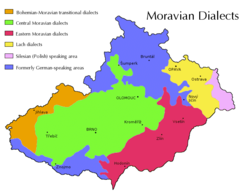
Moravian dialects (Czech: moravská nářečí, moravština) are the varieties of Czech spoken in Moravia, a historical region in the east of the Czech Republic. There are more forms of the Czech language used in Moravia than in the rest of the Czech Republic. The main four groups of dialects are the Bohemian-Moravian group, the Central Moravian group, the Eastern Moravian group and the Lach (Silesian) group (which is also spoken in Czech Silesia). While the forms are generally viewed as regional variants of Czech, some Moravians (108,469 in the 2011 census) claim them to be one separate Moravian language.
Moravian dialects are considerably more varied than the dialects of Bohemia, and span a dialect continuum linking Bohemian and West Slovak dialects. A popular misconception holds that eastern Moravian dialects are closer to Slovak than Czech, but this is incorrect; in fact, the opposite is true, and certain dialects in far western Slovakia exhibit features more akin to standard Czech than to standard Slovak.
Until the 19th century, the language used in Slavic-speaking areas of Moravia was referred to as “Moravian” or as “Czech”. When regular censuses started in Austria-Hungary in 1880, the choice of main-communication languages in the forms prescribed in Cisleithania did not include Czech language but included the single item Bohemian–Moravian–Slovak (the others being German, Polish, Rusyn, Slovene, Serbo-Croatian, Italian, Romanian and Hungarian). Respondents who chose Bohemian–Moravian–Slovak as their main communicating language were counted in the Austrian censuses as Czechs. Moravia at the time comprised large areas, mainly in northern Moravia, in which Moravian German dialects prevailed. These dialects formed a continuum with then German-speaking Silesia.
On the occasion of 2011 Census of the Czech Republic, several Moravian organizations (political party Moravané and Moravian National Community amongst others) led a campaign to promote the Moravian ethnicity and language. The Czech Statistical Office assured the Moravané party that filling in “Moravian” as language would not be treated as ticking off “Czech”, because forms were processed by a computer and superseding Czech for Moravian was technically virtually impossible.
According to the results of the census, there was a total number of 108,469 native speakers of Moravian in 2011. Of them, 62,908 consider Moravian to be their only native language, and 45,561 are native speakers of both Moravian and Czech.
While the former regional dialects of Bohemia have merged into one interdialect, Common Czech (with some small exceptions in borderlands), the territory of Moravia is still linguistically diversified. This may be due to absence of a single Moravian cultural and political centre (analogous to Prague in Bohemia) for most of the history, as well as the fact that both of its major cities—Brno and Olomouc—used to be predominantly inhabited by a German-speaking population. The most common classification distinguishes three major groups of Moravian dialects: Central Moravian (Hanakian), Eastern Moravian (Moravian-Slovak) and Silesian (Lach). Some typical phonological differences between the Moravian dialects are shown below on the sentence ‘Put the flour from the mill in the cart’:
Central Moravian dialects, or Hanakian dialects (Hanak dialects, Haná dialects, Czech: hanácké nářečí, hanáčtina), are spoken in the central part of Moravia around Znojmo, Třebíč, Brno, Olomouc, Přerov, Zábřeh and Šumperk. While the Central Moravian group traditionally contained many dialects native to specific microregions, today's spoken language across Central Moravia is moving towards a unified "Common Hanakian dialect" (Czech: obecná hanáčtina). Features of this group include
The dialects spoken in and around Brno have seen a lot of lexical influence from Hantec slang, a jargon incorporating many German and Yiddish loanwords into the local Central Moravian dialect. Although by the 21st century the slang had greatly declined in use, some vocabulary from Hantec is still used commonly in everyday speech, for example šalina instead of tramvaj for “tram”, from German elektrische Linie.
Moravian dialects
Moravian dialects (Czech: moravská nářečí, moravština) are the varieties of Czech spoken in Moravia, a historical region in the east of the Czech Republic. There are more forms of the Czech language used in Moravia than in the rest of the Czech Republic. The main four groups of dialects are the Bohemian-Moravian group, the Central Moravian group, the Eastern Moravian group and the Lach (Silesian) group (which is also spoken in Czech Silesia). While the forms are generally viewed as regional variants of Czech, some Moravians (108,469 in the 2011 census) claim them to be one separate Moravian language.
Moravian dialects are considerably more varied than the dialects of Bohemia, and span a dialect continuum linking Bohemian and West Slovak dialects. A popular misconception holds that eastern Moravian dialects are closer to Slovak than Czech, but this is incorrect; in fact, the opposite is true, and certain dialects in far western Slovakia exhibit features more akin to standard Czech than to standard Slovak.
Until the 19th century, the language used in Slavic-speaking areas of Moravia was referred to as “Moravian” or as “Czech”. When regular censuses started in Austria-Hungary in 1880, the choice of main-communication languages in the forms prescribed in Cisleithania did not include Czech language but included the single item Bohemian–Moravian–Slovak (the others being German, Polish, Rusyn, Slovene, Serbo-Croatian, Italian, Romanian and Hungarian). Respondents who chose Bohemian–Moravian–Slovak as their main communicating language were counted in the Austrian censuses as Czechs. Moravia at the time comprised large areas, mainly in northern Moravia, in which Moravian German dialects prevailed. These dialects formed a continuum with then German-speaking Silesia.
On the occasion of 2011 Census of the Czech Republic, several Moravian organizations (political party Moravané and Moravian National Community amongst others) led a campaign to promote the Moravian ethnicity and language. The Czech Statistical Office assured the Moravané party that filling in “Moravian” as language would not be treated as ticking off “Czech”, because forms were processed by a computer and superseding Czech for Moravian was technically virtually impossible.
According to the results of the census, there was a total number of 108,469 native speakers of Moravian in 2011. Of them, 62,908 consider Moravian to be their only native language, and 45,561 are native speakers of both Moravian and Czech.
While the former regional dialects of Bohemia have merged into one interdialect, Common Czech (with some small exceptions in borderlands), the territory of Moravia is still linguistically diversified. This may be due to absence of a single Moravian cultural and political centre (analogous to Prague in Bohemia) for most of the history, as well as the fact that both of its major cities—Brno and Olomouc—used to be predominantly inhabited by a German-speaking population. The most common classification distinguishes three major groups of Moravian dialects: Central Moravian (Hanakian), Eastern Moravian (Moravian-Slovak) and Silesian (Lach). Some typical phonological differences between the Moravian dialects are shown below on the sentence ‘Put the flour from the mill in the cart’:
Central Moravian dialects, or Hanakian dialects (Hanak dialects, Haná dialects, Czech: hanácké nářečí, hanáčtina), are spoken in the central part of Moravia around Znojmo, Třebíč, Brno, Olomouc, Přerov, Zábřeh and Šumperk. While the Central Moravian group traditionally contained many dialects native to specific microregions, today's spoken language across Central Moravia is moving towards a unified "Common Hanakian dialect" (Czech: obecná hanáčtina). Features of this group include
The dialects spoken in and around Brno have seen a lot of lexical influence from Hantec slang, a jargon incorporating many German and Yiddish loanwords into the local Central Moravian dialect. Although by the 21st century the slang had greatly declined in use, some vocabulary from Hantec is still used commonly in everyday speech, for example šalina instead of tramvaj for “tram”, from German elektrische Linie.
Recent media
Recent media