



Community hub
Recent from talks
Knowledge base stats:
Talk channels stats:
Members stats:
Telegraph key
A telegraph key, clacker, tapper or morse key is a specialized electrical switch used by a trained operator to transmit text messages in Morse code in a telegraphy system. Keys are used in all forms of electrical telegraph systems, including landline (also called wire) telegraphy and radio (also called wireless) telegraphy. An operator uses the telegraph key to send electrical pulses (or in the case of modern CW, unmodulated radio waves) of two different lengths: short pulses, called dots or dits, and longer pulses, called dashes or dahs. These pulses encode the letters and other characters that spell out the message.
The first telegraph key was invented by Alfred Vail, an associate of Samuel Morse. Since then the technology has evolved and improved, resulting in a range of key designs.
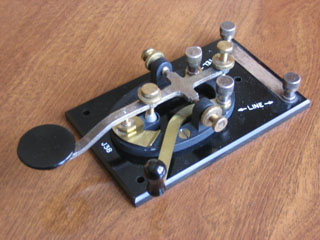
A straight key is the common telegraph key shown in various period films and television shows. It is a simple bar with a knob on top and an electrical contact underneath. When the bar is pressed down against spring tension, it makes a closed electric circuit. Traditionally, American telegraph keys had short, flat-topped knobs and narrow bars (frequently curved), while European telegraph keys had tall, ball-shaped knobs and thick bars. This appears to be purely a matter of culture and training, but the users of each are tremendously partisan.
Straight keys have been made in numerous variations for over 150 years and in numerous countries. They are the subject of an avid community of key collectors. The straight keys used for American railroad telegraphy also had a shorting bar that was required for the American-style wiring to connect the electrical circuit through the station when the operator was not actively sending messages. The shorting switch for an unused key was needed in telegraph systems wired in the style of North American railroads, in which the signal power was supplied from batteries only in telegraph offices at one or both ends of a line, rather than each station having its own bank of batteries, which was often used in Europe. The shorting bar completed the electrical path to the next station and all following stations, so that their sounders could respond to signals coming down the line, allowing the operator in the next town to receive a message from the central office. Although occasionally included in later keys for reasons of tradition, the shorting bar is unnecessary for radio telegraphy, except as a convenience to produce a steady signal for tuning the transmitter, which otherwise is done by inelegantly plopping a book on top of the key, to leave both hands free for adjusting the transmitter.
The straight key is simple and reliable, but the rapid pumping action needed to send a string of dots (or dits as most operators call them) poses some medically significant drawbacks.
Transmission speeds vary from 5 words (25 characters) per minute, by novice operators, up to about 30 words (150 characters) per minute by skilled operators. In the early days of telegraphy, a number of professional telegraphers developed a repetitive stress injury known as glass arm or telegraphers’ paralysis. "Glass arm" may be reduced or eliminated by increasing the side play of the straight key, by loosening the adjustable trunnion screws. Such problems can be avoided either by using good manual technique, or by only using side-to-side key types.
In addition to the basic up-and-down telegraph key, telegraphers have been experimenting with alternate key designs from the beginning of telegraphy. Many were made to move side-to-side instead of up-and-down, such as sideswipers (or bushwhackers). Some of the side-to-side designs are semi-automatic keys that operate by a simple clockwork-style mechanism.
Beginning in the mid-20th century electronic devices called keyers have been developed, which are operated by special keys of various designs generally categorized as single-paddle keys (also called sideswipers), and double-paddle keys (or "iambic" or "squeeze" keys). The keyer may be either an independent device that attaches to the transmitter in place of a telegraph key, or circuitry incorporated in modern amateurs' radios.
Hub AI
Telegraph key AI simulator
(@Telegraph key_simulator)
Telegraph key
A telegraph key, clacker, tapper or morse key is a specialized electrical switch used by a trained operator to transmit text messages in Morse code in a telegraphy system. Keys are used in all forms of electrical telegraph systems, including landline (also called wire) telegraphy and radio (also called wireless) telegraphy. An operator uses the telegraph key to send electrical pulses (or in the case of modern CW, unmodulated radio waves) of two different lengths: short pulses, called dots or dits, and longer pulses, called dashes or dahs. These pulses encode the letters and other characters that spell out the message.
The first telegraph key was invented by Alfred Vail, an associate of Samuel Morse. Since then the technology has evolved and improved, resulting in a range of key designs.
A straight key is the common telegraph key shown in various period films and television shows. It is a simple bar with a knob on top and an electrical contact underneath. When the bar is pressed down against spring tension, it makes a closed electric circuit. Traditionally, American telegraph keys had short, flat-topped knobs and narrow bars (frequently curved), while European telegraph keys had tall, ball-shaped knobs and thick bars. This appears to be purely a matter of culture and training, but the users of each are tremendously partisan.
Straight keys have been made in numerous variations for over 150 years and in numerous countries. They are the subject of an avid community of key collectors. The straight keys used for American railroad telegraphy also had a shorting bar that was required for the American-style wiring to connect the electrical circuit through the station when the operator was not actively sending messages. The shorting switch for an unused key was needed in telegraph systems wired in the style of North American railroads, in which the signal power was supplied from batteries only in telegraph offices at one or both ends of a line, rather than each station having its own bank of batteries, which was often used in Europe. The shorting bar completed the electrical path to the next station and all following stations, so that their sounders could respond to signals coming down the line, allowing the operator in the next town to receive a message from the central office. Although occasionally included in later keys for reasons of tradition, the shorting bar is unnecessary for radio telegraphy, except as a convenience to produce a steady signal for tuning the transmitter, which otherwise is done by inelegantly plopping a book on top of the key, to leave both hands free for adjusting the transmitter.
The straight key is simple and reliable, but the rapid pumping action needed to send a string of dots (or dits as most operators call them) poses some medically significant drawbacks.
Transmission speeds vary from 5 words (25 characters) per minute, by novice operators, up to about 30 words (150 characters) per minute by skilled operators. In the early days of telegraphy, a number of professional telegraphers developed a repetitive stress injury known as glass arm or telegraphers’ paralysis. "Glass arm" may be reduced or eliminated by increasing the side play of the straight key, by loosening the adjustable trunnion screws. Such problems can be avoided either by using good manual technique, or by only using side-to-side key types.
In addition to the basic up-and-down telegraph key, telegraphers have been experimenting with alternate key designs from the beginning of telegraphy. Many were made to move side-to-side instead of up-and-down, such as sideswipers (or bushwhackers). Some of the side-to-side designs are semi-automatic keys that operate by a simple clockwork-style mechanism.
Beginning in the mid-20th century electronic devices called keyers have been developed, which are operated by special keys of various designs generally categorized as single-paddle keys (also called sideswipers), and double-paddle keys (or "iambic" or "squeeze" keys). The keyer may be either an independent device that attaches to the transmitter in place of a telegraph key, or circuitry incorporated in modern amateurs' radios.