
Recent from talks
Mortuary Affairs
Knowledge base stats:
Talk channels stats:
Members stats:
Mortuary Affairs
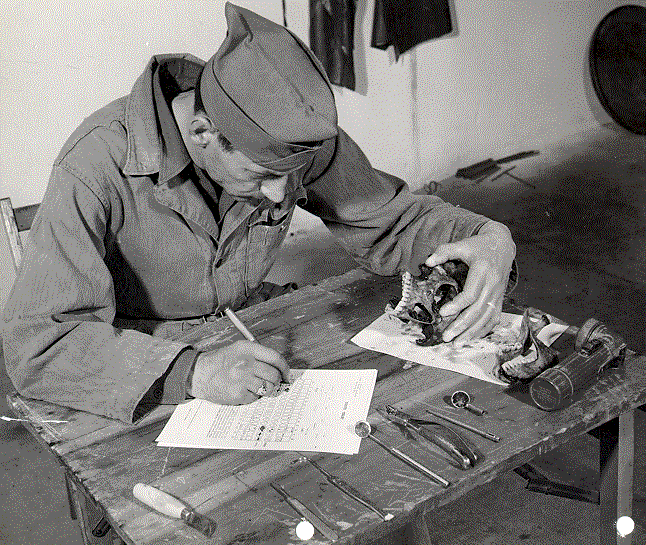
Mortuary Affairs is a service within the United States Army Quartermaster Corps tasked with the recovery, identification, transportation, and preparation for burial of deceased American and American-allied military personnel. The human remains of enemy or non-friendly persons are collected and returned to their respective governments or affiliations. The Air Force has a similar facility at Dover AFB in Delaware, manned by the Army's Mortuary Affairs Personnel.
Until 1991, the army's mortuary affairs was known as the Graves Registration Service (GRS or GRREG). The Graves Registration Service was created several months after the United States entered World War I. The current Army Military Occupational Specialty for the career field is 92A (a general code for officers across the Quartermaster Corps) with a 4-Victor qualification course completion and 92M for enlisted personnel.
Mortuary Affairs is responsible for retrieval, identification, transportation, and burial of American soldiers. Retrieval can be further subdivided into:
The role of the Mortuary Affairs service is legally defined in 10 USC, subtitle A, Chapter 75, Subchapter I, section 1471.
Mortuary Affairs has historically been tied with investigation of war crimes. Following World War II, Graves Registration Personnel were instructed to forward all pathological evidence indicating war crimes to the War Crimes Commission.
The Mortuary Affairs Creed is 'Dignity, Reverence, Respect.'
In the Seminole Wars and Mexican–American War, American soldiers were buried near where they fell, with no effort made to return and little effort made to identify the dead. The American Civil War marked the first time the United States made a concerted effort to identify fallen soldiers. General Orders No. 75 specified that field commanders were responsible for identification and burial efforts. However, these efforts were not well organized or executed, and were often given low priority. (Commanders were more concerned with winning battles than with the disposition of fallen soldiers). After the war, remains of Union soldiers were disinterred and reburied in National Cemeteries.
During the Spanish–American War, the United States initiated a policy of returning soldiers killed on foreign soil back to next-of-kin in the United States, the first country in the world to do so. Quartermaster General Marshall I. Ludington spoke words that became a harbinger of U.S. retrieval efforts in major world conflicts only a few years later. He said the efforts of the Quartermaster Corps in the Spanish–American War were most likely the first attempt of a nation to "disinter the remains of all its soldiers who, in defense of their country, had given up their lives on a foreign shore, and bring them... to their native land for return to their relatives and friends or their reinternment in the beautiful cemeteries which have been provided by our Government for its defenders."
Hub AI
Mortuary Affairs AI simulator
(@Mortuary Affairs_simulator)
Mortuary Affairs
Mortuary Affairs is a service within the United States Army Quartermaster Corps tasked with the recovery, identification, transportation, and preparation for burial of deceased American and American-allied military personnel. The human remains of enemy or non-friendly persons are collected and returned to their respective governments or affiliations. The Air Force has a similar facility at Dover AFB in Delaware, manned by the Army's Mortuary Affairs Personnel.
Until 1991, the army's mortuary affairs was known as the Graves Registration Service (GRS or GRREG). The Graves Registration Service was created several months after the United States entered World War I. The current Army Military Occupational Specialty for the career field is 92A (a general code for officers across the Quartermaster Corps) with a 4-Victor qualification course completion and 92M for enlisted personnel.
Mortuary Affairs is responsible for retrieval, identification, transportation, and burial of American soldiers. Retrieval can be further subdivided into:
The role of the Mortuary Affairs service is legally defined in 10 USC, subtitle A, Chapter 75, Subchapter I, section 1471.
Mortuary Affairs has historically been tied with investigation of war crimes. Following World War II, Graves Registration Personnel were instructed to forward all pathological evidence indicating war crimes to the War Crimes Commission.
The Mortuary Affairs Creed is 'Dignity, Reverence, Respect.'
In the Seminole Wars and Mexican–American War, American soldiers were buried near where they fell, with no effort made to return and little effort made to identify the dead. The American Civil War marked the first time the United States made a concerted effort to identify fallen soldiers. General Orders No. 75 specified that field commanders were responsible for identification and burial efforts. However, these efforts were not well organized or executed, and were often given low priority. (Commanders were more concerned with winning battles than with the disposition of fallen soldiers). After the war, remains of Union soldiers were disinterred and reburied in National Cemeteries.
During the Spanish–American War, the United States initiated a policy of returning soldiers killed on foreign soil back to next-of-kin in the United States, the first country in the world to do so. Quartermaster General Marshall I. Ludington spoke words that became a harbinger of U.S. retrieval efforts in major world conflicts only a few years later. He said the efforts of the Quartermaster Corps in the Spanish–American War were most likely the first attempt of a nation to "disinter the remains of all its soldiers who, in defense of their country, had given up their lives on a foreign shore, and bring them... to their native land for return to their relatives and friends or their reinternment in the beautiful cemeteries which have been provided by our Government for its defenders."
Recent media