


Community hub
Recent from talks
Contribute something
Nothing was collected or created yet.
Dover Air Force Base
View on Wikipedia
Dover Air Force Base or Dover AFB (IATA: DOV, ICAO: KDOV, FAA LID: DOV) is a United States Air Force (USAF) base under the operational control of Air Mobility Command (AMC), located 2 miles (3.2 km) southeast of the city of Dover, Delaware. The 436th Airlift Wing is the host wing, and runs the busiest and largest air freight terminal in the Department of Defense.[2]
Key Information


History
[edit]20th century
[edit]Construction of Municipal Airport, Dover Airdrome began in March 1941 and the facility was opened on December 17, 1941. It was converted to a U.S. Army Air Corps airfield just weeks after the December 7, 1941 Attack on Pearl Harbor. It was renamed Dover Army Airbase on April 8, 1943; *Dover Subbase on June 6, 1943, and Dover Army Airfield on February 2, 1944. With the establishment of the United States Air Force (USAF) on September 18, 1947, the facility was renamed Dover Air Force Base on January 13, 1948.
* Was a subbase of Camp Springs AAF, Maryland, June 6, 1943 – April 15, 1944.
World War II
[edit]In March 1941, Dover Air Force Base was founded during World War II to meet the need of the United States Army Air Corps (USAAC) for an airfield that could be used as a training center. USAAC obtained jurisdiction over the municipal airport at Dover, Delaware.
Once the airport came under military control, an immediate construction program began to turn the civil airport into a military facility. Construction involved runways and airplane hangars, with three concrete runways, several taxiways, a large parking apron and a control tower. Several large hangars were also constructed. Buildings were ultimately utilitarian and quickly assembled. Most base buildings, not intended for long-term use, were constructed with temporary or semi-permanent materials. Although some hangars had steel frames, and the occasional brick or tile brick building could be seen, most support buildings sat on concrete foundations, but were of frame construction, and clad in little more than plywood and tarpaper. Initially under USAAC, the name of the facility was Municipal Airport, Dover Airdrome and the airfield opened on 17 December 1941. The airfield was assigned to the First Air Force.
On 20 December the first military unit arrived at Dover's new airfield: the 112th Observation Squadron of the Ohio National Guard which flew anti-submarine patrols off the Delaware Coast. In early 1942, three B-25 Mitchell bomber squadrons arrived with the 45th Bombardment Group from I Bomber Command, later part of Army Air Forces Antisubmarine Command, assumed the anti-submarine mission.
On 8 April 1943, the name of the airfield was changed to Dover Army Air Base. The antisubmarine mission ended on 6 June, and construction crews moved back to the base for a major upgrading project that lengthened the main runway to 7,000 feet. During the construction period and continuing into June 1944, Dover AAB became a sub-base of Camp Springs Army Airfield, Maryland.
Full operational capability was restored to Dover in September, and seven P-47 Thunderbolt squadrons arrived for training in preparation for eventual involvement in the European Theater, while the 83d Fighter Group was assigned to Dover as the Operational Training Unit, The 83rd was redesignated the 125th Base Unit on 10 April 1944, with very little change in its mission. It was further redesignated as the 125th Army Air Force base Unit on 15 September 1944.
In 1944, the Air Technical Service Command chose Dover as a site to engineer, develop, and conduct classified air-launched rocket tests. The information collected during these experiments resulted in the effective deployment of air-to-surface rockets in both the European and Pacific combat theaters.
On 1 September 1946, as a result of the drawdown of United States forces after the war, Dover Army Airfield was placed on temporary inactive status. A small housekeeping unit, the 4404th Base Standby Squadron, remained on the airfield for care and maintenance of the facility.
Cold War and Vietnam
[edit]

Dover Airfield was reactivated on 1 August 1950 as a result of the Korean War and the expansion of the USAF in response to the Soviet threat in the Cold War. On February 1, 1951, the 148th Fighter Interceptor Squadron of the Pennsylvania Air National Guard arrived with P-51 Mustang fighter aircraft. During the 1950s problems developed with many of the facilities in Dover, which had been hastily constructed to support its World War II mission. As a result, a massive engineering project was undertaken to modernize the base.
On April 1, 1952, Dover was transferred to the Military Air Transport Service (MATS) and became home to 1607th Air Transport Wing (Heavy). A full function hospital was completed in 1958 and base housing was expanded to handle 1,200 families in 1961. On January 1, 1966, the Military Air Transport Service was redesignated the Military Airlift Command (MAC). Along with the reorganization, the 1607th was discontinued and the 436th Military Airlift Wing (436 MAW) activated and assumed the mission at Dover. The 436 MAW started replacing C-141 Starlifters and C-133 Cargomasters with the new C-5 Galaxy in 1971. Two years later Dover became the first all C-5 equipped wing in the USAF, trading the last of its C-141 to Charleston AFB, South Carolina.
During the Vietnam War, the bodies of more than 20,000 American soldiers were brought back to the United States via Dover. The Vietnam War dead account for over 90% of all the remains processed at Dover before 1988.[3]
When the Yom Kippur War broke out between Israel and the combined forces of Egypt and Syria on October 13, 1973, the 436 MAW responded with a 32-day airlift that delivered 22,305 tons of munitions and military equipment to Israel. The 436 MAW also assisted in the evacuation of Americans from Iran on December 9, 1978, following the Islamic Revolution. That year, Dover AFB was also used to store hundreds of bodies from the mass murder and suicide of the Jonestown community in Guyana.[4][5]
Some of the more memorable flights during the post-war period included the airdrop and test firing of a Minuteman I intercontinental ballistic missile and the delivery of a 40-ton superconducting magnet to Moscow during the Cold War, for which the crew received the Mackay Trophy.
After the Space Shuttle Challenger disaster, the remains of the seven astronauts were transferred to Dover AFB. It is one of only seven airports in the country that served as launch abort facilities for the Space Shuttle.[6]
In March 1989, C-5s from Dover delivered special equipment used to clean up the Exxon Valdez oil spill in Prince William Sound, Alaska. On June 7, 1989, while attending the Airlift Rodeo, a 436 MAW C-5 set a world record when it airdropped 190,346 pounds and 73 paratroopers. In October 1983, the wing flew 24 missions in support of Operation Urgent Fury, the Grenada rescue operation and later flew 16 missions to support Operation Just Cause, the invasion of Panama, in December 1989 – January 1990.
During Desert Shield, the wing flew approximately 17,000 flying hours and airlifted a total of 131,275 tons of cargo in support of combat operations after the Iraqi invasion of Kuwait.
In 1992, with the disestablishment of Military Airlift Command, Dover AFB was transferred to the newly established Air Mobility Command (AMC) and the 436 MAW and 512 MAW (Associate) were redesignated as the 436th Airlift Wing (436 AW) and the 512th Airlift Wing (512 AW), respectively. Dover also served as a major port of entry and exit for the conflicts in the Balkans and Somalia during the latter half of the 1990s.
21st century
[edit]September 11 attacks
[edit]Following the September 11 attacks, the 436 AW and 512 AW became major participants in Operation Enduring Freedom and Operation Iraqi Freedom. An aircrew from Dover's 3rd Airlift Squadron landed the first C-5 in Iraq in late 2003 when they landed at Baghdad International Airport and the two wings continue to support operations in the region.
Also following September 11, 2001, U.S. Army mortuary specialists organized support for Pentagon recovery efforts out of the base.[7] This effort evolved into the Joint Personal Effects Depot, which supports recovery and redistribution of the personal effects of wounded and killed personnel from all arms of the military.[7] In 2003, the Depot was transferred to Aberdeen Proving Ground in Maryland.[7] Dover AFB is also where service members from all six branches of service killed in combat are repatriated. Their remains are processed, inspected for unexploded ordnance, cleaned, and prepared for burial before being escorted to the point of interment decided by the family. The Depot returned to Dover in 2011, when in April a new $14 million custom-built facility officially opened.[7]
On April 3, 2006, a C-5 Galaxy crashed short of a runway, skidding into a farm field. There were no fatalities.
By 2008, the air traffic tower serving the airfield, built in 1955, was the oldest such tower in use in the USAF. In 2009 the base received a new 128-foot tall tower, overlapping the original 103-foot one which was donated to the Air Mobility Command Museum, accessible to visitors.[8]
Dover AFB is the first air force base to receive the new C-5M "Super Galaxy", receiving the aircraft on February 9, 2009 (named "The Spirit of Global Reach").[9]
On February 2, 2015, the 9,600 foot runway 01-19 was closed for repairs. The runway was re-opened for operation on September 23, 2016. During the repair, the 12,900 foot runway 14–32 was temporarily cut in half so that the intersection of the two runways could be repaired. C-17 Globemasters could land on either half of runway 14–32.[10][11]
Facilities and aircraft
[edit]
The airport has two runways. Runway 14/32 measures 12903 x 150 ft (3933 x 46 m) and is paved with asphalt and concrete. Runway 1/19 measures 9602 x 150 ft (2927 x 46 m) and is paved with concrete. The airport averages 123,735 aircraft operations per year, an average of 339 per day. It is entirely military aviation.[12]
Airlines and destinations
[edit]Role and operations
[edit]
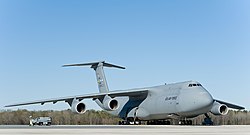
Dover AFB is home to the 436th Airlift Wing (436 AW) of the Air Mobility Command (AMC), known as the "Eagle Wing", and the AMC-gained 512th Airlift Wing (512 AW) of the Air Force Reserve Command (AFRC), referred to as the "Liberty Wing". It was previously the only base to solely operate the massive C-5 Galaxy and now operates both that aircraft plus the C-17 Globemaster III. The 436 AW has two active flying squadrons (the 3rd Airlift Squadron, which now operates the C-17, and 9th Airlift Squadron), and the 512 AW has two AFRC flying squadrons (the 326th Airlift Squadron and the 709th Airlift Squadron).
Dover AFB is also the home for the largest military mortuary in the Department of Defense, and has been used for processing military personnel killed in both war and peacetime; the remains of those killed overseas are traditionally brought to Dover AFB before being transferred to family. The Charles C. Carson Center for Mortuary Affairs has also been used to identify remains of civilians in certain exceptional circumstances: in 1978 for the victims of the Jonestown mass murder/suicide, in 1986 for identifying the remains of the crew of the Space Shuttle Challenger, and in 2003 for the crew of the Space Shuttle Columbia. It was also a major site for identifying the remains of military personnel killed in the 9/11 attacks. During the night of October 28, 2009, before making a decision on the committal of further troops to Afghanistan, President Barack Obama visited the base to receive the bodies of several American soldiers killed in Afghanistan.
Two sections of the 436th Aerial Port Squadron warehouse collapsed on February 18, 2003, as a result of a record snow storm. No one was injured in the collapse that caused more than an estimated $1 million in damages. The damage covered two of the six cargo processing bays in the facility.
Dover Air Force Base is also home to the Air Mobility Command Museum.
Air Show
[edit]Dover Air Force Base holds an annual air show, with the most recent occurring in May 2022.[13] The show includes static displays of military aircraft and equipment, and flight demonstrations of the United States Air Force Thunderbirds or United States Navy Blue Angels demonstration teams.
Based units
[edit]Flying and notable non-flying units based at Dover Air Force Base:[14]
United States Air Force[edit]Air Mobility Command (AMC)
|
Air Force Reserve Command (AFRC)
|
United States Army[edit]US Army Human Resources Command
Department of Defense[edit]
Department of the Air Force[edit]
|
Major assigned commands
[edit]- First Air Force, December 17, 1941
- Air Service Command, December 19, 1942
- First Air Force, March 17, 1943
- Continental Air Forces, June 6, 1945
- Redesignated: Strategic Air Command, March 21, 1946
- Tactical Air Command, April 1, 1946
- Continental Air Command, December 1, 1948
- Air Defense Command, January 1, 1951
- Military Air Transport Service, April 1, 1952
- Redesignated: Military Airlift Command, January 1, 1966
- Air Mobility Command, June 1, 1992 – present
* Base put on temporary inactive status, September 1, 1946 – August 1, 1950. During inactive status, field remained under major command jurisdiction.
Major units assigned
[edit]
|
|
References for history introduction, major commands and major units[15]
Geography
[edit]A section of the base is treated as a census-designated place named "Dover Base Housing."[16] It is part of the Dover metropolitan area. Dover Base Housing had a population of 3,450 at the 2010 census. According to the United States Census Bureau, Dover Base Housing has a total area of 0.7 square miles (1.7 km2), all land.
Other portions of the base are in the city limits of Dover.[17]
Dover Base Housing consists of a development called Eagle Heights Family Housing, which is made up of 980 homes in single-family, duplex, triplex, and fourplex configurations. The development features a community center, multiple neighborhood centers, picnic areas, fitness center, and golf course. Eagle Heights Family Housing contains a total of 19,500 feet (5,900 m) of greenbelt paths for walking, jogging, and biking. Students in the development attend public schools in the Caesar Rodney School District.[18]
Since 1997, the base has been served by three highway exits with Delaware Route 1, allowing quick access to Dover and to southern Delaware from the complex. Dover AFB provides almost $470 million a year in revenue to the city of Dover, making it the third largest industry in Delaware.
Demographics
[edit]| Census | Pop. | Note | %± |
|---|---|---|---|
| 1970 | 8,106 | — | |
| 1980 | 4,391 | −45.8% | |
| 1990 | 4,376 | −0.3% | |
| 2000 | 3,394 | −22.4% | |
| 2010 | 3,450 | 1.6% | |
| 2020 | 2,810 | −18.6% | |
| U.S. Decennial Census[19] | |||
As of the census[20] of 2000, there were 3,394 people, 1,032 households, and 1,017 families residing in the base. The population density was 5,061.6 people per square mile (1,955.9/km2). There were 1,245 housing units at an average density of 1,856.7 per square mile (717.5/km2). The racial makeup of the base was 72.57% White, 16.59% African American, 0.77% Native American, 1.86% Asian, 0.12% Pacific Islander, 2.80% from other races, and 5.30% from two or more races. Hispanic or Latino of any race were 7.75% of the population.
There were 6,032 households, out of which 76.1% had children under the age of 18 living with them, 90.2% were married couples living together, 5.4% had a female householder with no husband present, and 1.4% were non-families. 1.2% of all households were made up of individuals, and 0.2% had someone living alone who was 65 years of age or older. The average household size was 3.29 and the average family size was 3.30.
In the base the population was spread out, with 40.2% under the age of 18, 16.5% from 18 to 24, 41.5% from 25 to 44, 1.7% from 45 to 64, and 0.1% who were 65 years of age or older. The median age was 23 years. For every 100 females, there were 103.0 males. For every 100 females age 18 and over, there were 97.5 males.
The median income for a household in the base was $34,318, and the median income for a family was $34,659. Males had a median income of $26,322 versus $20,444 for females. The per capita income for the base was $12,119. About 5.2% of families and 4.2% of the population were below the poverty line, including 3.5% of those under age 18 and none of those age 65 or over.
Air Mobility Command Museum
[edit]Building 1301, Dover Air Force Base | |
 Building 1301, January 2011 | |
  Location in Delaware  Location in United States | |
| Location | Dover AFB, E. Dover Hundred, Dover, Delaware |
|---|---|
| Area | 1 acre (0.40 ha) |
| NRHP reference No. | 94001377[21] |
| Added to NRHP | December 7, 1994 |

Hangar 1301 at Dover Air Force Base is home to the Air Mobility Command Museum.[22] The museum is dedicated to military airlift and air refueling aircraft and the people who maintain them. It has a large collection of fully restored cargo and tanker aircraft. Tours are conducted during the day by volunteers, many of whom are retired pilots, navigators, flight engineers and loadmasters who provide first-person narratives of actual events. The hangar encloses over 20,000 square feet (1,900 m2) of aircraft display gallery plus 1,300 square feet (120 m2) of exhibit rooms. An attached 6,400-square-foot (590 m2) building houses a theater, museum store, exhibit workshop, and various offices. A 100,000-square-foot (9,300 m2) aircraft parking area allows close-up inspection of the outside aircraft. The museum also maintains archives related to the history of the Air Mobility Command and Dover AFB. Building 1301, Dover Air Force Base was added to the National Register of Historic Places in 1994.[21]
There are 33 airframes in the collection in 2015, and a staff of more than 170 volunteers. A single battered Douglas C-47A Skytrain, salvaged in 1986 off of a dump at Olmsted Air Force Base, near Harrisburg, Pennsylvania, after being used for target practice, was the museum's modest beginning. Airlifted to Dover AFB by a Pennsylvania National Guard helicopter, "It was the first aircraft restored for the newly conceptualized museum that would form here."
Founded as the Dover AFB Historical Center on 13 October 1986, it originally was housed in three hangars within the main area of the base. It was officially recognized with museum status in 1995 and moved to its current location in 1996. On 5 February 1997, Air Mobility Command officially named the Dover AFB Museum as the AMC Museum.[23]
Education
[edit]The Dover Base Housing is located in the Caesar Rodney School District.[24] It is assigned to the Dover Air Base schools for grades K-8: Major George S. Welch Elementary School and Dover Air Force Base Middle School.[25] Caesar Rodney High School in Camden is the comprehensive high school for the entire district.
Wilmington University has a center on Dover AFB.[26]
Accidents and incidents
[edit]- On January 13, 2013, a Piper PA-28 was substantially damaged during a forced landing following a total loss of engine power while on approach to Dover Air Force Base. The aircraft was flying an instrument approach into the airport while on an instrument flight plan bound for the Summit Airport in Middletown. The aircraft was completely fueled before the accident flight. During flight, the pilot was advised that previous traffic had been unable to land at the Summit Airport due to weather, and the accident pilot requested an approach into Salisbury Regional Airport in Maryland, which ultimately didn't work out. The pilot subsequently tried to land at the Sussex County Airport, then expressed interest in landing at the Delaware Airpark in Dover. The pilot requested to land at Dover Air Force Base but was subsequently told he only could in an emergency. The pilot eventually declared a fuel emergency and tried an instrument approach into DOV, but the aircraft crashed before landing. The probable cause of the accident was found to be the pilot's failure to land the airplane at multiple airports that were equipped with adequate instrument approach procedures while operating in low instrument meteorological conditions and his delay in declaring a fuel-related emergency, which resulted in a loss of engine power due to fuel exhaustion.[27]
See also
[edit]
References
[edit] This article incorporates public domain material from the Air Force Historical Research Agency
- This article incorporates public domain material from Dover Air Force Base. United States Air Force.

- ^ "Airport Diagram – Dover AFB (KDOV)" (PDF). Federal Aviation Administration. May 23, 2019. Retrieved June 17, 2019.
- ^ "DOVER AIR FORCE BASE & THE DELMARVA PENINSULA" (PDF). Retrieved March 27, 2020.
- ^ Theresa Humphrey, Associated Press (October 23, 1988). "Armed Forces' Mortuary Base : Debriefings Ease Stress of Dealing With Dead". Los Angeles Times. Retrieved October 28, 2016.
- ^ "Dover Air Force Base Finds 34 Pages – Alternative Considerations of Jonestown & Peoples Temple".
- ^ Chidester, David (2003). Salvation and Suicide. Indiana University Press. ISBN 9780253216328. Retrieved February 7, 2015.
- ^ Space Shuttle Emergency Landing Sites
- ^ a b c d Montgomery, Jeff (April 15, 2011). "Dover Air Force Base: Caring for what the dead last carried with them". News Journal. Gannett. DelawareOnline. Retrieved April 16, 2011.
- ^ "AMC Museum Dover AFB Control Tower". Dover: AMC Museum. Air Mobility Command Museum. August 24, 2012. Local. Retrieved August 24, 2012.
The original tower was in service for over 50 years spanning the era of the propeller-driven C-54 Skymaster cargo plane to the jet-age C-17 Globemaster III.
- ^ "Spirit of Global Reach lands at Dover". February 10, 2009. Retrieved March 27, 2020.
- ^ "Runway 01-19 to open, C-5s to return home". Dover Air Force Base. Retrieved March 6, 2017.
- ^ "Slowed Dover runway work now on track". delawareonline. Retrieved March 6, 2017.
- ^ "AirNav: KDOV - Dover Air Force Base". airnav.com. Retrieved May 22, 2023.
- ^ "Thunder Over Dover: 2022 Dover AFB Air Show".
- ^ "Units". Dover Air Force Base. US Air Force. Archived from the original on April 28, 2020. Retrieved June 20, 2019.
- ^ Mueller, Robert (1989). Volume 1: Active Air Force Bases Within the United States of America on 17 September 1982. USAF Reference Series, Office of Air Force History, United States Air Force, Washington, D.C. ISBN 0-912799-53-6, ISBN 0-16-002261-4
- ^ "2020 CENSUS - CENSUS BLOCK MAP: Dover Base Housing CDP, DE" (PDF). U.S. Census Bureau. Retrieved July 1, 2023.
- ^ "2020 CENSUS - CENSUS BLOCK MAP (INDEX): Dover city, DE" (PDF). U.S. Census Bureau. Retrieved July 1, 2023.
- ^ "Military Housing". Eagle Heights at Dover. Retrieved October 28, 2018.
- ^ "Census of Population and Housing". Census.gov. Retrieved June 4, 2016.
- ^ "U.S. Census website". United States Census Bureau. Retrieved January 31, 2008.
- ^ a b "National Register Information System". National Register of Historic Places. National Park Service. July 9, 2010.
- ^ "Air Mobility Command Museum - Dover AFB Delaware". amcmuseum.org. Retrieved February 7, 2015.
- ^ Cacicia, Zachary, Airman 1st Class, "AMCM: It all started with one wrecked airplane", Hangar Digest, The AMC Museum Foundation Inc., Dover Air Force Base, Delaware, January – March 2015, Volume 15, Number 1, page 12.
- ^ "2020 CENSUS - SCHOOL DISTRICT REFERENCE MAP: Kent County, DE" (PDF). U.S. Census Bureau. Retrieved June 16, 2021.
- ^ "CRSD Map" (PDF). Caesar Rodney School District. Retrieved June 16, 2021.
- ^ "Locations". Wilmington University. Retrieved June 22, 2021.
- ^ "Piper PA-28R-200 crash in Delaware (N4975S) | PlaneCrashMap.com". planecrashmap.com. Retrieved May 22, 2023.
External links
[edit]
- Official website
- Air Mobility Command Museum
- Civil Air Terminal at Dover AFB (Delaware River and Bay Authority)
- Historic American Buildings Survey (HABS) No. DE-297, "Dover Air Force Base, Hangar No. 1301, Dover, Kent County, DE", 18 photos, 13 data pages, 3 photo caption pages
- FAA Airport Diagram (PDF), effective October 30, 2025
- Resources for this U.S. military airport:
- FAA airport information for DOV
- AirNav airport information for KDOV
- ASN accident history for DOV
- NOAA/NWS latest weather observations
- SkyVector aeronautical chart for KDOV
| Leadership |  | ||||||||||
|---|---|---|---|---|---|---|---|---|---|---|---|
| Structure |
| ||||||||||
| Personnel and training | |||||||||||
| Uniforms and equipment | |||||||||||
| History and traditions |
| ||||||||||

 Air Mobility Command (AMC) Air Mobility Command (AMC) | |||||||||||||
|---|---|---|---|---|---|---|---|---|---|---|---|---|---|
| Numbered Air Forces | | ||||||||||||
| Command Organizations | |||||||||||||
| Bases | |||||||||||||
| Group | |||||||||||||
| Wings |
| ||||||||||||


.jpg)


| International | |
|---|---|
| National | |
| Other | |

Dover Air Force Base
View on GrokipediaHistory
Establishment and World War II
Construction of the Dover Municipal Airport, also known as Dover Airdrome, began in March 1941, with the facility opening on December 17, 1941, shortly after the U.S. entry into World War II.[6] Weeks following the December 7, 1941, Japanese attack on Pearl Harbor, the airfield was leased to the U.S. Army Air Corps, assigned to First Air Force, and converted into a military installation designated Dover Army Airfield to support urgent national defense needs.[6][2] Early operations focused on antisubmarine warfare against German U-boats disrupting Atlantic convoys, with units including the 39th Bombardment Squadron conducting patrols from the base.[2][7] In February 1943, as submarine threats waned, the 39th Squadron transferred to Fort Dix Army Field, New Jersey, prompting a temporary closure of Dover to air traffic for infrastructure expansions, including runway lengthening to handle increased operational demands.[2] Post-upgrades, the base shifted to fighter pilot training, serving as a key site where hundreds of pilots qualified on the P-47 Thunderbolt, preparing them for European Theater deployments; it was redesignated Dover Army Air Base on April 8, 1943, underscoring its growing strategic importance.[2][6]Cold War and Vietnam Era
In the early 1950s, Dover Air Force Base underwent significant facility upgrades to address the deterioration of World War II-era structures, enabling a shift from fighter operations to strategic airlift capabilities. On April 1, 1952, the base transferred to the Military Air Transport Service (MATS), which assumed command and established it as home to the 1607th Air Transport Wing (Heavy), focusing on global personnel and cargo transport. The wing operated Douglas C-124 Globemaster II aircraft, capable of carrying heavy loads including vehicles and artillery, and later the Douglas C-133 Cargomaster, a turboprop freighter introduced in the late 1950s for oversized cargo missions. These upgrades and aircraft transitions positioned Dover as a key node in U.S. power projection during the Cold War, supporting rapid deployment against Soviet and communist threats through reliable heavy-lift operations.[2][8] During the Vietnam War, Dover served as a critical logistics hub, facilitating troop deployments and resupply efforts essential to countering North Vietnamese and Viet Cong advances. The base supported major operations such as Blue Light in January 1966 and Eagle Thrust starting December 28, 1967, which airlifted elements of the 101st Airborne Division to Southeast Asia, demonstrating the base's role in enabling swift U.S. force commitments. Dover's C-124 and C-133 fleets conducted numerous trans-Pacific sorties, delivering munitions, equipment, and personnel that formed the logistical backbone for ground operations amid escalating communist aggression. Empirical data from these missions highlight Dover's contributions, with aircrews logging thousands of flight hours to sustain frontline needs, though specific tonnage figures for the base underscore the broader MATS effort that transported millions of tons of materiel across the theater from 1965 to 1973.[9][10][11] The introduction of jet-powered strategic airlifters further enhanced Dover's capabilities in the mid-1960s. On August 18, 1965, the first Lockheed C-141 Starlifter arrived, assigned to the 20th Air Transport Squadron, offering greater speed, range, and payload over predecessors for time-sensitive Vietnam resupplies. By April 16, 1971, the wing received its initial Lockheed C-5 Galaxy, initiating the phase-out of C-133s and marking Dover's transition to an all-jet heavy-lift force by the mid-1970s, with the C-5's 243,000-pound payload capacity revolutionizing massive equipment deployments. These advancements, amid Strategic Air Command influences on base realignments, solidified Dover's focus on airlift, enabling sustained logistical support against communist expansion without reliance on forward staging.[8][9][5]Post-Cold War Modernization
Following the dissolution of the Soviet Union in 1991, Dover Air Force Base adapted to a unipolar strategic landscape requiring agile power projection capabilities, prioritizing heavy strategic airlift for swift deployment of armored and mechanized forces without reliance on extensive forward basing. The base retained its core mission amid broader U.S. military drawdowns, supporting operations that underscored the causal imperative of outsized cargo transport in enabling rapid global response. Dover's 436th Airlift Wing played a pivotal role in Operation Desert Storm, processing and airlifting nearly 140,000 tons of cargo from 1990 to 1991, including critical sustainment for coalition forces in the Persian Gulf.[12] In the 1990s Base Realignment and Closure (BRAC) rounds of 1991, 1993, and 1995, Dover avoided closure recommendations, preserving its infrastructure as a key node for Air Mobility Command while peer installations faced consolidation or shutdown to align with post-Cold War force structure reductions. The U.S. Air Force retired legacy C-141 Starlifters progressively, with Dover's final C-141 departing in February 1996, paving the way for integration of the more versatile C-17 Globemaster III, whose first aircraft arrived at the base on June 4, 2007, enhancing short-field capabilities and overall fleet interoperability.[13][14] Central to modernization efforts was the upgrade of the C-5 Galaxy fleet to the C-5M Super Galaxy configuration, incorporating the Avionics Modernization Program and Reliability Enhancement and Re-engining Program, which re-engined aircraft with General Electric CF6-80C2 turbofans and modernized cockpits for improved fuel efficiency, range, and situational awareness. These enhancements, implemented starting in the early 2000s, boosted mission-capable rates and reliability through over 70 modifications, enabling the C-5M to achieve superior climb performance and payload delivery in contested environments.[15][16] Despite Air Force-wide personnel cuts—from approximately 570,000 active-duty members in the late Cold War era to around 400,000 by the mid-1990s—Dover maintained sortie generation rates through process efficiencies and technological upgrades, ensuring sustained operational tempo for humanitarian and contingency missions in the post-Desert Storm era. This adaptation reflected empirical priorities on maintainability and availability, allowing the base to support diverse airlift demands with a leaner footprint while upholding readiness for expeditionary operations.[17]21st Century Operations and Deployments
Following the September 11, 2001, terrorist attacks, Dover Air Force Base intensified its strategic airlift operations in support of Operations Enduring Freedom in Afghanistan and Iraqi Freedom in Iraq. Aircraft from the 436th Airlift Wing and associate 512th Airlift Wing, including C-5 Galaxy models, executed numerous sorties to deliver troops, equipment, and supplies to forward-deployed forces, contributing to the sustainment of combat operations across Southwest Asia.[18][19] Dover's role extended to personnel recovery and dignified transfers, with over 6,200 fallen service members returned through the base's Charles C. Carson Center for Mortuary Affairs since 2001, reflecting the scale of post-9/11 commitments.[20] In 2025, the Armed Forces Medical Examiner System at Dover accelerated processing of remains and artifacts from Operation Colony Glacier, a recovery effort targeting the 1952 crash of a C-124 Globemaster II in Alaska's Colony Glacier, which claimed 52 lives.[21] Into the 2020s, Dover's modernized C-5M Super Galaxy and C-17 Globemaster III fleets have sustained global mobility, enabling rapid transatlantic deployments for contingency responses and great-power competition scenarios, such as reinforcing European allies.[22][19] During the federal government shutdown commencing October 1, 2025, the base preserved core airlift and mortuary functions, with active-duty personnel exempted from furloughs to maintain operational readiness.[23][24]Geography and Infrastructure
Location and Environmental Context
Dover Air Force Base is located approximately 2 miles southeast of the city of Dover in Kent County, Delaware, occupying a low-lying coastal plain terrain that supports expansive airfield development.[1] The base encompasses roughly 3,900 acres, surrounded primarily by wetlands and agricultural cropland, providing flat, unobstructed land conducive to aviation operations.[1] [25] This topography facilitated the construction of a primary runway measuring 12,903 feet in length, enabling heavy aircraft takeoffs and landings essential for strategic airlift missions.[26] The site's selection leveraged its inherent defensibility through minimal topographic vulnerabilities in peacetime and superior accessibility via regional infrastructure, including proximity to U.S. Highway 13 for ground transport.[1] The environmental context features a temperate climate typical of the Mid-Atlantic region, with average annual temperatures ranging from 30°F in winter to 80°F in summer, though coastal influences introduce periodic fog that necessitates specialized weather forecasting for safe operations.[27] Dover's central position on the Delmarva Peninsula positions it optimally for transatlantic routes, minimizing flight times to Europe while enhancing logistics through nearness to East Coast ports like the Delaware Bay, approximately 20 miles east.[25] This geospatial alignment supports efficient cargo throughput, integrating air operations with maritime and highway networks for rapid deployment and sustainment.[7]