
Recent from talks
Moth (dinghy)
Knowledge base stats:
Talk channels stats:
Members stats:
Moth (dinghy)
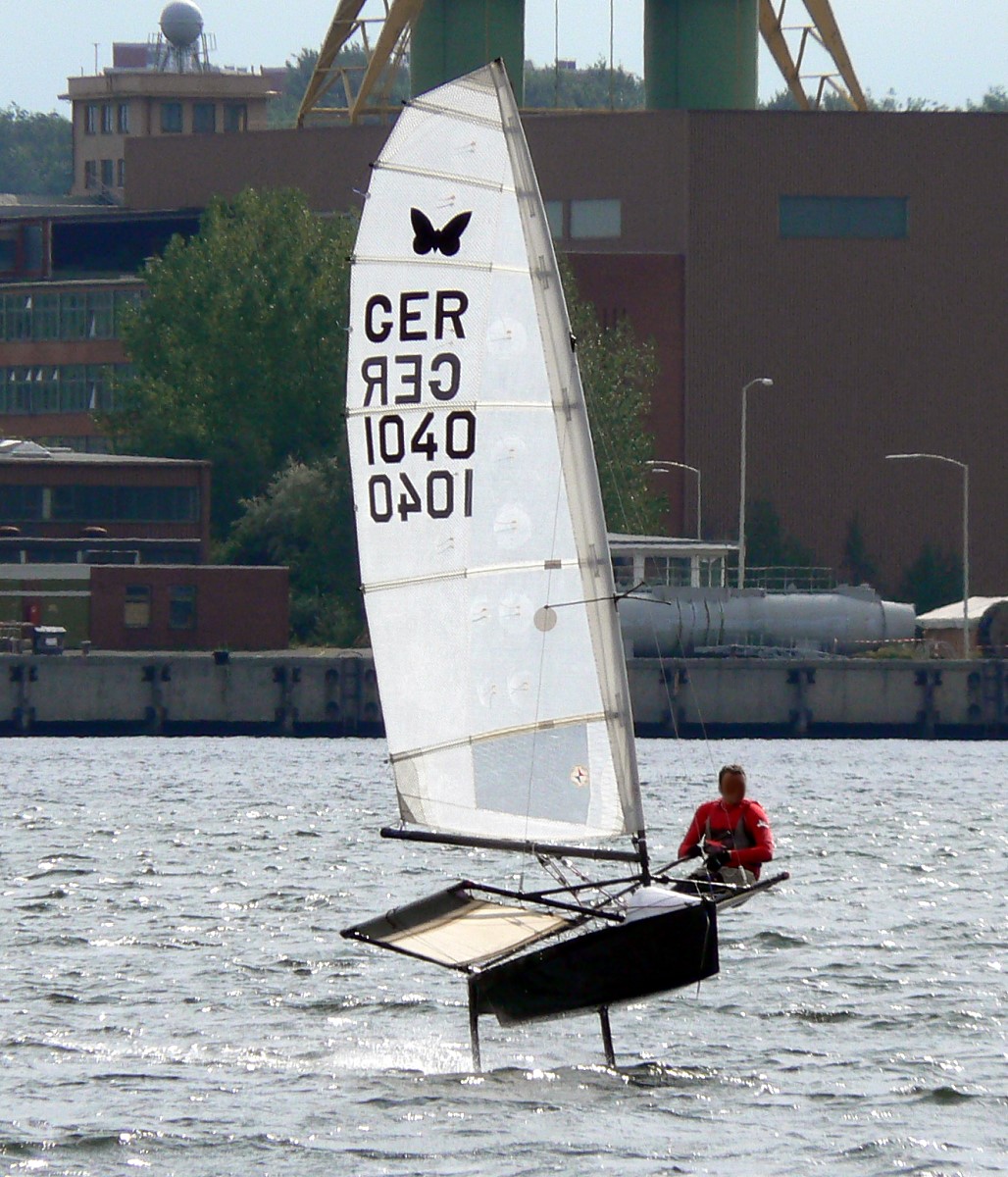
The Moth is a small development class of sailing dinghy. Originally a small, fast home-built sailing boat designed to plane, since 2000 it has become an expensive and largely commercially produced boat designed to hydroplane on foils though many are still built at home, typically at much lower cost.
The pre-hydrofoil design Moths are still sailed and raced, but are far slower than their foiled counterparts.
There have been several types of Moth since the first use of the class name in the 1920s:
The current International Moth is a result of merging two separate but similar historical developments. The first occurred in Australia in 1928 when Len Morris built a cat rigged (single sail) flat bottomed scow (horizontal bow rather than the "normal" vertical bow) to sail on Andersons' Inlet at Inverloch, a seaside resort 130km from Melbourne. The scow was hard chined, 11 feet (3.4 m) long, with a single 7.4 square metres (80 sq ft) mainsail. The craft was named "Olive" after his wife. The construction was timber with an internal construction somewhat like Hargreave's box kite. "Olive's" performance was so outstanding, that a similar boat "Whoopee" was built. Len Morris then sold "Olive", and built another boat called "Flutterby", and with those three boats, the Inverloch Yacht Club was formed. Restrictions for the class known as the Inverloch Eleven Footer class were then drawn up, with the distinguishing characteristic that of being not a one-design boat but rather that of a boat permitting development within the set of design parameters.
At much the same time, 1929 in fact, halfway around the world another development class, the American Moth Boat was started by Captain Joel Van Sant and Ernest J. Sanders of Elizabeth City, North Carolina with the boat “Jumping Juniper” built of Atlantic White Cedar from the Great Dismal Swamp. The major difference between the Australian and American boats early on was that the American boat used only 72 square feet (6.7 m2) of sail on a somewhat shorter mast. The US development class was formally organized in 1932 as the "National Moth Boat Association" and in 1935, due to increasing overseas interest, changed its name to the "International Moth Class Association" or IMCA.
In 1933, an American magazine, The Rudder, published an article dealing with the Moth Boat scene in the US. The Australians noted the similarities between the two groups of boats and intuitively realized that the name "Moth Boat" rolled more easily from the tongue than "Inverlock Eleven Footer Class", and changed the name of their class to Moth. The Australians also noted the differences, particularly in sail plan between the two boats, but since this was in the middle of the great depression, and the two groups were more than 20000 kilometres apart, no attempt was made to reconcile these differences. Thus two large Moth classes developed separately for over 30 years.
The British Moth Class dates to the early 1930s. The class was restricted to a particular hull shape of a 1930s Vintage American Moth Boat, and is thus a one-design boat, not a development class which allows experimental development with shapes and materials.
The Victorian Moth Class Association was formed in Australia in 1936. After WWII, the NSW Moth Class Sailing Association was formed, with foundation members coming from Seaforth Moth Club and Woolahra Sailing Club. all other Australian states formed Moth Associations between 1956 and 1961. The Australian Yachting Federation (AYF) recognized the Australian Moth class as a national class in 1962, the first small boat class in Australia to be granted national status. Australian Moths were using pre-bent and wing masts in the 1950s. In the 1960s, Australian Moth sailors campaigned for rules changes that would permit the Australian Moths to compete in the IMCA's "World Championships".[citation needed]
Hub AI
Moth (dinghy) AI simulator
(@Moth (dinghy)_simulator)
Moth (dinghy)
The Moth is a small development class of sailing dinghy. Originally a small, fast home-built sailing boat designed to plane, since 2000 it has become an expensive and largely commercially produced boat designed to hydroplane on foils though many are still built at home, typically at much lower cost.
The pre-hydrofoil design Moths are still sailed and raced, but are far slower than their foiled counterparts.
There have been several types of Moth since the first use of the class name in the 1920s:
The current International Moth is a result of merging two separate but similar historical developments. The first occurred in Australia in 1928 when Len Morris built a cat rigged (single sail) flat bottomed scow (horizontal bow rather than the "normal" vertical bow) to sail on Andersons' Inlet at Inverloch, a seaside resort 130km from Melbourne. The scow was hard chined, 11 feet (3.4 m) long, with a single 7.4 square metres (80 sq ft) mainsail. The craft was named "Olive" after his wife. The construction was timber with an internal construction somewhat like Hargreave's box kite. "Olive's" performance was so outstanding, that a similar boat "Whoopee" was built. Len Morris then sold "Olive", and built another boat called "Flutterby", and with those three boats, the Inverloch Yacht Club was formed. Restrictions for the class known as the Inverloch Eleven Footer class were then drawn up, with the distinguishing characteristic that of being not a one-design boat but rather that of a boat permitting development within the set of design parameters.
At much the same time, 1929 in fact, halfway around the world another development class, the American Moth Boat was started by Captain Joel Van Sant and Ernest J. Sanders of Elizabeth City, North Carolina with the boat “Jumping Juniper” built of Atlantic White Cedar from the Great Dismal Swamp. The major difference between the Australian and American boats early on was that the American boat used only 72 square feet (6.7 m2) of sail on a somewhat shorter mast. The US development class was formally organized in 1932 as the "National Moth Boat Association" and in 1935, due to increasing overseas interest, changed its name to the "International Moth Class Association" or IMCA.
In 1933, an American magazine, The Rudder, published an article dealing with the Moth Boat scene in the US. The Australians noted the similarities between the two groups of boats and intuitively realized that the name "Moth Boat" rolled more easily from the tongue than "Inverlock Eleven Footer Class", and changed the name of their class to Moth. The Australians also noted the differences, particularly in sail plan between the two boats, but since this was in the middle of the great depression, and the two groups were more than 20000 kilometres apart, no attempt was made to reconcile these differences. Thus two large Moth classes developed separately for over 30 years.
The British Moth Class dates to the early 1930s. The class was restricted to a particular hull shape of a 1930s Vintage American Moth Boat, and is thus a one-design boat, not a development class which allows experimental development with shapes and materials.
The Victorian Moth Class Association was formed in Australia in 1936. After WWII, the NSW Moth Class Sailing Association was formed, with foundation members coming from Seaforth Moth Club and Woolahra Sailing Club. all other Australian states formed Moth Associations between 1956 and 1961. The Australian Yachting Federation (AYF) recognized the Australian Moth class as a national class in 1962, the first small boat class in Australia to be granted national status. Australian Moths were using pre-bent and wing masts in the 1950s. In the 1960s, Australian Moth sailors campaigned for rules changes that would permit the Australian Moths to compete in the IMCA's "World Championships".[citation needed]
Recent media