
Recent from talks
Mound Builders
Knowledge base stats:
Talk channels stats:
Members stats:
Mound Builders
Many pre-Columbian cultures in North America were collectively termed "Mound Builders", but the term has no formal meaning. It does not refer to specific people or archaeological culture but refers to the characteristic mound earthworks that indigenous peoples erected for an extended period of more than 5,000 years. The "Mound Builder" cultures span the period of roughly 3500 BCE (the construction of Watson Brake) to the 16th century CE, including the Archaic period (Horr's Island), Woodland period (Caloosahatchee, Adena and Hopewell cultures), and Mississippian period. Geographically, the cultures were present in the region of the Great Lakes, the Ohio River Valley, Florida, and the Mississippi River Valley and its tributary waters. Outlying mounds exist in South Carolina at Santee and in North Carolina at Town Creek.
The first mound building was an early marker of political and social complexity among the cultures in the Eastern United States. Watson Brake in Louisiana, constructed about 3500 BCE during the Middle Archaic period, is the oldest known and dated mound complex in North America. It is one of 11 mound complexes from this period found in the Lower Mississippi Valley. These cultures generally had developed hierarchical societies that had an elite. These commanded hundreds or even thousands of workers to dig up tons of earth with the hand tools available, move the soil long distances, and finally, workers to create the shape with layers of soil as directed by the builders. However early mounds found in Louisiana preceded such cultures and were products of hunter-gatherer cultures.
From about 800 CE, the mound-building cultures were dominated by the Mississippian culture, a large archaeological horizon, whose youngest descendants, the Plaquemine culture and the Fort Ancient culture, were still active at the time of European contact in the 16th century. One tribe of the Fort Ancient culture has been identified as the Mosopelea, presumably of southeast Ohio, who spoke an Ohio Valley Siouan language. The bearers of the Plaquemine culture were presumably speakers of the Natchez language isolate. The first written description of these cultures were made by members of Spanish explorer Hernando de Soto's expedition, between 1540 and 1542.
The namesake cultural trait of the Mound Builders was the building of mounds and other earthworks. These burial and ceremonial structures were typically flat-topped pyramids or platform mounds, flat-topped or rounded cones, elongated ridges, and sometimes a variety of other forms. They were generally built as part of complex villages. The early earthworks built in Louisiana around 3500 BCE are the only ones known to have been built by a hunter-gatherer culture, rather than a more settled culture based on agricultural surpluses.
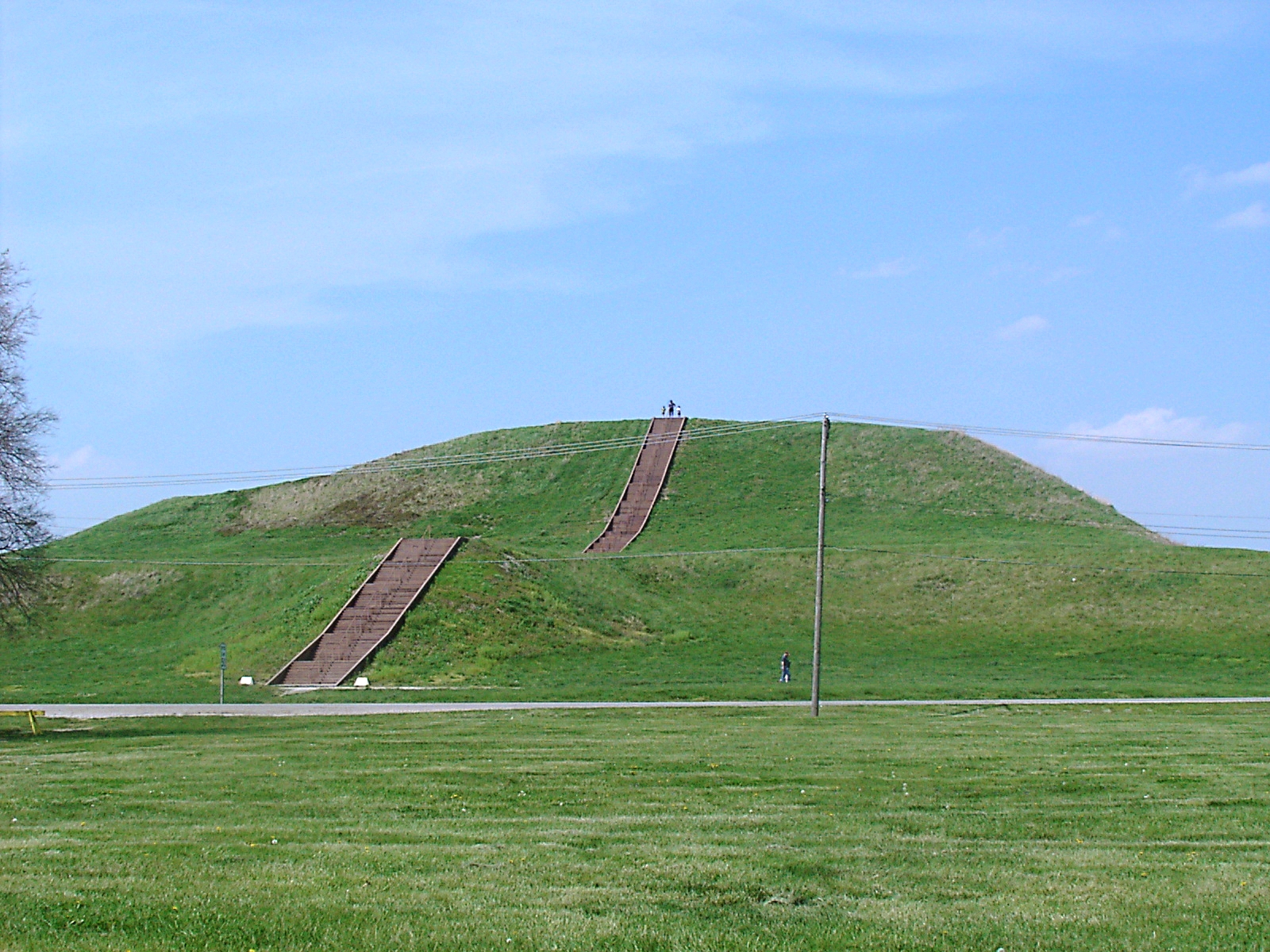
The best-known flat-topped pyramidal structure is Monks Mound at Cahokia, near present-day Collinsville, Illinois. This community was the center of the Mississippian culture. This mound appears to have been the main ceremonial and residential mound for the religious and political leaders; it is more than 100 feet (30 m) tall and is the largest pre-Columbian earthwork north of Mexico. This site had numerous mounds, some with conical or ridge tops, as well as palisaded stockades protecting the large settlement and elite quarter. At its maximum about 1150 CE, Cahokia was an urban settlement with 20,000–30,000 people.
Some effigy mounds were constructed in the shapes or outlines of culturally significant animals. The most famous effigy mound, Serpent Mound in southern Ohio, ranges from 1 foot (0.30 m) to just over 3 feet (0.91 m) tall, 20 feet (6.1 m) wide, more than 1,330 feet (410 m) long, and shaped as an undulating serpent.
Between 1540 and 1542, Hernando de Soto, the Spanish conquistador, traversed what became the southeastern United States. There he encountered many different mound-builder peoples who were perhaps descendants of the great Mississippian culture. De Soto observed people living in fortified towns with lofty mounds and plazas and surmised that many of the mounds served as foundations for priestly temples. Near present-day Augusta, Georgia, de Soto encountered a group ruled by a queen, Cofitachequi. She told him that the mounds within her territory served as burial places for nobles.
The artist Jacques le Moyne, who had accompanied French settlers to northeastern Florida during the 1560s, likewise noted Native American groups using existing mounds and constructing others. He produced a series of watercolor paintings depicting scenes of native life. Although most of his paintings have been lost, some engravings were copied from the originals and published in 1591 by a Flemish company. Among these is a depiction of the burial of an aboriginal Floridian tribal chief, an occasion of great mourning and ceremony. The original caption reads:
Hub AI
Mound Builders AI simulator
(@Mound Builders_simulator)
Mound Builders
Many pre-Columbian cultures in North America were collectively termed "Mound Builders", but the term has no formal meaning. It does not refer to specific people or archaeological culture but refers to the characteristic mound earthworks that indigenous peoples erected for an extended period of more than 5,000 years. The "Mound Builder" cultures span the period of roughly 3500 BCE (the construction of Watson Brake) to the 16th century CE, including the Archaic period (Horr's Island), Woodland period (Caloosahatchee, Adena and Hopewell cultures), and Mississippian period. Geographically, the cultures were present in the region of the Great Lakes, the Ohio River Valley, Florida, and the Mississippi River Valley and its tributary waters. Outlying mounds exist in South Carolina at Santee and in North Carolina at Town Creek.
The first mound building was an early marker of political and social complexity among the cultures in the Eastern United States. Watson Brake in Louisiana, constructed about 3500 BCE during the Middle Archaic period, is the oldest known and dated mound complex in North America. It is one of 11 mound complexes from this period found in the Lower Mississippi Valley. These cultures generally had developed hierarchical societies that had an elite. These commanded hundreds or even thousands of workers to dig up tons of earth with the hand tools available, move the soil long distances, and finally, workers to create the shape with layers of soil as directed by the builders. However early mounds found in Louisiana preceded such cultures and were products of hunter-gatherer cultures.
From about 800 CE, the mound-building cultures were dominated by the Mississippian culture, a large archaeological horizon, whose youngest descendants, the Plaquemine culture and the Fort Ancient culture, were still active at the time of European contact in the 16th century. One tribe of the Fort Ancient culture has been identified as the Mosopelea, presumably of southeast Ohio, who spoke an Ohio Valley Siouan language. The bearers of the Plaquemine culture were presumably speakers of the Natchez language isolate. The first written description of these cultures were made by members of Spanish explorer Hernando de Soto's expedition, between 1540 and 1542.
The namesake cultural trait of the Mound Builders was the building of mounds and other earthworks. These burial and ceremonial structures were typically flat-topped pyramids or platform mounds, flat-topped or rounded cones, elongated ridges, and sometimes a variety of other forms. They were generally built as part of complex villages. The early earthworks built in Louisiana around 3500 BCE are the only ones known to have been built by a hunter-gatherer culture, rather than a more settled culture based on agricultural surpluses.
The best-known flat-topped pyramidal structure is Monks Mound at Cahokia, near present-day Collinsville, Illinois. This community was the center of the Mississippian culture. This mound appears to have been the main ceremonial and residential mound for the religious and political leaders; it is more than 100 feet (30 m) tall and is the largest pre-Columbian earthwork north of Mexico. This site had numerous mounds, some with conical or ridge tops, as well as palisaded stockades protecting the large settlement and elite quarter. At its maximum about 1150 CE, Cahokia was an urban settlement with 20,000–30,000 people.
Some effigy mounds were constructed in the shapes or outlines of culturally significant animals. The most famous effigy mound, Serpent Mound in southern Ohio, ranges from 1 foot (0.30 m) to just over 3 feet (0.91 m) tall, 20 feet (6.1 m) wide, more than 1,330 feet (410 m) long, and shaped as an undulating serpent.
Between 1540 and 1542, Hernando de Soto, the Spanish conquistador, traversed what became the southeastern United States. There he encountered many different mound-builder peoples who were perhaps descendants of the great Mississippian culture. De Soto observed people living in fortified towns with lofty mounds and plazas and surmised that many of the mounds served as foundations for priestly temples. Near present-day Augusta, Georgia, de Soto encountered a group ruled by a queen, Cofitachequi. She told him that the mounds within her territory served as burial places for nobles.
The artist Jacques le Moyne, who had accompanied French settlers to northeastern Florida during the 1560s, likewise noted Native American groups using existing mounds and constructing others. He produced a series of watercolor paintings depicting scenes of native life. Although most of his paintings have been lost, some engravings were copied from the originals and published in 1591 by a Flemish company. Among these is a depiction of the burial of an aboriginal Floridian tribal chief, an occasion of great mourning and ceremony. The original caption reads:
Recent media