Recent from talks
Nothing was collected or created yet.
Monks Mound
View on Wikipedia
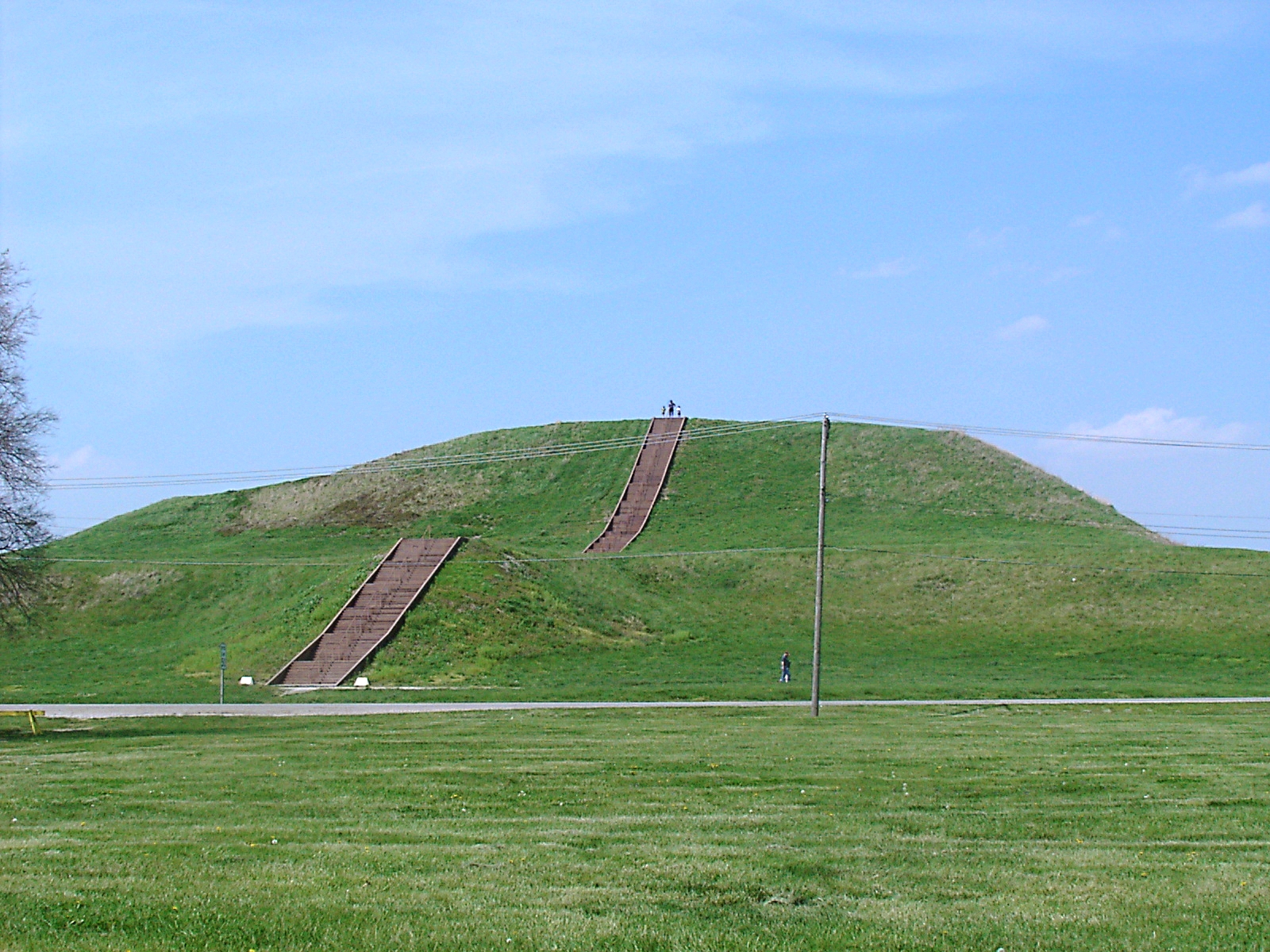
Monks Mound is the largest Pre-Columbian earthwork in the Americas and the largest pyramid north of Mesoamerica. The beginning of its construction dates from 900 to 955 CE. Located at the Cahokia Mounds UNESCO World Heritage Site near Collinsville, Illinois, the mound size was calculated in 1988 as about 100 feet (30 m) high, 955 feet (291 m) long including the access ramp at the southern end, and 775 feet (236 m) wide.[1] This makes Monks Mound roughly the same size at its base as the Great Pyramid of Giza (13.1 acres / 5.3 hectares). The perimeter of its base is larger than the Pyramid of the Sun at Teotihuacan. As a platform mound, the earthwork supported a wooden structure on the summit.
Key Information
Unlike Egyptian pyramids which were built of stone, the platform mound was constructed almost entirely of layers of basket-transported soil and clay. Because of this construction and its flattened top, over the years, it has retained rainwater within the structure. This has caused slumping, the avalanche-like sliding of large sections of the sides at the highest part of the mound. Its designed dimensions would have been significantly smaller than its present extent, but recent excavations have revealed that slumping was a problem even while the mound was being made.[2]
Construction and abandonment
[edit]
Construction of Monks Mound by the Mississippian culture began about 900–950 CE, on a site that had already been occupied by buildings. The original concept seems to have been a much smaller mound, now buried deep within the northern end of the present structure. At the northern end of the summit plateau, as finally completed around 1100 CE, is an area raised slightly higher still, on which was placed a building over 100 ft (30 m) long, the largest in the entire Cahokia Mounds urban zone. Excavations on the southwest corner found that several large ceremonial buildings had burned around 1150 CE.[3]
Botanical remains from Monks Mound suggest it was built much more quickly than previously thought, perhaps on the order of several consecutive decades, providing an alternative view of its construction history.[4] Deep excavations in 2007 confirmed findings from earlier test borings, that several types of earth and clay from different sources had been used successively.[2] Study of various sites suggests that the stability of the mound was improved by the incorporation of bulwarks, some made of clay, others of sods from the Mississippi flood-plain, which permitted steeper slopes than the use of earth alone.[5] The structure rises in four terraces to a height of 100 feet (30 m) with a rectangular base covering nearly 15 acres (6.1 ha) and containing 22 million cubic feet of adobe, carried basket by basket to the site.[6]
The most recent section of the mound, added some time before 1200 CE, is the lower terrace at the south end, which was added after the northern end had reached its full height. It may partly have been intended to help minimize the slumping which by then was already under way. Today, the western half of the summit plateau is significantly lower than the eastern; this is the result of massive slumping, beginning about 1200 CE.[7] This also caused the west end of the big building to collapse. It may have led to the abandonment of the mound's high status, following which various wooden buildings were erected on the south terrace, and garbage was dumped at the foot of the mound. By about 1300, the urban society at Cahokia Mounds was in serious decline. When the eastern side of the mound started to suffer serious slumping, it was not repaired.[8]
European settlers
[edit]There is no evidence of significant Native American settlement in the Cahokia Mounds urban area for hundreds of years after about 1400 CE. In 1735, French missionaries built a chapel at the west end of the south terrace of the mound. The River L'Abbe Mission served a small Illiniwek community, until they were forced to abandon the area by rival tribes about 1752. In 1776, during the American Revolutionary War, a trading post called the Cantine was established next to the mound (by then known as the Great Nobb). It lasted only until 1784.
In the early 19th century, the land was claimed by people of French descent, and Nicholas Jarrot had a deed for most of it. He donated some to a small group of French Trappist monks, who settled on one of the smaller mounds from 1809. They took advantage of the big mound's terraces to grow produce, which was elevated above the danger of flooding: wheat on the upper levels, garden produce on the south terrace. During their short stay in the area, which lasted until 1813, Henry Brackenridge visited the site and published the first detailed description of the largest mound. He named it Monks Mound.
In 1831 T. Amos Hill bought the plot including the Mound. He built a house on the upper terrace, and sank a well. This work revealed various archaeological remains, including human bones.[9]
Archaeology
[edit]Thomas I. Ramey, who bought the site in 1864, began an era of more responsible ownership, and encouraged archaeological investigation. Many artifacts were found at or near the surface. Ramey had a tunnel made nearly 30 m (98 ft) into the north face of the mound, but it revealed nothing of historic interest. By this time, people were beginning to consider the mound more within its context. A survey made for local dentist Dr. John R. Patrick in the 1880s marked the beginning of modern understanding of the Cahokia site as a whole, and its relationship to other sites in the area.[9]
Many archaeological investigations of the mound have taken place since then. One of the biggest began in the 1960s, when Nelson Reed, a local businessman and historian of native cultures, obtained permission to conduct excavations. He was trying to locate the high-status building (temple or palace) presumed to have stood at the peak of Monks Mound. By drilling cores at various points on the mound, his team revealed the various stages of its construction from the 10th to 12th centuries CE. Remains of a fairly recent house (presumably Hill's) were found, but no temple.
In 1970, Reed returned to work at the mound, and adopted a new strategy: scraping away the topsoil from several 5 m2 (54 sq ft) patches with a backhoe, to a depth of around 60 cm (24 in). This quickly revealed various features, including what appeared to be the outline of the temple. Further backhoe work in 1971 confirmed the shape of the presumed temple at over 30 m (98 ft) long, the largest building found at Cahokia. This technique was opposed by professional archaeologists because it destroyed several hundred years of stratification over most of the mound's summit, which was the evidence by which they could place and evaluate artifacts and construction. Reed's backhoe excavations revealed other significant features, such as a hole, which seemed to have been the socket for a post about three feet (one metre) in diameter. The dramatic finds encouraged the governor of Illinois to budget for an expansion of the Cahokia Mounds State Park.[10]
Preservation
[edit]From the time the original urban society collapsed, the great mound became overgrown with trees, the roots of which helped stabilize its steep slopes. In the 20th century, researchers removed the trees in the course of work at the mound and park preparation. Reduction of groundwater levels in the Mississippi floodplain during the 1950s caused the mound to dry out, damaging the clay layers within. When heavy rainfall occurred, it caused new slumping, starting about 1956. The increasingly violent weather of recent decades has exacerbated the problem.[11] In 1984-5 there were several slumps, and the state government brought in surplus soil to make repairs to the major scar on the eastern side. A decade later, there was further slumping on the western side, so irregular that repair was impractical. Drains were installed to reduce the effects of heavy rain. It was during this process that workers discovered a mass of stone deep within the mound.
The repairs of the 1980s and 1990s were only partly successful. In 2004-5 more serious slumping episodes occurred. These demonstrated that adding new earth to repair the major slump on the east side had been a mistake. Experts decided to take a new approach. In 2007, backhoes were used to dig out the entire mass of earth from this slump and another at the northwest corner, to a level beyond the internal slippage zone. Engineers created a series of anti-slip "steps" across the exposed face before the original earth (minus the imported repair material) was replaced at its original level. To avoid introducing water deep into the mound's interior, the work was carried out in high summer, and as quickly as possible. In parallel with the repair work, teams of archaeologists studied the evidence that was being revealed.[2] The eastern sliding zone penetrated more deeply within the mound than originally estimated, and the excavation had to be very large-[12] 50 feet (15 m) wide, to a height of 65 feet (20 m) above the mound base.[2] This heightened concerns about a conflict between conservation and archaeology.
See also
[edit]References
[edit]- ^ Skele, Mike "The Great Knob", Studies in Illinois Archaeology, no. 4], Springfield, IL, Illinois Historic Preservation Agency (1988) ISBN 0942579038, pp. 1–3, via archive.org
- ^ a b c d Iseminger, Bill et al. "Monks Mound (Mound 38) Projects 1997 – 2007 Archived 2005-01-08 at archive.today, from The Cahokian (various issues 1998–2007)- at cahokiamounds.com
- ^ Visitor's explanatory signpost, posted atop the Monks Mound by the Cahokia Mounds State Historic Site. For a photograph of the signpost, see minutes 3:28 in Cahokia Field Trip: The Mississippian Culture's First City on YouTube
- ^ Lopinot, Neal H.; Schilling, Timothy; Fritz, Gayle J.; Kelly, John E. (May 19, 2015). "Implications of Plant Remains from the East Face of Monks Mound". Midcontinental Journal of Archaeology. 40 (3): 209–230. doi:10.1179/2327427115y.0000000003. ISSN 0146-1109. S2CID 131309970.
- ^ S.C. Sherwood; Tristram .R. Kidder (March 2011). "The DaVincis of Dirt". Journal of Anthropological Archaeology. 30 (1): 69–87. doi:10.1016/j.jaa.2010.11.001.
- ^ Nash, Gary B. Red, White and Black: The Peoples of Early North America Los Angeles 2015. Chapter 1, p. 6
- ^ Rose, Mark (January–February 1999). "Sampling Monks Mound". Archaeology. 52 (1).
- ^ Young, Biloine W.; Fowler, Melvin L. (2000). Cahokia, the Great Native American Metropolis. Urbana, Illinois: University of Illinois Press. pp. 171–2. ISBN 0-252-06821-1.
- ^ a b John A. Walthall & Elizabeth D. Benchley, "The River L'Abbé Mission: A French Colonial Church for the Cahokia Illini on Monks Mound", Studies in Illinois Archaeology, No. 2, Springfield, IL: Historic Preservation Agency (1987), via archive.org
- ^ Young & Fowler, pp. 154–7
- ^ Skele, p98
- ^ Bostrom, Peter A. Mound repair: Cahokia Mounds (31 Jul 2007)- summary with photos
Further reading
[edit]- Price, Douglas T. and Gary M. Feinman. Images of the Past, 5th ed. New York: McGraw-Hill (2008) ISBN 978-0-07-340520-9. pp. 282–285.
- "The Trappists of Monk's Mound" — Illinois Catholic Historical Review, 8:106‑136 (1925)
External links
[edit]- Monks Mound (Mound 38), Cahokia Mounds State Historic Site website.
- UNESCO – Cahokia Mounds State Historic Site
- Cahokia Mounds Photo Gallery
- 2016 discussion of new research indicating construction in as little as twenty years
Monks Mound
View on GrokipediaPhysical Description
Dimensions and Structure
Monks Mound, the central feature of the Cahokia site, measures approximately 291 meters (955 feet) from north to south and 236 meters (775 feet) from east to west at its base, covering about 14 acres (5.7 hectares).[1][6] The structure rises to a height of around 30 meters (100 feet).[7][1] Its rectangular base and steep sides give it a stepped pyramid appearance when viewed from above, with the mound aligned roughly to the cardinal directions but oriented slightly off-axis at a heading of north 6° east.[1] The mound consists of four distinct terraces that ascend from the base, forming a flat-topped platform characteristic of Mississippian platform mounds.[7] The lowest terrace spans about 1.75 acres (0.71 hectares) and rises approximately 10.7 meters (35 feet), accessed via a prominent south-facing ramp that may have included log steps.[1] Higher terraces feature a bridge-like projection on the west side connecting to the third level, culminating in a broad, level summit on the fourth terrace, originally supporting wooden structures such as a temple or elite residence.[1] This terraced design emphasizes its role as a monumental platform, positioned at the heart of Cahokia's Grand Plaza.[7] As the largest prehistoric earthen mound in North America, Monks Mound's base is roughly equivalent in area to that of the Great Pyramid of Giza, though constructed entirely from earth rather than stone.[1][6] The perimeter of its base exceeds that of the Egyptian pyramid, highlighting the scale of indigenous engineering in the Americas.[6]Materials and Construction Techniques
Monks Mound was built primarily from layers of clay, silt, sand, and basket-loaded earth, without stone, mortar, or other binding agents, depending solely on the compaction of these soils for structural integrity. The earth was sourced from nearby borrow pits scattered across the Cahokia site, which provided the necessary variety of sediments to achieve the desired stability and volume. This reliance on local, unprocessed materials highlights the resourcefulness of the builders in utilizing the floodplain's natural deposits.[8][9][10] Construction techniques centered on manual labor, with workers transporting soil in woven baskets—an estimated 15 million basket-loads were required to form the mound's massive earthwork. To enhance durability, the builders applied clay veneers as protective outer layers and incorporated wooden retaining walls to contain the fill during buildup. Multi-stage layering was employed, where successive deposits of earth were added and compacted incrementally, allowing each level to settle and reducing the risk of slumping or erosion over time. Internal ramps facilitated the upward movement of materials, while careful attention to weight distribution ensured the broad base could support heavy wooden structures on the summit without collapse.[11][10][4] Archaeological evidence from soil cores extracted from the mound's base and slopes reveals a sophisticated composition, with alternating layers of coarse-grained silts and organically rich clays that promoted stability through varying rates of compaction and drainage. These cores also contain organic remains, such as plant materials and possible tool fragments, suggesting construction activities took place across wet and dry seasons to accommodate the labor-intensive process. This layered approach not only distributed loads effectively but also mitigated the challenges of building on a floodplain prone to moisture fluctuations.[9][12][10]Historical Context
Mississippian Culture Background
The Mississippian culture was a mound-building society that flourished from approximately 800 to 1600 CE across eastern North America, particularly along the Mississippi River Valley and into the southeastern United States, characterized by complex chiefdoms, intensive agriculture, and monumental earthworks.[13][14] This period marked a shift from earlier Woodland traditions to more hierarchical and urbanized communities, with maize cultivation supporting larger populations and enabling the construction of large-scale ceremonial centers.[15] Cahokia, located near modern-day Collinsville, Illinois, emerged as the preeminent urban center of this culture around 1050 CE, reaching a peak population of 10,000 to 20,000 inhabitants in its core area, making it the largest prehistoric city north of Mexico.[3][5] Mississippian society was organized hierarchically, with elites including chiefs and priests at the top, supported by warriors, artisans, and common laborers such as farmers who tended corn, beans, and squash fields.[15] Social status was reinforced through control of resources and rituals, as evidenced by elite burials containing prestige goods.[15] Mounds served as potent symbols of power and cosmology, functioning as platforms for elite residences, temples, ceremonies, and burials, thereby legitimizing authority and connecting the community to spiritual forces.[3][15] At Cahokia, Monks Mound stood as the central feature of a meticulously planned city spanning about 6 square miles, organized around expansive plazas, wooden stockades enclosing key areas, and over 120 satellite mounds arranged in a grid-like pattern to reflect symbolic alignments.[5] The site's vast trade networks extended across the continent, importing materials like copper from the Great Lakes region, marine shells from the Gulf Coast, and mica from the Appalachians, which were crafted into ornaments and tools that circulated among elites.[3] Monks Mound likely functioned as a temple platform for rituals linked to solar calendars and agricultural fertility, as suggested by the nearby Woodhenge—a circular arrangement of wooden posts that served as an astronomical observatory tracking solstices and equinoxes to time planting and harvesting ceremonies.[3][14] Associated artifacts, such as polished stone chunkey stones used in a ceremonial game symbolizing status and skill, and clay effigy pipes depicting human and animal figures, highlight the culture's artistic and spiritual traditions, often found in mound contexts.[3]Construction Timeline and Phases
The construction of Monks Mound began around 1050 CE during the Lohmann phase (ca. 1050–1100 CE) of Cahokia's development, marking the onset of significant monumental activity.[17] The major building phase occurred between 1050 and 1100 CE, during a period of rapid population growth and urban expansion at Cahokia.[18] Recent analyses, including core sampling from 2005 repairs and published in 2015, suggest the mound's primary structure was completed in as few as 20 years through continuous effort, with construction occurring in two rapid phases: the main mound in under 5 years and the final terrace added shortly after, challenging earlier estimates of prolonged incremental building.[19][17] The mound remained in active use until approximately 1250 CE, after which modifications ceased amid Cahokia's decline.[17] These phases reflect adaptive engineering, incorporating terraces to manage the mound's massive volume—estimated at approximately 730,000 cubic meters of earth—while accommodating potential elite structures on the summits.[17] The project demanded substantial seasonal labor from thousands of workers, potentially up to 5,000 individuals mobilized during peak efforts, drawn from Cahokia's burgeoning population that peaked at around 20,000 residents.[17] Earth for the mound was sourced primarily from local borrow pits in nearby bluffs and river valleys, transported by hand in baskets without wheeled technology. This construction coincided with Cahokia's population boom, facilitated by environmental adaptations such as intensified maize agriculture during a wetter climatic period from 1050–1100 CE, which supported the labor-intensive endeavor.[18]Post-Construction History
Abandonment and Pre-Columbian Legacy
The decline of Cahokia, centered on Monks Mound, commenced around 1200 CE, with the site experiencing full abandonment by approximately 1350 CE. This timeline aligns with a broader Mississippian cultural contraction, driven by multiple interconnected factors including the onset of the Little Ice Age around 1300 CE, which introduced severe droughts in the midcontinental United States, alongside resource depletion from centuries of intensive maize agriculture and monumental construction, and social upheaval manifested as political fragmentation and potential intergroup conflicts.[20][21][22] Archaeological evidence indicates that upon abandonment, Monks Mound retained its structural integrity, with no signs of deliberate dismantling or erosion damage, while the adjacent plazas and fields gradually reverted to natural vegetation cover, supporting interpretations of a protracted depopulation process rather than catastrophic events like warfare or invasion.[23][24] This gradual exodus is further evidenced by the absence of burn layers or mass destruction artifacts across the site, suggesting communities dispersed over generations in response to environmental and socioeconomic pressures.[21] Monks Mound's pre-Columbian legacy endured through the cultural continuity of descendant Dhegiha Siouan-speaking tribes, including the Osage and Quapaw, whose oral histories preserve accounts of ancestral migrations from the Cahokia region and venerate the earthworks as sacred manifestations of their forebears' spiritual and communal labor.[25][26] These traditions emphasize the mound's role in ancient rituals and cosmology, framing it as a enduring symbol of pre-contact Indigenous ingenuity and connection to the land.[27] Environmental proxies, such as pollen cores extracted from lakes adjacent to Cahokia, reveal a marked transition post-1300 CE from dominance of agricultural indicators like maize pollen—peaking during the site's occupation—to a resurgence of arboreal species such as oak and hickory, signifying widespread forest regrowth and the cessation of large-scale human land modification after abandonment.[28] This palynological shift underscores the site's return to pre-urban ecological states, with minimal agricultural disturbance persisting into the late 15th century.[29]European Settlement and Early Documentation
The Cahokia site, including Monks Mound, had long been abandoned by its Native American builders when the first Europeans arrived in the region during the late 17th century. French explorers and missionaries, establishing settlements along the Mississippi River, encountered the ancient earthen structures. In 1735, French missionaries established the River L'Abbe Mission on the south terrace of Monks Mound to serve a small community of Cahokia Illiniwek, building a chapel and village there that lasted until around 1750; this marked an early organized European use of the site, though broader documentation remained limited and often speculative regarding the mounds' origins.[30][31] By the early 19th century, American settlers had begun occupying the area, converting much of the surrounding landscape—including the flat summit of Monks Mound—into farmland, which initiated significant alterations to the site.[31] The mound acquired its modern name from a small community of French Trappist monks who arrived in 1809 and resided on a nearby smaller mound until 1813. These monks, fleeing political unrest in Europe, constructed a mill powered by a nearby stream and cultivated extensive gardens and orchards on the terraces of Monks Mound itself, though they did not build their living quarters there. Their brief presence marked one of the earliest organized European uses of the mound, highlighting its utility as elevated, fertile land amid the floodplain. After the monks departed due to harsh conditions and conflicts with local authorities, the property passed to American owners who continued agricultural activities.[1] European settlement profoundly impacted the physical integrity of Monks Mound and the broader Cahokia complex. Intensive plowing by farmers eroded the mound's surfaces and slopes, stripping away protective vegetative cover and accelerating soil loss over decades. Concurrently, the site's growing reputation as a curiosity drew early tourists, who frequently climbed the steep sides of Monks Mound for panoramic views of the Mississippi Valley, contributing to additional foot traffic and wear.[4] Initial European documentation emphasized the mound's scale and mystery, often through the lens of Romantic-era speculation. In 1811, traveler and writer Henry Marie Brackenridge visited the site and provided one of the earliest detailed accounts, describing Monks Mound as a "stupendous pile of earth" rising nearly 100 feet, with a base larger than the Great Pyramid of Giza, and estimating over 150 surrounding mounds arranged in geometric patterns. His observations, published in subsequent letters and journals, marveled at the engineering while positing it as evidence of a vanished, advanced civilization—possibly linked to ancient migrants from Asia or Europe—rather than recent Native American achievement, perpetuating the era's "Mound Builder" myth that denied indigenous capabilities.[32][2]Archaeological Investigations
Early 19th-20th Century Excavations
In the early 19th century, informal explorations of Monks Mound were conducted by local settlers and early antiquarians, who noted the mound's imposing scale and occasionally undertook small-scale digs to uncover artifacts, though these efforts were unsystematic and poorly documented.[32] A notable early observer was Henry Marie Brackenridge, who visited the site in 1811 and described Monks Mound as a massive earthen pyramid rivaling ancient structures, sparking wider interest in the region's prehistoric remains.[32] By the mid- to late 19th century, more structured surveys emerged, including those by the Bureau of American Ethnology under Cyrus Thomas in the 1880s. Thomas's team mapped Monks Mound in detail, measuring its height at approximately 100 feet and base dimensions exceeding 1,000 feet north-south, while collecting surface artifacts that linked the mound to Native American traditions.[32] His 1894 report decisively debunked prevailing myths attributing the mounds to lost civilizations or non-Native builders, instead demonstrating through comparative artifact analysis and site distributions that they were constructed by indigenous peoples ancestral to historic tribes.[33] The 20th century saw more organized archaeological projects at Monks Mound, beginning in the 1920s with excavations sponsored by the University of Illinois and the Illinois State Museum. Led by Warren K. Moorehead, these efforts included auger borings into the mound's north end and east slope in 1922, which penetrated up to 17.5 feet and revealed stratified layers of clay, sand, and midden deposits indicative of multiple construction terraces.[32] Further work in the 1920s and 1930s targeted adjacent areas, such as Mound 11 near Monks Mound's base, where trenching exposed post molds and structural remnants, while observations of the destruction of nearby Powell Mound (Mound 86) in 1930–1931 by Thorne Deuel recovered secondary burials with copper artifacts.[32] In the 1940s, the Civilian Conservation Corps (CCC), in collaboration with the Works Progress Administration, focused on stabilization to prevent erosion, during which crews uncovered evidence of earthen ramps on the south side, suggesting practical access routes for construction and use.[32] Key discoveries from these investigations included burials at the mound's base and surrounding vicinity, such as those in nearby Mound 66 (Harding Mound), where over 140 interments were found with accompanying artifacts like copper scales, shell beads, and chunky stones, indicating elite or ceremonial contexts.[32] Auger borings and test excavations also yielded evidence of wooden structures on the summit, including post holes and burned thatch remnants suggestive of large buildings or enclosures, while artifact assemblages—pottery sherds, flint tools, and shell ornaments—confirmed Monks Mound's role in Mississippian culture, with construction phases spanning circa A.D. 900–1400 based on stratigraphic correlations.[32] These early efforts were hampered by methodological limitations, including destructive trenching and borings that damaged intact deposits without precise stratigraphic controls or comprehensive recording.[32] Lacking modern dating methods like radiocarbon analysis, researchers relied on relative chronology from artifact styles, often prioritizing mound origins and sequences over long-term preservation, which resulted in incomplete data and the irreversible loss of features like parts of the ramps and terraces.[32]Modern Research and Technologies
Since the 1960s, archaeological research on Monks Mound has employed core sampling and geophysical surveys to delineate its construction history. Early investigations, such as solid-core drilling led by Nelson A. Reed and colleagues, initially suggested at least 14 distinct building stages spanning from around A.D. 800 to 1400.[34] However, more recent Bayesian modeling of radiocarbon dates has revised this timeline, indicating construction in two rapid phases starting no earlier than A.D. 1050 and completed by approximately A.D. 1150, likely within 20 years. These methods identified layered deposits of earth, clay, and stabilizing materials like limonite bands, providing evidence of incremental platform expansions that formed the mound's terraces and summit. Subsequent geophysical techniques, such as magnetic gradiometry and electrical resistivity in the 1990s and 2000s at adjacent areas like Ramey Field, mapped subsurface anomalies including borrow pits used for sourcing construction soils, enhancing understanding of the mound's resource logistics without extensive excavation.[36] Lidar mapping from 2005 to 2015, prompted by structural slumping on the mound's south side, uncovered hidden landscape features around Cahokia, including extensive borrow pits that supplied the estimated 22 million cubic feet of earth for Monks Mound.[19] High-resolution aerial lidar data, collected by institutions like the Illinois State Archaeological Survey, visualized low-relief depressions and ridges, confirming that soils were quarried from nearby wetlands and uplands, with some pits later refilled by community debris from feasting activities.[37] This non-invasive technology integrated with ground surveys to model the mound's integration into Cahokia's broader urban layout. More recent analyses, including a 2013 study by Timothy Schilling based on archaeomagnetic dating and plant remains from intact mound fills, support the rapid construction model for the mound's final form around A.D. 1100–1200.[38] Erosion pattern studies since 2018 have linked accelerated degradation on the mound's slopes to intensified rainfall and flooding from climate change, with models indicating high vulnerability for earthen structures like Monks Mound, potentially losing significant volume without intervention.[39] Additionally, ancient DNA extracted from human remains in nearby Cahokia burial mounds, such as Mound 72, shows mitochondrial haplogroups consistent with modern Native American populations, including descendants among tribes like the Osage and Illini, affirming cultural continuity from Mississippian builders to contemporary Indigenous groups.[40] Advanced technologies continue to drive insights into Monks Mound's fabrication. Geophysical surveys in the 2010s and 2020s, including ground-penetrating radar (GPR) at the broader Cahokia site, have enabled non-invasive imaging of subsurface features, with ongoing projects as of 2025 surveying the entire site for potential new data on the mound.[8] Isotopic analysis of soils from core samples has sourced construction materials to specific local geologies, such as loess deposits from the Mississippi floodplain, revealing how builders selected stable clays for durability despite the mound's suboptimal alluvial foundation.[10] In 2023, geophysical surveys detected a rebuilt circular structure on the southeastern extension of Monks Mound, suggesting additional ceremonial features integrated with the mound complex.[41] Ongoing scholarly debates center on Monks Mound's symbolic role, with some researchers proposing it functioned partly as an astronomical observatory aligned to solstices and cardinal directions, based on its orientation and proximity to wooden post circles interpreted as calendars.[42] This interpretation ties into broader Cahokia studies on social inequality, where mound construction demanded massive labor mobilization, evidencing hierarchical organization, and ecological impacts, as resource extraction for the mound contributed to regional deforestation and soil depletion around A.D. 1100.[43]Preservation and Management
Historical Protection Initiatives
In 1925, the State of Illinois acquired 144 acres of land encompassing Monks Mound and surrounding areas, establishing Cahokia Mounds State Historic Site to safeguard the prehistoric earthworks from further degradation and development. This initial purchase marked the beginning of organized state-level protection, transforming the site from private farmland—where plowing and quarrying had already caused significant erosion—into a dedicated public preserve managed for conservation and interpretation.[7][5] Subsequent federal recognitions bolstered these efforts, with Cahokia Mounds designated a National Historic Landmark in 1964, extending legal protections to additional state-owned lands and emphasizing its national significance as the largest pre-Columbian settlement north of Mexico. In the 1920s through 1940s, federal funding supported early stabilization measures, including vegetation planting and minor earthwork capping on select mounds to mitigate erosion from weather and foot traffic, though comprehensive restoration programs emerged later. The site's international stature was affirmed in 1982 when UNESCO inscribed Cahokia Mounds on the World Heritage List, recognizing its outstanding universal value and prompting enhanced preservation standards under the World Heritage Convention.[7][5] Management responsibilities have primarily rested with the Illinois Historic Preservation Agency (IHPA), established in 1985 and now integrated into the Illinois Department of Natural Resources (IDNR), which oversees daily operations, land acquisitions, and interpretive programs. Collaborative partnerships with Native American tribes, including the Osage Nation and Peoria Tribe of Indians of Oklahoma, have grown since the 1990s, involving consultations on repatriation under NAGPRA and cultural programming to honor descendant communities' perspectives in site stewardship.[44][45] The centennial of state protection was commemorated in June 2025 with events highlighting the ongoing land acquisition program, which has expanded the preserved core to over 2,200 acres encompassing 72 mounds, underscoring a century of incremental efforts to reclaim and protect the ancient urban landscape. Events included public programs and highlights of the land acquisition progress.[46][47]Current Challenges and Visitor Access
Monks Mound faces significant preservation challenges from climate change, particularly accelerated erosion caused by intensified rainfall and flooding. Recent studies indicate that the mound has experienced slumping and increased erosion due to more frequent severe spring floods in surrounding wetlands, exacerbating vulnerabilities in its earthen structure.[48] Intense rain events have contributed to ongoing degradation, with over 80% of Illinois' archaeological sites, including earthen mounds like Monks Mound, at risk of severe erosion.[39] Additional threats include natural and human-induced factors such as development pressures from urban encroachment and potential vandalism, which have historically damaged adjacent areas.[7] Flooding remains a persistent concern, compounded by flood control measures that could indirectly heighten development risks.[7] In response, management efforts emphasize proactive monitoring and stabilization. The site employs advanced technologies like unmanned aerial systems (UAS) with LiDAR for detailed surveys, including the creation of a 3D foundational model of Monks Mound to detect subsurface features and track changes.[49] Vegetation control targets deep-rooted plants that destabilize slopes and archaeological layers, as part of a broader long-term monitoring program outlined in the site's 2008 master management plan.[7] Tribal consultations play a key role, with ongoing NAGPRA initiatives involving descendant communities to develop strategies for repatriating human remains and associated funerary objects, ensuring culturally sensitive preservation.[44] A 2025 legislative effort, through the Cahokia Mounds Mississippian Culture Study Act (S.1516), seeks to conduct a special resources study for potential designation as a National Historical Park, which could enhance federal protections and funding; as of November 2025, the bill remains pending in the Senate Committee on Energy and Natural Resources.[50][51] Visitor access to Monks Mound remains a highlight, with a 156-step wooden stairway allowing ascent to the summit for panoramic views and interpretive signage.[52] The broader Cahokia Mounds site attracted approximately 202,000 visitors in 2024, reflecting a decline since the interpretive center's closure for major renovations in 2022.[53] The center, featuring exhibits on Mississippian culture, will remain closed for most of 2025 due to mechanical upgrades, including HVAC and fire suppression systems, limiting indoor educational resources during this period.[54] Grounds and trails, including access to Monks Mound, stay open daily from dawn to dusk, but restrictions apply during any erosion repair work or weather events to protect the structure.[54] Looking ahead, adaptation strategies focus on mitigating flooding through enhanced monitoring and potential infrastructure adjustments, as recommended in UNESCO assessments to safeguard against climate impacts.[7] Educational programs, informed by tribal perspectives, aim to integrate indigenous narratives into future interpretive efforts once the center reopens, promoting awareness of Monks Mound's cultural significance amid ongoing environmental threats.[44]References
- https://www.mpm.edu/research-collections/[anthropology](/page/Anthropology)/online-collections-research/aztalan-collection/middle
- https://www.[researchgate](/page/ResearchGate).net/publication/276330452_The_chronology_of_Monks_Mound