



Community hub
Recent from talks
Knowledge base stats:
Talk channels stats:
Members stats:
Mount Erebus disaster
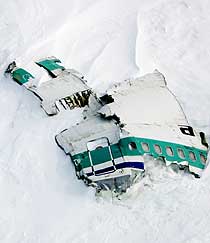
The Mount Erebus disaster occurred on 28 November 1979 when Air New Zealand Flight 901 (TE901) flew into Mount Erebus on Ross Island, Antarctica, killing all 237 passengers and 20 crew on board. Air New Zealand had been operating scheduled Antarctic sightseeing flights since 1977. This flight left Auckland Airport in the morning and was supposed to spend a few hours flying over the Antarctic continent, before returning to Auckland in the evening via Christchurch.
The initial investigation concluded the accident was caused primarily by pilot error, but public outcry led to the establishment of a Royal Commission of Inquiry into the crash. The commission, presided over by Justice Peter Mahon, concluded that the accident was primarily caused by a correction made to the coordinates of the flight path the night before the disaster, coupled with a failure to inform the flight crew of the change, with the result that the aircraft, instead of being directed by computer down McMurdo Sound (as the crew had been led to believe), was instead rerouted to a path toward Mount Erebus. Justice Mahon's report accused Air New Zealand of presenting "an orchestrated litany of lies", and this led to changes in senior management at the airline. The Judicial Committee of the Privy Council later ruled that the finding of a conspiracy was a breach of natural justice and not supported by the evidence.
The accident is the deadliest in the history of Air New Zealand, the deadliest aviation accident in Antarctica, and New Zealand's deadliest peacetime disaster.
Flight 901 was designed and marketed as a unique sightseeing experience, carrying an experienced Antarctic guide, who pointed out scenic features and landmarks using the aircraft's public-address system, while passengers enjoyed a low-flying sweep of McMurdo Sound. The flights left and returned to New Zealand the same day. The plane left Auckland International Airport at 8:00 am for Antarctica, and was scheduled to arrive back at Christchurch International Airport at 7:00 pm after flying 8,630 kilometres (5,360 mi). The aircraft would make a 45-minute stop at Christchurch for refuelling and a crew change, before flying the remaining 747 kilometres (464 mi) to Auckland, arriving at 9:00 pm. Tickets for the November 1979 flights cost NZ$359 per person (equivalent to $2527 in 2024). Dignitaries including Sir Edmund Hillary had acted as guides on previous flights. Hillary was scheduled to act as the guide for the fatal flight of 28 November 1979, but had to cancel because of other commitments. His long-time friend and climbing companion, Peter Mulgrew, stood in as guide.
The aircraft used for Antarctic flights were Air New Zealand's eight McDonnell Douglas DC-10-30 trijets. The aircraft on 28 November was registered ZK-NZP. The 182nd DC-10 to be built, and the fourth DC-10 to be introduced by Air New Zealand, ZK-NZP was handed over to the airline on 12 December 1974 at McDonnell Douglas's Long Beach plant. It had logged more than 20,700 flight hours prior to the crash. Captain Thomas James "Jim" Collins, age 45, was an experienced pilot who had accumulated 11,151 flight hours, including 2,872 hours in the DC-10. First Officer Gregory Mark "Greg" Cassin, age 37, had accumulated 7,934 flight hours, including 1,361 in the DC-10. Flight Engineer Gordon Barrett Brooks, age 43, had 10,886 flight hours, including 3,000 in the DC-10 (Brooks had also been Flight Engineer on the Air New Zealand flight involved in the Cessna 188 Pacific rescue in 1978). Also on board were First Officer Graham Neville Lucas, age 39, and Flight Engineer Nicholas John "Nick" Moloney, age 44. Flight Engineer Moloney had a total of 6,468 flight hours, including 1,700 in the DC-10.
All times are in New Zealand Standard Time (UTC+12), as at McMurdo Base. Mainland New Zealand was running on New Zealand Daylight Time (UTC+13) at the time of the crash.
Captain Collins and co-pilot Cassin had never flown to Antarctica before (while flight engineer Brooks had flown to Antarctica only once previously), but they were experienced pilots and were considered qualified for the flight. On 9 November 1979, 19 days before departure, the two pilots attended a briefing in which they were given a copy of the previous flight's flight plan.
The flight plan had been approved in 1977 by the Civil Aviation Division of the New Zealand Department of Transport and was along a track directly from Cape Hallett to the McMurdo non-directional beacon (NDB), which, coincidentally, entailed flying almost directly over the 3,794-metre (12,448 ft) peak of Mount Erebus. Due to a typing error in the coordinates when the route was computerised, however, the printout from Air New Zealand's ground computer system that was presented at the 9 November briefing corresponded to a southerly flight path down the middle of the wide McMurdo Sound, about 27 nautical miles (50 km; 31 mi) to the west of Mount Erebus. The majority of the previous 13 flights had also entered this flight plan's coordinates into their aircraft inertial navigational system and flown the McMurdo Sound route, unaware that the route flown did not correspond with the approved route.
Hub AI
Mount Erebus disaster AI simulator
(@Mount Erebus disaster_simulator)
Mount Erebus disaster
The Mount Erebus disaster occurred on 28 November 1979 when Air New Zealand Flight 901 (TE901) flew into Mount Erebus on Ross Island, Antarctica, killing all 237 passengers and 20 crew on board. Air New Zealand had been operating scheduled Antarctic sightseeing flights since 1977. This flight left Auckland Airport in the morning and was supposed to spend a few hours flying over the Antarctic continent, before returning to Auckland in the evening via Christchurch.
The initial investigation concluded the accident was caused primarily by pilot error, but public outcry led to the establishment of a Royal Commission of Inquiry into the crash. The commission, presided over by Justice Peter Mahon, concluded that the accident was primarily caused by a correction made to the coordinates of the flight path the night before the disaster, coupled with a failure to inform the flight crew of the change, with the result that the aircraft, instead of being directed by computer down McMurdo Sound (as the crew had been led to believe), was instead rerouted to a path toward Mount Erebus. Justice Mahon's report accused Air New Zealand of presenting "an orchestrated litany of lies", and this led to changes in senior management at the airline. The Judicial Committee of the Privy Council later ruled that the finding of a conspiracy was a breach of natural justice and not supported by the evidence.
The accident is the deadliest in the history of Air New Zealand, the deadliest aviation accident in Antarctica, and New Zealand's deadliest peacetime disaster.
Flight 901 was designed and marketed as a unique sightseeing experience, carrying an experienced Antarctic guide, who pointed out scenic features and landmarks using the aircraft's public-address system, while passengers enjoyed a low-flying sweep of McMurdo Sound. The flights left and returned to New Zealand the same day. The plane left Auckland International Airport at 8:00 am for Antarctica, and was scheduled to arrive back at Christchurch International Airport at 7:00 pm after flying 8,630 kilometres (5,360 mi). The aircraft would make a 45-minute stop at Christchurch for refuelling and a crew change, before flying the remaining 747 kilometres (464 mi) to Auckland, arriving at 9:00 pm. Tickets for the November 1979 flights cost NZ$359 per person (equivalent to $2527 in 2024). Dignitaries including Sir Edmund Hillary had acted as guides on previous flights. Hillary was scheduled to act as the guide for the fatal flight of 28 November 1979, but had to cancel because of other commitments. His long-time friend and climbing companion, Peter Mulgrew, stood in as guide.
The aircraft used for Antarctic flights were Air New Zealand's eight McDonnell Douglas DC-10-30 trijets. The aircraft on 28 November was registered ZK-NZP. The 182nd DC-10 to be built, and the fourth DC-10 to be introduced by Air New Zealand, ZK-NZP was handed over to the airline on 12 December 1974 at McDonnell Douglas's Long Beach plant. It had logged more than 20,700 flight hours prior to the crash. Captain Thomas James "Jim" Collins, age 45, was an experienced pilot who had accumulated 11,151 flight hours, including 2,872 hours in the DC-10. First Officer Gregory Mark "Greg" Cassin, age 37, had accumulated 7,934 flight hours, including 1,361 in the DC-10. Flight Engineer Gordon Barrett Brooks, age 43, had 10,886 flight hours, including 3,000 in the DC-10 (Brooks had also been Flight Engineer on the Air New Zealand flight involved in the Cessna 188 Pacific rescue in 1978). Also on board were First Officer Graham Neville Lucas, age 39, and Flight Engineer Nicholas John "Nick" Moloney, age 44. Flight Engineer Moloney had a total of 6,468 flight hours, including 1,700 in the DC-10.
All times are in New Zealand Standard Time (UTC+12), as at McMurdo Base. Mainland New Zealand was running on New Zealand Daylight Time (UTC+13) at the time of the crash.
Captain Collins and co-pilot Cassin had never flown to Antarctica before (while flight engineer Brooks had flown to Antarctica only once previously), but they were experienced pilots and were considered qualified for the flight. On 9 November 1979, 19 days before departure, the two pilots attended a briefing in which they were given a copy of the previous flight's flight plan.
The flight plan had been approved in 1977 by the Civil Aviation Division of the New Zealand Department of Transport and was along a track directly from Cape Hallett to the McMurdo non-directional beacon (NDB), which, coincidentally, entailed flying almost directly over the 3,794-metre (12,448 ft) peak of Mount Erebus. Due to a typing error in the coordinates when the route was computerised, however, the printout from Air New Zealand's ground computer system that was presented at the 9 November briefing corresponded to a southerly flight path down the middle of the wide McMurdo Sound, about 27 nautical miles (50 km; 31 mi) to the west of Mount Erebus. The majority of the previous 13 flights had also entered this flight plan's coordinates into their aircraft inertial navigational system and flown the McMurdo Sound route, unaware that the route flown did not correspond with the approved route.