



Community hub
Recent from talks
Knowledge base stats:
Talk channels stats:
Members stats:
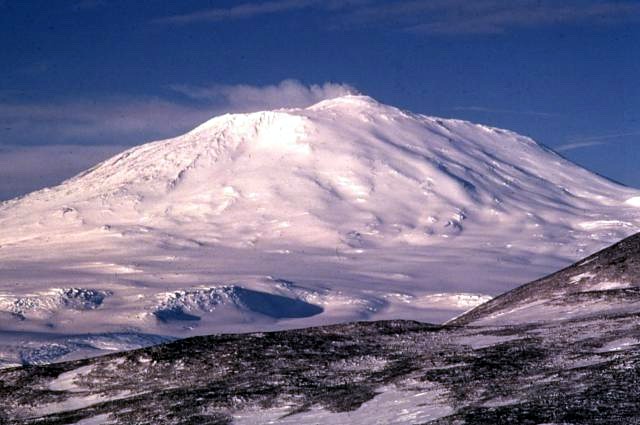
Mount Erebus
Mount Erebus (/ˈɛrɪbəs/) is the southernmost active volcano on Earth, located on Ross Island in the Ross Dependency in Antarctica. With a summit elevation of 3,792 metres (12,441 ft), it is the second most prominent mountain in Antarctica (after Mount Vinson) and the second-highest volcano in Antarctica (after the dormant Mount Sidley). It is the highest point on Ross Island, which is also home to three inactive volcanoes: Mount Terror, Mount Bird, and Mount Terra Nova. It makes Ross Island the sixth-highest island on Earth.
The mountain was named by Captain James Clark Ross in 1841 for his ship, HMS Erebus. The volcano has been active for around 1.3 million years and has a long-lived lava lake in its inner summit crater that has been present since at least the early 1970s. On 28 November 1979, Air New Zealand Flight 901 crashed on Mount Erebus, killing all 257 people on board.
Mount Erebus is the world's southernmost active volcano. It is the current eruptive centre of the Erebus hotspot. The summit contains a persistent convecting phonolitic lava lake, one of five long-lasting lava lakes on Earth. Characteristic eruptive activity consists of Strombolian eruptions from the lava lake or from one of several subsidiary vents, all within the volcano's inner crater. The volcano is scientifically remarkable in that its relatively low-level and unusually persistent eruptive activity enables long-term volcanological study of a Strombolian eruptive system very close (hundreds of metres) to the active vents, a characteristic shared with only a few volcanoes on Earth, such as Stromboli in Italy. Scientific study of the volcano is also facilitated by its proximity to McMurdo Station (U.S.) and Scott Base (New Zealand), both sited on the same island around 35 km away.
Mount Erebus is classified as a polygenetic stratovolcano. The bottom half of the volcano is a shield and the top half is a stratocone. The composition of the current eruptive products of Erebus are anorthoclase-porphyritic tephritic phonolite and phonolite, which are the bulk of exposed lava flow on the volcano. The oldest eruptive products consist of relatively undifferentiated and nonviscous basanite lavas that form the low broad platform shield of Erebus. Slightly younger basanite and phonotephrite lavas crop out on Fang Ridge – an eroded remnant of an early Erebus volcano – and at other isolated locations on the flanks of Erebus. Erebus is the world's only presently erupting phonolite volcano.
Lava flows of more viscous phonotephrite and trachyte erupted after the basanite. The upper slopes of Mount Erebus are dominated by steeply dipping (about 30°) tephritic phonolite lava flows with large-scale flow levees. A conspicuous break in slope around 3,200 m ASL calls attention to a summit plateau representing a caldera. The summit caldera was created by an explosive VEI-6 eruption that occurred 18,000 ± 7,000 years ago. It is filled with small volume tephritic phonolite and phonolite lava flows. In the center of the summit caldera is a small, steep-sided cone composed primarily of decomposed lava bombs and a large deposit of anorthoclase crystals known as Erebus crystals. The active lava lake in this summit cone undergoes continuous degassing.
Microscopic gold particles have been found up to 1000 kilometres from Mount Erebus, ranging in size up to 60 micrometres. A 1991 paper shows that these particles condense from the volcano's emissions that include 80 grams of gold vapor daily. This amount of gold vapor is low compared to other volcanoes, but the condensation from vapor into gold particles is the first ever documented.
Researchers spent more than three months during the 2007–08 field season installing an atypically dense array of seismometers around Mount Erebus to listen to waves of energy generated by small, controlled blasts from explosives they buried along its flanks and perimeter, and to record scattered seismic signals generated by lava lake eruptions and local ice quakes. By studying the refracted and scattered seismic waves, the scientists produced an image of the uppermost (top few km) of the volcano to understand the geometry of its "plumbing" and how the magma rises to the lava lake. These results demonstrated a complex upper-volcano conduit system with appreciable upper-volcano magma storage to the northwest of the lava lake at depths hundreds of meters below the surface.
Mount Erebus is notable for its numerous ice fumaroles – ice towers that form around gases that escape from vents in the surface. The ice caves associated with the fumaroles are dark, in polar alpine environments starved in organics and with oxygenated hydrothermal circulation in highly reducing host rock. The life is sparse, mainly bacteria and fungi. This makes it of special interest for studying oligotrophs – organisms that can survive on minimal amounts of resources.
Hub AI
Mount Erebus AI simulator
(@Mount Erebus_simulator)
Mount Erebus
Mount Erebus (/ˈɛrɪbəs/) is the southernmost active volcano on Earth, located on Ross Island in the Ross Dependency in Antarctica. With a summit elevation of 3,792 metres (12,441 ft), it is the second most prominent mountain in Antarctica (after Mount Vinson) and the second-highest volcano in Antarctica (after the dormant Mount Sidley). It is the highest point on Ross Island, which is also home to three inactive volcanoes: Mount Terror, Mount Bird, and Mount Terra Nova. It makes Ross Island the sixth-highest island on Earth.
The mountain was named by Captain James Clark Ross in 1841 for his ship, HMS Erebus. The volcano has been active for around 1.3 million years and has a long-lived lava lake in its inner summit crater that has been present since at least the early 1970s. On 28 November 1979, Air New Zealand Flight 901 crashed on Mount Erebus, killing all 257 people on board.
Mount Erebus is the world's southernmost active volcano. It is the current eruptive centre of the Erebus hotspot. The summit contains a persistent convecting phonolitic lava lake, one of five long-lasting lava lakes on Earth. Characteristic eruptive activity consists of Strombolian eruptions from the lava lake or from one of several subsidiary vents, all within the volcano's inner crater. The volcano is scientifically remarkable in that its relatively low-level and unusually persistent eruptive activity enables long-term volcanological study of a Strombolian eruptive system very close (hundreds of metres) to the active vents, a characteristic shared with only a few volcanoes on Earth, such as Stromboli in Italy. Scientific study of the volcano is also facilitated by its proximity to McMurdo Station (U.S.) and Scott Base (New Zealand), both sited on the same island around 35 km away.
Mount Erebus is classified as a polygenetic stratovolcano. The bottom half of the volcano is a shield and the top half is a stratocone. The composition of the current eruptive products of Erebus are anorthoclase-porphyritic tephritic phonolite and phonolite, which are the bulk of exposed lava flow on the volcano. The oldest eruptive products consist of relatively undifferentiated and nonviscous basanite lavas that form the low broad platform shield of Erebus. Slightly younger basanite and phonotephrite lavas crop out on Fang Ridge – an eroded remnant of an early Erebus volcano – and at other isolated locations on the flanks of Erebus. Erebus is the world's only presently erupting phonolite volcano.
Lava flows of more viscous phonotephrite and trachyte erupted after the basanite. The upper slopes of Mount Erebus are dominated by steeply dipping (about 30°) tephritic phonolite lava flows with large-scale flow levees. A conspicuous break in slope around 3,200 m ASL calls attention to a summit plateau representing a caldera. The summit caldera was created by an explosive VEI-6 eruption that occurred 18,000 ± 7,000 years ago. It is filled with small volume tephritic phonolite and phonolite lava flows. In the center of the summit caldera is a small, steep-sided cone composed primarily of decomposed lava bombs and a large deposit of anorthoclase crystals known as Erebus crystals. The active lava lake in this summit cone undergoes continuous degassing.
Microscopic gold particles have been found up to 1000 kilometres from Mount Erebus, ranging in size up to 60 micrometres. A 1991 paper shows that these particles condense from the volcano's emissions that include 80 grams of gold vapor daily. This amount of gold vapor is low compared to other volcanoes, but the condensation from vapor into gold particles is the first ever documented.
Researchers spent more than three months during the 2007–08 field season installing an atypically dense array of seismometers around Mount Erebus to listen to waves of energy generated by small, controlled blasts from explosives they buried along its flanks and perimeter, and to record scattered seismic signals generated by lava lake eruptions and local ice quakes. By studying the refracted and scattered seismic waves, the scientists produced an image of the uppermost (top few km) of the volcano to understand the geometry of its "plumbing" and how the magma rises to the lava lake. These results demonstrated a complex upper-volcano conduit system with appreciable upper-volcano magma storage to the northwest of the lava lake at depths hundreds of meters below the surface.
Mount Erebus is notable for its numerous ice fumaroles – ice towers that form around gases that escape from vents in the surface. The ice caves associated with the fumaroles are dark, in polar alpine environments starved in organics and with oxygenated hydrothermal circulation in highly reducing host rock. The life is sparse, mainly bacteria and fungi. This makes it of special interest for studying oligotrophs – organisms that can survive on minimal amounts of resources.