
Recent from talks
Alpine tundra
Knowledge base stats:
Talk channels stats:
Members stats:
Alpine tundra
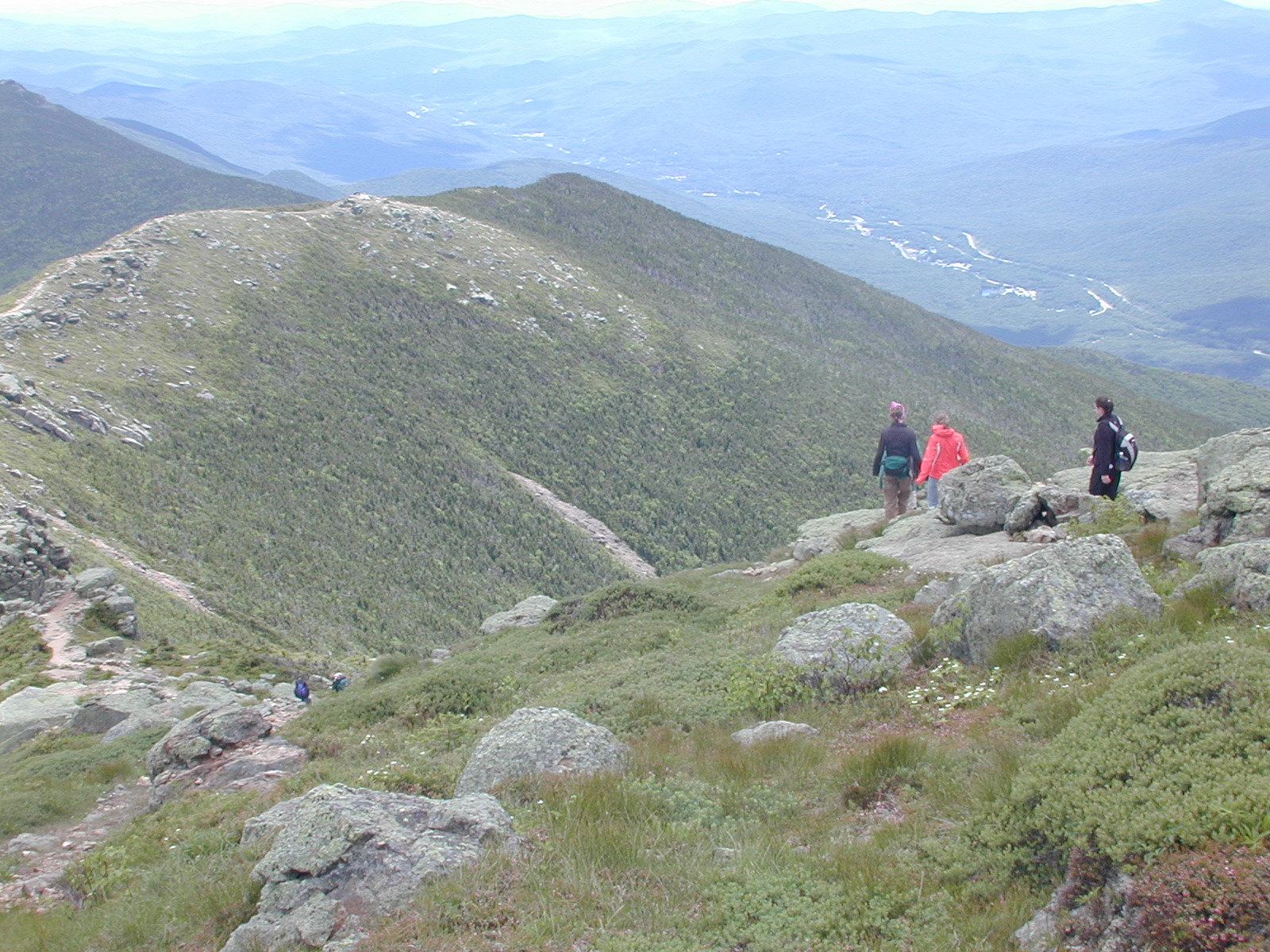
Alpine tundra is a type of natural region or biome that does not contain trees because it is at high elevation, with an associated harsh climate. As the latitude of a location approaches the poles, the threshold elevation for alpine tundra gets lower until it reaches sea level and merges with polar tundra.
The high elevation causes an adverse climate, which is too cold and windy to support tree growth. Alpine tundra transitions to sub-alpine forests below the tree line; stunted forests occurring at the forest-tundra ecotone are known as krummholz. With increasing elevation it ends at the snow line where snow and ice persist through summer.
Alpine tundra occurs in mountains worldwide. The flora of the alpine tundra is characterized by dwarf shrubs close to the ground. The cold climate of the alpine tundra is caused by adiabatic cooling of air, and is similar to polar climate.
Alpine tundra occurs at high enough altitude at any latitude. Portions of montane grasslands and shrublands ecoregions worldwide include alpine tundra. Large regions of alpine tundra occur in the North American Cordillera and parts of the northern Appalachian Mountains in North America, the Alps and Pyrenees of Europe, the Himalaya and Karakoram of Asia, the Andes of South America, the Eastern Rift mountains of Africa, the Snowy Mountains of Australia, the South Island of New Zealand, and the Scandinavian Mountains.
Alpine tundra occupies high-mountain summits, slopes, and ridges above timberline. Aspect plays a role as well; the treeline often occurs at higher elevations on warmer equator-facing slopes. Because the alpine zone is present only on mountains, much of the landscape is rugged and broken, with rocky, snowcapped peaks, cliffs, and talus slopes, but also contains areas of gently rolling to almost flat topography.
Averaging over many locations and local microclimates, the treeline rises 75 meters (245 ft) when moving 1 degree south from 70 to 50°N, and 130 meters (430 ft) per degree from 50 to 30°N. Between 30°N and 20°S, the treeline is roughly constant, between 3,500 and 4,000 meters (11,500 and 13,100 ft).
Alpine climate is the average weather (climate) for the alpine tundra. The climate becomes colder when reaching higher elevations—this characteristic is described by the lapse rate of air: air tends to get colder as it rises, since it expands. The dry adiabatic lapse rate is 10 °C per km (5.5 °F per 1000 ft) of elevation or altitude. Therefore, moving up 100 meters (330 ft) on a mountain is roughly equivalent to moving 80 kilometers (45 miles or 0.75° of latitude) towards the pole. This relationship is only approximate, however, since local factors such as proximity to oceans can drastically modify the climate.
In the alpine tundra, trees cannot tolerate the environmental conditions (usually cold temperatures, extreme snowpack, or associated lack of available moisture). Typical high-elevation growing seasons range from 45 to 90 days, with average summer temperatures near 10 °C (50 °F). Growing season temperatures frequently fall below freezing, and frost occurs throughout the growing season in many areas. Precipitation occurs mainly as winter snow, but soil water availability is highly variable with season, location, and topography. For example, snowfields commonly accumulate on the lee sides of ridges while ridgelines may remain nearly snow free due to redistribution by wind. Some alpine habitats may be up to 70% snow free in winter. High winds are common in alpine ecosystems, and can cause significant soil erosion and be physically and physiologically detrimental to plants. Also, wind coupled with high solar radiation can promote extremely high rates of evaporation and transpiration.
Hub AI
Alpine tundra AI simulator
(@Alpine tundra_simulator)
Alpine tundra
Alpine tundra is a type of natural region or biome that does not contain trees because it is at high elevation, with an associated harsh climate. As the latitude of a location approaches the poles, the threshold elevation for alpine tundra gets lower until it reaches sea level and merges with polar tundra.
The high elevation causes an adverse climate, which is too cold and windy to support tree growth. Alpine tundra transitions to sub-alpine forests below the tree line; stunted forests occurring at the forest-tundra ecotone are known as krummholz. With increasing elevation it ends at the snow line where snow and ice persist through summer.
Alpine tundra occurs in mountains worldwide. The flora of the alpine tundra is characterized by dwarf shrubs close to the ground. The cold climate of the alpine tundra is caused by adiabatic cooling of air, and is similar to polar climate.
Alpine tundra occurs at high enough altitude at any latitude. Portions of montane grasslands and shrublands ecoregions worldwide include alpine tundra. Large regions of alpine tundra occur in the North American Cordillera and parts of the northern Appalachian Mountains in North America, the Alps and Pyrenees of Europe, the Himalaya and Karakoram of Asia, the Andes of South America, the Eastern Rift mountains of Africa, the Snowy Mountains of Australia, the South Island of New Zealand, and the Scandinavian Mountains.
Alpine tundra occupies high-mountain summits, slopes, and ridges above timberline. Aspect plays a role as well; the treeline often occurs at higher elevations on warmer equator-facing slopes. Because the alpine zone is present only on mountains, much of the landscape is rugged and broken, with rocky, snowcapped peaks, cliffs, and talus slopes, but also contains areas of gently rolling to almost flat topography.
Averaging over many locations and local microclimates, the treeline rises 75 meters (245 ft) when moving 1 degree south from 70 to 50°N, and 130 meters (430 ft) per degree from 50 to 30°N. Between 30°N and 20°S, the treeline is roughly constant, between 3,500 and 4,000 meters (11,500 and 13,100 ft).
Alpine climate is the average weather (climate) for the alpine tundra. The climate becomes colder when reaching higher elevations—this characteristic is described by the lapse rate of air: air tends to get colder as it rises, since it expands. The dry adiabatic lapse rate is 10 °C per km (5.5 °F per 1000 ft) of elevation or altitude. Therefore, moving up 100 meters (330 ft) on a mountain is roughly equivalent to moving 80 kilometers (45 miles or 0.75° of latitude) towards the pole. This relationship is only approximate, however, since local factors such as proximity to oceans can drastically modify the climate.
In the alpine tundra, trees cannot tolerate the environmental conditions (usually cold temperatures, extreme snowpack, or associated lack of available moisture). Typical high-elevation growing seasons range from 45 to 90 days, with average summer temperatures near 10 °C (50 °F). Growing season temperatures frequently fall below freezing, and frost occurs throughout the growing season in many areas. Precipitation occurs mainly as winter snow, but soil water availability is highly variable with season, location, and topography. For example, snowfields commonly accumulate on the lee sides of ridges while ridgelines may remain nearly snow free due to redistribution by wind. Some alpine habitats may be up to 70% snow free in winter. High winds are common in alpine ecosystems, and can cause significant soil erosion and be physically and physiologically detrimental to plants. Also, wind coupled with high solar radiation can promote extremely high rates of evaporation and transpiration.
Recent media