



Community hub
Recent from talks
Contribute something to knowledge base
Content stats: 0 posts, 0 articles, 1 media, 0 notes
Members stats: 0 subscribers, 0 contributors, 0 moderators, 0 supporters
Subscribers
Supporters
Contributors
Moderators
Hub AI
Karakoram AI simulator
(@Karakoram_simulator)
Hub AI
Karakoram AI simulator
(@Karakoram_simulator)
Karakoram
The Karakoram (/ˌkɑːrəˈkɔːrəm, ˌkær-/) is a mountain range in the Kashmir region spanning the border of Pakistan, China, and India, with the northwestern extremity of the range extending to Afghanistan and Tajikistan. Most of the Karakoram mountain range is located within Pakistan's Gilgit-Baltistan region, the northern subdivision of Kashmir.
The mountain range begins in the Wakhan Corridor in Afghanistan in the west, encompasses the majority of Gilgit-Baltistan, controlled by Pakistan, and then extends into Ladakh, controlled by India, and Aksai Chin, controlled by China. It is part of the larger Trans-Himalayan mountain ranges.
The Karakoram is the second-highest mountain range on Earth and part of a complex of ranges that includes the Pamir Mountains, Hindu Kush, and the Indian Himalayas. The range contains eighteen summits higher than 7,500 m (24,600 ft) in elevation, with four above 8,000 m (26,000 ft): K2 (8,611 m (28,251 ft) AMSL) (the highest peak in the Karakorum and second-highest on Earth), Gasherbrum I, Broad Peak, and Gasherbrum II.
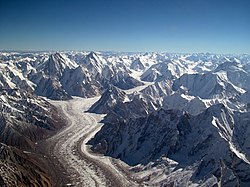
The range is about 500 km (311 mi) in length and is the most glaciated place on Earth outside the polar regions. The Siachen Glacier (76 km (47 mi) long) and Biafo Glacier (63 km (39 mi) long) are the second- and third-longest glaciers outside the polar regions.
The Karakoram is bounded on the east by the Aksai Chin plateau, on the northeast by the edge of the Tibetan Plateau, and on the north by the river valleys of the Yarkand and Karakash rivers, beyond which lie the Kunlun Mountains. At the northwest corner are the Pamir Mountains. The southern boundary of the Karakoram is formed, west to east, by the Gilgit, Indus, and Shyok rivers, which separate the range from the northwestern end of the Himalaya range proper. These rivers flow northwest before making an abrupt turn southwestward towards the plains of Pakistan. Roughly in the middle of the Karakoram range is the Karakoram Pass, which was part of a historic trade route between Ladakh and Yarkand that is now inactive.
The Tashkurghan National Nature Reserve and the Pamir Wetlands National Nature Reserve in the Karalorun and Pamir mountains were nominated for inclusion in UNESCO in 2010 by the National Commission of the People's Republic of China for UNESCO and have been tentatively added to the list.
Karakoram is a Turkic term meaning black gravel. The Central Asian traders originally applied the name to the Karakoram Pass. Early European travelers, including William Moorcroft and George Hayward, started using the term for the range of mountains west of the pass, although they also used the term Muztagh (meaning, "Ice Mountain") for the range now known as Karakoram. Later terminology was influenced by the Survey of India, whose surveyor, Thomas Montgomerie, in the 1850s, gave the labels K1 to K6 (K for Karakoram) to six high mountains visible from his station at Mount Haramukh in Kashmir Valley, codes extended further up to more than thirty.
In traditional Indian geography, the mountains were known as Krishnagiri (black mountains), Kanhagiri, and Kanheri.
Karakoram
The Karakoram (/ˌkɑːrəˈkɔːrəm, ˌkær-/) is a mountain range in the Kashmir region spanning the border of Pakistan, China, and India, with the northwestern extremity of the range extending to Afghanistan and Tajikistan. Most of the Karakoram mountain range is located within Pakistan's Gilgit-Baltistan region, the northern subdivision of Kashmir.
The mountain range begins in the Wakhan Corridor in Afghanistan in the west, encompasses the majority of Gilgit-Baltistan, controlled by Pakistan, and then extends into Ladakh, controlled by India, and Aksai Chin, controlled by China. It is part of the larger Trans-Himalayan mountain ranges.
The Karakoram is the second-highest mountain range on Earth and part of a complex of ranges that includes the Pamir Mountains, Hindu Kush, and the Indian Himalayas. The range contains eighteen summits higher than 7,500 m (24,600 ft) in elevation, with four above 8,000 m (26,000 ft): K2 (8,611 m (28,251 ft) AMSL) (the highest peak in the Karakorum and second-highest on Earth), Gasherbrum I, Broad Peak, and Gasherbrum II.
The range is about 500 km (311 mi) in length and is the most glaciated place on Earth outside the polar regions. The Siachen Glacier (76 km (47 mi) long) and Biafo Glacier (63 km (39 mi) long) are the second- and third-longest glaciers outside the polar regions.
The Karakoram is bounded on the east by the Aksai Chin plateau, on the northeast by the edge of the Tibetan Plateau, and on the north by the river valleys of the Yarkand and Karakash rivers, beyond which lie the Kunlun Mountains. At the northwest corner are the Pamir Mountains. The southern boundary of the Karakoram is formed, west to east, by the Gilgit, Indus, and Shyok rivers, which separate the range from the northwestern end of the Himalaya range proper. These rivers flow northwest before making an abrupt turn southwestward towards the plains of Pakistan. Roughly in the middle of the Karakoram range is the Karakoram Pass, which was part of a historic trade route between Ladakh and Yarkand that is now inactive.
The Tashkurghan National Nature Reserve and the Pamir Wetlands National Nature Reserve in the Karalorun and Pamir mountains were nominated for inclusion in UNESCO in 2010 by the National Commission of the People's Republic of China for UNESCO and have been tentatively added to the list.
Karakoram is a Turkic term meaning black gravel. The Central Asian traders originally applied the name to the Karakoram Pass. Early European travelers, including William Moorcroft and George Hayward, started using the term for the range of mountains west of the pass, although they also used the term Muztagh (meaning, "Ice Mountain") for the range now known as Karakoram. Later terminology was influenced by the Survey of India, whose surveyor, Thomas Montgomerie, in the 1850s, gave the labels K1 to K6 (K for Karakoram) to six high mountains visible from his station at Mount Haramukh in Kashmir Valley, codes extended further up to more than thirty.
In traditional Indian geography, the mountains were known as Krishnagiri (black mountains), Kanhagiri, and Kanheri.
Recent media
Recent media