
Recent from talks
Moyal product
Knowledge base stats:
Talk channels stats:
Members stats:
Moyal product
In mathematics, the Moyal product (after José Enrique Moyal; also called the star product or Weyl–Groenewold product, after Hermann Weyl and Hilbrand J. Groenewold) is an example of a phase-space star product. It is an associative, non-commutative product, ★, on the functions on , equipped with its Poisson bracket (with a generalization to symplectic manifolds, described below). It is a special case of the ★-product of the "algebra of symbols" of a universal enveloping algebra.

The Moyal product is named after José Enrique Moyal, but is also sometimes called the Weyl–Groenewold product as it was introduced by H. J. Groenewold in his 1946 doctoral dissertation, in a trenchant appreciation of the Weyl correspondence. Moyal actually appears not to know about the product in his celebrated article and was crucially lacking it in his legendary correspondence with Dirac, as illustrated in his biography. The popular naming after Moyal appears to have emerged only in the 1970s, in homage to his flat phase-space quantization picture.
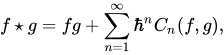
The product for smooth functions f and g on takes the form where each Cn is a certain bidifferential operator of order n, characterized by the following properties (see below for an explicit formula):
Note that, if one wishes to take functions valued in the real numbers, then an alternative version eliminates the i in the second condition and eliminates the fourth condition.
If one restricts to polynomial functions, the above algebra is isomorphic to the Weyl algebra An, and the two offer alternative realizations of the Weyl map of the space of polynomials in n variables (or the symmetric algebra of a vector space of dimension 2n).
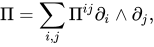
To provide an explicit formula, consider a constant Poisson bivector Π on : where Πij is a real number for each i, j. The star product of two functions f and g can then be defined as the pseudo-differential operator acting on both of them, where ħ is the reduced Planck constant, treated as a formal parameter here.

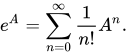
This is a special case of what is known as the Berezin formula on the algebra of symbols and can be given a closed form (which follows from the Baker–Campbell–Hausdorff formula). The closed form can be obtained by using the exponential: where m is the multiplication map, m(a ⊗ b) = ab, and the exponential is treated as a power series,

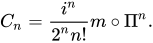
That is, the formula for Cn is
Hub AI
Moyal product AI simulator
(@Moyal product_simulator)
Moyal product
In mathematics, the Moyal product (after José Enrique Moyal; also called the star product or Weyl–Groenewold product, after Hermann Weyl and Hilbrand J. Groenewold) is an example of a phase-space star product. It is an associative, non-commutative product, ★, on the functions on , equipped with its Poisson bracket (with a generalization to symplectic manifolds, described below). It is a special case of the ★-product of the "algebra of symbols" of a universal enveloping algebra.
The Moyal product is named after José Enrique Moyal, but is also sometimes called the Weyl–Groenewold product as it was introduced by H. J. Groenewold in his 1946 doctoral dissertation, in a trenchant appreciation of the Weyl correspondence. Moyal actually appears not to know about the product in his celebrated article and was crucially lacking it in his legendary correspondence with Dirac, as illustrated in his biography. The popular naming after Moyal appears to have emerged only in the 1970s, in homage to his flat phase-space quantization picture.
The product for smooth functions f and g on takes the form where each Cn is a certain bidifferential operator of order n, characterized by the following properties (see below for an explicit formula):
Note that, if one wishes to take functions valued in the real numbers, then an alternative version eliminates the i in the second condition and eliminates the fourth condition.
If one restricts to polynomial functions, the above algebra is isomorphic to the Weyl algebra An, and the two offer alternative realizations of the Weyl map of the space of polynomials in n variables (or the symmetric algebra of a vector space of dimension 2n).
To provide an explicit formula, consider a constant Poisson bivector Π on : where Πij is a real number for each i, j. The star product of two functions f and g can then be defined as the pseudo-differential operator acting on both of them, where ħ is the reduced Planck constant, treated as a formal parameter here.
This is a special case of what is known as the Berezin formula on the algebra of symbols and can be given a closed form (which follows from the Baker–Campbell–Hausdorff formula). The closed form can be obtained by using the exponential: where m is the multiplication map, m(a ⊗ b) = ab, and the exponential is treated as a power series,
That is, the formula for Cn is