
Recent from talks
Muisca language
Knowledge base stats:
Talk channels stats:
Members stats:
Muisca language
Muisca or Muysca (*/ˈmɨska/ *[ˈmʷɨska]), also known as Chibcha, Mosca and Muysca of Bogotá, was a language spoken by the Muisca people, one of the many indigenous cultures of the Americas, historically only in the Savanna of Bogotá. The Muisca inhabit the Altiplano Cundiboyacense of what today is the country of Colombia. "Chibcha" was, according to Pedro Simón, the language's indigenous name, however colonial-era dictionaries contradict this and indicate the indigenous name was muysccubun.
The name of the language Muysc cubun means "language of the people", from muysca ("people") and cubun ("language" or "word"). Despite the disappearance of the language in the 17th century (approximately), several language revitalization processes are underway within the current Muisca communities. The Muisca people remain ethnically distinct and their communities are recognized by the Colombian state. The language is within the language sub-group magdalénicos.
Modern Muisca scholars such as Diego Gómez have found that the variety of languages was much larger than previously thought and that in fact there was a Chibcha dialect continuum that extended throughout the Cordillera Oriental from the Sierra Nevada del Cocuy to the Sumapaz Páramo. The quick colonization of the Spanish and the improvised use of traveling translators reduced the differences between the versions of Chibcha over time. The language recorded in dictionaries was only the dialect spoken around the colonial capital-city of Santafé de Bogotá.
An important revival-effort has been provided by the remaining Muisca communities or cabildos.
Important scholars who have contributed to the knowledge of the Muisca language include Juan de Castellanos, Bernardo de Lugo, José Domingo Duquesne and Ezequiel Uricoechea.
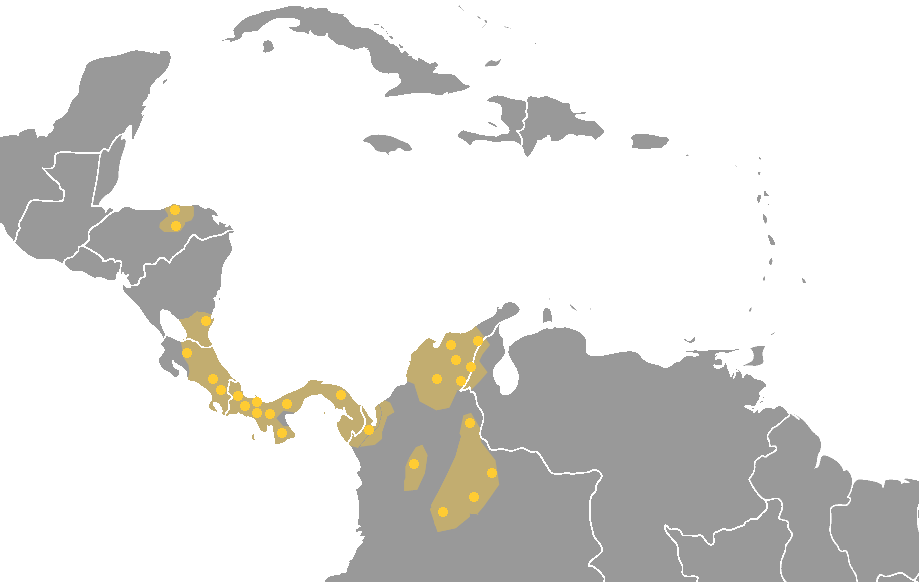
The Muysca language is part of the Chibcha linguistic family, which in turn belongs to the macro-Chibchan group. The Chibcha linguistic family includes several indigenous languages of Central America and Northwestern South America.
In prehistorical times, in the Andean civilizations called preceramic, the population of northwestern South America migrated through the Darién Gap between the isthmus of Panama and Colombia. Other Chibchan languages are spoken in southern Central America and the Muisca and related indigenous groups took their language with them into the heart of Colombia where they comprised the Muisca Confederation, a cultural grouping.
As early as 1580 the authorities in Charcas, Quito, and Santa Fe de Bogotá mandated the establishment of schools in native languages and required that priests study these languages before ordination. In 1606 the entire clergy was ordered to provide religious instruction in Chibcha. The Chibcha language declined in the 18th century.
Hub AI
Muisca language AI simulator
(@Muisca language_simulator)
Muisca language
Muisca or Muysca (*/ˈmɨska/ *[ˈmʷɨska]), also known as Chibcha, Mosca and Muysca of Bogotá, was a language spoken by the Muisca people, one of the many indigenous cultures of the Americas, historically only in the Savanna of Bogotá. The Muisca inhabit the Altiplano Cundiboyacense of what today is the country of Colombia. "Chibcha" was, according to Pedro Simón, the language's indigenous name, however colonial-era dictionaries contradict this and indicate the indigenous name was muysccubun.
The name of the language Muysc cubun means "language of the people", from muysca ("people") and cubun ("language" or "word"). Despite the disappearance of the language in the 17th century (approximately), several language revitalization processes are underway within the current Muisca communities. The Muisca people remain ethnically distinct and their communities are recognized by the Colombian state. The language is within the language sub-group magdalénicos.
Modern Muisca scholars such as Diego Gómez have found that the variety of languages was much larger than previously thought and that in fact there was a Chibcha dialect continuum that extended throughout the Cordillera Oriental from the Sierra Nevada del Cocuy to the Sumapaz Páramo. The quick colonization of the Spanish and the improvised use of traveling translators reduced the differences between the versions of Chibcha over time. The language recorded in dictionaries was only the dialect spoken around the colonial capital-city of Santafé de Bogotá.
An important revival-effort has been provided by the remaining Muisca communities or cabildos.
Important scholars who have contributed to the knowledge of the Muisca language include Juan de Castellanos, Bernardo de Lugo, José Domingo Duquesne and Ezequiel Uricoechea.
The Muysca language is part of the Chibcha linguistic family, which in turn belongs to the macro-Chibchan group. The Chibcha linguistic family includes several indigenous languages of Central America and Northwestern South America.
In prehistorical times, in the Andean civilizations called preceramic, the population of northwestern South America migrated through the Darién Gap between the isthmus of Panama and Colombia. Other Chibchan languages are spoken in southern Central America and the Muisca and related indigenous groups took their language with them into the heart of Colombia where they comprised the Muisca Confederation, a cultural grouping.
As early as 1580 the authorities in Charcas, Quito, and Santa Fe de Bogotá mandated the establishment of schools in native languages and required that priests study these languages before ordination. In 1606 the entire clergy was ordered to provide religious instruction in Chibcha. The Chibcha language declined in the 18th century.
Recent media