



Community hub
Recent from talks
Knowledge base stats:
Talk channels stats:
Members stats:
Muladhara
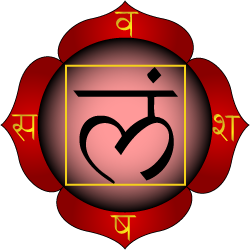
Muladhara (Sanskrit: मूलाधार or मूलाधारा; IAST: Mūlādhāra, lit. "root of Existence." Mula means root and dhara means flux.) or the root chakra is one of the seven primary chakras according to Hindu tantrism. It is symbolized by a lotus with four petals and the colour pink or red.
Muladhara is said to be located near the coccygeal plexus beneath the sacrum, while its kshetram, or superficial activation point, is located between the perineum and the coccyx or the pelvic bone. Muladhara is said to be the base from which the three main psychic channels or nadis emerge: the Ida, Pingala and Sushumna. The deity associated with Muladhara (root) chakra is Lord Ganesh. In the highest revered prayer for Ganapati (Ganesh), the Ganapati Atharvashirsha, it is mentioned that "one who worships Lord Ganapati would easily grasp the concept and realise Brahman".[citation needed]
It is symbolized by a red, four-petaled lotus with a yellow square at its center. Each petal has one of the Sanskrit syllables वं vaṃ, शं śaṃ, षं ṣaṃ, and सं saṃ written on it in gold, representing the four vrittis: greatest joy, natural pleasure, delight in controlling passion, and blissfulness in concentration. Alternatively, they may represent dharma (psycho-spiritual longing), artha (psychic longing), kama (physical longing) and moksha (longing for spiritual liberation). Eight spears point out of the sides and corners of the square.
The deity Indra is associated with Muladhara. In these depictions, he is yellow, four-armed, and holds a vajra and a blue lotus in his hands.[clarification needed] He is mounted upon the white elephant Airavata, who has seven trunks denoting the seven elements necessary for supporting life. Occasionally, Ganesha is also associated with Muladhara. In these depictions, he has orange skin, wears a yellow dhoti, and a green silk scarf draped around his shoulders. In three hands he holds a laddu, a lotus flower, and a hatchet, and the fourth is raised in the mudra of dispelling fear.
The seed mantra syllable is लं laṃ. Within the bindu, the point that forms a part of the letter, is Brahma. He is deep red, with four faces and four arms, holding a staff, a sacred vase of nectar, and a japa mala, and making the gesture of dispelling fear. Alternatively, instead of the staff and japa mala, he may hold a lotus flower and the sacred scriptures. He is seated on a swan. The goddess Dakini, his shakti, is depicted with him. She is beautiful, with three eyes and four arms. Dakini is usually depicted with red or white skin, holding a trident, a skulled staff, a swan, and a drinking vessel, and is seated on a swan. At times, instead of a swan and drinking vessel, she holds a sword and a shield.
In the center of the square, below the seed syllable, is a deep red inverted triangle. The kundalini shakti is said to sleep here, waiting to be aroused and brought back up to Brahman, the source from which it originated. It is represented by a snake wrapped three and a half times around a smoky grey lingam.
Muladhara is considered the foundation of the "energy body". Yogic systems stress the importance of stabilizing this chakra. Kundalini awakening begins here. It is also known as the seat of the "red bindu," or subtle drop, which rises up to the "white bindu" in the head to unite the feminine and masculine energies, the Shakti and Shiva.
It is associated with the element of earth. An imbalanced root chakra can manifest in various ways. Physically, people might experience lower back pain, fatigue, or digestive issues. Emotionally, they may feel anxious, fearful, or disconnected. Understanding these symptoms is crucial for recognizing when root chakra needs attention.
Hub AI
Muladhara AI simulator
(@Muladhara_simulator)
Muladhara
Muladhara (Sanskrit: मूलाधार or मूलाधारा; IAST: Mūlādhāra, lit. "root of Existence." Mula means root and dhara means flux.) or the root chakra is one of the seven primary chakras according to Hindu tantrism. It is symbolized by a lotus with four petals and the colour pink or red.
Muladhara is said to be located near the coccygeal plexus beneath the sacrum, while its kshetram, or superficial activation point, is located between the perineum and the coccyx or the pelvic bone. Muladhara is said to be the base from which the three main psychic channels or nadis emerge: the Ida, Pingala and Sushumna. The deity associated with Muladhara (root) chakra is Lord Ganesh. In the highest revered prayer for Ganapati (Ganesh), the Ganapati Atharvashirsha, it is mentioned that "one who worships Lord Ganapati would easily grasp the concept and realise Brahman".[citation needed]
It is symbolized by a red, four-petaled lotus with a yellow square at its center. Each petal has one of the Sanskrit syllables वं vaṃ, शं śaṃ, षं ṣaṃ, and सं saṃ written on it in gold, representing the four vrittis: greatest joy, natural pleasure, delight in controlling passion, and blissfulness in concentration. Alternatively, they may represent dharma (psycho-spiritual longing), artha (psychic longing), kama (physical longing) and moksha (longing for spiritual liberation). Eight spears point out of the sides and corners of the square.
The deity Indra is associated with Muladhara. In these depictions, he is yellow, four-armed, and holds a vajra and a blue lotus in his hands.[clarification needed] He is mounted upon the white elephant Airavata, who has seven trunks denoting the seven elements necessary for supporting life. Occasionally, Ganesha is also associated with Muladhara. In these depictions, he has orange skin, wears a yellow dhoti, and a green silk scarf draped around his shoulders. In three hands he holds a laddu, a lotus flower, and a hatchet, and the fourth is raised in the mudra of dispelling fear.
The seed mantra syllable is लं laṃ. Within the bindu, the point that forms a part of the letter, is Brahma. He is deep red, with four faces and four arms, holding a staff, a sacred vase of nectar, and a japa mala, and making the gesture of dispelling fear. Alternatively, instead of the staff and japa mala, he may hold a lotus flower and the sacred scriptures. He is seated on a swan. The goddess Dakini, his shakti, is depicted with him. She is beautiful, with three eyes and four arms. Dakini is usually depicted with red or white skin, holding a trident, a skulled staff, a swan, and a drinking vessel, and is seated on a swan. At times, instead of a swan and drinking vessel, she holds a sword and a shield.
In the center of the square, below the seed syllable, is a deep red inverted triangle. The kundalini shakti is said to sleep here, waiting to be aroused and brought back up to Brahman, the source from which it originated. It is represented by a snake wrapped three and a half times around a smoky grey lingam.
Muladhara is considered the foundation of the "energy body". Yogic systems stress the importance of stabilizing this chakra. Kundalini awakening begins here. It is also known as the seat of the "red bindu," or subtle drop, which rises up to the "white bindu" in the head to unite the feminine and masculine energies, the Shakti and Shiva.
It is associated with the element of earth. An imbalanced root chakra can manifest in various ways. Physically, people might experience lower back pain, fatigue, or digestive issues. Emotionally, they may feel anxious, fearful, or disconnected. Understanding these symptoms is crucial for recognizing when root chakra needs attention.