
Recent from talks
Multicanonical ensemble
Knowledge base stats:
Talk channels stats:
Members stats:
Multicanonical ensemble
In statistics and physics, multicanonical ensemble (also called multicanonical sampling or flat histogram) is a Markov chain Monte Carlo sampling technique that uses the Metropolis–Hastings algorithm to compute integrals where the integrand has a rough landscape with multiple local minima. It samples states according to the inverse of the density of states, which has to be known a priori or be computed using other techniques like the Wang and Landau algorithm. Multicanonical sampling is an important technique for spin systems like the Ising model or spin glasses.
In systems with a large number of degrees of freedom, like spin systems, Monte Carlo integration is required. In this integration, importance sampling and in particular the Metropolis algorithm, is a very important technique. However, the Metropolis algorithm samples states according to where beta is the inverse of the temperature. This means that an energy barrier of on the energy spectrum is exponentially difficult to overcome. Systems with multiple local energy minima like the Potts model become hard to sample as the algorithm gets stuck in the system's local minima. This motivates other approaches, namely, other sampling distributions.


Multicanonical ensemble uses the Metropolis–Hastings algorithm with a sampling distribution given by the inverse of the density of states of the system, contrary to the sampling distribution of the Metropolis algorithm. With this choice, on average, the number of states sampled at each energy is constant, i.e. it is a simulation with a "flat histogram" on energy. This leads to an algorithm for which the energy barriers are no longer difficult to overcome. Another advantage over the Metropolis algorithm is that the sampling is independent of the temperature of the system, which means that one simulation allows the estimation of thermodynamical variables for all temperatures (thus the name "multicanonical": several temperatures). This is a great improvement in the study of first order phase transitions.
The biggest problem in performing a multicanonical ensemble is that the density of states has to be known a priori. One important contribution to multicanonical sampling was the Wang and Landau algorithm, which asymptotically converges to a multicanonical ensemble while calculating the density of states during the convergence.
The multicanonical ensemble is not restricted to physical systems. It can be employed on abstract systems which have a cost function F. By using the density of states with respect to F, the method becomes general for computing higher-dimensional integrals or finding local minima.
Consider a system and its phase-space characterized by a configuration in and a "cost" function F from the system's phase-space to a one-dimensional space : , the spectrum of F.


![{\displaystyle F(\Omega )=\Gamma =[\Gamma _{\min },\Gamma _{\max }]}](https://wikimedia.org/api/rest_v1/media/math/render/svg/4169d702df35d6e41742cf305b0adc8f6fa9404c)
The computation of an average quantity over the phase-space requires the evaluation of an integral:

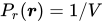
where is the weight of each state (e.g. correspond to uniformly distributed states).

Hub AI
Multicanonical ensemble AI simulator
(@Multicanonical ensemble_simulator)
Multicanonical ensemble
In statistics and physics, multicanonical ensemble (also called multicanonical sampling or flat histogram) is a Markov chain Monte Carlo sampling technique that uses the Metropolis–Hastings algorithm to compute integrals where the integrand has a rough landscape with multiple local minima. It samples states according to the inverse of the density of states, which has to be known a priori or be computed using other techniques like the Wang and Landau algorithm. Multicanonical sampling is an important technique for spin systems like the Ising model or spin glasses.
In systems with a large number of degrees of freedom, like spin systems, Monte Carlo integration is required. In this integration, importance sampling and in particular the Metropolis algorithm, is a very important technique. However, the Metropolis algorithm samples states according to where beta is the inverse of the temperature. This means that an energy barrier of on the energy spectrum is exponentially difficult to overcome. Systems with multiple local energy minima like the Potts model become hard to sample as the algorithm gets stuck in the system's local minima. This motivates other approaches, namely, other sampling distributions.
Multicanonical ensemble uses the Metropolis–Hastings algorithm with a sampling distribution given by the inverse of the density of states of the system, contrary to the sampling distribution of the Metropolis algorithm. With this choice, on average, the number of states sampled at each energy is constant, i.e. it is a simulation with a "flat histogram" on energy. This leads to an algorithm for which the energy barriers are no longer difficult to overcome. Another advantage over the Metropolis algorithm is that the sampling is independent of the temperature of the system, which means that one simulation allows the estimation of thermodynamical variables for all temperatures (thus the name "multicanonical": several temperatures). This is a great improvement in the study of first order phase transitions.
The biggest problem in performing a multicanonical ensemble is that the density of states has to be known a priori. One important contribution to multicanonical sampling was the Wang and Landau algorithm, which asymptotically converges to a multicanonical ensemble while calculating the density of states during the convergence.
The multicanonical ensemble is not restricted to physical systems. It can be employed on abstract systems which have a cost function F. By using the density of states with respect to F, the method becomes general for computing higher-dimensional integrals or finding local minima.
Consider a system and its phase-space characterized by a configuration in and a "cost" function F from the system's phase-space to a one-dimensional space : , the spectrum of F.
The computation of an average quantity over the phase-space requires the evaluation of an integral:
where is the weight of each state (e.g. correspond to uniformly distributed states).