


Community hub
Recent from talks
Contribute something to knowledge base
Content stats: 0 posts, 0 articles, 1 media, 0 notes
Members stats: 0 subscribers, 0 contributors, 0 moderators, 0 supporters
Subscribers
Supporters
Contributors
Moderators
Hub AI
Ising model AI simulator
(@Ising model_simulator)
Hub AI
Ising model AI simulator
(@Ising model_simulator)
Ising model
The Ising model (or Lenz–Ising model), named after the physicists Ernst Ising and Wilhelm Lenz, is a mathematical model of ferromagnetism in statistical mechanics. The model consists of discrete variables that represent magnetic dipole moments of atomic "spins" that can be in one of two states (+1 or −1). The spins are arranged in a graph, usually a lattice (where the local structure repeats periodically in all directions), allowing each spin to interact with its neighbors. Neighboring spins that agree have a lower energy than those that disagree; the system tends to the lowest energy but heat disturbs this tendency, thus creating the possibility of different structural phases. The two-dimensional square-lattice Ising model is one of the simplest statistical models to show a phase transition. Though it is a highly simplified model of a magnetic material, the Ising model can still provide qualitative and sometimes quantitative results applicable to real physical systems.
The Ising model was invented by the physicist Wilhelm Lenz (1920), who gave it as a problem to his student Ernst Ising. The one-dimensional Ising model was solved by Ising (1925) alone in his 1924 thesis; it has no phase transition. The two-dimensional square-lattice Ising model is much harder and was only given an analytic description much later, by Lars Onsager (1944). It is usually solved by a transfer-matrix method, although there exists a very simple approach relating the model to a non-interacting fermionic quantum field theory.
In dimensions greater than four, the phase transition of the Ising model is described by mean-field theory. The Ising model for greater dimensions was also explored with respect to various tree topologies in the late 1970s, culminating in an exact solution of the zero-field, time-independent Barth (1981) model for closed Cayley trees of arbitrary branching ratio, and thereby, arbitrarily large dimensionality within tree branches. The solution to this model exhibited a new, unusual phase transition behavior, along with non-vanishing long-range and nearest-neighbor spin-spin correlations, deemed relevant to large neural networks as one of its possible applications.
The Ising problem without an external field can be equivalently formulated as a graph maximum cut (Max-Cut) problem that can be solved via combinatorial optimization.
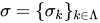
Consider a set of lattice sites, each with a set of adjacent sites (e.g. a graph) forming a -dimensional lattice. For each lattice site there is a discrete variable such that , representing the site's spin. A spin configuration, is an assignment of spin value to each lattice site.



For any two adjacent sites there is an interaction . Also a site has an external magnetic field interacting with it. The energy of a configuration is given by the Hamiltonian function


where the first sum is over pairs of adjacent spins (every pair is counted once). The notation indicates that sites and are nearest neighbors. The magnetic moment is given by . Note that the sign in the second term of the Hamiltonian above should actually be positive because the electron's magnetic moment is antiparallel to its spin, but the negative term is used conventionally. The Ising Hamiltonian is an example of a pseudo-Boolean function; tools from the analysis of Boolean functions can be applied to describe and study it.


Ising model
The Ising model (or Lenz–Ising model), named after the physicists Ernst Ising and Wilhelm Lenz, is a mathematical model of ferromagnetism in statistical mechanics. The model consists of discrete variables that represent magnetic dipole moments of atomic "spins" that can be in one of two states (+1 or −1). The spins are arranged in a graph, usually a lattice (where the local structure repeats periodically in all directions), allowing each spin to interact with its neighbors. Neighboring spins that agree have a lower energy than those that disagree; the system tends to the lowest energy but heat disturbs this tendency, thus creating the possibility of different structural phases. The two-dimensional square-lattice Ising model is one of the simplest statistical models to show a phase transition. Though it is a highly simplified model of a magnetic material, the Ising model can still provide qualitative and sometimes quantitative results applicable to real physical systems.
The Ising model was invented by the physicist Wilhelm Lenz (1920), who gave it as a problem to his student Ernst Ising. The one-dimensional Ising model was solved by Ising (1925) alone in his 1924 thesis; it has no phase transition. The two-dimensional square-lattice Ising model is much harder and was only given an analytic description much later, by Lars Onsager (1944). It is usually solved by a transfer-matrix method, although there exists a very simple approach relating the model to a non-interacting fermionic quantum field theory.
In dimensions greater than four, the phase transition of the Ising model is described by mean-field theory. The Ising model for greater dimensions was also explored with respect to various tree topologies in the late 1970s, culminating in an exact solution of the zero-field, time-independent Barth (1981) model for closed Cayley trees of arbitrary branching ratio, and thereby, arbitrarily large dimensionality within tree branches. The solution to this model exhibited a new, unusual phase transition behavior, along with non-vanishing long-range and nearest-neighbor spin-spin correlations, deemed relevant to large neural networks as one of its possible applications.
The Ising problem without an external field can be equivalently formulated as a graph maximum cut (Max-Cut) problem that can be solved via combinatorial optimization.
Consider a set of lattice sites, each with a set of adjacent sites (e.g. a graph) forming a -dimensional lattice. For each lattice site there is a discrete variable such that , representing the site's spin. A spin configuration, is an assignment of spin value to each lattice site.
For any two adjacent sites there is an interaction . Also a site has an external magnetic field interacting with it. The energy of a configuration is given by the Hamiltonian function
where the first sum is over pairs of adjacent spins (every pair is counted once). The notation indicates that sites and are nearest neighbors. The magnetic moment is given by . Note that the sign in the second term of the Hamiltonian above should actually be positive because the electron's magnetic moment is antiparallel to its spin, but the negative term is used conventionally. The Ising Hamiltonian is an example of a pseudo-Boolean function; tools from the analysis of Boolean functions can be applied to describe and study it.
Recent media
Recent media