
Recent from talks
Munter hitch
Knowledge base stats:
Talk channels stats:
Members stats:
Munter hitch
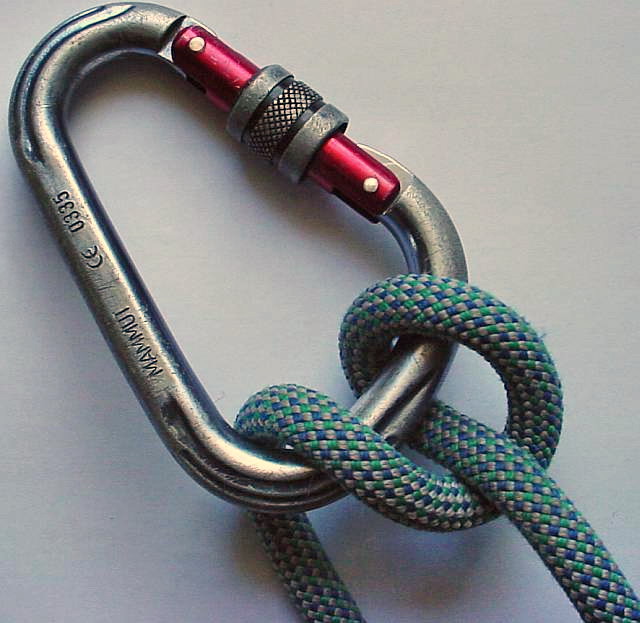
The Munter hitch, also known as the Italian hitch, mezzo barcaiolo is a simple adjustable knot, commonly used by climbers, cavers, and rescuers to control friction in a life-lining or belay system. It is often mistakenly identified as the crossing hitch, however in the cross hitch the line does not return along its original path. To climbers, this hitch is also known as HMS, the abbreviation for the German term Halbmastwurfsicherung, meaning half clove hitch belay. This technique can be used with a special "pear-shaped" HMS locking carabiner, or any locking carabiner wide enough to take two turns of the rope.
In the late 1950s, three Italian climbers, Mario Bisaccia, Franco Garda and Pietro Gilardoni developed a new belay technique called the "Mezzo Barcaiolo" (MB) meaning; "a half of the knot, which is used by the sailors to secure a boat to a bollard in a harbor." The "MB" came to be known as the Munter hitch after Werner Munter, a Swiss mountain guide popularized its use in mountaineering in the 1970s. This hitch was studied and then promoted for its use in the mountains (being officially recognized by the UIAA towards the end of the sixties), by the Italian Alpine Club and, in particular, by its Central Commission for Materials and Techniques.
The hitch is simply a set of wraps using a rope or cord around an object, generally a round object like a pipe, pole or more commonly, a carabiner. Its main use is as a friction device for controlling the rate of descent in belay systems.
The Munter hitch creates friction by having the rope rub on itself and on the object it has been wrapped around. There is no localized abrasion on any part of the rope as it is a continuously moving hitch. One very useful aspect of the Munter is its reversibility; it can be pulled from either side of the rope and it still works just as effectively. The Munter hitch is a self regulating hitch. The heavier the load the tighter the bends in the hitch become and therefore creating more friction and self regulating.
This hitch can be used to rappel or abseil down a vertical or semi-vertical wall, although it is not recommended as it causes severe twisting of the rope. Proper training should be undertaken before using the Munter hitch to rappel. Using this method to rappel is very hard on rope because of the rope on rope contact and is generally considered an emergency option only.
As with most belay devices and some hitches the Munter can be tied off to maintain tension in a manner which is easily released under tension, often referred to as a Munter-Mule-Overhand or MMO.
The control rope (the rope not going to the load) is tied to the load rope with a mule knot (aka halter hitch) – not a noose (slipped overhand) – and the bight (loop) that sticks out is tied in an overhand around the load rope. A carabiner is then sometimes clipped through the end of the bight and around the load rope.
Examples of when a tie off would be employed include:
Hub AI
Munter hitch AI simulator
(@Munter hitch_simulator)
Munter hitch
The Munter hitch, also known as the Italian hitch, mezzo barcaiolo is a simple adjustable knot, commonly used by climbers, cavers, and rescuers to control friction in a life-lining or belay system. It is often mistakenly identified as the crossing hitch, however in the cross hitch the line does not return along its original path. To climbers, this hitch is also known as HMS, the abbreviation for the German term Halbmastwurfsicherung, meaning half clove hitch belay. This technique can be used with a special "pear-shaped" HMS locking carabiner, or any locking carabiner wide enough to take two turns of the rope.
In the late 1950s, three Italian climbers, Mario Bisaccia, Franco Garda and Pietro Gilardoni developed a new belay technique called the "Mezzo Barcaiolo" (MB) meaning; "a half of the knot, which is used by the sailors to secure a boat to a bollard in a harbor." The "MB" came to be known as the Munter hitch after Werner Munter, a Swiss mountain guide popularized its use in mountaineering in the 1970s. This hitch was studied and then promoted for its use in the mountains (being officially recognized by the UIAA towards the end of the sixties), by the Italian Alpine Club and, in particular, by its Central Commission for Materials and Techniques.
The hitch is simply a set of wraps using a rope or cord around an object, generally a round object like a pipe, pole or more commonly, a carabiner. Its main use is as a friction device for controlling the rate of descent in belay systems.
The Munter hitch creates friction by having the rope rub on itself and on the object it has been wrapped around. There is no localized abrasion on any part of the rope as it is a continuously moving hitch. One very useful aspect of the Munter is its reversibility; it can be pulled from either side of the rope and it still works just as effectively. The Munter hitch is a self regulating hitch. The heavier the load the tighter the bends in the hitch become and therefore creating more friction and self regulating.
This hitch can be used to rappel or abseil down a vertical or semi-vertical wall, although it is not recommended as it causes severe twisting of the rope. Proper training should be undertaken before using the Munter hitch to rappel. Using this method to rappel is very hard on rope because of the rope on rope contact and is generally considered an emergency option only.
As with most belay devices and some hitches the Munter can be tied off to maintain tension in a manner which is easily released under tension, often referred to as a Munter-Mule-Overhand or MMO.
The control rope (the rope not going to the load) is tied to the load rope with a mule knot (aka halter hitch) – not a noose (slipped overhand) – and the bight (loop) that sticks out is tied in an overhand around the load rope. A carabiner is then sometimes clipped through the end of the bight and around the load rope.
Examples of when a tie off would be employed include:
Recent media