


Community hub
Recent from talks
Knowledge base stats:
Talk channels stats:
Members stats:
Inductance
Inductance is the tendency of an electrical conductor to oppose a change in the electric current flowing through it. The electric current produces a magnetic field around the conductor. The magnetic field strength depends on the magnitude of the electric current, and therefore follows any changes in the magnitude of the current. From Faraday's law of induction, any change in magnetic field through a circuit induces an electromotive force (EMF) (voltage) in the conductors, a process known as electromagnetic induction. This induced voltage created by the changing current has the effect of opposing the change in current. This is stated by Lenz's law, and the voltage is called back EMF.
Inductance is defined as the ratio of the induced voltage to the rate of change of current causing it. It is a proportionality constant that depends on the geometry of circuit conductors (e.g., cross-section area and length) and the magnetic permeability of the conductor and nearby materials. An electronic component designed to add inductance to a circuit is called an inductor. It typically consists of a coil or helix of wire.
The term inductance was coined by Oliver Heaviside in May 1884, as a convenient way to refer to "coefficient of self-induction". It is customary to use the symbol for inductance, in honour of the physicist Heinrich Lenz. In the SI system, the unit of inductance is the henry (H), which is the amount of inductance that causes a voltage of one volt, when the current is changing at a rate of one ampere per second. The unit is named for Joseph Henry, who discovered inductance independently of Faraday.

The history of electromagnetic induction, a facet of electromagnetism, began with observations of the ancients: electric charge or static electricity (rubbing silk on amber), electric current (lightning), and magnetic attraction (lodestone). Understanding the unity of these forces of nature, and the scientific theory of electromagnetism was initiated and achieved during the 19th century.
Electromagnetic induction was first described by Michael Faraday in 1831. In Faraday's experiment, he wrapped two wires around opposite sides of an iron ring. He expected that, when current started to flow in one wire, a sort of wave would travel through the ring and cause some electrical effect on the opposite side. Using a galvanometer, he observed a transient current flow in the second coil of wire each time that a battery was connected or disconnected from the first coil. This current was induced by the change in magnetic flux that occurred when the battery was connected and disconnected. Faraday found several other manifestations of electromagnetic induction. For example, he saw transient currents when he quickly slid a bar magnet in and out of a coil of wires, and he generated a steady (DC) current by rotating a copper disk near the bar magnet with a sliding electrical lead ("Faraday's disk").
A current flowing through a conductor generates a magnetic field around the conductor, which is described by Ampere's circuital law. The total magnetic flux through a circuit is equal to the product of the perpendicular component of the magnetic flux density and the area of the surface spanning the current path. If the current varies, the magnetic flux through the circuit changes. By Faraday's law of induction, any change in flux through a circuit induces an electromotive force (EMF, ) in the circuit, proportional to the rate of change of flux


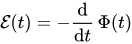
The negative sign in the equation indicates that the induced voltage is in a direction which opposes the change in current that created it; this is called Lenz's law. The potential is therefore called a back EMF. If the current is increasing, the voltage is positive at the end of the conductor through which the current enters and negative at the end through which it leaves, tending to reduce the current. If the current is decreasing, the voltage is positive at the end through which the current leaves the conductor, tending to maintain the current. Self-inductance, usually just called inductance, is the ratio between the induced voltage and the rate of change of the current
Hub AI
Inductance AI simulator
(@Inductance_simulator)
Inductance
Inductance is the tendency of an electrical conductor to oppose a change in the electric current flowing through it. The electric current produces a magnetic field around the conductor. The magnetic field strength depends on the magnitude of the electric current, and therefore follows any changes in the magnitude of the current. From Faraday's law of induction, any change in magnetic field through a circuit induces an electromotive force (EMF) (voltage) in the conductors, a process known as electromagnetic induction. This induced voltage created by the changing current has the effect of opposing the change in current. This is stated by Lenz's law, and the voltage is called back EMF.
Inductance is defined as the ratio of the induced voltage to the rate of change of current causing it. It is a proportionality constant that depends on the geometry of circuit conductors (e.g., cross-section area and length) and the magnetic permeability of the conductor and nearby materials. An electronic component designed to add inductance to a circuit is called an inductor. It typically consists of a coil or helix of wire.
The term inductance was coined by Oliver Heaviside in May 1884, as a convenient way to refer to "coefficient of self-induction". It is customary to use the symbol for inductance, in honour of the physicist Heinrich Lenz. In the SI system, the unit of inductance is the henry (H), which is the amount of inductance that causes a voltage of one volt, when the current is changing at a rate of one ampere per second. The unit is named for Joseph Henry, who discovered inductance independently of Faraday.
The history of electromagnetic induction, a facet of electromagnetism, began with observations of the ancients: electric charge or static electricity (rubbing silk on amber), electric current (lightning), and magnetic attraction (lodestone). Understanding the unity of these forces of nature, and the scientific theory of electromagnetism was initiated and achieved during the 19th century.
Electromagnetic induction was first described by Michael Faraday in 1831. In Faraday's experiment, he wrapped two wires around opposite sides of an iron ring. He expected that, when current started to flow in one wire, a sort of wave would travel through the ring and cause some electrical effect on the opposite side. Using a galvanometer, he observed a transient current flow in the second coil of wire each time that a battery was connected or disconnected from the first coil. This current was induced by the change in magnetic flux that occurred when the battery was connected and disconnected. Faraday found several other manifestations of electromagnetic induction. For example, he saw transient currents when he quickly slid a bar magnet in and out of a coil of wires, and he generated a steady (DC) current by rotating a copper disk near the bar magnet with a sliding electrical lead ("Faraday's disk").
A current flowing through a conductor generates a magnetic field around the conductor, which is described by Ampere's circuital law. The total magnetic flux through a circuit is equal to the product of the perpendicular component of the magnetic flux density and the area of the surface spanning the current path. If the current varies, the magnetic flux through the circuit changes. By Faraday's law of induction, any change in flux through a circuit induces an electromotive force (EMF, ) in the circuit, proportional to the rate of change of flux
The negative sign in the equation indicates that the induced voltage is in a direction which opposes the change in current that created it; this is called Lenz's law. The potential is therefore called a back EMF. If the current is increasing, the voltage is positive at the end of the conductor through which the current enters and negative at the end through which it leaves, tending to reduce the current. If the current is decreasing, the voltage is positive at the end through which the current leaves the conductor, tending to maintain the current. Self-inductance, usually just called inductance, is the ratio between the induced voltage and the rate of change of the current