



Community hub
Recent from talks
Contribute something to knowledge base
Content stats: 0 posts, 0 articles, 1 media, 0 notes
Members stats: 0 subscribers, 0 contributors, 0 moderators, 0 supporters
Subscribers
Supporters
Contributors
Moderators
Hub AI
Mutual Life Building (Seattle) AI simulator
(@Mutual Life Building (Seattle)_simulator)
Hub AI
Mutual Life Building (Seattle) AI simulator
(@Mutual Life Building (Seattle)_simulator)
Mutual Life Building (Seattle)
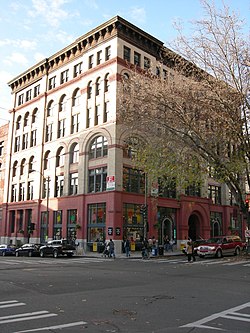
The Mutual Life Building, originally known as the Yesler Building, is an historic office building located in Seattle's Pioneer Square neighborhood that anchors the West side of the square. The building sits on one of the most historic sites in the city; the original location of Henry Yesler's cookhouse that served his sawmill in the early 1850s and was one of Seattle's first community gathering spaces. It was also the site of the first sermon delivered and first lawsuit tried in King County. By the late 1880s Yesler had replaced the old shanties with several substantial brick buildings including the grand Yesler-Leary Building, which would all be destroyed by the Great Seattle Fire in 1889. The realignment of First Avenue to reconcile Seattle's clashing street grids immediately after the fire would split Yesler's corner into two pieces; the severed eastern corner would become part of Pioneer Square park, and on the western lot Yesler would begin construction of his eponymous block in 1890 to house the First National Bank, which had previously been located in the Yesler-Leary Building. Portland brewer Louis Feurer began construction of a conjoined building to the west of Yesler's at the same time. Progress of both would be stunted and the original plans of architect Elmer H. Fisher were dropped by the time construction resumed in 1892. It would take 4 phases and 4 different architects before the building reached its final form in 1905. The Mutual Life Insurance Company of New York only owned the building from 1896 to 1909, but it would retain their name even after the company moved out in 1916.
Though well maintained as an office building into the 1940s under the ownership of the Shafer Brothers, by the 1950s the building was largely vacant and deteriorating, becoming a poster child of the blight facing the Pioneer Square neighborhood and in the early 1960s was recognized as one of the most historically significant buildings on the square. The building became the birthplace of Seattle's historic preservation movement and was listed on the National Register of Historic Places in 1970 as a contributing property in the Pioneer Square Historic District but was not fully restored until the early 1980s, which returned its use to office space.
In the wake of the Great Seattle Fire, the city took the opportunity to widen, raise and realign many downtown streets to reconcile the converging grids that met at Yesler Way which they had been attempting to fix for years. Yesler's property at 3 of the 4 corners of 1st and Yesler had stood in the way of these changes, and Yesler, being the frugal and stubborn man he was refused to surrender an inch of right of way. To firmly cement his property lines in 1883 he had one of Seattle's grandest buildings built on the corner that the city wanted to cut through, the Yesler-Leary Building. Designed by William E. Boone, the region's most prominent architect at the time, it was modeled after the triangular Phelan Building in San Francisco. The First National Bank, later known as Seafirst Bank, opened in the corner and the building soon became a busy gathering place.
Not long after the Yesler-Leary Building was completed an even larger 4-story annex of the same architecture with a central tower was proposed to fill the lot to the West between it and the Post Building, but these plans were shelved when Seattle's economy turned sour towards the end of 1884. A more conservative in style building known simply as the New Yesler Block (and also designed by Boone) would be built on the lot in 1888 but its life would be short lived. It is within the footprint of this building that the Mutual Life Building would eventually stand.
Yesler finally agreed to sell his corner lot to the city and in order to remove the jog separating Front Street (1st Avenue) and Commercial Street (1st Avenue South), the street was cut through Yesler's corner, creating Pioneer Square Park and leaving him with a roughly rectangular corner parcel where most of the New Yesler Block had been. The Western 30 feet of that lot, which Yesler had sold to John Leary in 1881 for construction of the original Post Building, had been purchased by German native and Portland, Oregon brewer Louis Feurer shortly after the fire for $35,000, who with Yesler would build their separate buildings with a unified appearance. About a year after the fire, after the dust had settled from regrades and widening, the two men began construction of their office buildings that would serve as the new home of the First National Bank as well as the Washington Savings Bank (No relation to Washington Mutual Savings). Yesler and Feurer both chose architect Elmer H. Fisher, who had designed for the latter the Pioneer Building and Bank of Commerce Buildings on neighboring corners of the square. In Fisher's original design Yesler's 6-story building and Feurer's 3-story building were to be clad in rusticated Salt Lake red sandstone, and would be the only buildings of their kind in the city. Feurer filed a permit for construction of his building in November 1889. Begun in late summer of 1890, construction proceeded slowly on Yesler's portion and a temporary roof was put over the completed first floor and basement as soon as it was fit for occupancy, with Feurer following suit. Despite reports at the time, the entire building would not be built at once, and not to the design originally proposed.
By the time construction of the building recommenced in the summer of 1892, Fisher had suffered a series of legal and financial setbacks and was no longer practicing architecture. Emil De Neuf, former head draftsmen and now successor to Fisher, was retained by Yesler to draft a new design for the top 5 floors, to bring it more up to date; The upper floors would now be faced with buff pressed brick and only trimmed with red sandstone (this time sourced from Portage, Wisconsin) to unify it with the base. The interiors were to be lavishly decorated in marble, mahogany, Spanish cedar, glazed tile and the most modern plumbing system in the city, ultimately making it more expensive than the original design. Wilmot, Middlebrook & Davis were awarded the $35,000 general contract for this next phase of construction which initially only covered the second and third floors before work would pause again. That September it was announced that instead of just adding the two floors and stopping again, the building would be completed to its full 6 story design at once. This expansion however, would not include Louis Feurer's portion of the building at 92 Yesler Way, then occupied by Hamm & Schmitz's Seattle Saloon; this part of the building would remain single-storied and under Feurer's ownership for another decade.
Henry Yesler died in December 1892, within days of the completion of the building's structure, but it had yet to be furnished on the inside. Plastering and woodwork would be postponed until Yesler's estate could be sorted out and the first upstairs tenant, The Washington Club, wouldn't move in until the following September.
After almost three years of tumultuous legal battles over Henry Yesler's estate were finally settled, the first order of business was to auction off his many Seattle properties, which began in July 1895. Of these, the Yesler Building garnered the most interest from buyers. Although all sales from the estate were required to be public, it was largely understood that the Mutual Life Insurance Company of New York would be the highest bidder, and they won the building for $130,000. The Mutual Life Insurance Company, which had been established in New York in 1843, opened their Seattle branch in 1890 with Fred L. Stinson as agent. First located in the Safe Deposit Building at the foot of Cherry Street, they moved to the Bailey (now Broderick) Building about a year before purchasing the Yesler Building. Sherwood Gillespy, recently installed as Mutual Life's agent overseeing the entire Northwest region, moved his offices into the building in early January 1896 at which time the building officially became known as the Mutual Life Building. That July they hired prominent local architect William E. Boone, who at that point had mostly set his practice aside to focus on civic affairs, to supervise alterations to the building and completion of the top 3 floors. Their first major change to the building would be replacing the stone relief above the main entrance arch that once said "Yesler Building" with their own name. The redesign, prepared by the prominent New York firm of Clinton and Russell would give the building its current projecting copper cornice, not originally envisioned by Fisher or De Neuf; this work would be completed by the end of 1898.
Mutual Life Building (Seattle)
The Mutual Life Building, originally known as the Yesler Building, is an historic office building located in Seattle's Pioneer Square neighborhood that anchors the West side of the square. The building sits on one of the most historic sites in the city; the original location of Henry Yesler's cookhouse that served his sawmill in the early 1850s and was one of Seattle's first community gathering spaces. It was also the site of the first sermon delivered and first lawsuit tried in King County. By the late 1880s Yesler had replaced the old shanties with several substantial brick buildings including the grand Yesler-Leary Building, which would all be destroyed by the Great Seattle Fire in 1889. The realignment of First Avenue to reconcile Seattle's clashing street grids immediately after the fire would split Yesler's corner into two pieces; the severed eastern corner would become part of Pioneer Square park, and on the western lot Yesler would begin construction of his eponymous block in 1890 to house the First National Bank, which had previously been located in the Yesler-Leary Building. Portland brewer Louis Feurer began construction of a conjoined building to the west of Yesler's at the same time. Progress of both would be stunted and the original plans of architect Elmer H. Fisher were dropped by the time construction resumed in 1892. It would take 4 phases and 4 different architects before the building reached its final form in 1905. The Mutual Life Insurance Company of New York only owned the building from 1896 to 1909, but it would retain their name even after the company moved out in 1916.
Though well maintained as an office building into the 1940s under the ownership of the Shafer Brothers, by the 1950s the building was largely vacant and deteriorating, becoming a poster child of the blight facing the Pioneer Square neighborhood and in the early 1960s was recognized as one of the most historically significant buildings on the square. The building became the birthplace of Seattle's historic preservation movement and was listed on the National Register of Historic Places in 1970 as a contributing property in the Pioneer Square Historic District but was not fully restored until the early 1980s, which returned its use to office space.
In the wake of the Great Seattle Fire, the city took the opportunity to widen, raise and realign many downtown streets to reconcile the converging grids that met at Yesler Way which they had been attempting to fix for years. Yesler's property at 3 of the 4 corners of 1st and Yesler had stood in the way of these changes, and Yesler, being the frugal and stubborn man he was refused to surrender an inch of right of way. To firmly cement his property lines in 1883 he had one of Seattle's grandest buildings built on the corner that the city wanted to cut through, the Yesler-Leary Building. Designed by William E. Boone, the region's most prominent architect at the time, it was modeled after the triangular Phelan Building in San Francisco. The First National Bank, later known as Seafirst Bank, opened in the corner and the building soon became a busy gathering place.
Not long after the Yesler-Leary Building was completed an even larger 4-story annex of the same architecture with a central tower was proposed to fill the lot to the West between it and the Post Building, but these plans were shelved when Seattle's economy turned sour towards the end of 1884. A more conservative in style building known simply as the New Yesler Block (and also designed by Boone) would be built on the lot in 1888 but its life would be short lived. It is within the footprint of this building that the Mutual Life Building would eventually stand.
Yesler finally agreed to sell his corner lot to the city and in order to remove the jog separating Front Street (1st Avenue) and Commercial Street (1st Avenue South), the street was cut through Yesler's corner, creating Pioneer Square Park and leaving him with a roughly rectangular corner parcel where most of the New Yesler Block had been. The Western 30 feet of that lot, which Yesler had sold to John Leary in 1881 for construction of the original Post Building, had been purchased by German native and Portland, Oregon brewer Louis Feurer shortly after the fire for $35,000, who with Yesler would build their separate buildings with a unified appearance. About a year after the fire, after the dust had settled from regrades and widening, the two men began construction of their office buildings that would serve as the new home of the First National Bank as well as the Washington Savings Bank (No relation to Washington Mutual Savings). Yesler and Feurer both chose architect Elmer H. Fisher, who had designed for the latter the Pioneer Building and Bank of Commerce Buildings on neighboring corners of the square. In Fisher's original design Yesler's 6-story building and Feurer's 3-story building were to be clad in rusticated Salt Lake red sandstone, and would be the only buildings of their kind in the city. Feurer filed a permit for construction of his building in November 1889. Begun in late summer of 1890, construction proceeded slowly on Yesler's portion and a temporary roof was put over the completed first floor and basement as soon as it was fit for occupancy, with Feurer following suit. Despite reports at the time, the entire building would not be built at once, and not to the design originally proposed.
By the time construction of the building recommenced in the summer of 1892, Fisher had suffered a series of legal and financial setbacks and was no longer practicing architecture. Emil De Neuf, former head draftsmen and now successor to Fisher, was retained by Yesler to draft a new design for the top 5 floors, to bring it more up to date; The upper floors would now be faced with buff pressed brick and only trimmed with red sandstone (this time sourced from Portage, Wisconsin) to unify it with the base. The interiors were to be lavishly decorated in marble, mahogany, Spanish cedar, glazed tile and the most modern plumbing system in the city, ultimately making it more expensive than the original design. Wilmot, Middlebrook & Davis were awarded the $35,000 general contract for this next phase of construction which initially only covered the second and third floors before work would pause again. That September it was announced that instead of just adding the two floors and stopping again, the building would be completed to its full 6 story design at once. This expansion however, would not include Louis Feurer's portion of the building at 92 Yesler Way, then occupied by Hamm & Schmitz's Seattle Saloon; this part of the building would remain single-storied and under Feurer's ownership for another decade.
Henry Yesler died in December 1892, within days of the completion of the building's structure, but it had yet to be furnished on the inside. Plastering and woodwork would be postponed until Yesler's estate could be sorted out and the first upstairs tenant, The Washington Club, wouldn't move in until the following September.
After almost three years of tumultuous legal battles over Henry Yesler's estate were finally settled, the first order of business was to auction off his many Seattle properties, which began in July 1895. Of these, the Yesler Building garnered the most interest from buyers. Although all sales from the estate were required to be public, it was largely understood that the Mutual Life Insurance Company of New York would be the highest bidder, and they won the building for $130,000. The Mutual Life Insurance Company, which had been established in New York in 1843, opened their Seattle branch in 1890 with Fred L. Stinson as agent. First located in the Safe Deposit Building at the foot of Cherry Street, they moved to the Bailey (now Broderick) Building about a year before purchasing the Yesler Building. Sherwood Gillespy, recently installed as Mutual Life's agent overseeing the entire Northwest region, moved his offices into the building in early January 1896 at which time the building officially became known as the Mutual Life Building. That July they hired prominent local architect William E. Boone, who at that point had mostly set his practice aside to focus on civic affairs, to supervise alterations to the building and completion of the top 3 floors. Their first major change to the building would be replacing the stone relief above the main entrance arch that once said "Yesler Building" with their own name. The redesign, prepared by the prominent New York firm of Clinton and Russell would give the building its current projecting copper cornice, not originally envisioned by Fisher or De Neuf; this work would be completed by the end of 1898.
Recent media
Recent media