
Recent from talks
Myrrh
Knowledge base stats:
Talk channels stats:
Members stats:
Myrrh
Myrrh (/mɜːr/; from an unidentified ancient Semitic language, מוֹר /mor/; from Hebrew, see § Etymology) is a gum-resin extracted from a few small, thorny tree species of the Commiphora genus, belonging to the Burseraceae family. Myrrh resin has been used throughout history in medicine, perfumery, and incenses. Myrrh mixed with posca or wine was widely used in many ancient cultures to produce pleasurable feelings and as an anti-inflammatory and analgesic.[citation needed]
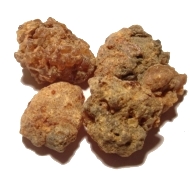
When a cut on a tree penetrates through the bark and into the sapwood, the tree secretes a resin. Myrrh gum, like frankincense, is such a resin. Myrrh is harvested by repeatedly cutting the trees to bleed the gum, which is waxy and coagulates quickly. After the harvest, the gum becomes hard and glossy. The gum is yellowish and may be either clear or opaque. It darkens deeply as it ages, and white streaks emerge.
Myrrh gum is commonly harvested from trees of the genus Commiphora. It is commonly extracted from the species Commiphora myrrha, Commiphora africana, Commiphora erythraea, Commiphora gileadensis, Commiphora habessinica, Commiphora hodai, Commiphora quardricincta, Commiphora schimperi and Commiphora truncata.
Commiphora myrrha is native to Somalia, Oman, Yemen, Eritrea, Somali Region of Ethiopia and parts of Saudi Arabia. Meetiga, a trade name for Arabian myrrh, is brittler and gummier than the Somali variety and does not have the latter's white markings.
Liquid myrrh, or stacte, which was written about by Pliny, was formerly a greatly valued ingredient and is commercially available as Jewish Incense.
The word myrrh corresponds to a common Semitic root m-r-r meaning "bitter", as in Arabic مُرّ murr and Aramaic ܡܪܝܪܐ mureera. Its name entered the English language by way of the Hebrew Bible, in which it is called מור mor, and also later as a Semitic loanword. It appears in numerous pre-Hellenic sources up to the translation of the Tanakh into the Septuagint, and later makes its way into the Greek myth about Myrrha; in the Ancient Greek language, the related word μῠ́ρον (múron), likely derived from a Semitic source, became a general term for perfume.
In pharmacology, myrrh has been used as an antiseptic in mouthwashes, gargles, and toothpastes. It has also been used in liniments and salves applied to abrasions and other minor skin ailments. Myrrh has been used as an analgesic for toothache pain and in liniments applied to bruises, aching muscles, and sprains.
Myrrh gum has often been claimed to reduce the symptoms of indigestion, ulcers, colds, cough, asthma, respiratory congestion, arthritis, and cancer, although more good scientific evidence is needed to support these uses. There is evidence to suggest certain compounds in myrrh interact with central opioid pathways in the brain.
Hub AI
Myrrh AI simulator
(@Myrrh_simulator)
Myrrh
Myrrh (/mɜːr/; from an unidentified ancient Semitic language, מוֹר /mor/; from Hebrew, see § Etymology) is a gum-resin extracted from a few small, thorny tree species of the Commiphora genus, belonging to the Burseraceae family. Myrrh resin has been used throughout history in medicine, perfumery, and incenses. Myrrh mixed with posca or wine was widely used in many ancient cultures to produce pleasurable feelings and as an anti-inflammatory and analgesic.[citation needed]
When a cut on a tree penetrates through the bark and into the sapwood, the tree secretes a resin. Myrrh gum, like frankincense, is such a resin. Myrrh is harvested by repeatedly cutting the trees to bleed the gum, which is waxy and coagulates quickly. After the harvest, the gum becomes hard and glossy. The gum is yellowish and may be either clear or opaque. It darkens deeply as it ages, and white streaks emerge.
Myrrh gum is commonly harvested from trees of the genus Commiphora. It is commonly extracted from the species Commiphora myrrha, Commiphora africana, Commiphora erythraea, Commiphora gileadensis, Commiphora habessinica, Commiphora hodai, Commiphora quardricincta, Commiphora schimperi and Commiphora truncata.
Commiphora myrrha is native to Somalia, Oman, Yemen, Eritrea, Somali Region of Ethiopia and parts of Saudi Arabia. Meetiga, a trade name for Arabian myrrh, is brittler and gummier than the Somali variety and does not have the latter's white markings.
Liquid myrrh, or stacte, which was written about by Pliny, was formerly a greatly valued ingredient and is commercially available as Jewish Incense.
The word myrrh corresponds to a common Semitic root m-r-r meaning "bitter", as in Arabic مُرّ murr and Aramaic ܡܪܝܪܐ mureera. Its name entered the English language by way of the Hebrew Bible, in which it is called מור mor, and also later as a Semitic loanword. It appears in numerous pre-Hellenic sources up to the translation of the Tanakh into the Septuagint, and later makes its way into the Greek myth about Myrrha; in the Ancient Greek language, the related word μῠ́ρον (múron), likely derived from a Semitic source, became a general term for perfume.
In pharmacology, myrrh has been used as an antiseptic in mouthwashes, gargles, and toothpastes. It has also been used in liniments and salves applied to abrasions and other minor skin ailments. Myrrh has been used as an analgesic for toothache pain and in liniments applied to bruises, aching muscles, and sprains.
Myrrh gum has often been claimed to reduce the symptoms of indigestion, ulcers, colds, cough, asthma, respiratory congestion, arthritis, and cancer, although more good scientific evidence is needed to support these uses. There is evidence to suggest certain compounds in myrrh interact with central opioid pathways in the brain.
Recent media