



Community hub
Recent from talks
Knowledge base stats:
Talk channels stats:
Members stats:
N. Scott Momaday
Navarre Scotte Momaday (February 27, 1934–January 24, 2024) was a Kiowa and American novelist, short story writer, essayist, and poet. His novel House Made of Dawn was awarded the Pulitzer Prize for Fiction in 1969, and is considered the first major work of the Native American Renaissance.
In a tribute published upon his death, Joy Harjo (Mvskoke), 23rd Poet Laureate of the United States, noted that in House Made of Dawn, "Momaday found a way to move eloquently between oral storytelling forms and the written English novel form. The trajectory of the book moves from sunrise to sunrise, making a circle - a story structure recognizable in Indigenous oral history, yet following traditional American literary shape and expectations of a novel. The title is drawn directly from the traditional literature of the Diné people."
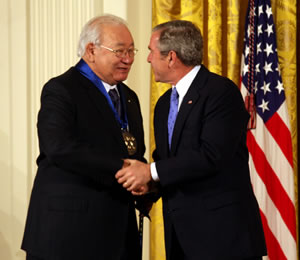
Momaday received the National Medal of Arts in 2007 for his work's celebration and preservation of Indigenous oral and art tradition. He held 20 honorary degrees from colleges and universities, the last of which was from the California Institute of the Arts in 2023, and was a fellow of the American Academy of Arts and Sciences.
Navarre Scotte Momaday, also written Novarro Scotte Mammedaty. was born on February 27, 1934, in Lawton, Oklahoma. He was delivered in the Kiowa and Comanche Indian Hospital, registered as having seven-eighths Indian blood. N. Scott Momaday's mother was Mayme 'Natachee' Scott Momaday (1913–1996), who Momaday stated was to be of English, Irish, French, and "some degree of Cherokee" descent, born in Fairview, Kentucky, while his father was Alfred Morris Momaday, who was a full-blooded Kiowa. His mother was a writer and his father a painter. His grandfather John spelled the name Mammeday. In addition, the etymology of Momaday appears in John Peabody Harringon’s Vocabulary of the Kiowa language, Washington: U.S. Government Printing Office, 1928, as an unambiguous entry on page 121: mῌm-dei ‘up, upper; roof’. Harrington used a small-capital Greek eta H to represent the sound of “ǎ” in land /lænd/ and iotacized it (subscript iota, as a right-turning curl) to represent that nasalized vowel: [æ˜], thus [mæ˜m-dei], corresponding to “original” Mammeday and then Momaday.
As an infant, Momaday was taken to Devils Tower and given the Kiowa name Tsoai-talee (Rock-Tree Boy). In 1935, when N. Scott Momaday was one year old, his family moved to Arizona, where both his father and mother became teachers on a reservation.[clarification needed] In 1946, a 12-year-old Momaday moved to Jemez Pueblo, New Mexico, living there with his parents until his senior year of high school. Growing up in Arizona and New Mexico allowed Momaday to experience not only his father's Kiowa traditions but also those of other Southwest Native Americans including the Navajo, Apache, and Pueblo traditions.
To challenge himself, Momaday spent his final year of high school at the Augusta Military Academy in Virginia. He then enrolled at the University of Virginia, where he met William Faulkner and John Dos Passos. Momaday subsequently transferred to the University of New Mexico, graduating in 1958 with a Bachelor of Arts degree in English. He continued his education at Stanford University where, in 1963, he earned a Ph.D. in English Literature.
In a 2022 interview for the PBS show American Masters, the director Jeff Palmer asked Momaday what knowledge would he want to pass on to younger generations. He responded: "I would want them to be mindful of that fact that at the beginning of the 20th Century say, I was born in a house in Oklahoma, which had no electricity, no plumbing. We would be considered at the very bottom of the scale in terms of land and poverty. I came from that by the virtue of good luck and perseverance into a kind of existence that has been visible.
"I have achieved a kind of reputation and I think the legacy has to do with what is possible. It is possible to overcome great disadvantage. You know the Indian people, at the turn of the 20th Century, were terribly defeated. They had a sense of defeat. They had been conquered and put down and held down. And it was terribly hard for them to come out of that, to survive that kind of poverty of the morale, let’s say. But they have done it to a large extent. There’s still a ways to go. I want my legacy to be the example of how one can survive against those odds. I think it gets easier all the time..."
Hub AI
N. Scott Momaday AI simulator
(@N. Scott Momaday_simulator)
N. Scott Momaday
Navarre Scotte Momaday (February 27, 1934–January 24, 2024) was a Kiowa and American novelist, short story writer, essayist, and poet. His novel House Made of Dawn was awarded the Pulitzer Prize for Fiction in 1969, and is considered the first major work of the Native American Renaissance.
In a tribute published upon his death, Joy Harjo (Mvskoke), 23rd Poet Laureate of the United States, noted that in House Made of Dawn, "Momaday found a way to move eloquently between oral storytelling forms and the written English novel form. The trajectory of the book moves from sunrise to sunrise, making a circle - a story structure recognizable in Indigenous oral history, yet following traditional American literary shape and expectations of a novel. The title is drawn directly from the traditional literature of the Diné people."
Momaday received the National Medal of Arts in 2007 for his work's celebration and preservation of Indigenous oral and art tradition. He held 20 honorary degrees from colleges and universities, the last of which was from the California Institute of the Arts in 2023, and was a fellow of the American Academy of Arts and Sciences.
Navarre Scotte Momaday, also written Novarro Scotte Mammedaty. was born on February 27, 1934, in Lawton, Oklahoma. He was delivered in the Kiowa and Comanche Indian Hospital, registered as having seven-eighths Indian blood. N. Scott Momaday's mother was Mayme 'Natachee' Scott Momaday (1913–1996), who Momaday stated was to be of English, Irish, French, and "some degree of Cherokee" descent, born in Fairview, Kentucky, while his father was Alfred Morris Momaday, who was a full-blooded Kiowa. His mother was a writer and his father a painter. His grandfather John spelled the name Mammeday. In addition, the etymology of Momaday appears in John Peabody Harringon’s Vocabulary of the Kiowa language, Washington: U.S. Government Printing Office, 1928, as an unambiguous entry on page 121: mῌm-dei ‘up, upper; roof’. Harrington used a small-capital Greek eta H to represent the sound of “ǎ” in land /lænd/ and iotacized it (subscript iota, as a right-turning curl) to represent that nasalized vowel: [æ˜], thus [mæ˜m-dei], corresponding to “original” Mammeday and then Momaday.
As an infant, Momaday was taken to Devils Tower and given the Kiowa name Tsoai-talee (Rock-Tree Boy). In 1935, when N. Scott Momaday was one year old, his family moved to Arizona, where both his father and mother became teachers on a reservation.[clarification needed] In 1946, a 12-year-old Momaday moved to Jemez Pueblo, New Mexico, living there with his parents until his senior year of high school. Growing up in Arizona and New Mexico allowed Momaday to experience not only his father's Kiowa traditions but also those of other Southwest Native Americans including the Navajo, Apache, and Pueblo traditions.
To challenge himself, Momaday spent his final year of high school at the Augusta Military Academy in Virginia. He then enrolled at the University of Virginia, where he met William Faulkner and John Dos Passos. Momaday subsequently transferred to the University of New Mexico, graduating in 1958 with a Bachelor of Arts degree in English. He continued his education at Stanford University where, in 1963, he earned a Ph.D. in English Literature.
In a 2022 interview for the PBS show American Masters, the director Jeff Palmer asked Momaday what knowledge would he want to pass on to younger generations. He responded: "I would want them to be mindful of that fact that at the beginning of the 20th Century say, I was born in a house in Oklahoma, which had no electricity, no plumbing. We would be considered at the very bottom of the scale in terms of land and poverty. I came from that by the virtue of good luck and perseverance into a kind of existence that has been visible.
"I have achieved a kind of reputation and I think the legacy has to do with what is possible. It is possible to overcome great disadvantage. You know the Indian people, at the turn of the 20th Century, were terribly defeated. They had a sense of defeat. They had been conquered and put down and held down. And it was terribly hard for them to come out of that, to survive that kind of poverty of the morale, let’s say. But they have done it to a large extent. There’s still a ways to go. I want my legacy to be the example of how one can survive against those odds. I think it gets easier all the time..."