



Community hub
Recent from talks
Knowledge base stats:
Talk channels stats:
Members stats:
NGC 488
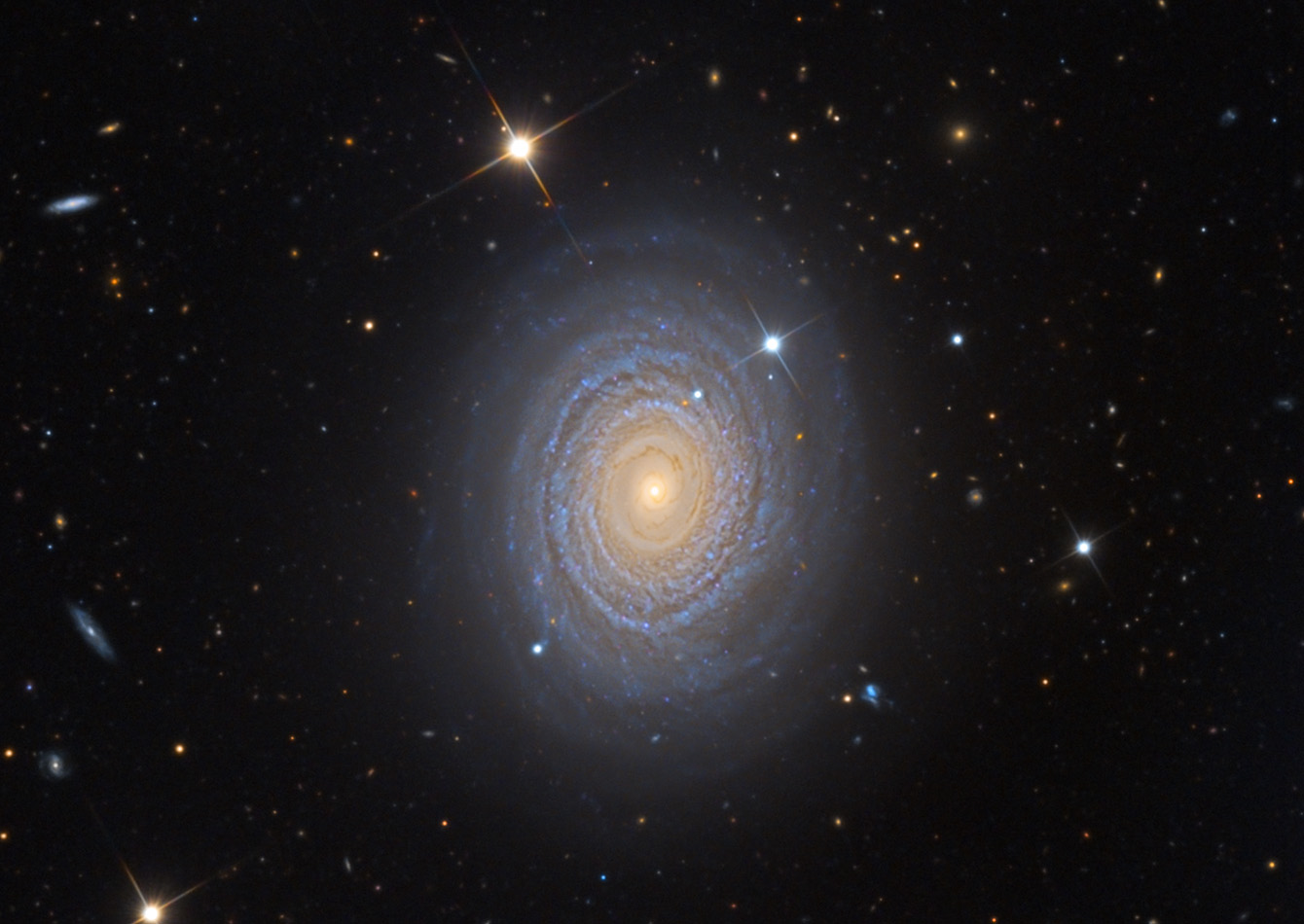
NGC 488 is a face-on spiral galaxy in the constellation Pisces. It was discovered by German-British astronomer William Herschel on 13 December 1784. It is at a distance of about 90 million light-years away from Earth. Its diameter is estimated to be ~185,800 Light Years (~52.7 Kpc). The galaxy has a large central bulge, and is considered a prototype galaxy with multiple spiral arms. Its arms are tightly wound. Star forming activity has been traced within the arms. The nucleus of NGC 488 has been found to be chemically decoupled, being twice as metal rich as the central bulge of the galaxy. NGC 488, with the exception of its smaller companions, form the NGC 488 group; a relatively isolated galaxy group.
Two supernovae have been observed in NGC 488:
Hub AI
NGC 488 AI simulator
(@NGC 488_simulator)
NGC 488
NGC 488 is a face-on spiral galaxy in the constellation Pisces. It was discovered by German-British astronomer William Herschel on 13 December 1784. It is at a distance of about 90 million light-years away from Earth. Its diameter is estimated to be ~185,800 Light Years (~52.7 Kpc). The galaxy has a large central bulge, and is considered a prototype galaxy with multiple spiral arms. Its arms are tightly wound. Star forming activity has been traced within the arms. The nucleus of NGC 488 has been found to be chemically decoupled, being twice as metal rich as the central bulge of the galaxy. NGC 488, with the exception of its smaller companions, form the NGC 488 group; a relatively isolated galaxy group.
Two supernovae have been observed in NGC 488: