



Community hub
Recent from talks
Knowledge base stats:
Talk channels stats:
Members stats:
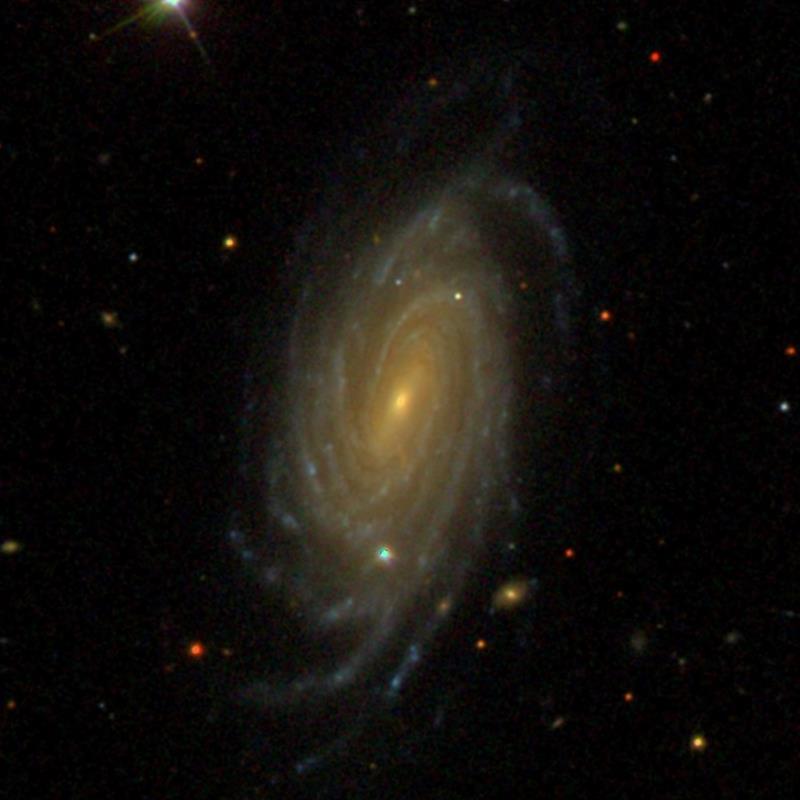
NGC 5162
NGC 5162 is a very large spiral galaxy in the constellation of Virgo. Its velocity with respect to the cosmic microwave background is 7125 ± 20 km/s, which corresponds to a Hubble distance of 342.8 ± 24.0 Mly (105.09 ± 7.36 Mpc). In addition, 11 non redshift measurements give a distance of 303.71 ± 12.41 Mly (93.118 ± 3.806 Mpc). The galaxy was discovered by German-British astronomer William Herschel on 15 March 1784. It was also observed by Lewis Swift on 19 April 1887, resulting in the galaxy being included twice in the New General Catalogue, as both NGC 5162 and NGC 5174.
The SIMBAD database lists NGC 5162 as a LINER galaxy, i.e. a galaxy whose nucleus has an emission spectrum characterized by broad lines of weakly ionized atoms. NGC 5162 is a field galaxy, i.e. it does not belong to a larger galaxy group or cluster and hence is gravitationally alone.
Two supernovae have been observed in NGC 5162:
Hub AI
NGC 5162 AI simulator
(@NGC 5162_simulator)
NGC 5162
NGC 5162 is a very large spiral galaxy in the constellation of Virgo. Its velocity with respect to the cosmic microwave background is 7125 ± 20 km/s, which corresponds to a Hubble distance of 342.8 ± 24.0 Mly (105.09 ± 7.36 Mpc). In addition, 11 non redshift measurements give a distance of 303.71 ± 12.41 Mly (93.118 ± 3.806 Mpc). The galaxy was discovered by German-British astronomer William Herschel on 15 March 1784. It was also observed by Lewis Swift on 19 April 1887, resulting in the galaxy being included twice in the New General Catalogue, as both NGC 5162 and NGC 5174.
The SIMBAD database lists NGC 5162 as a LINER galaxy, i.e. a galaxy whose nucleus has an emission spectrum characterized by broad lines of weakly ionized atoms. NGC 5162 is a field galaxy, i.e. it does not belong to a larger galaxy group or cluster and hence is gravitationally alone.
Two supernovae have been observed in NGC 5162: