Hubbry Logo
NIST Enterprise Architecture ModelNIST Enterprise Architecture ModelMain
Open search
NIST Enterprise Architecture Model
Community hub
NIST Enterprise Architecture Model
logo
8 pages, 0 posts
0 subscribers
Be the first to start a discussion here.
NIST Enterprise Architecture Model
from Wikipedia

NIST Enterprise Architecture Model.

NIST Enterprise Architecture Model (NIST EA Model) is a late-1980s reference model for enterprise architecture. It defines an enterprise architecture[1] by the interrelationship between an enterprise's business, information, and technology environments.[2]

Developed late-1980s by the National Institute of Standards and Technology (NIST) and others, the federal government of the United States promoted this reference model in the 1990s as the foundation for enterprise architectures of individual U.S. government agencies and in the overall federal enterprise architecture.[2]

Intro

[edit]

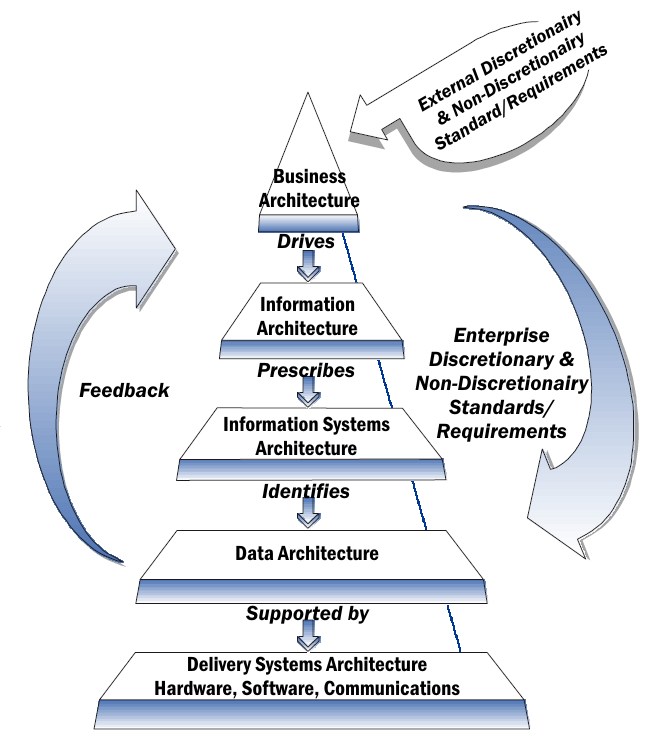
The NIST Enterprise Architecture Model is a five-layered model for enterprise architecture, designed for organizing, planning, and building an integrated set of information and information technology architectures. The five layers are defined separately but are interrelated and interwoven.[2] The model defined the interrelation as follows:[3]

  • Business Architecture drives the information architecture
  • Information architecture prescribes the information systems architecture
  • Information systems architecture identifies the data architecture
  • Data Architecture suggests specific data delivery systems, and
  • Data Delivery Systems (Software, Hardware, Communications) support the data architecture.

The hierarchy in the model is based on the notion that an organization operates a number of business functions, each function requires information from a number of source, and each of these sources may operate one or more operation systems, which in turn contain data organized and stored in any number of data systems.[4]

History

[edit]

The NIST Enterprise Architecture Model is initiated in 1988 in the fifth workshop on Information Management Directions sponsored by the NIST in cooperation with the Association for Computing Machinery (ACM), the IEEE Computer Society, and the Federal Data Management Users Group (FEDMUG). The results of this research project were published as the NIST Special Publication 500-167, Information Management Directions: The Integration Challenge.[3]

The emerging field of information management

[edit]

With the proliferation of information technology starting in the 1970s, the job of information management had taken a new light, and also began to include the field of data maintenance. No longer was information management a simple job that could be performed by almost anyone. An understanding of the technology involved, and the theory behind it became necessary. As information storage shifted to electronic means, this became more and more difficult.[3]

The notion of a three-schema model was first introduced in 1975 by the ANSI/X3/SPARC three level architecture, which determined three levels to model data.[5]

One of the first overall approaches to building information systems and systems information management from the 1970s was the three-schema approach. It proposes to use three different views in systems development, in which conceptual modelling is considered to be the key to achieving data integration:[6]

  • External schema for user views
  • Conceptual schema integrates external schemata
  • Internal schema that defines physical storage structures

At the center, the conceptual schema defines the ontology of the concepts as the users think of them and talk about them. The physical schema according to Sowa (2004) "describes the internal formats of the data stored in the database, and the external schema defines the view of the data presented to the application programs".[7]

Since the 1970s the NIST had held a series of four workshops on Database and Information Management Directions. Each of the workshops addresses a specific theme:[8]

  • "What information about database technology does the manager need to make prudent decisions about using new technology", in 1975.
  • "What information can help a manager assess the impact on a database system?" in 1977.
  • "Information management tools from the standpoint of: uses; policies and controls; logical and physical database design" in 1980; and
  • "The nature of information resource management practice and problems" in 1985.

The fifth workshop in 1989 was held by the National Computer Systems Laboratory (NCSL) of the NIST. By then this was one of the four institutes, that performed the technical work of the NIST. The specific goal of the NCSL was to conduct research and provide scientific and technical services to aid Federal agencies in the selection, acquisition, application, and use of computer technology.[9]

NIST workshop on Information Management Directions

[edit]

The fifth Information Management Directions workshop in 1989 focused on integration and productivity in information management. Five working groups considered specific aspects of the integration of knowledge, data management, systems planning, development and maintenance, computing environments, architectures and standards. Participants came from academia, industry, government and consulting firms. Among the 72 participants were Tom DeMarco, Ahmed K. Elmagarmid, Elizabeth N. Fong, Andrew U. Frank,[10] Robert E. Fulton,[11] Alan H. Goldfine,[12] Dale L. Goodhue,[13] Richard J. Mayer, Shamkant Navathe, T. William Olle, W. Bradford Rigdon, Judith A. Quillard, Stanley Y. W. Su,[14] and John Zachman.

Tom DeMarco delivered the keynote speech, claiming that standards do more harm than good when they work against the prevailing culture, and that the essence of standardization is discovery, not innovation.[15] The five working groups met to discuss different aspects of integration:

  • the integration of knowledge and data management
  • the integration of technical and business data management
  • the integration of systems planning, development, and maintenance tools and methods
  • the integration of distributed, heterogeneous computing environments, and
  • architectures and standards.

In the third working group on systems planning was chaired by John Zachman, and adopted the Zachman Framework as a basis for discussion.

Model of Enterprise Architecture, 1989

The fifth working group on architectures and standards was chaired W. Bradford Rigdon of the McDonnell Douglas Information Systems Company (MDISC), a division of McDonnell Douglas. Rigdon et al. (1989) [16] explained that discussions about architecture in that time mostly focus on technology concerns. Their aim was to "takes a broader view, and describes the need for an enterprise architecture that includes an emphasis on business and information requirements. These higher level issues impact data and technology architectures and decisions."[17] In order to do so, the working group addressed three issues:[18]

  • The levels of architecture in an enterprise
  • Problems addressed by architecture
  • Benefits and risks of having architecture

To illustrate the levels of architecture, what has become known as the NIST Enterprise Architecture Model, was presented (see image). In this concept the three layers of the three-schema approach are divided into five layers.

Application in the 1990s

[edit]

In a way the NIST Enterprise Architecture Model was ahead of his time. According to Zachman (1993) in the 1980s the "architecture" was acknowledged as a topic of interest, but there was still little consolidated theory concerning this concept.[19] Software architecture, for example. become an important topic not until the second half of the nineties.[20]

To support the NIST Enterprise Architecture Model in the 1990s, it was widely promoted within the U.S. federal government as Enterprise Architecture management tool.[2] The NIST Enterprise Architecture Model is applied as foundation in multiple Enterprise Architecture frameworks of U.S. Federal government agencies and in the overall Federal Enterprise Architecture Framework.[2] In coordinating this effort the NIST model was further explained and extended in the 1997 "Memoranda 97-16 (Information Technology Architectures)" issued by the US Office of Management and Budget.,[21] see further Information Technology Architecture.

NIST Enterprise Architecture Model topics

[edit]

Foundations

[edit]

According to Rigdon et al. (1989) an architecture is "a clear representation of a conceptual framework of components and their relationship at a point in time".[22] It may for example represent "a view of a current situation with islands of automation, redundant processes and data inconsistencies"[23] or a "future integrated automation information structure towards which the enterprise will move in a prescribed number on years."[24] The role of standards in architecture is to "enable or constrain the architecture and serve as its foundation".[23]

In order to develop an enterprise architecture Rigdon acknowledge:[17]

  • There are multiple ways to develop an architecture
  • There are multiple ways to implement standards
  • Development and implementation should be customized to the environment
  • Yet, every architecture itself can be divided into different levels.

The different levels of an enterprise architecture can be visualized as a pyramid: On top the business unit of an enterprise, and at the bottom the delivery system within the enterprise. The enterprise can consist of one or more business units, working in specific business area. The five levels of architecture are defined as: Business Unit, Information, Information System, Data and Delivery System.[23]

The separate levels of an enterprise architecture are interrelated in a special way. On every level the architectures assumes or dictates the architectures at the higher level. The illustration on the right gives an example of which elements can constitute an Enterprise Architecture.

Sample elements of an Enterprise Architecture (1989).

Levels of architecture

[edit]

Each layer of architecture in the model has a specific intention:[25]

  • Business Architecture level: This level can picture the total or a subunit of any corporation, which are in contact with external organizations.
  • Information architecture level: This level specifies types of content, presentation forms, and format of the information required.
  • Information systems architecture level: Specifications for automated and procedure-oriented information systems.
  • Data Architecture level: Framework for maintenance, access and use of data, with data dictionary and other naming conventions.
  • Data Delivery Systems level: Technical implementation level of software, hardware, and communications that support the data architecture.

Some sample elements of how the Enterprise Architecture can be described in more detail is shown in the illustration.

Information Technology Architecture

[edit]

The "Memoranda 97-16 (Information Technology Architectures)" gave the following definition of enterprise architecture:[21]

The Enterprise Architecture is the explicit description of the current and desired relationships among business and management process and information technology. It describes the "target" situation which the agency wishes to create and maintain by managing its IT portfolio.
The documentation of the Enterprise Architecture should include a discussion of principles and goals.[Note 1] For example, the agency's overall management environment, including the balance between centralization and decentralization and the pace of change within the agency, should be clearly understood when developing the Enterprise Architecture. Within that environment, principles and goals set direction on such issues as the promotion of interoperability, open systems, public access, end-user satisfaction, and security.

In this guidance the five component model of the NIST was adopted and further explained. Agencies were permitted to identify different components as appropriate and to specify the organizational level at which specific aspects of the components will be implemented. Although the substance of these components, sometimes called "architectures" or "sub-architectures," must be addressed in every agency's complete Enterprise Architecture, agencies have great flexibility in describing, combining, and renaming the components, which consist of:[21]

  • Business Processes: This component of the Enterprise Architecture describes the core business processes which support the organization's missions. The Business Processes component is a high-level analysis of the work the agency performs to support the organizations's mission, vision, and goals, and is the foundation of the ITA. Analysis of the business processes determine the information needed and processed by the agency. This aspect of the ITA must be developed by senior program managers in conjunction with IT managers. Without a thorough understanding of its business processes and their relation to the agency missions, the agency will not be able to use its ITA effectively.
    Business processes can be described by decomposing the processes into derivative business activities. There are a number of methodologies and related tools available to help agencies decompose processes. Irrespective of the tool used, the model should remain at a high enough level to allow a broad agency focus, yet sufficiently detailed to be useful in decision-making as the agency identifies its information needs. Agencies should avoid excessive emphasis on modeling business processes, which can result in a waste of agency resources.[Note 2]
  • Information Flows and Relationships: This component analyzes the information utilized by the organization in its business processes, identifying the information used and the movement of the information within the agency. The relationships among the various flows of information are described in this component. These information flows indicate where the information is needed and how the information is shared to support mission functions.[Note 3]
  • Applications : The Applications component identifies, defines, and organizes the activities that capture, manipulate, and manage the business information to support mission operations. It also describes the logical dependencies and relationships among business activities.[Note 4]
  • Data Descriptions: This component of the Enterprise Architecture identifies how data is maintained, accessed, and used. At a high level, agencies define the data and describe the relationships among data elements used in the agency's information systems. The Data Descriptions and Relationships component can include data models that describe the data underlying the business and information needs of the agency. Clearly representing the data and data relationships is important for identifying data that can be shared corporately, for minimizing redundancy, and for supporting new applications[Note 5]
  • Technology Infrastructure : The Technology Infrastructure component describes and identifies the physical layer including, the functional characteristics, capabilities, and interconnections of the hardware, software, and communications, including networks, protocols, and nodes. It is the "wiring diagram" of the physical IT infrastructure.[Note 6]

With the exception of the Business Processes component, the interrelationships among and priorities of these components are not prescribed by this guidance; there is no hierarchy of relationships implied. Furthermore, agencies should document not only their current environment for each of these components, but also the target environment that is desired.[21]

Applications

[edit]
FDIC EA Framework.[26]

The NIST Framework was picked up by several U.S. federal agencies and used as the basis for their information strategy.[27] The reference model is applicated the following frameworks:

See also

[edit]

Notes

[edit]

References

[edit]
[edit]
Revisions and contributorsEdit on WikipediaRead on Wikipedia
from Grokipedia
The NIST Enterprise Architecture Model (NIST EA Model) is a foundational reference framework published by the U.S. National Institute of Standards and Technology (NIST) in , based on John A. Zachman's 1987 framework for systems architecture, to guide the design, planning, and implementation of integrated s within federal enterprises. It organizes into five interconnected levels—business unit, , , data, and delivery system (technology infrastructure)—to align organizational objectives with IT capabilities, emphasizing , , and across the enterprise. Published as part of NIST Special Publication 500-167, Information Management Directions: The Integration Challenge, the model emerged during a period of growing federal emphasis on consolidation and efficiency, addressing challenges in managing disparate and promoting a holistic view of enterprise resources. The business unit level focuses on organizational processes and goals; the level defines flows and semantics; the level details application functionalities; the level specifies storage and structures; and the delivery system level covers hardware, networks, and supporting infrastructure. This layered approach enables systematic analysis and evolution from current to target architectures, facilitating better decision-making for IT investments. The NIST EA Model played a pivotal role in the early evolution of enterprise architecture practices, influencing subsequent frameworks such as the Framework (FEAF) and serving as a precursor to modern standards like TOGAF. Although it predates contemporary and zero-trust paradigms, its principles of and alignment remain relevant for ensuring secure, scalable IT environments in government and beyond. By providing a structured without prescriptive tools, it encouraged agencies to adapt the model to their specific needs, promoting long-term over siloed development.

Overview and Foundations

Introduction

The NIST Enterprise Architecture Model is a five-layered designed to organize across business, information, and technology domains. Developed by the National Institute of Standards and Technology (NIST), it provides a structured approach for describing the interrelationships among an organization's mission, processes, data, applications, and supporting technology to facilitate integrated . The core purpose of the model is to promote integration and in federal (IT) systems by mapping architectures from high-level business needs to technical implementation and delivery. It addresses the challenges of aligning diverse IT components with organizational objectives, enabling agencies to plan, develop, and maintain cohesive systems that support efficient service delivery and . This focus on systematic helps federal entities avoid and ensure across their IT environments. At a high level, the model's key layers include the Business layer, which outlines organizational missions and processes; the Information layer, which defines the required to support those processes; the Information Systems layer, which specifies applications and software; the layer, which details data structures and storage; and the Data Delivery Systems layer, which covers hardware, networks, and delivery mechanisms. These layers form a hierarchical progression from strategic business requirements to , emphasizing . Initiated in the late as part of NIST's efforts to guide U.S. federal agencies in IT architecture, the model emerged amid growing needs for standardized information systems in government operations. Unlike process-oriented frameworks such as the , which uses a matrix of perspectives and interrogatives to classify artifacts, the NIST model prioritizes layered to directly link business strategy with technical infrastructure.

Conceptual Foundations

The NIST Enterprise Architecture Model conceptualizes architecture as a clear representation of a comprising interrelated components and their relationships at a given point in time, serving to guide the design and integration of enterprise information systems. This framework emphasizes an integrated end-state vision for aligned with specific business contexts, enabling systematic planning and development across organizational domains. Central to the model is the role of standards, which act as enablers of by bridging architectures, , and applications management, while simultaneously constraining design choices to promote consistency and integration. Standards function as foundational elements that both facilitate and limit architectural possibilities, ensuring that components adhere to established protocols for data interchange, modeling, and platform compatibility. This approach underscores the model's commitment to structured integration, where standards bridge the gap between abstract business needs and concrete technical implementations. The model's theoretical underpinnings draw from prior database architecture concepts, notably the ANSI/X3/SPARC three-level schema proposed in 1975, which introduced abstraction layers for external, conceptual, and internal data views as a precursor to layered enterprise modeling. Key principles include hierarchical decomposition, progressing from high-level business objectives to detailed technical implementations, and the treatment of as a strategic corporate asset that underpins both technological and managerial integration. Unlike , which emerged prominently in the with a focus on code-level design and , the NIST model adopts a broader enterprise scope encompassing business processes, , and organizational support to foster holistic system alignment.

Historical Development

Emergence of Information Management Practices

During the 1970s, the rapid proliferation of , including the widespread adoption of minicomputers and early microcomputers, led to the emergence of fragmented information systems across organizations. This expansion, driven by advancements in hardware affordability and computing power, resulted in decentralized that often created silos, duplication of efforts, and significant challenges in maintaining consistency and . Enterprises faced difficulties in coordinating disparate systems, which hindered efficient and . Key influences in addressing these issues included methodologies like IBM's Business Systems Planning (BSP), initiated in the 1960s and formalized in its first edition in 1975, which emphasized top-down planning to align business objectives with information systems through relationship matrices and data flow analysis. Additionally, early database architectures such as the CODASYL network model, specified in the 1971 Report of the CODASYL Data Base Task Group, provided a framework for managing complex relationships in shared data environments, promoting more structured data handling beyond flat files. These developments marked a shift toward viewing information as a critical enterprise resource, with growing recognition in the late 1970s and early 1980s of the need to treat data as a strategic asset rather than a byproduct of operations. However, integration challenges persisted, particularly across departments, where varying technologies and standards exacerbated interoperability issues and increased costs. In the federal government context, this IT reliance intensified during the and , as agencies increasingly depended on computers for , such as tax at the IRS, leading to uncontrolled growth in hardware and software acquisitions that amplified fragmentation. By the mid-1980s, these challenges prompted a push for standardized approaches to unify systems and improve , setting the stage for coordinated efforts to manage information resources effectively. A pivotal contribution was the 1975 ANSI/X3/ proposal for a three-level database —comprising external (user views), conceptual (enterprise model), and internal (physical storage) schemas—which influenced layered thinking by enabling and easier maintenance amid evolving technologies. This pre-NIST backdrop of proliferation and integration hurdles underscored the necessity for federal initiatives to develop comprehensive models for .

NIST Workshops and Model Formulation

The development of the NIST Enterprise Architecture Model was triggered by the fifth NIST Workshop on Directions, held from October 31 to November 2, 1988, in . This event, attended by 72 experts from government, industry, and academia, addressed critical challenges in integrating information systems across federal enterprises. Keynote speaker Tom DeMarco emphasized cultural alignment in standards adoption, while John Zachman served as panel chair, introducing elements of his framework to structure discussions. The workshop organized participants into five working groups focused on integration themes, including the alignment of and (IT) processes, the unification of technical and , and the design of multi-level architectures tailored for federal government applications. A core emphasis was on fostering enterprise-wide integration to enhance and reduce silos in environments. Drawing from Zachman's 1987 framework, which organizes architecture into rows representing perspectives (e.g., models) and columns for primitives (e.g., , processes), the groups explored how such structures could support practical federal IT planning. Building on these 1988 discussions, the model's formulation culminated in a collaborative process documented in NIST Special Publication 500-167, published in 1989. Panels drafted and refined reports over the workshop days, synthesizing inputs into a five-layer architecture: business unit, information, information system, data, and delivery system. This structure prioritized actionable guidance for government agencies, promoting organizational commitment and tool integration to bridge business goals with IT implementation. The effort underscored the need for standards that align with enterprise culture, ensuring the model's applicability in real-world federal contexts.

Adoption and Promotion in the 1990s

The Clinger-Cohen Act of 1996 significantly advanced the adoption of practices across the U.S. federal government by mandating that each agency appoint a (CIO) responsible for developing, maintaining, and facilitating the implementation of an agency-wide IT architecture. This legislation, also known as the Information Technology Management Reform Act, emphasized the need for integrated IT architectures to improve mission effectiveness, promote interoperability, and ensure efficient use of federal resources, thereby elevating the NIST Enterprise Architecture Model as a foundational reference for compliance. Building on this momentum, the Office of Management and Budget (OMB) issued Memorandum 97-16 in June 1997, which provided detailed guidance on developing and implementing Architectures (ITAs) required under the Clinger-Cohen Act. The memorandum explicitly adapted the NIST Enterprise Architecture Model from NIST Special Publication 500-167, structuring it into five key components—business processes, information flows and relationships, applications, data descriptions, and technology infrastructure—while extending it with a Technical Reference Model (TRM) and standards profiles to address , , and emerging federal IT needs. This extension positioned the NIST model as the core basis for federal EA guidelines by the late , influencing agency planning and budgeting processes. Early implementations of the NIST model emerged in federal agencies during this period. For instance, agencies began documenting "as-is" and "to-be" architectures to support strategic IT planning, as part of broader initiatives in the late and early 2000s. In the late , challenges arose in adapting the NIST model to emerging software architectures, such as distributed systems and early web technologies, prompting extensions like the TRM in OMB guidance to incorporate standards for portability and scalability. These adaptations addressed limitations in the original model's focus on hierarchical layers, enabling better integration with client-server paradigms and initial requirements, though agencies often faced hurdles in achieving full due to varying maturity levels.

Model Components

Architectural Levels

The NIST Enterprise Architecture Model organizes enterprise information systems into five hierarchical levels, providing a structured approach to align business objectives with technical implementations. This model, developed through NIST workshops, emphasizes progressive abstraction, starting from high-level strategic business views and descending to detailed tactical components, ensuring coherence across the enterprise. The top level, , defines the organizational units, functions, and processes that drive the enterprise's mission and operations. It establishes a framework for identifying internal and external information needs, including business strategies, goals, and applicable standards, to guide overall . The purpose is to provide a foundational view that ensures IT supports core business activities without delving into technical details. Next, Information Architecture specifies the content, formats, and flows of required to fulfill needs. It details how information is presented, sourced, and utilized across organizational units, focusing on logical specifications rather than physical storage or processing. This level's purpose is to promote data consistency, , and , bridging requirements with downstream system designs. The Information Systems Architecture level addresses automated systems for acquiring, processing, and distributing . It includes frameworks for application logic, such as logical database designs and system functionalities that transform into usable . Its primary purpose is to define how systems operate independently of specific hardware, enabling efficient information handling while maintaining alignment with upper-level information specifications. Data Architecture provides frameworks for the storage, , and access of elements. It encompasses dictionaries, naming conventions, and structures that support sharing and integrity across systems. The purpose here is to ensure is managed as a , facilitating reuse and reducing in enterprise-wide operations. At the base, Data Delivery Systems encompass the hardware, software, and communications required to deliver and . This level details technical implementations, such as networks and platforms, that enable the physical realization of upper-level architectures. Its purpose is to provide the operational foundation, ensuring reliable performance and scalability for all preceding levels. Inter-level mappings in the model enforce alignment through top-down constraints, where higher levels dictate requirements for lower ones. For instance, business processes at the top level constrain information flows, which in turn prescribe system functionalities, data structures, and ultimately delivery mechanisms, promoting and integration. This hierarchical dependency supports the model's unique concept of progressive abstraction, transitioning from abstract strategic perspectives to concrete implementations. The model is often represented diagrammatically as a , with at the apex narrowing to Data Delivery Systems at the base, illustrating the flow of standards and dependencies from enterprise-wide to infrastructure-specific elements.

Information Technology Architecture Elements

The Information Technology Architecture Elements, as outlined in the 1997 (OMB) Memorandum M-97-16, provide a structured framework for detailing the IT components necessary to support federal agency missions under the Clinger-Cohen Act. These elements extend the foundational levels of the NIST Enterprise Architecture Model by offering practical specifications for implementation, particularly in the Information Systems and Data Delivery layers, ensuring alignment between business objectives and technological capabilities. Defined to facilitate informed federal IT investment decisions, they emphasize the use of standards to promote , portability, and across agency systems. The core elements include five interrelated components that form an IT-focused subset enabling the broader enterprise architecture:
  • Business Processes: These represent high-level analyses of core agency functions and workflows that support mission delivery, serving as the starting point for identifying IT requirements and ensuring that technology investments directly enhance operational efficiency.
  • Information Flows: This element maps the movement, exchange, and relationships of information across business processes, highlighting dependencies to optimize data handling and support mission-critical functions without unnecessary duplication.
  • Applications: Encompassing software systems and their logical interdependencies, applications are defined to capture, process, and manage business information, with a focus on modular designs that integrate seamlessly with other architectural layers.
  • Data Descriptions: These detail the structure, maintenance, access methods, and interrelationships of data elements, aiming to minimize redundancy, enhance data sharing, and ensure consistency through standardized schemas and metadata.
  • Technology Infrastructure: As the foundational physical layer, this includes hardware platforms, software environments, network topologies, and supporting services such as security protocols (e.g., authentication and access controls), all aligned with federal standards to enable reliable connectivity and resource sharing.
A key unique aspect of these elements is their integration with the Technical Reference Model (TRM) and Standards Profiles, which mandate adherence to OMB Circular A-130 guidelines for hardware, software, and network . By specifying these IT components, the model differentiates itself as a practical tool for federal agencies to evaluate and justify major IT investments, ensuring cost-effective and mission-aligned deployments.

Applications and Legacy

Implementations in Federal Agencies

The NIST Enterprise Architecture Model served as a foundational reference for early implementations in U.S. federal agencies during the , particularly in planning information systems to align IT with mission objectives. For instance, the U.S. Customs Service incorporated elements of the model into its August 1999 Enterprise Architecture Blueprint, which detailed activity models, data requirements, and technical infrastructure to support border security operations and reduce system redundancies. This approach helped agencies like Customs establish baseline architectures that integrated business processes with technology environments, promoting across federal operations. The model's broader adoption accelerated following the Clinger-Cohen Act of 1996, which required federal agencies to develop, maintain, and use enterprise architectures for IT investments and management. Agencies leveraged the NIST model as a basis for their EA frameworks, ensuring alignment with and capital investment control processes under the Act's guidelines. This integration facilitated more disciplined IT budgeting, as architectures informed the evaluation of proposed systems against agency missions, ultimately aiming to eliminate wasteful spending estimated at billions annually in federal IT. Post-2000 implementations extended the model's influence into ongoing IT management and budgeting. The model also shaped key Government Accountability Office (GAO) assessments of federal IT, notably influencing the 1999 Framework (FEAF) developed by the Federal CIO Council, which extended NIST's levels to guide cross-agency collaboration.

Influence on Contemporary Frameworks

The NIST Enterprise Architecture Model provided a foundational layered structure for the Framework (FEAF) version 1, released in September 1999 by the Federal Chief Information Officers (CIO) Council. This early FEAF integrated the NIST model's emphasis on interrelationships among business, information, and technology environments to standardize development across federal agencies, ensuring alignment with mission objectives and IT investments. The model's five architectural levels—spanning business units to delivery vehicles—influenced FEAF's core components, promoting a approach for and . Subsequent evolution in FEAF version 2, issued in January 2013 by the Office of Management and Budget (OMB), expanded to include performance reference models and a consolidated framework for federal IT governance. This update addressed broader enterprise needs, such as and collaborative planning. As of 2022, the model's historical principles continue to inform federal EA practices under OMB's Common Approach to . As one of the earliest formalized models (initiated in 1989), the NIST EA model contributed to the evolution of standards within federal contexts.

References

Add your contribution
Related Hubs
User Avatar
No comments yet.