Respect all members: no insults, harassment, or hate speech.
Be tolerant of different viewpoints, cultures, and beliefs. If you do not agree with others, just create separate note, article or collection.
Clearly distinguish between personal opinion and fact.
Verify facts before posting, especially when writing about history, science, or statistics.
Promotional content must be published on the “Related Services and Products” page—no more than one paragraph per service. You can also create subpages under the “Related Services and Products” page and publish longer promotional text there.
Do not post materials that infringe on copyright without permission.
Always credit sources when sharing information, quotes, or media.
Be respectful of the work of others when making changes.
Discuss major edits instead of removing others' contributions without reason.
If you notice rule-breaking, notify community about it in talks.
Do not share personal data of others without their consent.
A pyramid (from Ancient Greekπυραμίς (puramís)'pyramid',[1][2] from the Egyptian pir-em-us, the vertical height of the structure.[3]) is a structure whose visible surfaces are triangular in broad outline and converge toward the top, making the appearance roughly a pyramid in the geometric sense. The base of a pyramid can be of any polygon shape, such as triangular or quadrilateral, and its surface-lines either filled or stepped.
A pyramid has the majority of its mass closer to the ground[4] with less mass towards the pyramidion at the apex. This is due to the gradual decrease in the cross-sectional area along the vertical axis with increasing elevation. This offers a weight distribution that allowed early civilizations to create monumental structures.
Chogha Zanbil is an ancient Elamite complex in the Khuzestan province of Iran.
The Mesopotamians built the earliest pyramidal structures, called ziggurats. In ancient times, these were brightly painted in gold/bronze. They were constructed of sun-dried mud-brick, and little remains of them. Ziggurats were built by the Sumerians, Babylonians, Elamites, Akkadians, and Assyrians. Each ziggurat was part of a temple complex that included other buildings. The ziggurat's precursors were raised platforms that date from the Ubaid period[5] of the fourth millennium BC.
The earliest ziggurats began near the end of the Early Dynastic Period.[6] The original pyramidal structure, the anu ziggurat, dates to around 4000 BC. The White Temple was built on top of it circa 3500 BC.[7]
Built in receding tiers upon a rectangular, oval, or square platform, the ziggurat was a pyramidal structure with a flat top. Sun-baked bricks made up the core of the ziggurat with facings of fired bricks on the outside. The facings were often glazed in different colors and may have had astrological significance. Kings sometimes had their names engraved on them. The number of tiers ranged from two to seven. It is assumed that they had shrines at the top, but no archaeological evidence supports this and the only textual evidence is from Herodotus.[8] Access to the shrine would have been by a series of ramps on one side of the ziggurat or by a spiral ramp from base to summit.
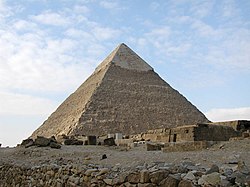
The most famous African pyramids are in Egypt—huge structures built of bricks or stones, primarily limestone, some of which are among the world's largest constructions. They are shaped in reference to the sun's rays. Most had a smoothed white limestone surface. Many of the facing stones have fallen or were removed and used for construction in Cairo.[9] The capstone was usually made of limestone, granite or basalt and some were plated with electrum.[10]
Ancient Egyptians built pyramids from 2700 BC until around 1700 BC. The first pyramid was erected during the Third Dynasty by the Pharaoh Djoser and his architect Imhotep. This step pyramid consisted of six stacked mastabas.[11][12] Early kings such as Snefru built pyramids, with subsequent kings adding to the number until the end of the Middle Kingdom. The age of the pyramids reached its zenith at Giza in 2575–2150 BC.[13] The last king to build royal pyramids was Ahmose,[14] with later kings hiding their tombs in the hills, such as those in the Valley of the Kings in Luxor's West Bank.[15] In Medinat Habu and Deir el-Medina, smaller pyramids were built by individuals. Smaller pyramids with steeper sides were built by the Nubians who ruled Egypt in the Late Period.[16]
The Great Pyramid of Giza is the largest in Egypt and one of the largest in the world. At 146.6 metres (481 ft) it was the tallest structure in the world until the Lincoln Cathedral was finished in 1311 AD. Its base covers an area of around 53,000 square metres (570,000 sq ft). The Great Pyramid is the only extant one of the Seven Wonders of the Ancient World.
Ancient Egyptian pyramids were, in most cases, placed west of the river Nile because the divine pharaoh's soul was meant to join with the sun during its descent before continuing with the sun in its eternal round.[10] As of 2008, some 135 pyramids had been discovered in Egypt,[17][18] most located near Cairo.[19]
Pyramids at Meroe with pylon-like entrancesNubian pyramids at archaeological sites of the Island of Meroe
While African pyramids are commonly associated with Egypt, Sudan has 220 extant pyramids, the most in the world.[20] Nubian pyramids were constructed (roughly 240 of them) at three sites in Sudan to serve as tombs for the kings and queens of Napata and Meroë. The pyramids of Kush, also known as Nubian Pyramids, have different characteristics than those of Egypt. The Nubian pyramids had steeper sides than the Egyptian ones. Pyramids were built in Sudan as late as 200 AD.
UNESCO describes the tomb as an example of the monumental mud-building traditions of the West African Sahel. The complex includes the pyramidal tomb, two mosques, a cemetery and an assembly ground. At 17 metres (56 ft) in height it is the largest pre-colonialarchitectural monument in Gao. It is a notable example of the Sudano-Sahelian architectural style that later spread throughout the region.
One of the unique structures of Igbo culture was the Nsude pyramids, in the Nigerian town of Nsude, northern Igboland. Ten pyramidal structures were built of clay/mud. The first base section was 60 ft (18 m) in circumference and 3 ft (0.9 m) in height. The next stack was 45 ft (14 m) in circumference. Circular stacks continued to the top. The structures were temples for the god Ala, who was believed to reside there. A stick was placed at the top to represent the god's residence. The structures were laid in groups of five parallel to each other. Because it was built of clay/mud like the Deffufa of Nubia, over time periodic reconstruction has been required.[21]
Pausanias (2nd century AD) mentions two buildings resembling pyramids, one, 19 kilometres (12 mi) southwest of a still standing structure at Hellenikon,[22] a common tomb for soldiers who died in a legendary struggle for the throne of Argos and another that he was told was the tomb of Argives killed in a battle around 669/8 BC. Neither survives and no evidence indicates that they resembled Egyptian pyramids.
At least two surviving pyramid-like structures are available to study, one at Hellenikon and the other at Ligourio/Ligurio, a village near the ancient theatre Epidaurus. These buildings have inwardly sloping walls, but bear no other resemblance to Egyptian pyramids. They had large central rooms (unlike Egyptian pyramids) and the Hellenikon structure is rectangular rather than square, 12.5 by 14 metres (41 by 46 ft) which means that the sides could not have met at a point.[23] The stone used to build these structures was limestone quarried locally and was cut to fit, not into freestanding blocks like the Great Pyramid of Giza.[24]
These structures were dated from pot shards excavated from the floor and grounds. The latest estimates are around the 5th and 4th centuries. Normally this technique is used for dating pottery, but researchers used it to try to date stone flakes from the structure walls. This launched debate about whether or not these structures are actually older than Egypt, part of the Black Athena controversy.[25]
Lefkowitz criticised this research, suggesting that some of the research was done not to determine the reliability of the dating method, as was suggested, but to back up a claim and to make points about pyramids and Greek civilization. She claimed that not only were the results imprecise, but that other structures mentioned in the research are not in fact pyramids, e.g. a tomb alleged to be the tomb of Amphion and Zethus near Thebes, a structure at Stylidha (Thessaly) which is a long wall, etc. She pushed the possibility that the stones that were dated might have been recycled from earlier constructions. She claimed that earlier research from the 1930s, confirmed in the 1980s by Fracchia, was ignored.[26]
Liritzis responded that Lefkowitz failed to understand and misinterpreted the methodology.[27]
The Pyramids of Güímar refer to six rectangular pyramid-shaped, terraced structures, built from lava without mortar. They are located in the district of Chacona, part of the town of Güímar on the island of Tenerife in the Canary Islands. The structures were dated to the 19th century and their function explained as a byproduct of contemporary agricultural techniques.
AutochthonousGuanche traditions as well as surviving images indicate that similar structures (also known as, "Morras", "Majanos", "Molleros", or "Paredones") were built in many locations on the island.[citation needed] However, over time they were dismantled and used as building material. Güímar hostred nine pyramids, only six of which survive.
The 27-metre-high Pyramid of Cestius was built by the end of the 1st century BC and survives close to the Porta San Paolo. Another, named Meta Romuli, stood in the Ager Vaticanus (today's Borgo), but was destroyed at the end of the 15th century.[28]
Andean cultures used pyramids in various architectural structures such as the ones in Caral, Túcume and Chavín de Huantar, constructed around the same time as early Egyptian pyramids.
Several Mesoamerican cultures built pyramid-shaped structures. Mesoamerican pyramids were usually stepped, with temples on top, more similar to the Mesopotamian ziggurat than the Egyptian pyramid.
The largest by volume is the Great Pyramid of Cholula, in the Mexican state of Puebla. Constructed from the 3rd century BC to the 9th century AD, this pyramid is the world's largest monument, and is still not fully excavated. The third largest pyramid in the world, the Pyramid of the Sun, at Teotihuacan, is also located in Mexico. An unusual pyramid with a circular plan survives at the site of Cuicuilco, now inside Mexico City and mostly covered with lava from an eruption of the Xitle Volcano in the 1st century BC. Several circular stepped pyramids called Guachimontones survive in Teuchitlán, Jalisco.
Pyramids in Mexico were often used for human sacrifice. Harner stated that for the dedication of the Great Pyramid of Tenochtitlan in 1487, "one source states 20,000, another 72,344, and several give 80,400" as the number of humans sacrificed.[29]
A diagram showing the various components of Eastern North American platform moundsMonks Mound, Cahokia
Many pre-Columbian Native American societies of ancient North America built large pyramidal earth structures known as platform mounds. Among the largest and best-known of these structures is Monks Mound at the site of Cahokia in what became Illinois, completed around 1100 AD. It has a base larger than that of the Great Pyramid. Many mounds underwent repeated episodes of expansion. They are believed to have played a central role in the mound-building peoples' religious life. Documented uses include semi-public chief's house platforms, public temple platforms, mortuary platforms, charnel house platforms, earth lodge/town house platforms, residence platforms, square ground and rotunda platforms, and dance platforms.[30][31][32] Cultures that built substructure mounds include the Troyville culture, Coles Creek culture, Plaquemine culture and Mississippian cultures.
Austronesianmegalithic culture in Indonesia featured earth and stone step pyramid structures called punden berundak. These were discovered in Pangguyangan near Cisolok[34] and in Cipari near Kuningan.[35] The stone pyramids were based on beliefs that mountains and high places were the abode for the spirit of the ancestors.[36]
The step pyramid is the basic design of the 8th century Borobudur Buddhist monument in Central Java.[37] However later Java temples were influenced by Indian Hindu architecture, as exemplified by the spires of Prambanan temple. In the 15th century, during late Majapahit period, Java saw the revival of indigenous Austronesian elements as displayed by Sukuh temple that somewhat resemble Mesoamerican pyramids, and also stepped pyramids of Mount Penanggungan.[38]
In east Asia, Buddhist stupas were usually represented as tall pagodas. However, some pyramidal stupas survive. One theory is that these pyramids were inspired by the Borobudur monument through Sumatran and Javanese monks.[39] A similar Buddhist monument survives in Vrang, Tajikistan.[40][41] At least nine Buddhist step pyramids survive, 4 from former Gyeongsang Province of Korea, 3 from Japan, 1 from Indonesia (Borobudur) and 1 from Tajikistan.[39][41]
Comparison of approximate profiles of several notable pyramidal or near-pyramidal buildings. Dotted lines indicate original heights, where data is available. In its SVG file, hover over a pyramid to highlight and click for its article.
Two pyramid-shaped tombs were erected in Maudlin's Cemetery, Ireland, c. 1840, belonging to the De Burgh family.
Louvre Pyramid (Paris, France)The Louvre Pyramid in Paris, France, in the court of the Louvre Museum, is a 20.6 metre (about 70 foot) glass structure that acts as a museum entrance. It was designed by American architect I. M. Pei and completed in 1989. The Pyramide Inversée (Inverted Pyramid) is displayed in the underground Louvre shopping mall.
The Tama-Re village was an Egyptian-themed set of buildings and monuments built near Eatonton, Georgia by Nuwaubians in 1993 that was mostly demolished after it was sold in 2005.
A former museum/monument in Tirana, Albania is commonly known as the "Pyramid of Tirana". It differs from typical pyramids in having a radial rather than square or rectangular shape, and gently sloped sides that make it short in comparison to the size of its base.
The Karlsruhe Pyramid is a pyramid made of red sandstone, located in the centre of the market square of Karlsruhe, Germany. It was erected in 1823–1825 over the vault of the city's founder, Margrave Charles III William (1679–1738).
The Donkin Memorial was erected on a Xhosa reserve in 1820 by Cape Governor Sir Rufane Shaw Donkin in memory of his late wife Elizabeth, in Port Elizabeth, South Africa. The pyramid is used in many different coats-of-arms associated with Port Elizabeth.
^πυραμίςArchived 2021-07-09 at the Wayback Machine, Henry George Liddell, Robert Scott, A Greek-English Lexicon, on Perseus Digital Library
^The word meant "a kind of cake of roasted wheat-grains preserved in honey"; the Egyptian pyramids were named after its form (R. S. P. Beekes, Etymological Dictionary of Greek, Brill, 2009, p. 1261).
^ abRedford, Donald B.; McCauley, Marissa (15 April 2014). "How were the Egyptian pyramids built?". Research. The Pennsylvania State University. Archived from the original on 22 December 2012. Retrieved 11 December 2012.
^Pollard, Lawrence (9 September 2004). "Sudan's past uncovered". BBC News. Archived from the original on 28 July 2020. Retrieved 12 April 2010.
^Basden, G. S(1966). Among the Ibos of Nigeria, 1912. Psychology Press: p. 109, ISBN0-7146-1633-8
^Mary Lefkowitz (2006). "Archaeology and the politics of origins". In Garrett G. Fagan (ed.). Archaeological Fantasies: How Pseudoarchaeology Misrepresents the Past and Misleads the Public. Routledge. p. 188. ISBN978-0-415-30593-8.
^Mary Lefkowitz (2006). "Archaeology and the politics of origins". In Garrett G. Fagan (ed.). Archaeological Fantasies: How Pseudoarchaeology Misrepresents the Past and Misleads the Public. Routledge. pp. 189–190. ISBN978-0-415-30593-8.
^Mary Lefkowitz (2006). "Archaeology and the politics of origins". In Garrett G. Fagan (ed.). Archaeological Fantasies: How Pseudoarchaeology Misrepresents the Past and Misleads the Public. Routledge. pp. 185–186. ISBN978-0-415-30593-8.
^Mary Lefkowitz (2006). "Archaeology and the politics of origins". In Garrett G. Fagan (ed.). Archaeological Fantasies: How Pseudoarchaeology Misrepresents the Past and Misleads the Public. Routledge. p. 195. ISBN978-0-415-30593-8.
^"Pangguyangan". Dinas Pariwisata dan Budaya Provinsi Jawa Barat (in Indonesian). Archived from the original on 24 December 2019. Retrieved 17 May 2017.
A pyramid is a monumental ancient structure characterized by a broad base, typically square or rectangular, with sloping sides that converge to a single apex, constructed primarily from stone or earth by various civilizations for purposes such as royal tombs, religious temples, or ceremonial platforms.[1][2] In ancient Egypt, pyramids emerged around 2780 BCE with the Step Pyramid of Djoser, designed by architect Imhotep as the first large-scale stone monument, evolving into the smooth-sided true pyramids of the Old Kingdom, exemplified by the Great Pyramid of Giza built for PharaohKhufu circa 2580–2560 BCE using approximately 2.3 million limestone blocks.[1][3] These Egyptian pyramids, aligned precisely with cardinal directions and astronomical features, served to protect pharaonic remains and facilitate the ruler's ascent to the afterlife, reflecting advanced engineering feats achieved through organized labor, ramps, and sledges rather than speculative technologies.[4][5] Similar pyramidal forms appeared independently in other regions, including the stepped ziggurats of Mesopotamia around 3500–3000 BCE as temple platforms, the smaller, steeper Nubian pyramids in Sudan from the 8th century BCE to 4th century CE, and massive temple pyramids in Mesoamerica like Teotihuacan's Pyramid of the Sun (c. 200 CE) and Chichen Itza's El Castillo (c. 9th–12th centuries CE), underscoring convergent architectural solutions to vertical monumentality across isolated cultures.[1][6] While Egyptian pyramids remain the most enduring symbols of antiquity due to their scale and preservation, global variants highlight human ingenuity in harnessing local materials and labor for sacred or funerary ends, with construction methods grounded in empirical evidence of quarrying, transportation, and assembly rather than unsubstantiated alternative theories.[7][5]
Etymology and Terminology
Definition and Classification
An architectural pyramid constitutes a monumental edifice with a square or polygonal base that ascends through inclined planes or tiers to converge at a singular apex, primarily erected from stone, brick, or compacted earth to serve funerary, religious, or ceremonial functions. This configuration leverages gravitational stability via a broad foundation supporting progressively narrower upper levels, setting it apart from mathematical polyhedra, ephemeral ramps, or haphazard earthen cones.[1]Pyramids classify into two principal morphologies: stepped and true. Stepped pyramids comprise stacked rectangular platforms of diminishing dimensions, yielding a terraced silhouette that approximates pyramidal geometry through discrete horizontal strata, as pioneered in early constructions for incremental elevation. True pyramids, evolving subsequently, exhibit seamless sloping faces formed by overlaying smooth casing over infilled steps, attaining a precise geometric taper that enhances structural integrity against lateral forces and erosion.[8][9]The archetype of pyramid construction originated in Egypt around 2780 BCE with the inaugural stepped form, subsequently manifesting across disparate civilizations including Mesoamerica and the Near East from the third millennium BCE onward, yet rigorously excluding geological outcrops or postmodern sculptural approximations predicated on their engineered anthropic intent.[1][10]
Geometric and Structural Properties
Mathematical Characteristics
The volume of a pyramid is calculated as V=31Bh, where B is the area of the base polygon and h is the perpendicularheight from the base to the apex.[11][12] This formula arises from the linear tapering of cross-sectional area with height, enabling ancient builders to achieve large volumes with reduced material compared to prismatic forms of equivalent height, as the upper sections require progressively less mass.[13] For a square-based pyramid, the total surface area comprises the base area plus the lateral area, given by A=B+21pl, where p is the base perimeter and l the slant height of the faces.[14] This geometry optimizes material distribution for load-bearing, as the sloped faces convert vertical compression into lateral stability, minimizing exposure while enclosing volume efficiently.[15]Pyramidal stability derives from mass distribution principles, with a wide base-to-height ratio lowering the center of gravity and countering overturning moments from eccentric loads or seismic activity.[16] In structures like the Great Pyramid of Giza, the original base side length of approximately 230 meters and height of 146 meters yield a ratio of roughly 1.57, distributing weight to reduce shear stress at the base and enhance resistance to sliding or toppling under gravity.[17][18] Such proportions, grounded in static equilibrium where the resultant force remains within the base footprint, allowed scalable heights without proportional increases in foundation stress, as verified by the endurance of these forms over millennia.[19]Symmetry and right angles in pyramid geometry ensure uniform stress propagation and fault tolerance during construction.[20] A square base with perpendicular edges aligns forces vertically, preventing torque from asymmetric settling, while isosceles triangular faces maintain planar integrity against differential erosion. Empirical measurements of ancient pyramids confirm base orthogonality deviations below 0.05 degrees, reflecting deliberate geometric controls that propagated accuracy layer-by-layer and mitigated cumulative errors in manual alignment.[21] This adherence to Euclidean principles—equal sides, 90-degree corners—facilitates self-correcting load paths, wherein deviations in one face induce compensatory tensions resolvable by symmetry.
Precision and Alignments
The Great Pyramid of Giza demonstrates exceptional precision in its cardinal alignment, with sides oriented to true north within 3.4 arcminutes of arc, equivalent to an error of about 1 millimeter per meter along the base.[22][23] This accuracy surpasses many modern constructions and underscores the sophistication of ancient Egyptian surveying. Similar alignments appear in other Giza pyramids, though with slightly greater deviations, achieved through archaeoastronomical techniques.[24]Archaeoastronomy indicates that Egyptians likely used observations of circumpolar stars, which remain visible year-round near the north celestial pole, to establish north. Methods included sighting the simultaneous culmination or transit of two such stars across a meridian line, providing a reliable reference without dependence on the sun's variable path.[25][26] Stars like Thuban in Draco, then closer to the pole around 2500 BCE, served as proxies for true north.[27]The pyramid's base, spanning approximately 230 meters per side and covering about 13 acres, is leveled to within 2.1 centimeters across all corners, with side lengths varying by no more than 4.4 centimeters.[28][29] This precision reflects the use of simple yet effective tools, including plumb bobs for vertical references and water levels—such as channels filled with fluid—to establish horizontality over large areas.[30][31]Cubit rods and stretched ropes further ensured squareness and straightness.[32]Certain dimensional ratios, such as the perimeter-to-height ratio approximating pi (around 3.14), have prompted speculation of encoded mathematics, but evidence points to coincidence rather than intent. Egyptian texts show approximations like 3.16 for pi in circle areas, derived practically from wheel circumferences, without indication of pyramidal application.[33][34] The pyramid's slope, based on the seked unit for practical batter angles, aligns more closely with functional engineering than esoteric symbolism.[33]
Ancient Pyramids by Civilization
Egyptian Pyramids
The Step Pyramid of Djoser, constructed circa 2630 BCE during Egypt's Third Dynasty, represents the earliest large-scale stone pyramid and marks the origin of monumental pyramid architecture as a royal tomb form. Designed by the architect Imhotep, it consists of six stepped mastabas stacked to achieve a height of approximately 62 meters, evolving from earlier flat-roofed tombs and demonstrating initial experimentation with verticality and enclosure walls within a broader funerary complex.[35][36]This transitional phase advanced under Sneferu, founder of the Fourth Dynasty around 2613 BCE, whose Bent Pyramid at Dahshur—reaching 104 meters with an abrupt angle change from 54° to 43°—and the subsequent Red Pyramid, the first successful true pyramid at 105 meters tall, refined the corbelled internal structure and smooth-sided exterior using limestone casing.[37][38] These structures, built in close succession circa 2610–2580 BCE, highlight iterative engineering to achieve stability, with the Red Pyramid's shallower 43° slope ensuring completion without collapse.[39]The apex of pyramid scale occurred with the Great Pyramid of Khufu at Giza, built circa 2580–2560 BCE, comprising an estimated 2.3 million limestone and granite blocks averaging 2.5 tons each, originally standing 146.6 meters tall on a 230-meter base. As part of a vast tomb complex including mortuary temples, causeways linking to valley temples, and solar boat pits containing disassembled vessels over 43 meters long, it served to facilitate the pharaoh's afterlife journey, with surrounding quarries and worker settlements providing direct evidence of localized resource extraction and organized labor.[40][28][41]Post-Old Kingdom, pyramid construction declined sharply after the Sixth Dynasty circa 2200 BCE amid economic decentralization, resource strain from prior mega-projects, and political fragmentation leading to the First Intermediate Period. Later Middle Kingdom examples, such as those of Amenemhat III circa 1850 BCE, shifted to smaller scales with mudbrick cores faced in limestone, which eroded faster due to inferior durability compared to the solid stone of earlier eras, reflecting reduced centralized capacity rather than lost knowledge.[42][43]Archaeological evidence from Giza, including cemetery excavations revealing tombs of overseers and laborers with medical care indicators like healed fractures, supports deployment of skilled, rotating work crews rather than mass slavery, countering ancient Greek accounts like Herodotus's by aligning with on-site inscriptions denoting organized teams such as "Friends of Khufu."[40][28]
Nubian Pyramids
The Nubian pyramids comprise over 200 structures built by the rulers of the Kingdom of Kush, an ancient Nubian civilization, at necropolises including Meroë, Napata (encompassing Jebel Barkal and Nuri), and El-Kurru, from approximately the 8th century BCE through the 4th century CE.[44][45] These tombs, primarily for kings and queens, marked a shift from earlier tumuli burials during the Napatan period (c. 750–300 BCE) and peaked in the Meroitic era (c. 300 BCE–350 CE) after the capital relocated southward.[44][46]Constructed from locally quarried sandstone blocks with internal rubble and earth fill, the pyramids averaged 20–30 meters in height, substantially smaller than Egyptian examples, and featured steeper slopes—often exceeding 60 degrees—achieved through narrower base-to-height ratios suited to the region's bedrock.[47][48] This design facilitated quicker construction and stability on the Nubian sandstone plateaus, distinguishing them architecturally while reflecting adaptation of imported pyramidal forms to local materials and geology.[47]Funerary chapels adjoined the eastern faces of most pyramids, adorned with sandstone reliefs depicting rituals, deities, and royal figures in a hybrid style: Egyptian motifs like offering scenes and hieroglyphic elements merged with Meroitic innovations, such as indigenous gods (e.g., Apedemak) and cursive Meroitic script, evidencing selective cultural borrowing alongside Kushite autonomy.[44][49] These chapels, often with pylon entrances, served ceremonial functions and housed stelae recording royal genealogies and achievements, highlighting the pyramids' role in legitimizing Meroitic power.[44]In the 1830s, Italian treasure hunter Giuseppe Ferlini demolished more than 40 pyramids at Meroë using explosives to access burial chambers, yielding artifacts like the Ferlini treasure but causing irreversible damage to superstructures and contexts.[50][51]A 2025 bioarchaeological study of skeletons from the Nubian site of Tombos (c. 1450–650 BCE) analyzed musculoskeletal markers indicating rigorous manual labor among pyramid-tomb interees, implying participation by lower-status individuals in construction or maintenance, and revealing greater socioeconomic fluidity in Nubian pyramid complexes than elite-only models suggest.[52][53] Such evidence from broader Nubian contexts underscores diverse labor contributions to these monuments.[52]
Mesoamerican Pyramids
Mesoamerican pyramids, constructed by cultures including the Teotihuacanos, Maya, and Aztecs from approximately 1000 BCE onward, consist of stepped platforms with flat summits supporting temples for religious ceremonies, distinguishing them from Egyptian pyramids used primarily as royal tombs. These structures facilitated rituals such as bloodletting and human sacrifice to appease deities and maintain cosmic order, often incorporating astronomical alignments to track solar and calendrical cycles. Unlike the smooth, inward-sloping sides of Egyptian examples, Mesoamerican variants feature terraced profiles accessed by central stairways, built with rubble cores retained by stone or adobe walls and veneered in cut stone.[54][55]The Pyramid of the Sun at Teotihuacan, one of the earliest major examples completed around 200 CE, measures about 63 meters in height with a square base exceeding 215 meters per side. Its construction involved layered adobe bricks, volcanic fill, and a limestone facing, oriented to align with the summer solstice when the sun passes overhead at noon, symbolizing connections to agricultural and divine cycles. This monument, part of a planned urban grid, underscores Teotihuacan's role as a ceremonial center influencing later Mesoamerican societies.[56][57]
Mayan pyramids exemplify advanced integration of architecture and astronomy, as seen in El Castillo (Pyramid of Kukulcan) at Chichen Itza, erected around 900 CE during the site's Terminal Classic peak. Standing 24 meters tall on a 55.5-meter base, it comprises nine stepped levels with 91 risers per northern staircase, totaling 365 when including the summit platform to mirror the solar year. Equinox sunlight casts triangular shadows down the steps, simulating a descending feathered serpent in homage to Kukulcan; clapping at its base produces a resonant chirp echoing the quetzal bird, likely an intentional acoustic design.[58][59][60]The Aztec Templo Mayor in Tenochtitlan, begun circa 1325 CE and rebuilt in at least seven phases until its destruction in 1521, formed a twin pyramid rising to about 60 meters, dedicated to war god Huitzilopochtli and rain god Tlaloc. Priests ascended its steep stairs for public rituals, including the extraction of victims' hearts offered to sustain the sun's movement, with evidence from excavations revealing over 600 skulls in tzompantli racks and thousands of sacrificial artifacts. Spanish accounts corroborated by archaeological finds, such as stone chacmools for holding offerings, confirm the scale of these practices central to Aztec cosmology.[61][62][63]
Mesopotamian and Asian Stepped Structures
Ziggurats in ancient Mesopotamia were terraced, pyramid-like platforms built primarily of sun-dried mud-bricks, functioning as elevated temple foundations to facilitate divine-human interaction through ritual access. The earliest surviving examples date to the Uruk period, around 3500–3000 BCE, as seen in the White Temple complex, where a simple rectangular platform rose in stepped form to support shrines dedicated to deities like Anu.[64] These structures symbolized primordial mountains linking earth to heaven, enabling gods to descend for worship, a concept reflected in Sumerian cuneiform texts describing temples atop such "houses of the mountain."[65]The Ziggurat of Ur, constructed circa 2100 BCE under King Ur-Nammu of the Third Dynasty, exemplifies mature Sumerian design with a rectangular base measuring 64 meters by 46 meters and an original height exceeding 30 meters across three main terraces.[66] Built with a rammed-earth core encased in baked bricks bound by bitumen mortar for waterproofing and stability, it supported a summit shrine to the moon god Nanna, accessed via an internal staircase and external ramps for ceremonial processions and maintenance.[65]Bitumen application mitigated mud-brick erosion in the region's flood-prone environment, contrasting with the stone permanence of Egyptian pyramids, while the terraced profile prioritized ritual elevation over monolithic enclosure.[67]Regional variants extended to Elamite architecture, as in the Chogha Zanbil ziggurat near Susa, erected around 1250 BCE by Untash-Napirisha, featuring five concentric levels on a 105-meter square base, constructed from millions of bricks including glazed varieties for aesthetic and protective purposes.[68] This structure, dedicated to the god Inshushinak, incorporated vaulted tunnels for internal access, diverging from Mesopotamian open ramps, and remains the best-preserved ziggurat outside southern Iraq due to its unfinished state and arid preservation.[69]In Asia, stepped structures analogous to ziggurats appeared in religious complexes, though often in stone rather than mud-brick. The Borobudur monument in Java, Indonesia, built between 778 and 850 CE under the Shailendra dynasty, forms a massive nine-leveled mandala with square terraces transitioning to circular stupa crowns, encompassing 504 Buddha statues and 2,672 relief panels narrating Buddhist texts and cosmology.[70] Unlike Mesopotamian platforms for repeated ascent, Borobudur guided pilgrims circumambulatorily upward to enlightenment symbolism, employing volcanic stone blocks without mortar for seismic resilience.[70] Chinese tumuli, such as those of the Qin and Han dynasties (circa 221 BCE–220 CE), comprised earthen mounds over tombs but lacked true terracing, serving funerary rather than active temple functions and thus diverging from ziggurat multi-level access designs.[65] These Asian forms highlight convergent engineering for elevation in worship, adapted to local materials and cosmology, without evidence of direct Mesopotamian influence.[70]
Other Regional Variants
In the Roman Empire, pyramid forms were adopted for elite tombs inspired by Egyptian models after the conquest of Ptolemaic Egypt in 30 BCE, as seen in the Pyramid of Cestius built between 18 and 12 BCE for praetorGaius Cestius Epulo using white Carrara marble blocks and concrete core, measuring 37 meters high with a square base of 29.6 meters per side.[71][72] The structure's 24.1-degree slope and internal barrel-vaulted chamber underscore its funerary purpose, later integrated into the Aurelian Walls around 270 CE for defensive reinforcement.[73]In Greece, truncated pyramid structures like the Hellinikon pyramid near Argos, constructed from limestone blocks in either the Early Helladic II period (c. 2800–2500 BCE) or the late 4th century BCE, deviate from tomb functions and likely served military roles such as fortifications or signal towers, with its purpose and exact dating contested due to limited inscriptions and comparative architecture.[74][75]The Güímar structures in Tenerife's Canary Islands comprise six terraced platforms of local basalt, once hypothesized by Thor Heyerdahl as pre-Hispanic Guanche ritual sites linking transatlantic cultures, but excavations since 1991 yielding 19th-century pottery and tool marks indicate origins as agricultural clearing piles from the 1800s rather than ancient monuments.[76][77]In southeastern Nigeria, the Nsude shrines feature ten pairs of earthen pyramids up to 10 meters high, built by Igbo communities using red mud and clay before colonial contact, primarily as stacked conical mounds for venerating earth deities Ala and Uto through rituals, first documented photographically by anthropologist G.I. Jones in 1935 following earlier sightings in 1891.[78][79]Geological assessments dismiss claims of monumental pyramids at Visoko, Bosnia, as Visočica hill and adjacent formations result from natural periglacial processes forming flatirons, with no artificial layering or tool marks confirmed by core sampling and geophysical surveys conducted since 2005.[80][81]
Engineering and Construction Practices
Materials and Sourcing
The core blocks of Egyptian pyramids, such as the Great Pyramid of Giza, were primarily sourced from local limestone quarries on the Giza plateau, approximately 400 meters south of the structure, providing readily accessible material for the bulk of the construction.[82] The outer casing stones consisted of fine-grained white limestone quarried from Tura, located across the Nile River about 15 kilometers away, valued for its durability and aesthetic polish.[82] Harder granite elements, including those in the King's Chamber, originated from Aswan quarries roughly 934 kilometers south along the Nile, transported by barge during the annual flood season to facilitate logistics over this distance.[83]Quarrying techniques evidenced by tool marks on stones and the unfinished obelisk at Aswan demonstrate the use of dolerite pounders to fracture granite and copper chisels for shaping softer limestone, with scoop-like indentations consistent with repeated pounding rather than advanced metal tools.[84][85] These methods align with Bronze Age capabilities, showing no traces of iron or steel implements that would indicate anachronistic technology.Nubian pyramids at sites like Meroë were constructed mainly from local sandstone blocks, a material more susceptible to weathering and erosion due to its sedimentary composition and exposure to wind, sand, and occasional rainfall.[86]In Mesoamerican contexts, such as Teotihuacan's Pyramid of the Moon, builders utilized volcanic tuff (tepetl), a lightweight porous stone quarried locally in the Teotihuacan Valley, often faced with stucco or carved for detail, complemented by adobe bricks in core fillings to enhance flexibility and resistance in seismically active regions.[87] This combination of materials contributed to the structures' ability to withstand earthquakes through energy dissipation in the softer adobe layers and the inherent stability of the volcanic stone.[57]
Workforce and Logistics
Archaeological excavations in the 1990s and early 2000s uncovered workers' tombs adjacent to the Giza pyramids, revealing burials of overseers, builders, and support staff such as bakers, indicating a structured society of skilled laborers rather than coerced slaves.[88][89] These tombs, containing tools, inscriptions, and provisions, suggest workers received honorable treatment, with evidence of medical care for injuries like fractured bones that healed under professional attention.[90] Faunal remains from associated villages point to substantial meat consumption, including cattle and sheep, far exceeding typical peasant diets and consistent with rations for valued contributors to state projects.[91]The workforce for the Great Pyramid is estimated at 20,000 to 30,000 individuals, comprising year-round skilled craftsmen and seasonal farmers mobilized during the Nile's annual inundation, when agriculture paused.[92] Labor was organized into rotating crews, with shifts of three to four months, supported by bread and beer rations—staples documented in administrative records as compensation equivalent to wages in ancient Egypt's economy.[93][94] No inscriptions or skeletal evidence indicate widespread chains, whips, or mass punishment typical of slavery; instead, hieroglyphs and graffiti denote pharaoh-commissioned teams with titles reflecting expertise and hierarchy.[95]Logistics relied on the Nile River's flooding cycle for efficient material and personnel transport, with a now-extinct tributary—the Ahramat Branch—extending near Giza to enable barge delivery of limestone and granite blocks during high water levels around 2500 BCE.[96] Harbors and canals, evidenced by 2013 discoveries at Wadi al-Jarf and subsequent Giza plateau surveys, facilitated stone shipments from quarries like Tura and Aswan, with papyri logs detailing crew rotations and supply chains under royal oversight.[97] This system mirrored causal efficiencies in large-scale human endeavors, leveraging seasonal hydrology to minimize overland hauling and sustain workforce mobility without evidence of unsustainable coercion.[98]
Established Methods and Evidence
Archaeological evidence from quarries near Giza reveals that limestone blocks were extracted using copper chisels, stone hammers, and wooden levers inserted into channels, with wedges to split stone along natural fissures.[99] Experiments replicating these tools demonstrate that groups of 12 workers could quarry and shape blocks efficiently, consistent with tool marks observed on unfinished stones at sites like Aswan for granite.[100]Blocks were transported overland on wooden sledges, with friction reduced by wetting the sand path, as confirmed by a 12th Dynasty tombrelief at El-Bersheh depicting workers pouring water ahead of a sledge hauling a colossal statue, and physics-based experiments showing wet sand forms a stiff layer that halves pulling force.[101][102]Papyrus logs from Wadi al-Jarf, dated to Khufu's reign around 2580 BCE, detail the shipment of limestone via Nile barges from Tura quarries to Giza, supporting riverine logistics for heavier loads.[103]For elevation, straight or zig-zag external ramps of mudbrick and rubble, evidenced by remnants at sites like the Pyramid of Sekhemkhet and quarry ramps at Hatnub with postholes for hauling ropes (dated circa 2500 BCE), allowed sledges to ascend slopes up to 10 degrees.[104] Internal spiral ramps, preserved in the Fifth Dynasty sun temple at Abu Ghurab, facilitated upper-level placement without excessive external buildup, with blocks maneuvered via levers and rollers into position, as indicated by lever sockets in core masonry.[105]Radiocarbon dating of organic inclusions in pyramid mortar and charcoal from worker camps yields calibrated dates for the Great Pyramid of 2589–2753 BCE (mean circa 2670 BCE), aligning with historical king lists placing Khufu's reign at 2589–2566 BCE and confirming Fourth Dynasty construction timelines.[106] Multiple studies, including those on Giza settlement charcoal, show date clusters consistent with phased building over 20–30 years, countering older erratic samples from reused wood.[107][108]
Theoretical Debates on Construction
Ramp and Leverage Systems
External ramps, typically straight or zigzag in configuration, were employed for transporting stone blocks to the lower levels of pyramids during construction. These earthen or rubble-filled structures facilitated the hauling of materials using sledges lubricated with water to reduce friction, as evidenced by experimental reconstructions and depictions in ancient Egyptian reliefs.[102] For upper levels, theories posit a transition to internal spiral ramps embedded within the pyramid's structure, allowing blocks to be maneuvered through notches or openings in the outer casing. This approach minimizes material volume compared to continuous external ramps, which would require excessive earthworks equivalent to the pyramid's own mass.[109]French architect Jean-Pierre Houdin's internal ramp hypothesis, developed in the late 1990s, proposes an external ramp for the initial third of the height, followed by a gently sloping internal ramp spiraling upward at about 7% grade, with periodic horizontal passages for turning blocks via levers or small cranes positioned in external notches. Microgravimetry scans in 2017 detected low-density corridors consistent with such voids, supporting the model's alignment with the pyramid's internal architecture.[110]Engineering simulations of this system, including 3D modeling, confirm structural integrity and logistical viability without requiring implausibly steep inclines.[109]Archaeological remnants bolster ramp usage, including rubble-filled causeways south of the Great Pyramid at Giza, interpreted as dismantled ramp bases mixed with quarry debris, and similar features at sites like Lisht where sequential layering is evident from tool marks on blocks. Quarry inscriptions and numbered stone alignments indicate blocks were placed in ascending order, compatible with ramp-facilitated delivery rather than random stacking.[111]Leverage systems complemented ramps through wooden levers, rollers, and counterweight mechanisms using sand-filled containers or water-filled vessels hoisted via ropes over pulleys or simply draped edges. Scale models and physical tests demonstrate that such aids could elevate multi-ton blocks at rates allowing completion within the inferred 20-30 year construction spans documented in ancient records like the Diary of Merer.[112] These methods rely on basic physics—friction reduction and mechanical advantage—yielding feasible force requirements for teams using capstans or human traction, as validated by biomechanical analyses of haulageefficiency.[102]
Alternative Engineering Hypotheses
A 2024 study published in PLOS ONE proposed that the Step Pyramid of Djoser, constructed around 2670–2650 BCE, may have employed a hydraulic lift system to elevate limestone blocks through a central shaft, utilizing water channeled from a nearby dam and Gisr el-Mudir enclosure.[113] Researchers analyzed sediment cores from the site, identifying layers of clean, sediment-free water deposits that could have been directed via internal corridors and shafts to float blocks on rafts or pistons, consistent with the pyramid's stepped internal architecture and surrounding dry moat features.[114] This hypothesis draws on evidence of ancient Egyptian water management, including canals and reservoirs documented in later periods, but lacks direct textual or pictorial confirmation of such lifts, and critics note the engineering challenges of maintaining pressure in vertical shafts without seals or valves evident in the remains.[115]Joseph Davidovits advanced the geopolymer theory in the 1980s, positing that many pyramid blocks were cast in situ from a limestone-based concrete aggregate rather than quarried and transported as solid stone, citing microscopic air bubbles and chemical signatures as evidence of artificial synthesis. However, subsequent petrographic examinations, including X-raydiffraction and scanning electronmicroscopy, have refuted this for core Giza pyramid stones by demonstrating intact sedimentary bedding, fossil inclusions, and tool marks matching nearby quarries like those at Giza and Tura, features incompatible with poured geopolymer that would homogenize textures.[116]Quarry sites show extraction scars and unfinished blocks with pyramid-specific dimensions, supporting hewing over molding, while experimental recreations of Davidovits' recipes fail to replicate the blocks' durability or uniformity without modern additives.[117]Hypotheses invoking acoustic levitation or sound-based molding for stone transport, popularized in fringe literature, lack empirical support, as no residues, tools, or acoustic resonators appear in archaeological contexts, and modern acoustic levitation experiments handle only small masses under controlled conditions far below pyramid-scale requirements.[118] These ideas contravene principles of parsimony, as incremental advancements in leverage, sledges, and earthen ramps—evidenced by worker villages, copper tools, and ramp remnants—sufficiently explain construction without invoking unverified technologies absent in Egyptian material culture.[119]
Cultural Purposes and Symbolism
Funerary and Religious Functions
Egyptian pyramids functioned primarily as monumental tombs designed to preserve the pharaoh's mummified body, enabling the ka—understood as the vital essence or double—and the ba, the mobile aspect of the soul capable of traversing between the tomb and the afterlife, to reunite and achieve eternal existence as an akh, or transfigured spirit.[120] This architectural choice reflected beliefs in the soul's dependence on physical remains, with internal chambers housing sarcophagi for the mummy and canopic jars preserving organs for ritual reintegration during the judgment by Osiris. Grave goods, including shabti figurines to perform labor in the afterlife, accompanied these elements, underscoring the pyramid's role in sustaining the deceased's provisions eternally.[121]The Pyramid Texts, the earliest known religious corpus, inscribed on chamber walls starting with the pyramid of Unas in the Fifth Dynasty (circa 2350 BCE), comprised over 700 spells, hymns, and incantations to facilitate the pharaoh's ascent to the sky, identification with gods like Osiris and Re, and protection from underworld perils such as serpents.[122] These hieroglyphic inscriptions, carved in corridors and burial rooms, invoked solar cycles and stellar journeys, evidencing a theology where the pyramid's form symbolized primordial mounds of creation and ensured divine kingship's continuity beyond death.[121]Nubian pyramids at sites like Meroe, constructed from the Third Century BCE to the Fourth Century CE, incorporated small offering chapels adjacent to the superstructure, where Meroitic script inscriptions detailed funerary rites affirming resurrection motifs akin to the Egyptian Osiris cult, including libations and invocations for the deceased's revival and sustenance.[44] These chapels facilitated ongoing mortuary cults, with reliefs depicting milk offerings to Osiris-derived deities, preserving Nubian adaptations of Egyptian afterlife doctrines amid indigenous elements like lion-headed Apedemak worship.[123] Smaller than Egyptian counterparts and steeper-sided, they housed rock-cut burials with stelae recording royal names and divine protections, linking pyramid design to beliefs in post-mortem judgment and eternal provisioning.[124]In Mesoamerica, pyramids such as those at Teotihuacan and Maya centers served as elevated temples for bloodletting rituals, where elites pierced tongues, ears, or genitals with obsidian blades or stingray spines to release blood as nourishment for gods, ensuring cosmic balance and agricultural fertility as described in pictorial codices and stelae.[125] Archaeological evidence from temple summits includes bloodstained altars and cached spines, corroborating textual depictions in surviving Maya books like the Dresden Codex, which illustrate royal autosacrifice atop stepped platforms to communicate with deities during calendrical ceremonies.[126] These practices, rooted in creation myths requiring divine blood debt repayment, positioned pyramids as sacred axes mundi for ritual renewal rather than mere burial sites, with minimal elite interments focused on symbolic offerings to sustain celestial order.[125]
Political Power and Social Organization
The construction of pyramids in ancient Egypt represented a profound exercise of pharaonic authority, enabling rulers to orchestrate nationwide resource mobilization that reinforced their legitimacy as divine intermediaries. The Wadi el-Jarf papyri, discovered in 2013 and dating to approximately 2575 BCE during the reign of Khufu, record the logistics of transporting Tura limestone blocks via boat to the Giza plateau for the Great Pyramid, involving teams of inspectors and sailors under state oversight.[98] These documents illustrate a bureaucratic apparatus capable of coordinating labor, materials, and transport across the Nile Delta and beyond, demonstrating the pharaoh's command over disparate regions and fostering a sense of unified purpose tied to the ruler's eternal legacy.[127]Such projects entrenched social organization through a hierarchical system where corvée labor from agricultural surpluses during inundation seasons integrated peasants into the state apparatus, while skilled artisans and overseers formed an elite administrative class loyal to the crown. The pyramids' scale—exemplified by the Great Pyramid's 2.3 million blocks—required sustained extraction of surplus production, which historians interpret as a mechanism to legitimize rule by associating the pharaoh with cosmic order and divine kingship, thereby mitigating potential factionalism in a riverine society prone to regionalism.[128] This centralization not only projected power to neighboring powers but also internalized hierarchy, with tomb inscriptions and worker villages like those at Giza evidencing organized provisioning that sustained thousands, binding social strata to the monarch's vision.[97]In Mesoamerica, pyramids at sites like Teotihuacan similarly embodied political consolidation, though within a more collective governance model amid multi-ethnic integration. The Pyramid of the Sun, completed around 200 CE, anchored a metropolis of up to 125,000 inhabitants, its monumental form symbolizing the polity's dominance and serving as a focal point for rituals that unified diverse groups through shared civic identity rather than singular dynastic cults. Archaeological evidence of apartment compounds and craft specialization indicates a decentralized yet coordinated social structure, where pyramid construction channeled labor from immigrant populations, enhancing the city's allure as a hub and underscoring elite oversight without overt evidence of autocratic rulers.From a causal perspective, these pyramid-building endeavors imposed high opportunity costs on agrarian economies, diverting labor and materials equivalent to substantial fractions of annual output—potentially straining food security during lean years—yet they cultivated social cohesion by framing participation as communal investment in stability and prosperity under elite direction. In Egypt, the post-pyramid decline of the Old Kingdom around 2181 BCE has been linked by some analyses to resource exhaustion from such monuments, highlighting how unchecked fiscal commitments could erode fiscal buffers against Nile variability.[129] Conversely, successful execution bolstered regime durability by visibly manifesting authority, a pattern echoed in Teotihuacan's expansion until its internal collapse circa 550 CE, possibly from overextension amid elite rivalries. This dynamic underscores pyramids not merely as architectural feats but as instruments of political realism, where demonstrated capacity for large-scale coordination deterred challenges and perpetuated stratified orders.[128]
Controversies and Fringe Interpretations
Extraterrestrial and Advanced Prehistoric Claims
Claims of extraterrestrial involvement in pyramid construction gained prominence through Erich von Däniken's 1968 book Chariots of the Gods?, which argued that the precision and scale of Egyptian pyramids, such as the Great Pyramid of Giza, exceeded the technological capabilities of ancient humans, implying assistance from advanced alien visitors.[130] Von Däniken cited the pyramids' alignment with cardinal directions and the transport of massive stones as evidence beyond Bronze Age tools.[131]Archaeological examinations refute these assertions by identifying tool marks on pyramid stones matching copper chisels, saws, and dolerite pounders employed by Egyptian workers, consistent with quarrying techniques documented at nearby sites like Aswan.[132] Furthermore, pyramid architecture demonstrates evolutionary progression from flat-roofed mastaba tombs of the Early Dynastic Period (c. 3100–2686 BCE) to the Step Pyramid of Djoser (c. 2670 BCE), built by stacking mastabas into terraced forms, and subsequently to smooth-sided true pyramids by the Fourth Dynasty (c. 2613–2494 BCE), reflecting iterative human experimentation rather than sudden extraterrestrial intervention.[133][1]Similar fringe hypotheses extend to purported advanced prehistoric civilizations predating known societies. A 2023 study claimed Gunung Padang in Indonesia represents a human-built pyramid dating to 27,000–16,000 BCE, based on ground-penetrating radar suggesting artificial layering beneath volcanic rock.[134] Geologists and archaeologists, however, have rejected this interpretation, attributing the site's core to natural andesitic lava flows from volcanic activity, with only superficial megalithic terraces added by humans around 2,500–500 BCE, as confirmed by stratigraphic analysis and lack of supporting artifacts for Ice Age construction.[135]No pyramid structures contain anomalous materials or technologies unaccounted for by human sourcing; the Great Pyramid's 2.3 million limestone blocks were quarried from local Giza plateaus, supplemented by Tura limestone casing and Aswan granite, all transported via Nile River barges and sledges, with worker villages and papyri logs evidencing organized labor by 20,000–30,000 skilled Egyptians over two decades.[136] Such feats align with human organizational capacity demonstrated in contemporaneous projects like the construction of multiple pyramids within a single dynasty, paralleling the scale of later endeavors such as the Roman aqueducts or medieval cathedrals, where large workforces achieved comparable precision through ramps, levers, and surveying tools.[137][138]
Pseudoscientific Theories (e.g., Energy Devices)
Claims of "pyramid power," emerging in the 1970s through popular books like Max Toth and Greg Nielsen's Pyramid Power (1975), asserted that scale models of pyramids could preserve organic matter such as food and razor blades longer than controls, sharpen dull blades, and enhance plant growth due to supposed energy-focusing properties of the shape.[139] These effects were attributed to unspecified "cosmic" or electromagnetic forces aligned with the pyramid's geometry, but proponents provided no measurable mechanism or replicable data. Controlled experiments, including those scrutinizing preservation claims, failed to demonstrate effects beyond normal environmental factors or observer bias, with skeptic Terence Hines concluding in Pseudoscience and the Paranormal (1998) that pyramid power constitutes pseudoscience lacking empirical validation.[140]Hypotheses positing ancient Egyptian pyramids as operational energy devices, such as engineerChristopher Dunn's theory in The Giza Power Plant (1998), suggest the Great Pyramid harnessed Earth's seismic vibrations or hydrogen reactions via granite components acting as resonators or masers to generate microwave or acoustic power. Dunn speculated that subterranean aquifers provided chemical inputs and that shafts channeled energy, but he has publicly admitted the absence of direct evidence, framing the idea as interpretive speculation rather than proven function.[141] Such claims overlook archaeological indicators of funerary use, including sarcophagi and canopic provisions, while overstating material properties: granite exhibits limited piezoelectric response under stress but poor electrical conductivity for power transmission, and limestone casing acts as an insulator, precluding efficient energy conversion or output.[142]No physical residues of fuels, electrodes, or conduits have been detected in pyramid interiors despite extensive excavations, and proposed alignments with cardinal directions or stars align better with practical surveying for construction and religious astronomy than with energy optimization. Theoretical models of electromagnetic focusing, such as a 2018 simulation showing radio-wave concentration under artificial resonance conditions, demonstrate passive scattering rather than active generation, requiring external input unattainable in antiquity without violating energy conservation principles.[143] Mainstream physicists dismiss these theories for lacking causal mechanisms grounded in verifiable physics, emphasizing that passive stone structures cannot produce net usable energy absent a power source.[142]
Modern Debates on Dating and Hidden Features
Geologist Robert Schoch proposed in the 1990s that precipitation-induced erosion on the Great Sphinx enclosure indicates exposure to heavy rainfall last occurring between 7000 and 5000 BCE, predating the Fourth Dynasty pyramids by millennia and suggesting an earlier advanced civilization.[144] This revisionist view has been contested by mainstream Egyptologists and geologists, who attribute the patterns primarily to wind, sand abrasion, and subsurface salt exfoliation under the post-dynastic arid climate, consistent with a Fourth Dynasty origin around 2500 BCE.[145] Archaeological evidence, including quarry stratigraphy at Giza with tool marks, worker inscriptions, and carbon-dated organic remains from the same limestone layers used in the Sphinx and pyramids, aligns the monuments to Khafre's reign circa 2558–2532 BCE, undermining claims of significantly older provenance.[146]The ScanPyramids project, employing muon radiography since 2015, detected a large void above the Grand Gallery in the Great Pyramid of Khufu in 2017, estimated at 30 meters long, alongside smaller corridors identified in 2023.[147] While some speculate these as undiscovered chambers, engineering analyses favor structural interpretations: the "Big Void" likely serves as a stress-relieving feature akin to known relieving chambers, distributing the pyramid's immense weight to prevent collapse, a technique evidenced in the pyramid's corbelled roofs and comparable to internal voids in other Old Kingdom structures.[148] Ongoing non-invasive scans have not yielded artifacts or access points supporting ritual or hidden-use theories, reinforcing consensus that such voids reflect pragmatic construction rather than concealed functions.[149]In March 2025, the Khafre Project—led by Italian and Scottish researchers using synthetic aperture radar (SAR)—claimed detection of a vast underground complex beneath the Pyramid of Khafre, including vertical shafts and spiral structures extending over 600 meters deep, purportedly forming an "underground city."[150]Egyptologist Zahi Hawass and geophysicists dismissed these as misinterpretations of natural karst features, groundwater anomalies, and radar artifacts, noting the absence of peer-reviewed data, on-site permissions, or corroboration from established techniques like ground-penetrating radar.[151] Critics highlighted methodological flaws, such as extrapolating satellite SAR beyond its subsurface resolution limits in limestonebedrock, with no matching anomalies in prior Giza surveys; the claims echo unverified fringe narratives without empirical validation from quarry excavations or stratigraphic cores tying to known Old Kingdom levels.[152]
Recent Discoveries and Research Advances
Archaeological Findings (2023–2025)
In early 2025, excavations at the Saqqaranecropolis by Egyptian and Japanese teams from Kanazawa University uncovered two rock-cut tombs, mastabas, and associated burials dating to the Old Kingdom, extending the known northern boundary of the site and revealing continued elite funerary practices through inscribed artifacts and structural alignments consistent with 5th Dynasty conventions.[153] These findings, analyzed via stratigraphic dating and ceramic typology, affirm architectural and ritual continuity from earlier pyramid complexes without evidence of disruption in pharaonic traditions.[153]A French-Swiss archaeological mission in January 2025 excavated a richly decorated tomb in Saqqara belonging to a high-ranking "wizard-doctor" from the late Old Kingdom, yielding papyri fragments, medical implements, and reliefs depicting ritual practices that corroborate textual records of specialized priestly roles in pyramid cults.[154] In April, a team led by Zahi Hawass unearthed the multichambered tomb of Prince Waserif Re, son of 5th Dynasty pharaoh Userkaf, including sarcophagi and votive offerings that link directly to the Step Pyramid era, supporting phased development in Saqqara's pyramid landscape through radiocarbon-dated organic remains.[155]At the Nubian site of Tombos in March 2025, a Dutch-American team identified skeletons of non-elite individuals interred within pyramid superstructure tombs, challenging prior assumptions of exclusive elite access and indicating broader social integration in Egyptian-administered Nubian pyramid construction.[156][157] Bioarchaeological examination of these remains, including entheseal changes and vertebral stress markers, evidenced physically demanding labor consistent with pyramid building, while strontium isotope ratios in tooth enamel suggested migration from southern Nubian populations to support Egyptian projects.[52] This points to organized labor recruitment from peripheral regions, with methodological controls via comparative elite burials ruling out post-depositional mixing.[158]
Technological Scans and Voids
The ScanPyramids project, initiated in 2015, has employed muon radiography—a non-invasive technique using cosmic-ray muons to detect density variations—to probe internal structures of Old Kingdom pyramids at Giza. In March 2023, the project announced the detection of a corridor-shaped anomaly, approximately 9 meters long and 2 meters by 2 meters in cross-section, located behind the chevron stones above the north entrance of the Great Pyramid of Khufu.[147] This feature, confirmed through muon flux measurements and endoscopic imaging, is interpreted by researchers as a structural element, possibly for weight distribution or construction access, rather than a funerary chamber.[159]Subsequent analyses in 2025 validated the corridor using multimodal non-destructive testing, including infrared thermography and ultrasonic testing, aligning with muon data to rule out artifacts from measurement error. The project continues to map voids, such as the larger "Big Void" above the Grand Gallery identified in 2017, emphasizing causal insights into construction techniques without invasive excavation. These scans reveal systematic internal cavities consistent with ancient engineering to manage stresses in limestonemasonry.[160]In March 2025, synthetic aperture radar (SAR) surveys targeted subsurface features beneath the Giza plateau, particularly around the Pyramid of Khafre, with claims of extensive artificial structures extending over 600 meters deep. However, Egyptological experts assessed these findings as overstated, confirming only known anomalies like shallow tunnels and natural fissures rather than a "vast underground city," attributing radar signals to geological variations and prior archaeological data.[161] Such applications of SAR highlight limitations in penetrating dense bedrock for unambiguous anthropogenic voids.Ground-penetrating radar (GPR) applications at pyramid-adjacent sites have illuminated hydrological infrastructure from the pyramid-building era. At the SaqqaraStep Pyramid complex, GPR profiling in the 2010s and updated in recent surveys delineated the western section of a "dry moat" channel encircling the structure, indicating engineered water management systems for quarrying or stabilization during construction around 2650 BCE.[162] Complementary geophysical work near Giza has traced ancient Nile branches, such as the Ahramat waterway, via integrated radar methods, supporting evidence that seasonal flooding facilitated material transport without positing speculative hydraulic lifts. These voids and channels underscore pragmatic environmental adaptations in pyramid erection.
Modern Pyramids and Legacy
Contemporary Architectural Uses
The Louvre Pyramid, designed by architect I.M. Pei and inaugurated on March 29, 1989, functions as the primary entrance to the Louvre Museum in Paris, utilizing a steel frame clad in 673 rhomboidal glass panels to channel daylight into the subterranean visitor areas beneath the Cour Napoléon.[163] This 21.6-meter-tall structure prioritizes optical clarity and minimal visual obstruction, achieved through collaboration with glass manufacturer Saint-Gobain to produce low-iron panels that eliminate the typical greenish hue of standard float glass, thereby preserving the pyramid's luminous transparency.[164] Pei's choice of the form symbolized convergence and elevation, dissolving upward into the sky while integrating modern engineering with the museum's historic fabric, though initial public backlash focused on perceived clashes with surrounding classical architecture.[165]In commercial contexts, the Luxor Las Vegas resort, completed in October 1993 after 18 months of construction, adopts a pyramidal silhouette for thematic evocation of ancient Egypt, constructed from cast-in-place concrete with a 201-meter height and a base measuring 201 meters per side.[166] The building encloses a 29-million-cubic-foot atrium—the largest by volume upon opening—serving hotel rooms, casino space, and entertainment venues, with interior lighting and inclinator elevators compensating for the sloping walls' structural challenges.[167] Unlike solid ancient prototypes, its hollow core and prefabricated spire—assembled at ground level and hoisted intact—enabled rapid erection but highlighted engineering trade-offs, as the steep 39-degree slopes complicated standard construction techniques and guest circulation.[166]Other 20th- and 21st-century examples include the Muttart Conservatory in Edmonton, Canada, featuring four truncated tetrahedral glass pyramids completed in 1976 to house biome-specific plant collections under climate-controlled environments, demonstrating the form's utility for natural illumination and thermal regulation in botanical architecture.[168] The Palace of Peace and Reconciliation in Astana (now Nur-Sultan), Kazakhstan, a 77-meter glass-and-steel pyramid finished in 2006, serves as a multifunctional venue for interfaith congresses, with its apex accommodating an observation deck and its base embedding conference halls, underscoring symbolic aspirations for unity through geometric stability.[168] These structures rarely replicate ancient scales—capped by costs exceeding billions for stone equivalents—opting instead for lighter composites and metals that yield slimmer profiles, while computer-aided design tools enable alignments precise to millimeters, surpassing manual ancient methods reliant on rudimentary sighting.[169]Modern pyramidal mausolea remain niche but draw on the shape's connotations of permanence, as seen in the Pyramid Hut in Okinawa, Japan, a 2023 concrete-and-steel tomb perched on a stepped base to evoke portable shrines amid sloped terrain, prioritizing durability and minimal site disruption over grandeur.[170] Sustainability drives some designs, such as experimental "green pyramids" integrating turf insulation and solar orientation for passive heating, though widespread adoption lags due to conventional rectangular efficiencies in zoning and fabrication.[171] Overall, contemporary uses emphasize aesthetic symbolism and functional adaptation—light diffusion, spatial drama, or energy flow—over raw monumentality, with engineering feats like finite element analysis ensuring seismic resilience absent in prehistoric builds.[169]
Influence on Science and Culture
The precise engineering of the Egyptian pyramids, particularly the Great Pyramid of Giza, has provided modern civil engineers with models for analyzing load distribution and structural stability in large-scale masonry projects. The pyramid's geometry, with its stepped core and smooth casing, effectively channels compressive forces downward, inspiring finite element analyses of ancient stress patterns that inform contemporary designs for earthquake-resistant buildings and dams.[172][173]Dimensions of the Giza pyramids also benchmark ancient metrology, as the base of the Great Pyramid spans approximately 440 royal cubits, with sides measured to within 11.4 centimeters of intended lengths using standardized bronze rods. The royal cubit, fixed at 524 millimeters plus or minus 2 millimeters, was derived from forearm-based units and verified through Petrie's 19th-century surveys, enabling reconstructions of Egyptian measurement accuracy in geometry and surveying.[174][175]Culturally, pyramids symbolize empirical human achievement via coordinated labor forces of up to 20,000 workers and logistical innovations, yet fringe theories positing extraterrestrial aid or advanced prehistoric tech persist, often dismissing evidence of ramps, levers, and quarrying. These unsubstantiated claims, rooted in misinterpretations rather than data, have fostered skepticism toward institutional archaeology, as seen in public embrace of pseudoarchaeology despite peer-reviewed demonstrations of feasible human construction methods.[176][177][178] Such narratives prioritize supernatural causation over verifiable causal chains of societal organization, though empirical education on pyramid logistics counters this by highlighting ancient innovations in mathematics and resource management.[173]