



Community hub
Recent from talks
Knowledge base stats:
Talk channels stats:
Members stats:
NZR ED class
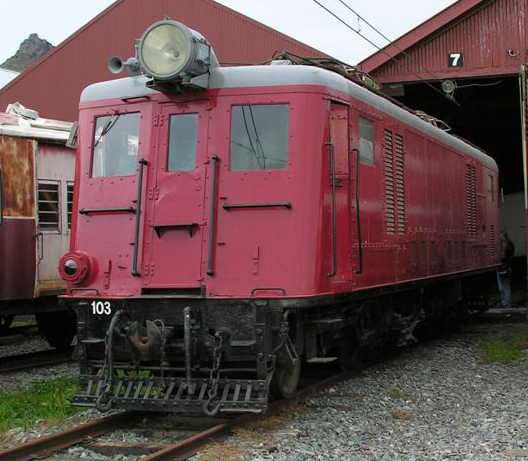
The NZR ED class locomotive was a type of electric locomotive used in Wellington, New Zealand. They were built by English Electric and the New Zealand Railways Department (NZR) between 1938 and 1940, and hauled mainly passenger trains on the Wellington region's 1500 V DC electrification, and banked freight trains on the steep section between Paekākāriki and Pukerua Bay.
The locomotives featured a unique wheel arrangement, 1-Do-2 under the UIC classification system, and incorporated a quill drive (the only type of locomotive to do so in New Zealand) to the driving wheels. A 19-tooth nickel-steel pinion drove a 71-tooth gear wheel.
They were found to be hard on the tracks, leading to speed restrictions on these locomotives and their replacement by EW class locomotives on the Johnsonville Line after the introduction of the EW class in 1952. The EW class was considered more suited to passenger services than the ED and replaced them on most passenger services on other lines.
Like all other electric locomotives in New Zealand, the leading letter of the locomotive's classification is E. There are two predominant theories about how the ED class acquired the second letter, D. The first is that it comes from the "Do" of its 1-Do-2 wheel arrangement. The second is from its original allocation to two locations, Wellington and Otira - Arthur's Pass, hence "duplicated". Official records do not confirm either theory.
New Zealand Railways purchased one ED class locomotive in 1938 from English Electric, No. 101, for use on the newly opened Tawa Flat deviation, which incorporated two long tunnels. This locomotive was known as "The Sergeant" because of the three longitudinal stripes on each side of the body that were unique to this locomotive. The first locomotive was shipped to New Zealand in January 1938. It arrived from Liverpool on SS Cambridge in February 1938 and started trials to Johnsonville from 25 May 1938.
The tender required the supply of locomotive components for the other locomotives required, as it was thought desirable to carry out manufacture in New Zealand in NZR workshops. A further seven locomotives were assembled at the Hutt Workshops, and two at Addington Workshops for use on the Otira - Arthur's Pass section of the Midland Line. The design required them to haul 250-ton passenger trains at up to 55 mph (89 km/h), 500-ton freight trains at up to 45 mph (72 km/h) and start and accelerate to 20 mph (32 km/h) on the 1 in 57 up to Pukerua Bay, on an axle load limited to 16 tons. They had four motors, with a total one-hour rating of 1,240 hp (920 kW), rigidly mounted on the mainframe. Access to the cabs was originally through a door at the front, but later a door was put on the left of the cab. A corridor linked the cabs on one side, which had windows. Axleboxes were of cast steel, with SKF roller bearings. Like the DG and DH classes, they had Westinghouse A7EL air brakes.
The first locomotive assembled at the Hutt Workshops was completed and undergoing trials in May 1939.
By December 1939 the assembly of four locomotives at the Hutt Workshops had been completed, and they were expected to be operating to Paekakariki early in the new year.
Hub AI
NZR ED class AI simulator
(@NZR ED class_simulator)
NZR ED class
The NZR ED class locomotive was a type of electric locomotive used in Wellington, New Zealand. They were built by English Electric and the New Zealand Railways Department (NZR) between 1938 and 1940, and hauled mainly passenger trains on the Wellington region's 1500 V DC electrification, and banked freight trains on the steep section between Paekākāriki and Pukerua Bay.
The locomotives featured a unique wheel arrangement, 1-Do-2 under the UIC classification system, and incorporated a quill drive (the only type of locomotive to do so in New Zealand) to the driving wheels. A 19-tooth nickel-steel pinion drove a 71-tooth gear wheel.
They were found to be hard on the tracks, leading to speed restrictions on these locomotives and their replacement by EW class locomotives on the Johnsonville Line after the introduction of the EW class in 1952. The EW class was considered more suited to passenger services than the ED and replaced them on most passenger services on other lines.
Like all other electric locomotives in New Zealand, the leading letter of the locomotive's classification is E. There are two predominant theories about how the ED class acquired the second letter, D. The first is that it comes from the "Do" of its 1-Do-2 wheel arrangement. The second is from its original allocation to two locations, Wellington and Otira - Arthur's Pass, hence "duplicated". Official records do not confirm either theory.
New Zealand Railways purchased one ED class locomotive in 1938 from English Electric, No. 101, for use on the newly opened Tawa Flat deviation, which incorporated two long tunnels. This locomotive was known as "The Sergeant" because of the three longitudinal stripes on each side of the body that were unique to this locomotive. The first locomotive was shipped to New Zealand in January 1938. It arrived from Liverpool on SS Cambridge in February 1938 and started trials to Johnsonville from 25 May 1938.
The tender required the supply of locomotive components for the other locomotives required, as it was thought desirable to carry out manufacture in New Zealand in NZR workshops. A further seven locomotives were assembled at the Hutt Workshops, and two at Addington Workshops for use on the Otira - Arthur's Pass section of the Midland Line. The design required them to haul 250-ton passenger trains at up to 55 mph (89 km/h), 500-ton freight trains at up to 45 mph (72 km/h) and start and accelerate to 20 mph (32 km/h) on the 1 in 57 up to Pukerua Bay, on an axle load limited to 16 tons. They had four motors, with a total one-hour rating of 1,240 hp (920 kW), rigidly mounted on the mainframe. Access to the cabs was originally through a door at the front, but later a door was put on the left of the cab. A corridor linked the cabs on one side, which had windows. Axleboxes were of cast steel, with SKF roller bearings. Like the DG and DH classes, they had Westinghouse A7EL air brakes.
The first locomotive assembled at the Hutt Workshops was completed and undergoing trials in May 1939.
By December 1939 the assembly of four locomotives at the Hutt Workshops had been completed, and they were expected to be operating to Paekakariki early in the new year.