
Recent from talks
NZR V class
Knowledge base stats:
Talk channels stats:
Members stats:
NZR V class
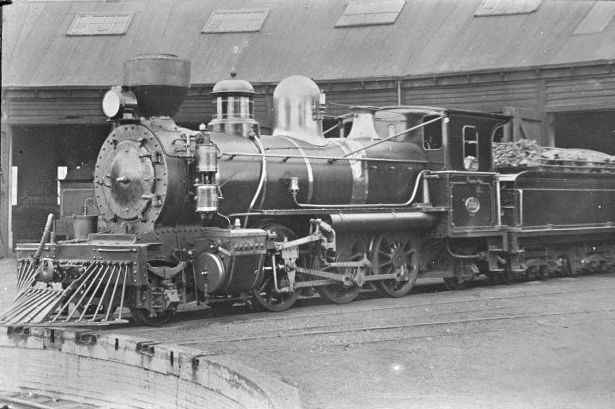
The New Zealand V class steam locomotive was used on New Zealand's railway network from 1885 onwards. They were operated by New Zealand Government Railways and the Wellington and Manawatu Railway Company.
The heavy increase in traffic by the early 1880s necessitated a design for a new class of passenger locomotive. The V class was conceived as an enlarged version of the 2-4-2 NZR K class of 1877. Instead of the K class's four coupled wheels, six coupled wheels were used. The order was placed with Nasmyth, Wilson and Company of Manchester. It took seven years for delivery to be made and then it was found that the engines were 5 and a half tons overweight without their tender.
As a result, the NZGR refused to accept the locomotives until the weight was pared down to an acceptable level. However, by the time they were modified, the engines had been superseded by the American-built NZR N class of similar dimensions.
The Wellington and Manawatu Railway Company also ordered three of those locomotives, numbers 6, 7, and 8, at a cost of about £6,000 each (equivalent to about $1 million in 2011). They were fitted with an ornate Rogers-styled wooden cab with Gothic windows, and an extended smokebox crowned with a copper-capped funnel. They could be fired with "any light fuel" including wood and were very slightly heavier than the NZR version. They had inside frames and journals on both pony trucks. When the WMR was taken over by the NZR in 1908, they were included in the V class.
The locomotives had one weakness in their frames, just behind the cylinders. This weak spot, when stressed, would break; this occurred when the Branxholme locomotives were dumped, thus rendering their frames beyond repair. The Mararoa Junction locomotives may have suffered similarly.
The first withdrawals of the V class began around 1925 and ended in the early 1930s. Most of the engines were dumped as stripped hulks comprising the boiler, frames, cylinders and wheels at the Branxholme Locomotive Dump in 1927. V 126 and V 127 were dumped as substantially more complete hulks at Mararoa Junction, in October 1928, complete with their cabs and tenders. V 132 was dismantled at the Bealey Quarry and its frames dumped there.
The three WMR engines were withdrawn the same time and their boilers removed for stationary use or sale. The fate of the 3 WMR V's is unknown, though there has been some speculation that one might have been dumped at Branxholme. One of the boilers from these engines was unearthed by KiwiRail in 2009 during construction of the Kai Iwi tunnel bypass.
In 1999, enthusiast Tony Bachelor salvaged the remains of locomotives V 35, V 125, and V 136 from Braxholme. Due to the weakness in the frames, the frame of V 132 and a Nasmyth Wilson pony truck were recovered from the Bealey Quarry. It was intended that the locomotives would be restored by the Hooterville Charitable Trust at Waitara, but this later fell through and Bachelor moved the remnants to his property in Ashhurst.
Hub AI
NZR V class AI simulator
(@NZR V class_simulator)
NZR V class
The New Zealand V class steam locomotive was used on New Zealand's railway network from 1885 onwards. They were operated by New Zealand Government Railways and the Wellington and Manawatu Railway Company.
The heavy increase in traffic by the early 1880s necessitated a design for a new class of passenger locomotive. The V class was conceived as an enlarged version of the 2-4-2 NZR K class of 1877. Instead of the K class's four coupled wheels, six coupled wheels were used. The order was placed with Nasmyth, Wilson and Company of Manchester. It took seven years for delivery to be made and then it was found that the engines were 5 and a half tons overweight without their tender.
As a result, the NZGR refused to accept the locomotives until the weight was pared down to an acceptable level. However, by the time they were modified, the engines had been superseded by the American-built NZR N class of similar dimensions.
The Wellington and Manawatu Railway Company also ordered three of those locomotives, numbers 6, 7, and 8, at a cost of about £6,000 each (equivalent to about $1 million in 2011). They were fitted with an ornate Rogers-styled wooden cab with Gothic windows, and an extended smokebox crowned with a copper-capped funnel. They could be fired with "any light fuel" including wood and were very slightly heavier than the NZR version. They had inside frames and journals on both pony trucks. When the WMR was taken over by the NZR in 1908, they were included in the V class.
The locomotives had one weakness in their frames, just behind the cylinders. This weak spot, when stressed, would break; this occurred when the Branxholme locomotives were dumped, thus rendering their frames beyond repair. The Mararoa Junction locomotives may have suffered similarly.
The first withdrawals of the V class began around 1925 and ended in the early 1930s. Most of the engines were dumped as stripped hulks comprising the boiler, frames, cylinders and wheels at the Branxholme Locomotive Dump in 1927. V 126 and V 127 were dumped as substantially more complete hulks at Mararoa Junction, in October 1928, complete with their cabs and tenders. V 132 was dismantled at the Bealey Quarry and its frames dumped there.
The three WMR engines were withdrawn the same time and their boilers removed for stationary use or sale. The fate of the 3 WMR V's is unknown, though there has been some speculation that one might have been dumped at Branxholme. One of the boilers from these engines was unearthed by KiwiRail in 2009 during construction of the Kai Iwi tunnel bypass.
In 1999, enthusiast Tony Bachelor salvaged the remains of locomotives V 35, V 125, and V 136 from Braxholme. Due to the weakness in the frames, the frame of V 132 and a Nasmyth Wilson pony truck were recovered from the Bealey Quarry. It was intended that the locomotives would be restored by the Hooterville Charitable Trust at Waitara, but this later fell through and Bachelor moved the remnants to his property in Ashhurst.
Recent media