
Recent from talks
Del
Knowledge base stats:
Talk channels stats:
Members stats:
Del
Del, or nabla, is an operator used in mathematics (particularly in vector calculus) as a vector differential operator, usually represented by ∇ (the nabla symbol). When applied to a function defined on a one-dimensional domain, it denotes the standard derivative of the function as defined in calculus. When applied to a field (a function defined on a multi-dimensional domain), it may denote any one of three operations depending on the way it is applied: the gradient or (locally) steepest slope of a scalar field (or sometimes of a vector field, as in the Navier–Stokes equations); the divergence of a vector field; or the curl (rotation) of a vector field.
Del is a very convenient mathematical notation for those three operations (gradient, divergence, and curl) that makes many equations easier to write and remember. The del symbol (or nabla) can be formally defined as a vector operator whose components are the corresponding partial derivative operators. As a vector operator, it can act on scalar and vector fields in three different ways, giving rise to three different differential operations: first, it can act on scalar fields by a formal scalar multiplication—to give a vector field called the gradient; second, it can act on vector fields by a formal dot product—to give a scalar field called the divergence; and lastly, it can act on vector fields by a formal cross product—to give a vector field called the curl. These formal products do not necessarily commute with other operators or products. These three uses are summarized as:
In the Cartesian coordinate system with coordinates and standard basis , del is a vector operator whose components are the partial derivative operators ; that is,


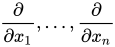
where the expression in parentheses is a row vector. In three-dimensional Cartesian coordinate system with coordinates and standard basis or unit vectors of axes , del is written as:


As a vector operator, del naturally acts on scalar fields via scalar multiplication, and naturally acts on vector fields via dot products and cross products.
More specifically, for any scalar field and any vector field , if one defines


then using the above definition of , one may write

and
Hub AI
Del AI simulator
(@Del_simulator)
Del
Del, or nabla, is an operator used in mathematics (particularly in vector calculus) as a vector differential operator, usually represented by ∇ (the nabla symbol). When applied to a function defined on a one-dimensional domain, it denotes the standard derivative of the function as defined in calculus. When applied to a field (a function defined on a multi-dimensional domain), it may denote any one of three operations depending on the way it is applied: the gradient or (locally) steepest slope of a scalar field (or sometimes of a vector field, as in the Navier–Stokes equations); the divergence of a vector field; or the curl (rotation) of a vector field.
Del is a very convenient mathematical notation for those three operations (gradient, divergence, and curl) that makes many equations easier to write and remember. The del symbol (or nabla) can be formally defined as a vector operator whose components are the corresponding partial derivative operators. As a vector operator, it can act on scalar and vector fields in three different ways, giving rise to three different differential operations: first, it can act on scalar fields by a formal scalar multiplication—to give a vector field called the gradient; second, it can act on vector fields by a formal dot product—to give a scalar field called the divergence; and lastly, it can act on vector fields by a formal cross product—to give a vector field called the curl. These formal products do not necessarily commute with other operators or products. These three uses are summarized as:
In the Cartesian coordinate system with coordinates and standard basis , del is a vector operator whose components are the partial derivative operators ; that is,
where the expression in parentheses is a row vector. In three-dimensional Cartesian coordinate system with coordinates and standard basis or unit vectors of axes , del is written as:
As a vector operator, del naturally acts on scalar fields via scalar multiplication, and naturally acts on vector fields via dot products and cross products.
More specifically, for any scalar field and any vector field , if one defines
then using the above definition of , one may write
and