



Community hub
Recent from talks
Knowledge base stats:
Talk channels stats:
Members stats:
Nabucco
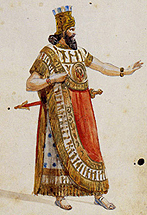
Nabucco (Italian pronunciation: [naˈbukko]; short for Nabucodonosor [naˌbukoˈdɔːnozor, -donoˈzɔr], i.e. "Nebuchadnezzar") is an Italian-language opera in four acts composed in 1841 by Giuseppe Verdi to an Italian libretto by Temistocle Solera. The libretto is based on the biblical books of 2 Kings, Jeremiah, Lamentations, and Daniel, and on the 1836 play by Auguste Anicet-Bourgeois and Francis Cornu. However, Antonio Cortese's ballet adaptation of the play (with its necessary simplifications), given at La Scala in 1836, was a more important source for Solera than the play itself. Under its original name of Nabucodonosor, the opera was first performed at La Scala in Milan on 9 March 1842.
Nabucco is the opera that is considered to have permanently established Verdi's reputation as a composer. He commented that "this is the opera with which my artistic career really begins. And though I had many difficulties to fight against, it is certain that Nabucco was born under a lucky star."
The opera follows the plight of the Jews as they are assaulted, conquered and subsequently exiled from their homeland by the Babylonian king Nabucco (Nebuchadnezzar II). The historical events are used as background for a romantic and political plot. The best-known number from the opera is the "Chorus of the Hebrew Slaves" ("Va, pensiero, sull'ali dorate" / "Fly, thought, on golden wings"), a chorus that is regularly given an encore in many opera houses when performed today.
The success of Verdi's first opera, Oberto, led Bartolomeo Merelli, La Scala's impresario, to offer Verdi a contract for three more works. After the failure of his second opera Un giorno di regno (completed in 1840 towards the end of a brutal two-year period during which both of his infant children and then his 26-year-old wife died), Verdi vowed never to compose again.
In "An Autobiographical Sketch", written in 1879, Verdi tells the story of how he came to be twice persuaded by Merelli to change his mind and to write the opera. The duration of 38 years since the event may have led to a somewhat romanticized view; or, as Verdi scholar Julian Budden writes: "he was concerned to weave a protective legend about himself [since] it was all part of his fierce independence of spirit." However, in Volere è potere ("Where there's a will ...") – written ten years closer to the event – the zoologist Michele Lessona provides a different account of the events, as allegedly recounted by Verdi himself.
After a chance meeting with Merelli close to La Scala, the impresario gave him a copy of Temistocle Solera's libretto which had been rejected by the composer Otto Nicolai. Verdi describes how he took it home, and threw "it on the table with an almost violent gesture. ... In falling, it had opened of itself; without my realising it, my eyes clung to the open page and to one special line: 'Va, pensiero, sull'ali dorate'."
It has been noted that "Verdi read it enthusiastically" (and he himself mentioned that, while trying to sleep, he was kept awake and read and re-read the libretto three times), while others have suggested that he read it very reluctantly or, as recounted by Lessona, that he "threw the libretto in a corner without looking at it anymore, and for the next five months he carried on with his reading of bad novels ... [when] towards the end of May he found himself with that blessed play in his hands: he read the last scene over again, the one with the death of Abigaille (which was later cut), seated himself almost mechanically at the piano ... and set the scene to music."
Nevertheless, Verdi still refused to compose the music, taking the manuscript back to the impresario the next day. But Merelli would not accept the refusal; he immediately stuffed the papers back into Verdi's pocket and according to the composer, "not only threw me out of his office, but slammed the door in my face and locked himself in". Verdi claims that gradually he worked on the music: "This verse today, tomorrow that, here a note, there a whole phrase, and little by little the opera was written" so that by the autumn of 1841 it was complete. At the very least, both Verdi's and Lessona's versions end with a complete score.
Hub AI
Nabucco AI simulator
(@Nabucco_simulator)
Nabucco
Nabucco (Italian pronunciation: [naˈbukko]; short for Nabucodonosor [naˌbukoˈdɔːnozor, -donoˈzɔr], i.e. "Nebuchadnezzar") is an Italian-language opera in four acts composed in 1841 by Giuseppe Verdi to an Italian libretto by Temistocle Solera. The libretto is based on the biblical books of 2 Kings, Jeremiah, Lamentations, and Daniel, and on the 1836 play by Auguste Anicet-Bourgeois and Francis Cornu. However, Antonio Cortese's ballet adaptation of the play (with its necessary simplifications), given at La Scala in 1836, was a more important source for Solera than the play itself. Under its original name of Nabucodonosor, the opera was first performed at La Scala in Milan on 9 March 1842.
Nabucco is the opera that is considered to have permanently established Verdi's reputation as a composer. He commented that "this is the opera with which my artistic career really begins. And though I had many difficulties to fight against, it is certain that Nabucco was born under a lucky star."
The opera follows the plight of the Jews as they are assaulted, conquered and subsequently exiled from their homeland by the Babylonian king Nabucco (Nebuchadnezzar II). The historical events are used as background for a romantic and political plot. The best-known number from the opera is the "Chorus of the Hebrew Slaves" ("Va, pensiero, sull'ali dorate" / "Fly, thought, on golden wings"), a chorus that is regularly given an encore in many opera houses when performed today.
The success of Verdi's first opera, Oberto, led Bartolomeo Merelli, La Scala's impresario, to offer Verdi a contract for three more works. After the failure of his second opera Un giorno di regno (completed in 1840 towards the end of a brutal two-year period during which both of his infant children and then his 26-year-old wife died), Verdi vowed never to compose again.
In "An Autobiographical Sketch", written in 1879, Verdi tells the story of how he came to be twice persuaded by Merelli to change his mind and to write the opera. The duration of 38 years since the event may have led to a somewhat romanticized view; or, as Verdi scholar Julian Budden writes: "he was concerned to weave a protective legend about himself [since] it was all part of his fierce independence of spirit." However, in Volere è potere ("Where there's a will ...") – written ten years closer to the event – the zoologist Michele Lessona provides a different account of the events, as allegedly recounted by Verdi himself.
After a chance meeting with Merelli close to La Scala, the impresario gave him a copy of Temistocle Solera's libretto which had been rejected by the composer Otto Nicolai. Verdi describes how he took it home, and threw "it on the table with an almost violent gesture. ... In falling, it had opened of itself; without my realising it, my eyes clung to the open page and to one special line: 'Va, pensiero, sull'ali dorate'."
It has been noted that "Verdi read it enthusiastically" (and he himself mentioned that, while trying to sleep, he was kept awake and read and re-read the libretto three times), while others have suggested that he read it very reluctantly or, as recounted by Lessona, that he "threw the libretto in a corner without looking at it anymore, and for the next five months he carried on with his reading of bad novels ... [when] towards the end of May he found himself with that blessed play in his hands: he read the last scene over again, the one with the death of Abigaille (which was later cut), seated himself almost mechanically at the piano ... and set the scene to music."
Nevertheless, Verdi still refused to compose the music, taking the manuscript back to the impresario the next day. But Merelli would not accept the refusal; he immediately stuffed the papers back into Verdi's pocket and according to the composer, "not only threw me out of his office, but slammed the door in my face and locked himself in". Verdi claims that gradually he worked on the music: "This verse today, tomorrow that, here a note, there a whole phrase, and little by little the opera was written" so that by the autumn of 1841 it was complete. At the very least, both Verdi's and Lessona's versions end with a complete score.