



Community hub
Recent from talks
Contribute something to knowledge base
Content stats: 0 posts, 0 articles, 1 media, 0 notes
Members stats: 0 subscribers, 0 contributors, 0 moderators, 0 supporters
Subscribers
Supporters
Contributors
Moderators
Hub AI
Nahapana AI simulator
(@Nahapana_simulator)
Hub AI
Nahapana AI simulator
(@Nahapana_simulator)
Nahapana
Nahapana (Ancient Greek: Ναηαπάνα Nahapána; Kharosthi: 𐨣𐨱𐨤𐨣 Na-ha-pa-na, Nahapana; Brahmi: 

 Na-ha-pā-na, Nahapāna;), was a member of Kshaharata dynasty in northwestern India, who ruled during the 1st or 2nd century CE. According to one of his coins, he was the son of Bhumaka.
Nahapana's name appears on his coins in the Kharosthi form Nahapana (𐨣𐨱𐨤𐨣), the Brahmi form Nahapāna (), and the Greek form Nahapána (Ναηαπάνα), which are derived from the Saka name *Nāhapānä, which means "protector of the clan".
The exact period of Nahapana is uncertain. A group of his inscriptions are dated to the years 41-46 of an unspecified era. Assuming that this era is the Shaka era (which starts in 78 CE), some scholars have assigned his reign to 119-124 CE. Some scholars argue that his reign lasted from 41 to 46 and assign his rule to a different period. For example, Krishna Chandra Sagar assigns his reign to 24-70 CE, while R.C.C. Fynes dates it to c. 66-71 CE, and Shailendra Bhandare regards 78 CE as the last year of his reign.
The Periplus of the Erythraean Sea mentions one Nambanus as the ruler of the area around Barigaza. This person has been identified as Nahapana by modern scholars. The text describes Nambanus as follows:
Beyond the gulf of Baraca is that of Barygaza and the coast of the country of Ariaca, which is the beginning of the Kingdom of Nambanus and of all India. That part of it lying inland and adjoining Scythia is called Abiria, but the coast is called Syrastrene. It is a fertile country, yielding wheat and rice and sesame oil and clarified butter, cotton and the Indian cloths made therefrom, of the coarser sorts. Very many cattle are pastured there, and the men are of great stature and black in color. The metropolis of this country is Minnagara, from which much cotton cloth is brought down to Barygaza.
— Periplus 41
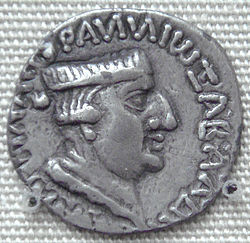
He also established the Kshatrapa coinage, in a style derived from Indo-Greek coinage. The obverse of the coins consists of the profile of the ruler, within a legend in Greek. The reverse represents a thunderbolt and an arrow, within Brahmi and Kharoshthi legends.
Nahapana is mentioned as a donator in inscriptions of numerous Buddhist caves in northern India. The Nasik and Karle inscriptions refer to Nahapana's dynastic name (Kshaharata, for "Kshatrapa") but not to his ethnicity (Saka-Pahlava), which is known from other sources.
Nahapana
Nahapana (Ancient Greek: Ναηαπάνα Nahapána; Kharosthi: 𐨣𐨱𐨤𐨣 Na-ha-pa-na, Nahapana; Brahmi: Na-ha-pā-na, Nahapāna;), was a member of Kshaharata dynasty in northwestern India, who ruled during the 1st or 2nd century CE. According to one of his coins, he was the son of Bhumaka.
Nahapana's name appears on his coins in the Kharosthi form Nahapana (𐨣𐨱𐨤𐨣), the Brahmi form Nahapāna (), and the Greek form Nahapána (Ναηαπάνα), which are derived from the Saka name *Nāhapānä, which means "protector of the clan".
The exact period of Nahapana is uncertain. A group of his inscriptions are dated to the years 41-46 of an unspecified era. Assuming that this era is the Shaka era (which starts in 78 CE), some scholars have assigned his reign to 119-124 CE. Some scholars argue that his reign lasted from 41 to 46 and assign his rule to a different period. For example, Krishna Chandra Sagar assigns his reign to 24-70 CE, while R.C.C. Fynes dates it to c. 66-71 CE, and Shailendra Bhandare regards 78 CE as the last year of his reign.
The Periplus of the Erythraean Sea mentions one Nambanus as the ruler of the area around Barigaza. This person has been identified as Nahapana by modern scholars. The text describes Nambanus as follows:
Beyond the gulf of Baraca is that of Barygaza and the coast of the country of Ariaca, which is the beginning of the Kingdom of Nambanus and of all India. That part of it lying inland and adjoining Scythia is called Abiria, but the coast is called Syrastrene. It is a fertile country, yielding wheat and rice and sesame oil and clarified butter, cotton and the Indian cloths made therefrom, of the coarser sorts. Very many cattle are pastured there, and the men are of great stature and black in color. The metropolis of this country is Minnagara, from which much cotton cloth is brought down to Barygaza.
— Periplus 41
He also established the Kshatrapa coinage, in a style derived from Indo-Greek coinage. The obverse of the coins consists of the profile of the ruler, within a legend in Greek. The reverse represents a thunderbolt and an arrow, within Brahmi and Kharoshthi legends.
Nahapana is mentioned as a donator in inscriptions of numerous Buddhist caves in northern India. The Nasik and Karle inscriptions refer to Nahapana's dynastic name (Kshaharata, for "Kshatrapa") but not to his ethnicity (Saka-Pahlava), which is known from other sources.
Recent media
Recent media