Respect all members: no insults, harassment, or hate speech.
Be tolerant of different viewpoints, cultures, and beliefs. If you do not agree with others, just create separate note, article or collection.
Clearly distinguish between personal opinion and fact.
Verify facts before posting, especially when writing about history, science, or statistics.
Promotional content must be published on the “Related Services and Products” page—no more than one paragraph per service. You can also create subpages under the “Related Services and Products” page and publish longer promotional text there.
Do not post materials that infringe on copyright without permission.
Always credit sources when sharing information, quotes, or media.
Be respectful of the work of others when making changes.
Discuss major edits instead of removing others' contributions without reason.
If you notice rule-breaking, notify community about it in talks.
Do not share personal data of others without their consent.
Brahmi is an abugida and uses a system of diacritical marks to associate vowels with consonant symbols. The writing system only went through relatively minor evolutionary changes from the Mauryan period (3rd century BCE) down to the early Gupta period (4th century CE), and it is thought that as late as the 4th century CE, a literate person could still read and understand Mauryan inscriptions.[7] Sometime thereafter, the ability to read the original Brahmi script was lost. The earliest (indisputably dated) and best-known Brahmi inscriptions are the rock-cut edicts of Ashoka in north-central India, dating to 250–232 BCE. During the late 20th century CE, the notion that Brahmi originated before the 3rd century BCE gained strength when archaeologists working at Anuradhapura in Sri Lanka retrieved Brahmi inscriptions on pottery belonging to the 450-350 BCE period.[8]
The origin of the script is still much debated, with most scholars stating that Brahmi was derived from or at least influenced by one or more contemporary Semitic scripts. Some scholars favour the idea of an indigenous origin,[20] or connection to the much older and as yet undeciphered Indus script[21][22] but the evidence is insufficient at best.
Brahmi script was the first in the list of scripts mentioned in the Sanskit Lalitavistara Sūtra. But it took some time for modern scholars to associate this name with the ancient script that we now know as 'Brahmi'. At first, modern scholars referred to it in English as "pin-man" script,[23] likening the characters to stick figures. It was also known by a variety of other names, including "lath", "Laṭ", "Southern Aśokan", "Indian Pali" or "Mauryan" (Salomon 1998, p. 17). But in the 1880s, Albert Étienne Jean Baptiste Terrien de Lacouperie, based on an observation by Gabriel Devéria, associated the ancient name with the actual script engraved on the monuments. Thence the name was adopted in the influential work of Georg Bühler, albeit in the variant form "Brahma".[24]
The Gupta script of the 5th century is sometimes called "Late Brahmi". From the 6th century onward, the Brahmi script diversified into numerous local variants, grouped as the Brahmic family of scripts. Dozens of modern scripts used across South and South East Asia have descended from Brahmi, making it one of the world's most influential writing traditions.[25] One survey found 198 scripts that ultimately derive from it.[26]
Among the inscriptions of Ashoka (c. 3rd century BCE) written in the Brahmi script a few numerals were found, which have come to be called the Brahmi numerals.[27] The numerals are additive and multiplicative and, therefore, not place value;[27] it is not known if their underlying system of numeration has a connection to the Brahmi script.[27] But in the second half of the 1st millennium CE, some inscriptions in India and Southeast Asia written in scripts derived from the Brahmi did include numerals that are decimal place value, and constitute the earliest existing material examples of the Hindu–Arabic numeral system, now in use throughout the world.[28] The underlying system of numeration, however, was older, as the earliest attested orally transmitted example dates to the middle of the 3rd century CE in a Sanskrit prose adaptation of a lost Greek work on astrology.[29][30][31]
A northern example of Brahmi epigraphy: ancient terracotta sculpture from Sugh"Child learning Brahmi", showing the first letters of the Brahmi alphabet, 2nd century BCE.[32]
The Brahmi script is mentioned in the ancient Indian texts of the three major Dharmic religions: Hinduism, Jainism, and Buddhism, as well as their Chinese translations.[33][34] For example, the 10th chapter of the Lalitavistara Sūtra (c. 200–300 CE),[35] titled the Lipisala samdarshana parivarta, lists 64 lipi (scripts), with the Brahmi script starting the list. The Lalitavistara Sūtra states that young Siddhartha, the future Gautama Buddha (~500 BCE), mastered philology, Brahmi and other scripts from the Brahmin Lipikāra and Deva Vidyāsiṃha at a school.[33][36]
A list of eighteen ancient scripts is found in the early Jaina texts, such as the Paṇṇavaṇā Sūtra (2nd century BCE) and the Samavāyāṅga Sūtra (3rd century BCE).[37][38] These Jain script lists include Brahmi at number 1 and Kharoṣṭhi at number 4, but also Javanaliya (probably Greek) and others not found in the Buddhist lists.[38]
While the contemporary Kharoṣṭhī script is widely accepted to be a derivation of the Aramaic alphabet, the genesis of the Brahmi script is less straightforward. Salomon reviewed existing theories in 1998,[4] while Falk provided an overview in 1993.[39]
Early theories proposed a pictographic-acrophonic origin for the Brahmi script, on the model of the Egyptian hieroglyphic script. These ideas however have lost credence, as they are "purely imaginative and speculative".[40] Similar ideas have tried to connect the Brahmi script with the Indus script, but they remain unproven, and particularly suffer from the fact that the Indus script is as yet undeciphered.[40]
The mainstream view is that Brahmi has an origin in Semitic scripts (usually Aramaic). This is accepted by the vast majority of script scholars since the publications by Albrecht Weber (1856) and Georg Bühler's On the origin of the Indian Brahma alphabet (1895).[41][5] Bühler's ideas have been particularly influential, though even by the 1895 date of his opus on the subject, he could identify no fewer than five competing theories of the origin, one positing an indigenous origin and the others deriving it from various Semitic models.[42]
The most disputed point about the origin of the Brahmi script has long been whether it was a purely indigenous development or was borrowed or derived from scripts that originated outside India. Goyal (1979)[43] noted that most proponents of the indigenous view are fringe Indian scholars, whereas the theory of Semitic origin is held by "nearly all" Western scholars, and Salomon agrees with Goyal that there has been "nationalist bias" and "imperialist bias" on the two respective sides of the debate.[44] In spite of this, the view of indigenous development had been prevalent among British scholars writing prior to Bühler: a passage by Alexander Cunningham, one of the earliest indigenous origin proponents, suggests that, in his time, the indigenous origin was a preference of British scholars in opposition to the "unknown Western" origin preferred by continental scholars.[42] Cunningham in the seminal Corpus Inscriptionum Indicarum of 1877 speculated that Brahmi characters were derived from, among other things, a pictographic principle based on the human body,[45] but Bühler noted that, by 1891, Cunningham considered the origins of the script uncertain.
Heliodorus pillar in the Indian state of Madhya Pradesh. Installed about 113 BCE and now named after Heliodorus, who was an ambassador of the Indo-Greek king Antialcidas from Taxila, and was sent to the Indian ruler Bhagabhadra. The pillar's Brahmi-script inscription states that Heliodorus is a Bhagvatena (devotee) of Vāsudeva. A couplet in it closely paraphrases a Sanskrit verse from the Mahabharata.[46][47]
Most scholars believe that Brahmi was likely derived from or influenced by a Semitic script model, with Aramaic being a leading candidate.[48] However, the issue is not settled due to the lack of direct evidence and unexplained differences between Aramaic, Kharoṣṭhī, and Brahmi.[49] Though Brahmi and the Kharoṣṭhī script share some general features, the differences between the Kharosthi and Brahmi scripts are "much greater than their similarities", and "the overall differences between the two render a direct linear development connection unlikely", states Richard Salomon.[50]
Virtually all authors accept that regardless of the origins, the differences between the Indian script and those proposed to have influenced it are significant. The degree of Indian development of the Brahmi script in both the graphic form and the structure has been extensive. It is also widely accepted that theories about the grammar of the Vedic language probably had a strong influence on this development. Some authors – both Western and Indian – suggest that Brahmi was borrowed or inspired by a Semitic script, invented in a short few years during the reign of Ashoka, and then used widely for Ashokan inscriptions.[49] In contrast, some authors reject the idea of foreign influence.[51][52]
Bruce Trigger states that Brahmi likely emerged from the Aramaic script (with extensive local development), but there is no evidence of a direct common source.[53] According to Trigger, Brahmi was in use before the Ashoka pillars, at least by the 4th or 5th century BCE in Sri Lanka and India, while Kharoṣṭhī was used only in northwest South Asia (eastern parts of modern Afghanistan and neighboring regions of Pakistan) for a while before it died out in the third century.[53] According to Salomon, evidence of the use of Kharoṣṭhī is found primarily in Buddhist records and those of Indo-Greek, Indo-Scythian, Indo-Parthian, and Kushana dynasty era.[50]
Justeson and Stephens proposed that this inherent vowel system in Brahmi and Kharoṣṭhī developed by transmission of a Semitic abjad through the recitation of its letter values. The idea is that learners of the source alphabet recite the sounds by combining the consonant with an unmarked vowel, e.g. /kə/,/kʰə/,/gə/, and in the process of borrowing into another language, these syllables are taken to be the sound values of the symbols. They also accepted the idea that Brahmi was based on a North Semitic model.[54]
unaspirated glyph back formed as if aspirated glyph with curve
ḍ/ḍh
curve addition
Many scholars link the origin of Brahmi to Semitic script models, particularly Aramaic.[41] The explanation of how this might have happened, the particular Semitic script, and the chronology of the derivation have been the subject of much debate. Bühler followed Albrecht Weber in connecting it particularly to Phoenician, and proposed an early 8th century BCE date[55] for the borrowing. A link to the South Semitic scripts, a less prominent branch of the Semitic script family, has occasionally been proposed, but has not gained much acceptance.[56] Finally, the Aramaic script being the prototype for Brahmi has been the more preferred hypothesis because of its geographic proximity to the Indian subcontinent, and its influence likely arising because Aramaic was the bureaucratic language of the Achaemenid empire. However, this hypothesis does not explain the mystery of why two very different scripts, Kharoṣṭhī and Brahmi, developed from the same Aramaic. A possible explanation might be that Ashoka created an imperial script for his edicts, but there is no evidence to support this conjecture.[57]
The chart below shows the close resemblance that Brahmi has with the first four letters of Semitic script, the first column representing the Phoenician alphabet.
According to the Semitic hypothesis as laid out by Bühler in 1898, the oldest Brahmi inscriptions were derived from a Phoenician prototype.[59][note 1] Salomon states Bühler's arguments are "weak historical, geographical, and chronological justifications for a Phoenician prototype". Discoveries made since Bühler's proposal, such as of six Mauryan inscriptions in Aramaic, suggest Bühler's proposal about Phoenician as weak. It is more likely that Aramaic, which was virtually certainly the prototype for Kharoṣṭhī, also may have been the basis for Brahmi. However, it is unclear why the ancient Indians would have developed two very different scripts.[57]
Comparison of North Semitic and Brahmi scripts[61][note 2]
According to Bühler, Brahmi added symbols for certain sounds not found in Semitic languages, and either deleted or repurposed symbols for Aramaic sounds not found in Prakrit. For example, Aramaic lacks the phonetic retroflex feature that appears among Prakrit dental stops, such as ḍ, and in Brahmi the symbols of the retroflex and non-retroflex consonants are graphically very similar, as if both had been derived from a single prototype. (See Tibetan alphabet for a similar later development.) Aramaic did not have Brahmi's aspirated consonants (kh, th, etc.), whereas Brahmi did not have Aramaic's emphatic consonants (q, ṭ, ṣ), and it appears that these unneeded emphatic letters filled in for some of Brahmi's aspirates: Aramaic q for Brahmi kh, Aramaic ṭ (Θ) for Brahmi th (ʘ), etc. And just where Aramaic did not have a corresponding emphatic stop, p, Brahmi seems to have doubled up for the corresponding aspirate: Brahmi p and ph are graphically very similar, as if taken from the same source in Aramaic p. Bühler saw a systematic derivational principle for the other aspirates ch, jh, ph, bh, and dh, which involved adding a curve or upward hook to the right side of the character (which has been speculated to derive from h, ), while d and ṭ (not to be confused with the Semitic emphatic ṭ) were derived by back formation from dh and ṭh.[63]
The attached table lists the correspondences between Brahmi and North Semitic scripts.[64][61]
Bühler states that both Phoenician and Brahmi had three voiceless sibilants, but because the alphabetical ordering was lost, the correspondences among them are not clear. Bühler was able to suggest Brahmi derivatives corresponding to all of the 22 North Semitic characters, though clearly, as Bühler himself recognized, some are more confident than others. He tended to place much weight on phonetic congruence as a guideline, for example connecting c to tsade 𐤑 rather than kaph 𐤊, as preferred by many of his predecessors.
One of the key problems with a Phoenician derivation is the lack of evidence for historical contact with Phoenicians in the relevant period.[57] Bühler explained this by proposing that the initial borrowing of Brahmi characters dates back considerably earlier than the earliest known evidence, as far back as 800 BCE, contemporary with the Phoenician glyph forms that he mainly compared. Bühler cited a near-modern practice of writing Brahmic scripts informally without vowel diacritics as a possible continuation of this earlier abjad-like stage in development.[55]
The weakest forms of the Semitic hypothesis are similar to Gnanadesikan's trans-cultural diffusion view of the development of Brahmi and Kharoṣṭhī, in which the idea of alphabetic sound representation was learned from the Aramaic-speaking Persians, but much of the writing system was a novel development tailored to the phonology of Prakrit.[65]
Further evidence cited in favor of Persian influence has been the Hultzsch proposal in 1925 that the Prakrit/Sanskrit word for writing itself, lipi is similar to the Old Persian word dipi, suggesting a probable borrowing.[66][67] A few of the Ashoka edicts from the region nearest the Persian empire use dipi as the Prakrit word for writing, which appears as lipi elsewhere, and this geographic distribution has long been taken, at least back to Bühler's time, as an indication that the standard lipi form is a later alteration that appeared as it diffused away from the Persian sphere of influence. Persian dipi itself is thought to be an Elamite loanword.[68]
Coin (circa 180 BCE) of Agathocles with Indian deities, in Greek and Brahmi. Obverse: With Greek legend: ΒΑΣΙΛΕΩΣ ΑΓΑΘΟΚΛΕΟΥΣ (Basileōs Agathokleous). Reverse: With Brahmi legend:𑀭𑀸𑀚𑀦𑁂 𑀅𑀕𑀣𑀼𑀓𑁆𑀮𑀬𑁂𑀲Rājane Agathukleyesa .[69][70]
Falk's 1993 book Schrift im Alten Indien is a study on writing in ancient India,[71][72] and has a section on the origins of Brahmi.[73] It features an extensive review of the literature up to that time. Falk sees the basic writing system of Brahmi as being derived from the Kharoṣṭhī script, itself a derivative of Aramaic. At the time of his writing, the Ashoka edicts were the oldest confidently dateable examples of Brahmi, and he perceives in them "a clear development in language from a faulty linguistic style to a well honed one"[74] over time, which he takes to indicate that the script had been recently developed.[73][75] Falk deviates from the mainstream of opinion in seeing Greek as also being a significant source for Brahmi. On this point particularly, Salomon disagrees with Falk, and after presenting evidence of very different methodology between Greek and Brahmi notation of vowel quantity, he states "it is doubtful whether Brahmi derived even the basic concept from a Greek prototype".[76] Further, adds Salomon, in a "limited sense Brahmi can be said to be derived from Kharosthi, but in terms of the actual forms of the characters, the differences between the two Indian scripts are much greater than the similarities".[77]
Falk also dated the origin of Kharoṣṭhī to no earlier than 325 BCE, based on a proposed connection to the Greek conquest.[78] Salomon questions Falk's arguments as to the date of Kharoṣṭhī and writes that it is "speculative at best and hardly constitutes firm grounds for a late date for Kharoṣṭhī. The stronger argument for this position is that we have no specimen of the script before the time of Ashoka, nor any direct evidence of intermediate stages in its development; but of course this does not mean that such earlier forms did not exist, only that, if they did exist, they have not survived, presumably because they were not employed for monumental purposes before Ashoka".[75]
Unlike Bühler, Falk does not provide details of which and how the presumptive prototypes may have been mapped to the individual characters of Brahmi. Further, states Salomon, Falk accepts there are anomalies in phonetic value and diacritics in Brahmi script that are not found in the presumed Kharoṣṭhī script source. Falk attempts to explain these anomalies by reviving the Greek influence hypothesis, a hypothesis that had previously fallen out of favor.[75][79]
Hartmut Scharfe, in his 2002 review of Kharoṣṭī and Brāhmī scripts, concurs with Salomon's questioning of Falk's proposal, and states, "the pattern of the phonemic analysis of the Sanskrit language achieved by the Vedic scholars is much closer to the Brahmi script than the Greek alphabet".[22]
As of 2018, Harry Falk refined his view by affirming that Brahmi was developed from scratch in a rational way at the time of Ashoka, by consciously combining the advantages of the pre-existing Greek script and northern Kharosthi script.[80] Greek-style letter types were selected for their "broad, upright and symmetrical form", and writing from left to right was also adopted for its convenience.[80] On the other hand, the Kharosthi treatment of vowels was retained, with its inherent vowel "a", derived from Aramaic, and stroke additions to represent other vowel signs.[80] In addition, a new system of combining consonants vertically to represent complex sounds was also developed.[80]
In 2023, Damodaram Pillai claimed to have adequately explained the derivation of each of the letters of the Brahmi script. He argues that Brahmi was not derived from a single script, but instead was a hybrid invention by ancient Indian scholars. They would have used Phoenician, Greek, ‘standard Aramaic’, as well as a particular form of Aramaic letters coming from the Nabataean Aramaic, to invent Brahmi. According to him, “a form of Aramaic script intermediate to standard Aramaic and its daughter Nabataean” was an important source of Brahmi. Thus, 15 letters of Brahmi were derived from the standard Aramaic, 7 were derived from “specific Nabataean letters”, 3 letters from Greek, 3 letters from Phoenician, and 1 Brahmi letter also came from the Square Aramaic script. The Nabatean Aramaic script would have been introduced to India by traders from that region via the sea route.[20]
The possibility of an indigenous origin such as a connection to the Indus script is supported by some Western and Indian scholars and writers. The theory that there are similarities to the Indus script was suggested by early European scholars such as the archaeologist John Marshall[81] and the Assyriologist Stephen Langdon.[82] G. R. Hunter in his book The Script of Harappa and Mohenjodaro and Its Connection with Other Scripts (1934) proposed a derivation of the Brahmi alphabets from the Indus script, the match being considerably higher than that of Aramaic in his estimation.[83] British archaeologist Raymond Allchin stated that there is a powerful argument against the idea that the Brahmi script has Semitic borrowing because the whole structure and conception is quite different. He at one time suggested that the origin may have been purely indigenous with the Indus script as its predecessor.[84] However, Allchin and Erdosy later in 1995 expressed the opinion that there was as yet insufficient evidence to resolve the question.[85]
A proposed connection between the Brahmi and Indus scripts, made in the 19th century by Alexander Cunningham.
Today the indigenous origin hypothesis is more commonly promoted by non-specialists, such as the computer scientist Subhash Kak, the spiritual teachers David Frawley and Georg Feuerstein, and the social anthropologist Jack Goody.[86][87][88] Subhash Kak disagrees with the proposed Semitic origins of the script,[89] instead stating that the interaction between the Indic and the Semitic worlds before the rise of the Semitic scripts might imply a reverse process.[90] However, the chronology thus presented and the notion of an unbroken tradition of literacy is opposed by a majority of academics who support an indigenous origin. Evidence for a continuity between Indus and Brahmi has also been seen in graphic similarities between Brahmi and the late Indus script, where the ten most common ligatures correspond with the form of one of the ten most common glyphs in Brahmi.[91] There is also corresponding evidence of continuity in the use of numerals.[92] Further support for this continuity comes from statistical analysis of the relationship carried out by Das.[93]
Salomon considered simple graphic similarities between characters to be insufficient evidence for a connection without knowing the phonetic values of the Indus script, though he found apparent similarities in patterns of compounding and diacritical modification to be "intriguing". However, he felt that it was premature to explain and evaluate them due to the large chronological gap between the scripts and the thus far indecipherable nature of the Indus script.[94]
The main obstacle to this idea is the lack of evidence for writing during the millennium and a half between the collapse of the Indus Valley civilisation around 1500 BCE and the first widely accepted appearance of Brahmi in the 3rd or 4th centuries BCE. Iravathan Mahadevan makes the point that even if one takes the latest dates of 1500 BCE for the Indus script and earliest claimed dates of Brahmi around 500 BCE, a thousand years still separates the two.[95] Furthermore, there is no accepted decipherment of the Indus script, which makes theories based on claimed decipherments tenuous.
A promising possible link between the Indus script and later writing traditions may be in the megalithic graffiti symbols of the South Indian megalithic culture, which may have some overlap with the Indus symbol inventory and persisted in use up at least through the appearance of the Brahmi and scripts up into the third century CE. These graffiti usually appear singly, though on occasion may be found in groups of two or three, and are thought to have been family, clan, or religious symbols.[96] In 1935, C. L. Fábri proposed that symbols found on Mauryan punch-marked coins were remnants of the Indus script that had survived the collapse of the Indus civilization.[97]
Another form of the indigenous origin theory is that Brahmi was invented ex nihilo, entirely independently from either Semitic models or the Indus script, though Salomon found these theories to be wholly speculative in nature.[98]
Pāṇini (6th to 4th century BCE) mentions lipi, the Indian word for writing scripts in his definitive work on Sanskrit grammar, the Ashtadhyayi. According to Scharfe, the words lipi and libi are borrowed from the Old Persiandipi, in turn derived from Sumerian dup.[67][99] To describe his own Edicts, Ashoka used the word Lipī, now generally simply translated as "writing" or "inscription". It is thought the word "lipi", which is also spelled "dipi" in the two Kharosthi-version of the rock edicts,[note 3] comes from an Old Persian prototype dipî also meaning "inscription", which is used for example by Darius I in his Behistun inscription,[note 4] suggesting borrowing and diffusion.[100][101][102][full citation needed]
Scharfe adds that the best evidence is that no script was used or ever known in India, aside from the Persian-dominated Northwest where Aramaic was used, before around 300 BCE because Indian tradition "at every occasion stresses the orality of the cultural and literary heritage",[67] yet Scharfe in the same book admits that "a script has been discovered in the excavations of the Indus Valley Civilization that flourished in the Indus valley and adjacent areas in the third millennium B.C. The number of different signs suggest a syllabic script, but all attempts at decipherment have been unsuccessful so far. Attempts by some Indian scholars to connect this undeciphered script with the Indian scripts in vogue from the third century B.C. onward are total failures."[103]
Megasthenes, a Greek ambassador to the Mauryan court in Northeastern India only a quarter century before Ashoka, noted "... and this among a people who have no written laws, who are ignorant even of writing, and regulate everything by memory."[104] This has been variously and contentiously interpreted by many authors. Ludo Rocher almost entirely dismisses Megasthenes as unreliable, questioning the wording used by Megasthenes' informant and Megasthenes' interpretation of them.[105] Timmer considers it to reflect a misunderstanding that the Mauryans were illiterate "based upon the fact that Megasthenes rightly observed that the laws were unwritten and that oral tradition played such an important part in India."[106]
Some proponents of the indigenous origin theories[who?] question the reliability and interpretation of comments made by Megasthenes (as quoted by Strabo in the Geographica XV.i.53). For one, the observation may only apply in the context of the kingdom of "Sandrakottos" (Chandragupta). Elsewhere in Strabo (Strab. XV.i.39), Megasthenes is said to have noted that it was a regular custom in India for the "philosopher" caste (presumably Brahmins) to submit "anything useful which they have committed to writing" to kings,[107] but this detail does not appear in parallel extracts of Megasthenes found in Arrian and Diodorus Siculus.[108][109] The implication of writing per se is also not totally clear in the original Greek as the term "συντάξῃ" (source of the English word "syntax") can be read as a generic "composition" or "arrangement", rather than a written composition in particular. Nearchus, a contemporary of Megasthenes, noted, a few decades prior, the use of cotton fabric for writing in Northern India. Indologists have variously speculated that this might have been Kharoṣṭhī or the Aramaic alphabet. Salomon regards the evidence from Greek sources to be inconclusive.[110] Strabo himself notes this inconsistency regarding reports on the use of writing in India (XV.i.67).
Connections between Phoenician (4th column) and Brahmi (5th column). Note that 6th-to-4th-century BCE Aramaic (not shown) is in many cases intermediate in form between the two.
Kenneth Norman (2005) suggests that Brahmi was devised over a longer period of time predating Ashoka's rule:[111]
Support for this idea of pre-Ashokan development has been given very recently by the discovery of sherds at Anuradhapura in Sri Lanka, inscribed with small numbers of characters which seem to be Brāhmī. These sherds have been dated, by both Carbon 14 and Thermo-luminescence dating, to pre-Ashokan times, perhaps as much as two centuries before Ashoka.[112]
He also notes that the variations seen in the Asokan edicts would be unlikely to have emerged so quickly if Brahmi had a single origin in the chancelleries of the Mauryan Empire.[113] He suggests a date of not later than the end of the 4th century for the development of Brahmi script in the form represented in the inscriptions, with earlier possible antecedents.[113]
Jack Goody (1987) had similarly suggested that ancient India likely had a "very old culture of writing" along with its oral tradition of composing and transmitting knowledge, because the Vedic literature is too vast, consistent and complex to have been entirely created, memorized, accurately preserved and spread without a written system.[114][115]
Opinions on this point, the possibility that there may not have been any writing scripts including Brahmi during the Vedic age, given the quantity and quality of the Vedic literature, are divided. While Falk (1993) disagrees with Goody,[116] while Walter Ong and John Hartley (2012) concur,[117] not so much based on the difficulty of orally preserving the Vedic hymns, but on the basis that it is highly unlikely that Panini's grammar was composed. Johannes Bronkhorst (2002) takes the intermediate position that the oral transmission of the Vedic hymns may well have been achieved orally, but that the development of Panini's grammar presupposes writing (consistent with a development of Indian writing in c. the 4th century BCE).[71]
Several divergent accounts of the origin of the name "Brahmi" (ब्राह्मी) appear in history. The term Brahmi (बाम्भी in original) appears in Indian texts in different contexts. According to the rules of the Sanskrit language, it is a feminine word meaning literally "of Brahma" or "the female energy of the Brahman".[118] In popular Hindu texts such as the Mahabharata, it appears in the sense of a goddess, particularly for Saraswati as the goddess of speech and elsewhere as "personified Shakti (energy) of Brahma, the god of Hindu scriptures Veda and creation".[119] Later Chinese Buddhist account of the 6th century CE also supports its creation to the god Brahma, though Monier Monier-Williams, Sylvain Lévi and others thought it was more likely to have been given the name because it was moulded by the Brahmins.[120][121]
Alternatively, some Buddhist sutras such as the Lalitavistara Sūtra (possibly 4th century CE), list Brāhmī and Kharoṣṭī as some of the sixty-four scripts the Buddha knew as a child.[122] Several sutras of Jainism such as the Vyakhya Pragyapti Sutra, the Samvayanga Sutra and the Pragyapna Sutra of the Jain Agamas include a list of 18 writing scripts known to teachers before the Mahavira was born, the first one being Bambhi (बाम्भी) in the original Prakrit, which has been interpreted as "Bramhi".[122] The Brahmi script is missing from the list of 18 scripts in the surviving versions of two later Jaina Sutras, namely the Vishesha Avashyaka and the Kalpa Sutra. Jain legend recounts that 18 writing scripts were taught by their first Tirthankara Rishabhanatha to his daughter Bambhi (बाम्भी); she emphasized बाम्भी as the main script as she taught others, and therefore the name Brahmi for the script comes after her name.[123] There is no early epigraphic proof for the expression "Brahmi script". Ashoka himself when he created the first known inscriptions in the new script in the 3rd century BCE, used the expression dhaṃma lipi (Prakrit in the Brahmi script: 𑀥𑀁𑀫𑀮𑀺𑀧𑀺, "Inscriptions of the Dharma") but this is not to describe the script of his own Edicts.[124]
The earliest known full inscriptions of Brahmi are in Prakrit, dated to be from the 3rd to 1st centuries BCE, particularly the Edicts of Ashoka, c. 250 BCE.[125] Prakrit records predominate the epigraphic records discovered in the Indian subcontinent through about the 1st century CE.[125] The earliest known Brahmi inscriptions in Sanskrit are from the 1st century BCE, such as the few discovered in Ayodhya, Ghosundi and Hathibada (both near Chittorgarh).[126][note 5] Ancient inscriptions have also been discovered in many North and Central Indian sites, occasionally in South India as well, that are in hybrid Sanskrit-Prakrit language called "Epigraphical Hybrid Sanskrit".[note 6] These are dated by modern techniques to between the 1st and 4th centuries CE.[129][130] Surviving ancient records of the Brahmi script are found as engravings on pillars, temple walls, metal plates, terracotta, coins, crystals and manuscripts.[131][130]
One of the most important recent developments regarding the origin of Brahmi has been the discovery of Brahmi characters inscribed on fragments of pottery from the trading town of Anuradhapura in Sri Lanka, which have been dated to between the 6th and the early 4th century BCE,[132] although these finds are controversial (see Tamil Brahmi § Conflicting theories about origin since 1990s). In 1996, Coningham et al.[133] stated that the script on the Anuradhapura inscriptions is Brahmi, but stated that the language was a Prakrit rather than a Dravidian language. The historical sequence of the specimens was interpreted to indicate an evolution in the level of stylistic refinement over several centuries, and they concluded that the Brahmi script may have arisen out of "mercantile involvement" and that the growth of trade networks in Sri Lanka was correlated with its first appearance in the area.[133] Salomon in his 1998 review states that the Anuradhapura inscriptions support the theory that Brahmi existed in South Asia before the Mauryan times, with studies favoring the 4th century BCE, but some doubts remain whether the inscriptions might be intrusive into the potsherds from a later date.[132] Indologist Harry Falk has argued that the Edicts of Ashoka represent an older stage of Brahmi, whereas certain paleographic features of even the earliest Anuradhapura inscriptions are likely to be later, and so these potsherds may date from after 250 BCE.[134]
More recently in 2013, Rajan and Yatheeskumar published excavations at Porunthal and Kodumanal in Tamil Nadu, where numerous both Tamil-Brahmi and "Prakrit-Brahmi" inscriptions and fragments have been found.[135] Their stratigraphic analysis combined with radiocarbon dates of paddy grains and charcoal samples indicated that inscription contexts date to as far back as the 6th and perhaps 7th centuries BCE.[136] As these were published very recently, they have as yet not been commented on extensively in the literature. Indologist Harry Falk has criticized Rajan's claims as "particularly ill-informed"; Falk argues that some of the earliest supposed inscriptions are not Brahmi letters at all, but merely misinterpreted non-linguistic Megalithic graffiti symbols, which were used in South India for several centuries during the pre-literate era.[137]
Calligraphic evolution (3rd century BCE – 1st century CE)
Calligraphical evolution: 3rd century BCE calligraphy (top), and a sample of the new calligraphic style introduced by the Indo-Scythians (bottom, fragment of the Mirzapur stele inscription, in the vicinity of Mathura, c. 15 CE).[138][139] The text is Svāmisya Mahakṣatrapasya Śudasasya "Of the Lord and Great Satrap Śudāsa"[140]
The calligraphy of the Brahmi script remained virtually unchanged from the time of the Maurya Empire to the end of the 1st century BCE.[139] Around this time, the Indo-Scythians ("Northern Satraps"), after their establishment in northern India introduced "revolutionary changes" in the way Brahmi was written.[139] In the 1st century BCE, the shape of Brahmi characters became more angular, and the vertical segments of letters were equalized, a phenomenon that is clearly visible in coin legends and that made the script visually more similar to the Greek script.[139] In this new typeface, the letters were "neat and well-formed".[139] The probable introduction of ink and pen writing, with the characteristic thickenned start of each stroke generated by the usage of ink, was reproduced in the calligraphy of stone inscriptions by the creation of a triangle-shaped form at the beginning of each stroke.[139][141] This new writing style is particularly visible in the numerous dedicatory inscriptions made in Mathura, in association with devotional works of art.[139] This new calligraphy of the Brahmi script was adopted in the rest of the subcontinent of the next half century.[139] The "new-pen-style" initiated a rapid evolution of the script from the 1st century CE, with regional variations starting to emerge.[139]
Classification of Brahmi characters by James Prinsep in March 1834. The structure of Brahmi (consonantal characters with vocalic "inflections") was properly identified, but the individual values of characters remained undetermined, except for four of the vocalic inflections. Journal of the Asiatic Society of Bengal Volume 3 (March 1834).[142]Norwegian scholar Christian Lassen used the bilingual Greek-Brahmi coinage of Indo-Greek king Agathocles to correctly achieve in 1836 the first secure decipherment of several letters of the Brahmi script, which was later completed by James Prinsep.[143][144]Consonants of the Brahmi script, and evolution down to modern Devanagari, according to James Prinsep, as published in the Journal of the Asiatic Society of Bengal, in March 1838. All the letters are correctly deciphered, except for two missing on the right: 𑀰(ś) and 𑀱(ṣ).[145] Vowels and compounds here. All scripts derived from Brahmi are gathered under the term "Brahmic scripts".
Besides a few inscriptions in Greek and Aramaic (which were only discovered in the 20th century), the Edicts of Ashoka were written in the Brahmi script and sometimes in the Kharoshthi script in the northwest, which had both become extinct around the 4th century CE, and were yet undeciphered at the time the Edicts were discovered and investigated in the 19th century.[146][19]
Inscriptions of the 6th century CE in late Brahmi were already deciphered in 1785 by Charles Wilkins, who published an essentially correct translation of the Gopika Cave Inscription written by the Maukhari king Anantavarman.[147] Wilkins seems to have relied essentially on the similarities with later Brahmic scripts, such as the script of the Pala period and early forms of Devanagari.[147]
James Prinsep, an archaeologist, philologist, and official of the East India Company, started to analyse the inscriptions and made deductions on the general characteristics of the early Brahmi script essentially relying on statistical methods.[143] This method, published in March 1834, allowed him to classify the characters found in inscriptions, and to clarify the structure of Brahmi as being composed of consonantal characters with vocalic "inflections". He was able to correctly guess four out of five vocalic inflections, but the value of consonants remained unknown.[143] Although this statistical method was modern and innovative, the actual decipherment of the script would have to wait until after the discovery of bilingual inscriptions, a few years later.[148]
The same year, in 1834, some attempts by Rev. J. Stevenson were made to identify intermediate early Brahmi characters from the Karla Caves (c. 1st century CE) based on their similarities with the Gupta script of the Samudragupta inscription of the Allahabad pillar (4th century CE), which had just been published, but this led to a mix of good (about 1/3) and bad guesses and did not permit proper decipherment of the Brahmi.[149][143]
The next major step towards deciphering the ancient Brahmi script of the 3rd–2nd centuries BCE was made in 1836 by Norwegian scholar Christian Lassen, who used a bilingual Greek-Brahmi coin of Indo-Greek king Agathocles and similarities with the Pali script to correctly and securely identify several Brahmi letters.[19][143][150] The matching legends on the bilingual coins of Agathocles were:
James Prinsep was then able to complete the decipherment of the Brahmi script.[143][152][19][153] After acknowledging Lassen's first decipherment,[154] Prinsep used a bilingual coin of Indo-Greek king Pantaleon to decipher a few more letters.[150] James Prinsep then analysed a large number of donatory inscriptions on the reliefs in Sanchi, and noted that most of them ended with the same two Brahmi characters: "𑀤𑀦𑀁". Prinsep guessed correctly that they stood for "danam", the Sanskrit word for "gift" or "donation", which permitted to further increase the number of known letters.[143][155] With the help of Ratna Pâla, a Singhalese Pali scholar and linguist, Prinsep then completed the full decipherment of the Brahmi script.[156][157][158][159] In a series of results that he published in March 1838 Prinsep was able to translate the inscriptions on a large number of rock edicts found around India, and provide, according to Richard Salomon, a "virtually perfect" rendering of the full Brahmi alphabet.[160][161]
Ashokan inscriptions are found all over India and a few regional variants have been observed. The Bhattiprolu alphabet, with earliest inscriptions dating from a few decades of Ashoka's reign, is believed to have evolved from a southern variant of the Brahmi alphabet. The language used in these inscriptions, nearly all of which have been found upon Buddhist relics, is exclusively Prakrit, though Kannada and Telugu proper names have been identified in some inscriptions. Twenty-three letters have been identified. The letters ga and sa are similar to Mauryan Brahmi, while bha and da resemble those of modern Kannada and Telugu script.
Tamil-Brahmi is a variant of the Brahmi alphabet that was in use in South India by about the 3rd century BCE, particularly in Tamil Nadu and Kerala. Inscriptions attest their use in parts of Sri Lanka in the same period. The language used in around 70 Southern Brahmi inscriptions discovered in the 20th century have been identified as a Prakrit language.[162][163]
In English, the most widely available set of reproductions of Brahmi texts found in Sri Lanka is Epigraphia Zeylanica; in volume 1 (1976), many of the inscriptions are dated to the 3rd–2nd century BCE.[164]
Unlike the edicts of Ashoka, however, the majority of the inscriptions from this early period in Sri Lanka are found above caves. The language of Sri Lanka Brahmi inscriptions has been mostly been Prakrit though some Tamil-Brahmi inscriptions have also been found, such as the Annaicoddai seal.[165] The earliest widely accepted examples of writing in Brahmi are found in Anuradhapura, Sri Lanka.[133]
The Khuan Luk Pat inscription discovered in Thailand is in Tamil Brahmi script. Its date is uncertain; the first century CE has been proposed.[166][167] According to Frederick Asher, Tamil Brahmi inscriptions on potsherds have been found in Quseir al-Qadim and in Berenike, Egypt, which suggest that merchant and trade activity was flourishing in ancient times between India and the Red Sea region.[167] Additional Tamil Brahmi inscription has been found in Khor Rori region of Oman on an archaeological site storage jar.[167]
Brahmi is usually written from left to right, as in the case of its descendants. However, an early coin found in Eran is inscribed with Brahmi running from right to left, as in Aramaic. Several other instances of variation in the writing direction are known, though directional instability is fairly common in ancient writing systems.[168]
Brahmi is an abugida, meaning that each letter represents a consonant, while vowels are written with obligatory diacritics called mātrās in Sanskrit, except when the vowels begin a word. When no vowel is written, the vowel /a/ is understood. This "default short a" is a characteristic shared with Kharosthī, though the treatment of vowels differs in other respects.
Some major conjunct consonants in the Brahmi script.
Special conjunct consonants are used to write consonant clusters such as /pr/ or /rv/. In modern Devanagari the components of a conjunct are written left to right when possible (when the first consonant has a vertical stem that can be removed at the right), whereas in Brahmi characters are joined vertically downwards.
Kya (vertical assembly of consonants "Ka" and "Ya" ), as in "Sa-kya-mu-nī " ( 𑀲𑀓𑁆𑀬𑀫𑀼𑀦𑀻, "Sage of the Shakyas")
Sva (Sa+Va)
Sya (Sa+Ya)
Hmī (Ha+Ma+i+i), as in the word "Brāhmī" (𑀩𑁆𑀭𑀸𑀳𑁆𑀫𑀻).
Brahmi diacritic vowels.The Brahmi symbol for /ka/, modified to represent different vowels
Vowels following a consonant are inherent or written by diacritics, but initial vowels have dedicated letters. There are three "primary" vowels in Ashokan Brahmi, which each occur in length-contrasted forms: /a/, /i/, /u/; long vowels are derived from the letters for short vowels. There are also four "secondary" vowels that do not have the long-short contrast, /e:/, /ai/, /o:/, /au/.[169] Note though that the grapheme for /ai/ is derivative from /e/ in a way that parallels the short-long contrast of the primary vowels (historically they were /ai/ and /a:i/). However, there are only nine distinct vowel diacritics, as short /a/ is understood if no vowel is written. The initial vowel symbol for /au/ is also apparently lacking in the earliest attested phases, even though it has a diacritic. Ancient sources suggest that there were either 11 or 12 vowels enumerated at the beginning of the character list around the Ashokan era, probably adding either aṃ or aḥ.[170] Later versions of Brahmi add vowels for four syllabic liquids, short and long /ṛ/ and /ḷ/. Chinese sources indicate that these were later inventions by either Nagarjuna or Śarvavarman, a minister of King Hāla.[171]
It has been noted that the basic system of vowel marking common to Brahmi and Kharosthī, in which every consonant is understood to be followed by a vowel, was well suited to Prakrit,[172] but as Brahmi was adapted to other languages, a special notation called the virāma was introduced to indicate the omission of the final vowel. Kharoṣṭhī also differs in that the initial vowel representation has a single generic vowel symbol that is differentiated by diacritics, and long vowels are not distinguished.
The collation order of Brahmi is believed to have been the same as most of its descendant scripts, one based on Shiksha, the traditional Vedic theory of Sanskrit phonology. This begins the list of characters with the initial vowels (starting with a), then lists a subset of the consonants in five phonetically related groups of five called vargas, and ends with four liquids, three sibilants, and a spirant. Thomas Trautmann attributes much of the popularity of the Brahmic script family to this "splendidly reasoned" system of arrangement.[173]
A 1st century BCE/CE inscription from Sanchi: "Vedisakehi daṃtakārehi rupakaṃmaṃ kataṃ" (𑀯𑁂𑀤𑀺𑀲𑀓𑁂𑀳𑀺 𑀤𑀁𑀢𑀓𑀸𑀭𑁂𑀳𑀺 𑀭𑀼𑀧𑀓𑀁𑀫𑀁 𑀓𑀢𑀁, "Ivory workers from Vidisha have done the carving").[174]
Punctuation[175] can be perceived as more of an exception than as a general rule in Asokan Brahmi. For instance, distinct spaces in between the words appear frequently in the pillar edicts but not so much in others. ("Pillar edicts" refers to the texts that are inscribed on the stone pillars oftentimes with the intention of making them public.) The idea of writing each word separately was not consistently used.
In the early Brahmi period, the existence of punctuation marks is not very well shown. Each letter has been written independently with some occasional space between words and longer sections.
In the middle period, the system seems to be developing. The use of a dash and a curved horizontal line is found. A lotus (flower) mark seems to mark the end, and a circular mark appears to indicate the full stop. There seem to be varieties of full stop.
In the late period, the system of interpunctuation marks gets more complicated. For instance, there are four different forms of vertically slanted double dashes that resemble " //" to mark the completion of the composition. Despite all the decorative signs that were available during the late period, the signs remained fairly simple in the inscriptions. One of the possible reasons may be that engraving is restricted while writing is not.
Baums identifies seven different punctuation marks needed for computer representation of Brahmi:[176]
single (𑁇) and double (𑁈) vertical bar (danda) – delimiting clauses and verses
dot (𑁉), double dot (𑁊), and horizontal line (𑁋) – delimiting shorter textual units
crescent (𑁌) and lotus (𑁍) – delimiting larger textual units
In a particularly famous Edict, the Rummindei Edict in Lumbini, Nepal, Ashoka describes his visit in the 21st year of his reign, and designates Lumbini as the birthplace of the Buddha. He also, for the first time in historical records, uses the epithet "Sakyamuni" (Sage of the Shakyas), to describe the Buddha.[183]
Rummindei pillar, inscription of Ashoka (c. 248 BCE)
When King Devanampriya Priyadarsin had been anointed twenty years, he came himself and worshipped (this spot) because the Buddha Shakyamuni was born here. (He) both caused to be made a stone bearing a horse (?) and caused a stone pillar to be set up, (in order to show) that the Blessed One was born here. (He) made the village of Lummini free of taxes, and paying (only) an eighth share (of the produce).
This Garuda-standard of Vāsudeva, the God of Gods
was erected here by the devotee Heliodoros,
the son of Dion, a man of Taxila,
sent by the Great Yona King Antialkidas, as ambassador
to King Kasiputra Bhagabhadra,
the Savior son of the princess from Varanasi,
in the fourteenth year of his reign.[188]
Three immortal precepts (footsteps)... when practiced
lead to heaven: self-restraint, charity, consciousness
Middle Brahmi or "Kushana Brahmi" was in use from the 1st–3rd centuries CE. It is more rounded than its predecessor, and introduces some significant variations in shapes. Several characters (r̩ and l̩), classified as vowels, were added during the "Middle Brahmi" period between the 1st and 3rd centuries CE, in order to accommodate the transcription of Sanskrit:[192][193]
Early/Middle Brahmi legend on the coinage of Chastana: RAJNO MAHAKSHATRAPASA GHSAMOTIKAPUTRASA CHASHTANASA "Of the Rajah, the Great Satrap, son of Ghsamotika, Chashtana". 1st–2nd century CE.[194]
Inscribed Kushan statue of Western Satraps King Chastana, with inscription "Shastana" in Middle Brahmi script of the Kushan period (Ṣa-sta-na).[195] Here, sta is the conjunct consonant of sa and ta, vertically combined. Circa 100 CE.
The rulers of the Western Satraps were called Mahākhatapa ("Great Satrap") in their Brahmi script inscriptions, as here in a dedicatory inscription by Prime Minister Ayama in the name of his ruler Nahapana, Manmodi Caves, c. 100 CE.[196]
1800 years separate these two inscriptions: Brahmi script of the 3rd century BCE (Edict of Ashoka), and its derivative, 16th century CE Devanagari script (1524 CE), on the Delhi-Topra pillar.
Over the course of a millennium, Brahmi developed into numerous regional scripts. Over time, these regional scripts became associated with the local languages. A Northern Brahmi gave rise to the Gupta script during the Gupta Empire, sometimes also called "Late Brahmi" (used during the 5th century), which in turn diversified into a number of cursives during the Middle Ages, including the Siddhaṃ script (6th century) and Śāradā script (9th century).
Also in the Brahmic family of scripts are several Central Asian scripts such as Tibetan, Tocharian (also called slanting Brahmi), and the one used to write the Saka language.
The Brahmi script also evolved into the Nagari script, which in turn evolved into Devanagari and Nandinagari. Both were used to write Sanskrit, until the latter was merged into the former. The resulting script is widely adopted across India to write Sanskrit, Marathi, Hindi and its dialects, and Konkani.
The arrangement of Brahmi was adopted as the modern order of Japanese kana, though the letters themselves are unrelated.[203]
Evolution from Brahmi to Gupta, and to Devanagari[204]
Some authors have theorized that some of the basic letters of hangul may have been influenced by the 'Phags-pa script of the Mongol Empire, itself a derivative of the Tibetan alphabet, a Brahmi script (see Origin of Hangul).[205][206] However, one of the authors, Gari Ledyard, on whose work much of this theorized connection rests, cautions against giving 'Phags-pa much credit in the development of Hangul:
I have devoted much space and discussion to the role of the Mongol ʼPhags-pa alphabet in the origin of the Korean alphabet, but it should be clear to any reader that in the total picture, that role was quite limited. [...] The origin of the Korean alphabet is, in fact, not a simple matter at all. Those who say it is "based" in ʼPhags-pa are partly right; those who say it is "based" on abstract drawings of articulatory organs are partly right.... Nothing would disturb me more, after this study is published, than to discover in a work on the history of writing a statement like the following: "According to recent investigations, the Korean alphabet was derived from the Mongol ʼPhags-pa script" ... ʼPhags-pa contributed none of the things that make this script perhaps the most remarkable in the world.[207]
Early Ashokan Brahmi was added to the Unicode Standard in October, 2010 with the release of version 6.0.
The Unicode block for Brahmi is U+11000–U+1107F. It lies within the Supplementary Multilingual Plane. As of June 2022 there are two non-commercially available fonts that support Brahmi, namely Noto Sans Brahmi commissioned by Google, which covers almost all the characters,[208] and Adinatha, which only covers Tamil Brahmi.[209]Segoe UI Historic, tied in with Windows 10, also features Brahmi glyphs.[210]
The Sanskrit word for Brahmi, ब्राह्मी (IASTBrāhmī) in the Brahmi script should be rendered as follows: 𑀩𑁆𑀭𑀸𑀳𑁆𑀫𑀻.
^Aramaic is written from right to left, as are several early examples of Brahmi.[60][page needed] For example, Brahmi and Aramaic g (𑀕 and 𐡂) and Brahmi and Aramaic t (𑀢 and 𐡕) are nearly identical, as are several other pairs. Bühler also perceived a pattern of derivation in which certain characters were turned upside down, as with pe 𐡐 and 𑀧 pa, which he attributed to a stylistic preference against top-heavy characters.
^Bühler notes that other authors derive (cha) from qoph. "M.L." indicates that the letter was used as a mater lectionis in some phase of Phoenician or Aramaic. The matres lectionis functioned as occasional vowel markers to indicate medial and final vowels in the otherwise consonant-only script. Aleph 𐤀 and particularly ʿayin 𐤏 only developed this function in later phases of Phoenician and related scripts, though 𐤀 also sometimes functioned to mark an initial prosthetic (or prothetic) vowel from a very early period.[62]
^"Dhrama-Dipi" in Kharosthi script.For example, according to Hultzsch, the first line of the First Edict at Shahbazgarhi (or at Mansehra) reads: (Ayam) Dhrama-dipi Devanapriyasa Raño likhapitu ("This Dharma-Edict was written by King Devanampriya" Hultzsch, E. (1925). Inscriptions of Asoka (in Sanskrit) (New ed.). p. 51. This appears in the reading of Hultzsch's original rubbing of the Kharoshthi inscription of the first line of the First Edict at Shahbazgarhi (here attached, which reads "Di" rather than "Li" ).
^More numerous inscribed Sanskrit records in Brahmi have been found near Mathura and elsewhere, but these are from the 1st century CE onwards.[127]
^The archeological sites near the northern Indian city of Mathura has been one of the largest source of such ancient inscriptions. Andhau (Gujarat) and Nasik (Maharashtra) are other important sources of Brahmi inscriptions from the 1st century CE.[128]
^Salomon 1998, p. 17. "Until the late nineteenth century, the script of the Aśokan (non-Kharosthi) inscriptions and its immediate derivatives was referred to by various names such as 'lath' or 'Lat', 'Southern Aśokan', 'Indian Pali', 'Mauryan', and so on. The application to it of the name Brahmi [sc. lipi], which stands at the head of the Buddhist and Jaina script lists, was first suggested by T[errien] de Lacouperie, who noted that in the Chinese Buddhist encyclopedia Fa yiian chu lin the scripts whose names corresponded to the Brahmi and Kharosthi of the Lalitavistara are described as written from left to right and from right to left, respectively. He therefore suggested that the name Brahmi should refer to the left-to-right 'Indo-Pali' script of the Aśokan pillar inscriptions, and Kharosthi to the right-to-left 'Bactro-Pali' script of the rock inscriptions from the northwest."
^Salomon 1998, p. 17. "... the Brahmi script appeared in the third century BCE as a fully developed pan-Indian national script (sometimes used as a second script even within the proper territory of Kharosthi in the north-west) and continued to play this role throughout history, becoming the parent of all of the modern Indic scripts both within India and beyond. Thus, with the exceptions of the Indus script in the protohistoric period, of Kharosthi in the northwest in the ancient period, and of the Perso–Arabic and European scripts in the medieval and modern periods, respectively, the history of writing in India is virtually synonymous with the history of the Brahmi script and its derivatives."
^"Brahmi". Encyclopedia Britannica. 1999. Archived from the original on 2020-07-19. Retrieved 2017-03-21. Among the many descendants of Brāhmī are Devanāgarī (used for Sanskrit, Hindi and other Indian languages), the Bengali and Gujarati scripts and those of the Dravidian languages
^Lahiri, Nayanjot (2015). Ashoka in Ancient India. Harvard University Press. pp. 14, 15. ISBN978-0-674-05777-7. Archived from the original on 2021-10-18. Retrieved 2021-03-20. Facsimiles of the objects and writings unearthed—from pillars in North India to rocks in Orissa and Gujarat—found their way to the Asiatic Society of Bengal. The meetings and publications of the Society provided an unusually fertile environment for innovative speculation, with scholars constantly exchanging notes on, for instance, how they had deciphered the Brahmi letters of various epigraphs from Samudragupta's Allahabad pillar inscription, to the Karle cave inscriptions. The Eureka moment came in 1837 when James Prinsep, a brilliant secretary of the Asiatic Society, building on earlier pools of epigraphic knowledge, very quickly uncovered the key to the extinct Mauryan Brahmi script. Prinsep unlocked Ashoka; his deciphering of the script made it possible to read the inscriptions.
^Thapar, Romila (2004). Early India: From the Origins to AD 1300. University of California Press. pp. 11, 178–179. ISBN978-0-520-24225-8. Archived from the original on 2021-07-22. Retrieved 2021-03-20. The nineteenth century saw considerable advances in what came to be called Indology, the study of India by non-Indians using methods of investigation developed by European scholars in the nineteenth century. In India the use of modern techniques to 'rediscover' the past came into practice. Among these was the decipherment of the brahmi script, largely by James Prinsep. Many inscriptions pertaining to the early past were written in brahmi, but knowledge of how to read the script had been lost. Since inscriptions form the annals of Indian history, this decipherment was a major advance that led to the gradual unfolding of the past from sources other than religious and literary texts. [p. 11] ... Until about a hundred years ago in India, Ashoka was merely one of the many kings mentioned in the Mauryan dynastic list included in the Puranas. Elsewhere in the Buddhist tradition he was referred to as a chakravartin, ..., a universal monarch but this tradition had become extinct in India after the decline of Buddhism. However, in 1837, James Prinsep deciphered an inscription written in the earliest Indian script since the Harappan, brahmi. There were many inscriptions in which the King referred to himself as Devanampiya Piyadassi (the beloved of the gods, Piyadassi). The name did not tally with any mentioned in the dynastic lists, although it was mentioned in the Buddhist chronicles of Sri Lanka. Slowly the clues were put together but the final confirmation came in 1915, with the discovery of yet another version of the edicts in which the King calls himself Devanampiya Ashoka. [pp. 178–179]
^Coningham, Robin; Young, Ruth (2015). The Archaeology of South Asia: From the Indus to Asoka, c. 6500 BCE – 200 CE. Cambridge University Press. pp. 71–72. ISBN978-0-521-84697-4. Archived from the original on 2021-11-10. Retrieved 2021-03-20. Like William Jones, Prinsep was also an important figure within the Asiatic Society and is best known for deciphering early Brahmi and Kharosthi scripts. He was something of a polymath, undertaking research into chemistry, meteorology, Indian scriptures, numismatics, archaeology and mineral resources, while fulfilling the role of Assay Master of the East India Company mint in East Bengal (Kolkata). It was his interest in coins and inscriptions that made him such an important figure in the history of South Asian archaeology, utilising inscribed Indo-Greek coins to decipher Kharosthi and pursuing earlier scholarly work to decipher Brahmi. This work was key to understanding a large part of the Early Historical period in South Asia ...
^Kopf, David (2021). British Orientalism and the Bengal Renaissance: The Dynamics of Indian Modernization 1773–1835. University of California Press. pp. 265–266. ISBN978-0-520-36163-8. Archived from the original on 2021-10-14. Retrieved 2021-03-26. In 1837, four years after Wilson's departure, James Prinsep, then Secretary of the Asiatic Society, unravelled the mystery of the Brahmi script and thus was able to read the edicts of the great Emperor Asoka. The rediscovery of Buddhist India was the last great achievement of the British orientalists. The later discoveries would be made by Continental Orientalists or by Indians themselves.
^Kulke, Hermann; Rothermund, Dietmar (2016). A History of India. London: Routledge. pp. 39ff. ISBN978-1-317-24212-3. Archived from the original on 2021-05-15. Retrieved 2021-03-20. Ashoka's reign of more than three decades is the first fairly well-documented period of Indian history. Ashoka left us a series of great inscriptions (major rock edicts, minor rock edicts, pillar edicts) which are among the most important records of India's past. Ever since they were discovered and deciphered by the British scholar James Prinsep in the 1830s, several generations of Indologists and historians have studied these inscriptions with great care.
^Wolpert, Stanley A. (2009). A New History of India. Oxford University Press. p. 62. ISBN978-0-19-533756-3. Archived from the original on 2016-05-01. Retrieved 2021-03-26. James Prinsep, an amateur epigraphist who worked in the British mint in Calcutta, first deciphered the Brāhmi script.
^Chakrabarti, Pratik (2020). Inscriptions of Nature: Geology and the Naturalization of Antiquity. Johns Hopkins University Press. pp. 48ff. ISBN978-1-4214-3874-0. Archived from the original on 2021-10-14. Retrieved 2021-03-20. Prinsep, the Orientalist scholar, as the secretary of the Asiatic Society of Bengal (1832–39), oversaw one of the most productive periods of numismatic and epigraphic study in nineteenth-century India. Between 1833 and 1838, Prinsep published a series of papers based on Indo-Greek coins and his deciphering of Brahmi and Kharoshthi scripts.
^Salomon 1998, pp. 204–205. "Prinsep came to India in 1819 as assistant to the assay master of the Calcutta Mint and remained until 1838, when he returned to England for reasons of health. During this period Prinsep made a long series of discoveries in the fields of epigraphy and numismatics as well as in the natural sciences and technical fields. But he is best known for his breakthroughs in the decipherment of the Brahmi and Kharosthi scripts.... Although Prinsep's final decipherment was ultimately to rely on paleographic and contextual rather than statistical methods, it is still no less a tribute to his genius that he should have thought to apply such modern techniques to his problem."
^Sircar, D. C. (2017) [1965]. Indian Epigraphy. Delhi: Motilal Banarsidass. pp. 11ff. ISBN978-81-208-4103-1. Archived from the original on 2021-10-14. Retrieved 2021-03-20. The work of the reconstruction of the early period of Indian history was inaugurated by European scholars in the 18th century. Later on, Indians also became interested in the subject. The credit for the decipherment of early Indian inscriptions, written in the Brahmi and Kharosthi alphabets, which paved the way for epigraphical and historical studies in India, is due to scholars like Prinsep, Lassen, Norris and Cunningham.
^Plofker 2009, p. 47. "A firm upper bound for the date of this invention is attested by a Sanskrit text of the mid-third century CE, the Yavana-jātaka or 'Greek horoscopy' of one Sphujidhvaja, which is a versified form of a translated Greek work on astrology. Some numbers in this text appear in concrete number format."
^ abGeorg Bühler (1898). On the Origin of the Indian Brahma Alphabet. K.J. Trübner. pp. 6, 14–15, 23, 29. Archived from the original on 2020-07-27. Retrieved 2016-10-18., Quote: "(...) a passage of the Lalitavistara which describes the first visit of Prince Siddhartha, the future Buddha, to the writing school..." (page 6); "In the account of Prince Siddhartha's first visit to the writing school, extracted by Professor Terrien de la Couperie from the Chinese translation of the Lalitavistara of 308 CE, there occurs besides the mention of the sixty-four alphabets, known also from the printed Sanskrit text, the utterance of the Master Visvamitra[.]"
^Nado, Lopon (1982). "The Development of Language in Bhutan". The Journal of the International Association of Buddhist Studies. 5 (2): 95. Under different teachers, such as the Brahmin Lipikara and Deva Vidyasinha, he mastered Indian philology and scripts. According to Lalitavistara, there were as many as sixty-four scripts in India.
^Tsung-i, Jao (1964). "Chinese Sources on Brāhmī and Kharoṣṭhī". Annals of the Bhandarkar Oriental Research Institute. 45 (1/4): 39–47. JSTOR41682442.
^Goyal, S. R. (1979). S. P. Gupta; K. S. Ramachandran (eds.). The Origin of Brahmi Script., apud Salomon (1998).
^Salomon 1998, p. 19, fn. 42: "there is no doubt some truth in Goyal's comment that some of their views have been affected by 'nationalist bias' and 'imperialist bias,' respectively."
^Cunningham, Alexander (1877). Corpus Inscriptionum Indicarum. Vol. 1: Inscriptions of Asoka. Calcutta: Superintendent of Government Printing. p. 54.
^"Brahmi". Encyclopedia Britannica. 1999. Archived from the original on 2020-07-19. Retrieved 2017-03-21. Brāhmī, writing system ancestral to all Indian scripts except Kharoṣṭhī. Of Aramaic derivation or inspiration, it can be traced to the 8th or 7th century BCE, when it may have been introduced to Indian merchants by people of Semitic origin.… a coin of the 4th century BCE, discovered in Madhya Pradesh, is inscribed with Brāhmī characters running from right to left.
^ abTrigger, Bruce G. (2004). "Writing Systems: a case study in cultural evolution". In Houston, Stephen D. (ed.). The First Writing: Script Invention as History and Process. Cambridge University Press. pp. 60–61.
^Andersen, F. I.; Freedman, D. N. (1992). "Aleph as a vowel in Old Aramaic". Studies in Hebrew and Aramaic Orthography. Winona Lake, IN: Eisenbrauns. pp. 79–90.
^ ab"Falk goes too far. It is fair to expect that we believe that Vedic memorisation – though without parallel in any other human society – has been able to preserve very long texts for many centuries without losing a syllable.... However, the oral composition of a work as complex as Pāṇini's grammar is not only without parallel in other human cultures, it is without parallel in India itself.... It just will not do to state that our difficulty in conceiving any such thing is our problem." Bronkhorst, Johannes (2002). "Literacy and Rationality in Ancient India". Asiatische Studien/Études Asiatiques. 56 (4): 803–804, 797–831.
^ abcSalomon, Richard (1995). "Review: On the Origin of the Early Indian Scripts". Journal of the American Oriental Society. 115 (2): 271–278. doi:10.2307/604670. JSTOR604670.
^Goody, Jack (1987). The Interface Between the Written and the Oral. Cambridge University Press. pp. 301–302 (note 4).
^Allchin, F. Raymond; Erdosy, George (1995). The Archaeology of Early Historic South Asia: The Emergence of Cities and States. Cambridge University Press. p. 336.
^Goody, Jack (1987). The Interface Between the Written and the Oral. Cambridge University Press. p. 301 fn. 4. ISBN978-0-521-33794-6. Archived from the original on 2016-12-24. Retrieved 2016-10-24. In recent years, I have been leaning towards the view that the Brahmi script had an independent Indian evolution, probably emerging from the breakdown of the old Harappan script in the first half of the second millennium BC.
^Kak, S. (1990). "Indus and Brahmi – further connections". Cryptologia 14: 169–83
^Das, S.; Ahuja, A.; Natarajan, B.; Panigrahi, B. K. (2009). "Multi-objective optimization of Kullback-Leibler divergence between Indus and Brahmi writing". World Congress on Nature & Biologically Inspired Computing 2009. NaBIC 2009. 1282–86. ISBN978-1-4244-5053-4
^Ray, Himanshu Prabha (2006). "Inscribed pots, emerging identities". In Patrick Olivelle (ed.). Between the Empires: Society in India 300 BCE to 400 CE. Oxford University Press. pp. 121–122.
^Fábri, C. L. (1935). "The Punch-Marked Coins: A Survival of the Indus Civilization". The Journal of the Royal Asiatic Society of Great Britain and Ireland. 67 (2): 307–318. doi:10.1017/S0035869X00086482. JSTOR25201111. S2CID162603638.
^"The word dipi appears in the Old Persian inscription of Darius I at Behistan (Column IV. 39) having the meaning inscription or 'written document'." Congress, Indian History (2007). Proceedings – Indian History Congress. p. 90. Archived from the original on 2019-12-27. Retrieved 2018-09-19.
^Scharfe, Hartmut (2002). Education in Ancient India. Handbook of Oriental Studies. Leiden, Netherlands: Brill Publishers. p. 9.
^Strabo (1903). Hamilton, H. C.; Falconer, W. (eds.). Geography. London: George Bell and Sons. p. 15.1.53. Archived from the original on 2021-03-12. Retrieved 2021-02-20.
^Strabo (1903). Hamilton, H. C.; Falconer, W. (eds.). Geography. London: George Bell and Sons. p. 15.1.39. Archived from the original on 2021-03-08. Retrieved 2021-02-20.
^Sterling, Gregory E. (1992). Historiography and Self-Definition: Josephos, Luke–Acts, and Apologetic Historiography. Brill. p. 95.
^ abNorman, Kenneth R. "The Development of Writing in India and its Effect upon the Pāli Canon". Wiener Zeitschrift Für Die Kunde Südasiens [Vienna Journal of South Asian Studies], vol. 36, 1992, pp. 239–249. JSTOR24010823. Accessed 11 May 2020.
^ abcConingham, R.A.E.; Allchin, F.R.; Batt, C.M.; Lucy, D. (22 December 2008). "Passage to India? Anuradhapura and the Early Use of the Brahmi Script". Cambridge Archaeological Journal. 6 (1): 73. doi:10.1017/S0959774300001608. S2CID161465267.
^Salomon 1998, pp. 204–208 Equally impressive was Prinsep's arrangement, presented in plate V of JASB 3, of the unknown alphabet, wherein he gave each of the consonantal characters, whose phonetic values were still entirely unknown, with its "five principal inflections", that is, the vowel diacritics. Not only is this table almost perfectly correct in its arrangement, but the phonetic value of the vowels is correctly identified in four out of five cases (plus anusvard); only the vowel sign for i was incorrectly interpreted as o.
^Daniels, Peter T. (1996). "Methods of Decipherment". In Peter T. Daniels; William Bright (eds.). The World's Writing Systems. Oxford University Press. pp. 141–159, 151. ISBN978-0-19-507993-7. Archived from the original on 2021-12-09. Retrieved 2021-03-20. Brahmi: The Brahmi script of Ashokan India (SECTION 30) is another that was deciphered largely on the basis of familiar language and familiar related script—but it was made possible largely because of the industry of young James Prinsep (1799-1840), who inventoried the characters found on the immense pillars left by Ashoka and arranged them in a pattern like that used for teaching the Ethiopian abugida (FIGURE 12). Apparently, there had never been a tradition of laying out the full set of aksharas thus—or anyone, Prinsep said, with a better knowledge of Sanskrit than he had had could have read the inscriptions straight away, instead of after discovering a very minor virtual bilingual a few years later. (p. 151)
^Iravatham Mahadevan (2003). Early Tamil Epigraphy. Harvard University Department of Sanskrit and Indian Studies. pp. 91–94. ISBN978-0-674-01227-1. Archived from the original on 2019-12-11. Retrieved 2018-10-27.; Iravatham Mahadevan (1970). Tamil-Brahmi Inscriptions. State Department of Archaeology, Government of Tamil Nadu. pp. 1–12. Archived from the original on 2021-11-04. Retrieved 2018-10-27.
^Ram Sharma, Brāhmī Script: Development in North-Western India and Central Asia, 2002
^Stefan Baums (2006). "Towards a computer encoding for Brahmi". In Gail, A.J.; Mevissen, G.J.R.; Saloman, R. (eds.). Script and Image: Papers on Art and Epigraphy. New Delhi: Shri Jainendra Press. pp. 111–143.
^Sukthankar, Vishnu Sitaram, V. S. Sukthankar Memorial Edition, Vol. II: Analecta, Bombay: Karnatak Publishing House 1945 p.266Archived 2020-10-24 at the Wayback Machine
^"The three letters give us a complete name, which I read as Ṣastana (vide facsimile and cast). Dr. Vogel read it as Mastana but that is incorrect for Ma was always written with a circular or triangular knob below with two slanting lines joining the knob" in Journal of the Bihar and Orissa Research Society. The Society. 1920. Archived from the original on 2020-02-27. Retrieved 2019-08-20.
^Gari Keith Ledyard (1966). The Korean language reform of 1446: the origin, background, and early history of the Korean alphabet, University of California, pp. 367–368, 370, 376.
Annette Wilke; Oliver Moebus (2011). Sound and Communication: An Aesthetic Cultural History of Sanskrit Hinduism. Walter de Gruyter. ISBN978-3-11-024003-0.
Falk, Harry (1993). Schrift im alten Indien: ein Forschungsbericht mit Anmerkungen (in German). Gunter Narr Verlag.
Gérard Fussman, Les premiers systèmes d'écriture en Inde, in Annuaire du Collège de France 1988–1989 (in French)
Hayashi, Takao (2003). "Indian Mathematics". In Grattan-Guinness, Ivor (ed.). Companion Encyclopedia of the History and Philosophy of the Mathematical Sciences. Vol. 1. Baltimore: The Johns Hopkins University Press. pp. 118–130. ISBN978-0-8018-7396-6.
Oscar von Hinüber, Der Beginn der Schrift und frühe Schriftlichkeit in Indien, Franz Steiner Verlag, 1990 (in German)
Norman, Kenneth R. (1992). "The Development of Writing in India and its Effect upon the Pāli Canon". Wiener Zeitschrift für die Kunde Südasiens / Vienna Journal of South Asian Studies. 36 (Proceedings of the VIIIth World Sanskrit Conference Vienna): 239–249.
Plofker, K. (2007). "Mathematics of India". In Katz, Victor J. (ed.). The Mathematics of Egypt, Mesopotamia, China, India, and Islam: A Sourcebook. Princeton, N.J.: Princeton University Press. pp. 385–514. ISBN978-0-691-11485-9.
Salomon, Richard (1995). "On the Origin of the Early Indian Scripts". Journal of the American Oriental Society. 115 (2): 271–279. doi:10.2307/604670. JSTOR604670.
Buswell, Robert E. Jr.; Lopez, David S. Jr., eds. (2017). "Brāhmī". The Princeton Dictionary of Buddhism. Princeton University Press. ISBN9780691157863.
Hitch, Douglas A. (1989). "BRĀHMĪ". Encyclopaedia Iranica, Vol. IV, Fasc. 4. pp. 432–433.
Matthews, P. H. (2014). "Brahmi". The Concise Oxford Dictionary of Linguistics (3 ed.). Oxford University Press. ISBN978-0-19-967512-8.
Red. (2017). "Brahmi-Schrift". Lexikon des gesamten Buchwesens Online (in German). Brill Online.
The Brahmi script is an ancient abugidawriting system that originated in the Indian subcontinent during the 3rd century BCE, characterized by its phonetic structure where each character represents a consonant with an inherent vowel, modifiable by diacritics for other vowels.[1] It was primarily used to inscribe Prakrit and Sanskrit languages on stone edicts, pillars, and pottery, marking the advent of widespread literacy in ancient India.[2]Scholars trace Brahmi's origins to the early Mauryan period (late 4th to mid-3rd century BCE), with evidence suggesting it was a deliberate invention or adaptation, possibly commissioned by Emperor Ashoka (r. 268–232 BCE) to propagate his edicts promoting Dhamma.[1] Its development reflects influences from Semitic scripts like Aramaic, introduced through trade and administrative contacts in the northwest, but restructured into an indigenous alphabetical order based on Vedic phonology, featuring vowels followed by consonants grouped by place of articulation (e.g., a 5x5 grid for plosives).[2] This phonological sophistication distinguished it from earlier undeciphered systems like the Indus script, which had fallen out of use by 1900 BCE.[1]Brahmi's historical significance lies in its role as the foundational script for over 200 descendant systems, including Devanagari (used for Hindi and Sanskrit), Tamil, Telugu, Thai, Tibetan, and Khmer, spreading across the Indian subcontinent and Southeast Asia via Buddhism and trade from the 3rd century BCE onward.[1] The script's left-to-right direction and adaptability facilitated the documentation of royal decrees, such as Ashoka's rock and pillar edicts, which survive as the earliest substantial corpus of Indian writing, influencing later epigraphy and even contributing to the development of the International Phonetic Alphabet through colonial-era linguistic studies.[1] By the Gupta period (4th–6th century CE), Brahmi had evolved into more cursive forms, laying the groundwork for regional variations that persist in contemporary alphabets.[1]
Origins
Development Hypotheses
The development of the Brahmi script has been the subject of extensive scholarly debate, with several competing hypotheses regarding its origins. One of the most influential theories is the Semitic hypothesis proposed by Georg Bühler in his 1898 work Indian Paleography. Bühler argued that Brahmi derived primarily from the Aramaic script, which was widely used in the Achaemenid Empire and likely known in northwestern India through administrative and trade contacts. He posited that Indian scribes adapted the 22-letter Aramaic alphabet to fit Indo-Aryan phonology by adding symbols for sounds absent in Semitic languages, such as aspirates and retroflexes, while repurposing or omitting others. Specific correspondences include the Brahmi 'kha' (ख) resembling the Aramaic 'kaph' (ܟ), and 'gha' (घ) showing influence from the Aramaic 'gimel' (ܓ) with modifications for voicing and aspiration. Bühler supported this model through detailed glyph comparisons, suggesting the script's creation around the 4th century BCE under Mauryan patronage.[3][4]Building on but refining Bühler's ideas, Richard Salomon proposed a Greek-Semitic hybrid model in his 1995 article "On the Origin of the Early Indian Scripts." Salomon suggested that while the core consonantal structure of Brahmi draws from Semitic prototypes like Aramaic, certain vowel notations and letter shapes exhibit Greek influences, possibly transmitted via Achaemenid or Hellenistic interactions in the northwest. For instance, the independent vowel signs in Brahmi, such as those for 'i' and 'u', may synthesize Semitic consonant-based forms with Greek alphabetic vowel representations, creating a unique abugida system. Salomon emphasized that this synthesis allowed Brahmi to represent the full range of Prakrit sounds more efficiently than pure Semitic models, critiquing overly rigid derivations by noting the lack of direct prototypes for some aspirated consonants. This model highlights Brahmi's innovative adaptation rather than straightforward borrowing.[5][3]In contrast, the indigenous origin hypothesis posits that Brahmi evolved internally within the Indian subcontinent from pre-existing symbols or pictographic systems, without significant foreign influence. Proponents, including scholars like Alexander Cunningham and later supporters such as Harry Falk, argue that the script developed from logographic or ideographic precursors, potentially linked to earlier undeciphered systems like the Indus Valley script. This view emphasizes gradual evolution through regional scribal traditions, with Brahmi emerging as a syllabic alphabet suited to Indo-Aryan languages via phonetic reanalysis of symbols representing words or concepts. Critics of foreign models point to the absence of intermediary scripts and the script's phonetic sophistication as evidence of local invention.[6][7]The name "Brahmi" itself reflects its cultural associations, derived from "Brahma," the Hindu deity of creation, and linked to Brahmanical traditions as a sacred writing system attributed to divine origin in later texts like the Lalitavistara. This nomenclature underscores its perceived sanctity in Vedic and post-Vedic contexts, though the script's earliest confirmed examples appear in the Ashokan edicts.[4][8]
Archaeological Evidence
The earliest archaeological evidence for the Brahmi script comes from potsherd inscriptions discovered at Kodumanal in Tamil Nadu, India, where Tamil-Brahmi markings on pottery have been dated to the 5th–4th century BCE through radiocarbon analysis of associated organic materials. These fragments, excavated from layers of an ancient trade settlement, include short inscriptions such as personal names and mercantile terms, indicating practical use in daily commerce during the Iron Age. The site's stratigraphy, spanning over 185 cm of cultural deposits, places these artifacts in contexts with iron tools and beads, supporting a timeline that predates the Mauryan period. Revised radiocarbon dates from associated contexts at sites like Kodumanal and Anuradhapura confirm Brahmi use as early as the 6th–5th century BCE.[9][10][11]Similarly, excavations at Anuradhapura in Sri Lanka have yielded potsherds incised with Brahmi characters from sealed contexts radiocarbon-dated to the 6th–5th century BCE, representing some of the oldest confirmed instances of the script outside mainland India. These findings, part of the Anuradhapura Citadel Archaeological Project, were recovered from Phase J4 layers associated with early urban development and imported goods, suggesting the script's transmission via trade networks across the Palk Strait. The inscriptions, often single characters or brief phrases, align paleographically with northern Indian Brahmi variants, though adapted for local Prakrit dialects. Other sites, such as those in southern India, corroborate this timeframe with comparable potsherd evidence from the 6th–4th century BCE.[11]The most extensive corpus of Brahmi inscriptions appears in the edicts of Emperor Ashoka (r. 268–232 BCE), comprising over 30 major rock edicts, minor rock edicts, and pillar inscriptions distributed across modern-day India, from Afghanistan to Karnataka. These monolithic artifacts, carved in Prakrit using the Brahmi script, proclaim moral and administrative policies, with examples like the Major Rock Edicts at Girnar (Gujarat) and Dhauli (Odisha) featuring detailed proclamations on pillars and boulders polished to a high sheen. Archaeological surveys by the Archaeological Survey of India have documented their in-situ preservation, revealing uniform script styles that facilitated empire-wide communication, though regional variations in letter forms emerge in southern sites. This body of evidence, totaling thousands of aksharas, underscores Brahmi's role as a standardized medium by the mid-3rd century BCE.[12]Contemporary literary evidence from the Greek ambassador Megasthenes, who visited the Mauryan court around 300 BCE, references practices in his lost work Indica, preserved in fragments quoted by later authors like Strabo. Megasthenes notes that Indians relied heavily on oral traditions for laws and contracts, with limited use of writing.
Recent Findings
Recent archaeological research has significantly revised the timeline of Brahmi script's origins, with a 2025 paper by archaeologist Vinay Gupta from the Archaeological Survey of India (ASI) presenting evidence of pre-Ashokan usage based on advanced radiocarbon dating techniques. Gupta's analysis of artifacts from northern Indian sites indicates that Brahmi inscriptions appeared as early as the 5th–6th century BCE, predating the Mauryan emperor Ashoka's standardization efforts in the 3rd century BCE by several centuries. This finding challenges traditional views by suggesting an indigenous evolution of the script within local scribal traditions, supported by calibrated dates from organic residues on inscribed pottery and seals.[13]Updated analyses of excavations at Kodumanal, a key site in Tamil Nadu, have further corroborated these earlier dates through scientific dating of Brahmi-inscribed pottery. Between 2020 and 2023, re-examination of samples from layers yielding inscribed sherds produced uncalibrated radiocarbon dates ranging from 408 BCE to 275 BCE, placing the script's use in southern India during the late Iron Age. These results, derived from accelerator mass spectrometry on associated charcoal and organic matter, highlight Kodumanal's role as a trade hub where Brahmi facilitated early mercantile records, extending the script's geographic and temporal scope beyond northern imperial contexts.[14]Technological advancements have also enhanced the study of Brahmi materials, particularly through the Asiatic Society's 2025 AI-driven project in Kolkata aimed at deciphering faint and damaged manuscripts. Employing machine learning algorithms for pattern recognition and optical character recognition tailored to ancient Indic scripts, the initiative has successfully transcribed fragmented texts from palm-leaf and birch-bark documents previously deemed illegible. This project not only accelerates the digitization of over 20,000 archival items but also reveals new linguistic and cultural insights, such as variant letter forms in regional adaptations.[15]A January 2025 ResearchGate publication has synthesized these developments into a broader framework for understanding Brahmi's indigenous origins, providing typological and epigraphic proofs of its evolution from pre-existing logographic elements in the Indian subcontinent. The study evaluates stratigraphic and paleographic data to argue for an expanded history, emphasizing autonomous development without heavy reliance on Semitic influences, and proposes prospects for future interdisciplinary research integrating genetics and material science. This work underscores the script's role as a foundational innovation in classical Indian alphabetical systems.[16]
Historical Development
Early Brahmi (3rd–1st century BCE)
The Early Brahmi script, spanning the 3rd to 1st century BCE, exhibited a distinctive angular and lapidary style optimized for engraving on durable surfaces like rock and stone pillars. This form emphasized straight vertical stems and prominent horizontal bars, contributing to its bold, symmetrical appearance and high legibility even at reduced scales, which facilitated precise chiseling without ambiguity.[17][18] Such characteristics made it well-suited for monumental and administrative purposes during the Mauryan period, reflecting a standardized system likely developed for imperial communication.[17]Prominent examples of Early Brahmi appear in the extensive edicts of Emperor Ashoka (r. 268–232 BCE), inscribed on over 30 pillars, boulders, and cave walls across the Indian subcontinent to propagate moral and religious principles. The Lumbini pillar inscription, dated to Ashoka's 20th regnal year (ca. 249 BCE), records his pilgrimage to the Buddha's birthplace, where he reduced local taxes and erected a stone railing and pillar as markers; this six-line Brahmi text in Prakrit names the ruler as "King Priyadarshi" (one of Ashoka's titles).[19] Similarly, the Heliodorus pillar at Besnagar (ca. 113 BCE), erected by the Indo-Greek ambassador Heliodorus from Taxila, features a Brahmi dedication to the god Vāsudeva (Krishna), illustrating the script's adoption in contexts of Hellenistic-Indian cultural synthesis during the post-Mauryan Śuṅga period.[20][21]By the 2nd century BCE, regional variations in Brahmi began to emerge, distinguishing northern forms—characterized by sharper, more angular incisions—from southern variants that adopted curvier, rounded contours to accommodate local phonetics and carving traditions. Northern Brahmi, prevalent in areas like the Gangetic plain, retained additional letters for aspirated and voiced sounds, while southern adaptations, such as Tamil-Brahmi in Tamil Nadu, simplified these elements and shifted certain consonants (e.g., 's' to 'y') for Dravidian languages.[22][6] These divergences are evident in post-Ashokan inscriptions, highlighting the script's flexibility across linguistic boundaries.[18]Beyond edicts, Early Brahmi found practical application in numismatics and sigillography under Ashoka and his successors, appearing on punch-marked silver coins and small seals crafted from materials like ivory, bone, stone, and terracotta. These artifacts, often bearing short legends such as royal titles or merchant names, underscore the script's role in facilitating trade, administration, and donative records during the late Mauryan and early Śuṅga eras.[23][17]
Middle Brahmi (1st–3rd centuries CE)
The Middle Brahmi script, evolving from the more angular and monumental forms of the Ashokan era, underwent notable transformations during the 1st–3rd centuries CE, particularly under the patronage of the Kushan Empire. This period marked a shift toward smoother, more cursive and rounded letter shapes, facilitated by the increasing use of pen-and-ink on perishable materials like palm leaves and birch bark, which encouraged fluid writing styles suitable for manuscripts and administrative records. Characters such as ta, na, bha, and sa exemplify this rounding, with head marks becoming more integrated and regionally variable, reflecting calligraphic elaboration that first emerged prominently in the 2nd and 3rd centuries CE.A key example of these developments appears in the Mathura lion capital inscription, dated to the early 1st century CE, which records donations by the family of Mahaksatrapa Rajula to Sarvastivadin Buddhist monks and features early Sanskrit and hybrid Prakrit dialects in a transitional Brahmi style. This artifact highlights the script's adaptation for religious patronage, blending northern Indian conventions with emerging cursive traits. Similarly, Kushan coins from this era incorporated Brahmi legends alongside Greek inscriptions on some issues, showcasing bilingual formats that promoted the empire's multicultural administration; these coins often displayed rounded Brahmi forms for Prakrit or Sanskrit terms, alongside early Brahmi numerals, as seen in finds from sites like the Jamalpur mound.Kushan rule, spanning Central Asia and northern India, introduced influences from regional scripts, including diacritic innovations like horizontal lines for fricatives, which contributed to the bifurcation of Brahmi into distinct northern and southern paths. Northern variants developed squarish, angular features influenced by Central Asian writing practices and biscript usage with Kharoshthi, while southern forms retained or emphasized rounded, flowing contours more suited to local materials. This divergence is evident in inscriptions like the Mathura pedestal, which employs both Brahmi and Kharoshthi, underscoring the script's flexibility amid cross-cultural exchanges.The period also saw expanded application of Middle Brahmi in Buddhist and Jain textual traditions, supporting the dissemination of religious doctrines across the Kushan realm. Buddhist sites like Sarnath yielded inscriptions such as the umbrella shaft dedication in "Middle Brahmi of the Kusana period," composed in Buddhist Sanskrit to commemorate monastic endowments. Jain contexts, including Mathura's donative records, further illustrate this growth, with private inscriptions in Epigraphical Hybrid Sanskrit promoting sectarian affiliations and Sanskritization efforts to legitimize Kushan authority.
Late Brahmi (4th–6th centuries CE)
The Late Brahmi script, commonly known as the Gupta script, flourished during the 4th to 6th centuries CE under the Gupta Empire, serving as the primary writing system for Sanskrit in northern India.[24] This period marked the script's artistic peak, with letter forms evolving into curvilinear shapes and elegant proportions that emphasized rounded contours over the angularity of prior variants.[25] These refinements, influenced by the adaptation to ink on palm leaves, enhanced the script's aesthetic appeal and legibility for monumental and manuscript use.[25] Building upon the more cursive styles developed during the Kushan period, Late Brahmi achieved a balanced maturity that positioned it as a direct precursor to later scripts like Nagari.[26]Exemplary inscriptions from this era showcase the script's sophistication. The Allahabad Pillar Inscription, composed around 375 CE by the poet Harisena to eulogize Emperor Samudragupta's military campaigns and patronage of arts, employs the Gupta script's flowing characters to convey poetic grandeur on the repurposed Ashokan pillar.[27] Similarly, the Iron Pillar of Delhi features a six-line Sanskrit inscription in archaic Gupta Brahmi, dating to the late 4th or early 5th century CE, which honors a Gupta ruler—likely Chandragupta II—and highlights the script's precision in metal engraving, with letters measuring 0.3 to 0.5 inches and prominent horizontal top strokes.[28]Late Brahmi played a pivotal role in documenting the Gupta era's intellectual output, including literary and scientific texts in Sanskrit. It facilitated the transcription of dramatic works by Kalidasa, such as Abhijñānaśākuntalam and Mālavikāgnimitram, which blend poetry, romance, and philosophy to reflect courtly ideals of the time.[29] In mathematics, the script recorded seminal treatises like Āryabhaṭa's Āryabhaṭīya (c. 499 CE), which advanced concepts in astronomy and arithmetic using Brahmi-derived numerals adapted into Gupta forms for precise calculations.[30]By the mid-6th century CE, the script's uniformity declined as regional adaptations proliferated, paving the way for diverse descendants and signaling the end of Brahmi's pan-Indian coherence.[24]
Characteristics
Consonant Letters
The Brahmi script features a core inventory of 33 consonants, systematically organized to represent the phonemic structure of Middle Indo-Aryan languages such as Prakrit, with adaptations for Sanskrit.[31] These consonants form the backbone of the script's abugida system, where each inherently implies the vowel 'a' unless modified.[32] The inventory excludes vowels and semivowel-like sounds treated separately, focusing on stops, nasals, and fricatives essential for accurate phonetic rendering.[31]The consonants are classified into five main groups (vargas) based on place of articulation, each containing unaspirated and aspirated voiceless stops, voiced stops, aspirated voiced stops, and nasals, followed by semivowels, sibilants, and a glottal fricative. This arrangement reflects a phonetic logic prioritizing articulatory features.[32]
Group
Consonants (with approximate IPA phonetic values for Prakrit/Sanskrit)
Velars (gutturals)
ka /k/, kha /kʰ/, ga /g/, gha /gʰ/, ṅa /ŋ/
Palatals
ca /t͡ʃ/, cha /t͡ʃʰ/, ja /d͡ʒ/, jha /d͡ʒʰ/, ña /ɲ/
Retroflex
ṭa /ʈ/, ṭha /ʈʰ/, ḍa /ɖ/, ḍha /ɖʰ/, ṇa /ɳ/
Dentals
ta /t/, tha /tʰ/, da /d/, dha /dʰ/, na /n/
Labials
pa /p/, pha /pʰ/, ba /b/, bha /bʰ/, ma /m/
Semivowels
ya /j/, ra /ɾ/, la /l/, va /ʋ/
Sibilants and aspirate
śa /ʃ/, ṣa /ʂ/, sa /s/, ha /ɦ/
This classification ensures phonetic accuracy, capturing distinctions like aspiration and voicing absent in many contemporary scripts, thus enabling precise representation of Prakrit's syllabic structure and Sanskrit's additional phonemes.[32][31]Graphically, early Brahmi consonants (3rd century BCE) exhibit angular, square forms derived from Semitic influences, such as the velar 'ka' adapted from the Aramaic 'qoph', featuring a cross-like or looped shape.[32] Over time, these evolved into more curved and rounded glyphs by the Gupta period (4th–6th centuries CE), reflecting adaptations in writing materials and styles while preserving core recognizability.[32][31]Regional variations appear in glyph shapes, particularly in southern India, where forms like 'ra' in Tamil Brahmi diverge with elongated or looped tails to accommodate Dravidian phonetics, contrasting northern angular versions.[32] Such adaptations highlight the script's flexibility without altering the standard 33-consonant core.[31]
Vowel Marks and Independence
In the Brahmi script, an abugida system, each consonant letter inherently includes a short vowel sound /a/, forming a basic syllable such as ka for the consonant k plus /a/. This inherent vowel is unmarked and reflects the phonetic structure of Middle Indo-Aryan languages like Prakrit, where /a/ is a default schwa-like sound in open syllables.[33] To represent other vowels, dependent signs called mātrās (diacritics) are attached to the consonant, modifying or replacing the inherent /a/ to form syllables like ki or ku. These mātrās are positioned around the consonant—typically to the right for /i/ and /ī* (a short vertical stroke), below for /u/ and /ū/ (a curved hook), left for /e/ and /ai/ (a horizontal bar), and above or below for /o/ and /au/ (combined elements)—allowing compact syllable formation without altering the consonant's core shape.[34][35]Independent vowel letters are employed when a vowel appears without a preceding consonant, such as at the start of a word or in isolation, and are derived from the full graphical forms of vowel-initial syllables. The primary set comprises ten signs: for short /a/ (a simple curve), long /ā/ (extended form), /i/ and /ī/, /u/ and /ū/, /ṛ/ and /ṝ/ (syllabic r), /ḷ/ (syllabic l, rare), /e/, /ai/, /o/, and /au/, often visually resembling a consonant with its inherent vowel but simplified for standalone use. In regional variants like Tamil Brahmi, the independent /a/ sign sometimes merges functions with diacritics to denote short or long /a/ based on context.[33][35]Short and long vowels in Brahmi distinguish phonemic contrasts essential to Indo-Aryan languages such as Prakrit and later Sanskrit, where length affects meaning—for instance, short /i/ versus long /ī/ can differentiate lexical items or grammatical markers, as in bhid- ("to split," short) versus bhīd- ("to fear," long). The script's design supports these oppositions by pairing short and long mātrās systematically, with long forms often extending or doubling short ones graphically.[36][33]The representation of vowels evolved across Brahmi's phases while preserving the inherent /a/ and mātrā system. In the early period (3rd–1st century BCE), mātrās were rudimentary strokes without a virāma (vowelless marker), suiting Prakrit's avoidance of final consonants; independent vowels were basic and uniform.[35] The middle period (1st–3rd centuries CE) introduced the virāma (a dot or stroke) to suppress inherent /a/ for Sanskrit loanwords and added mātrās for new vowels like /ṛ/, with positions stabilizing but showing early regional divergence, such as in Tamil Brahmi where a single ā sign covered both short and long /a/.[33] By the late period (4th–6th centuries CE), cursivization led to variations like leftward shifts for /e/ and /ai/ mātrās in southern India and specialized signs for Central Asian phonemes (e.g., schwa-like vowels in Tocharian), though the core diacritic framework endured.[35]
Conjunct Consonants
In the Brahmi script, consonant clusters, known as conjunct consonants, are formed by combining two or more consonants while suppressing the inherent vowel /a/ of the preceding consonant(s), typically through stacked or fused ligatures without a dedicated virama mark. Consonant clusters are indicated by the simple juxtaposition of two or more consonants, or in some cases by the use of a special conjunct form, creating a stacked ligature oriented from top-left to bottom-right. Common ligatures involve reduced or subscript forms of the second consonant, such as in the cluster kṣa (ka + ṣa), where ṣa is rendered in a subscript or fused form below ka.[37][35]In early Brahmi, particularly in the Ashokan inscriptions from the 3rd century BCE, explicit virama marks are absent, as the Prakrit language used in these edicts rarely featured final consonants or complex clusters requiring vowel suppression. Instead, conjuncts, when they occur, are rendered as fused ligatures or stacked forms without a distinct virama, with examples including tma (ta + ma) and kta (ka + ta), where the second consonant appears in a diminished shape below the primary one. These formations reflect a system where phonetic clusters like stra in words such as "sangha" (community) are approximated through visual fusion rather than strict subscripting.[31][35]The limited use of conjuncts in early Brahmi posed challenges, as the script's design prioritized simplicity for inscription on stone, leading to phonetic approximations where complex clusters were either avoided, represented by single aksharas, or simplified to maintain readability. For instance, in Ashokan texts, the term "dhamma" (corresponding to Sanskrit "dharma") is often written with a ligature for the geminate mm, fusing the m consonants vertically without an overt virama, illustrating regional and linguistic adaptations that evolved over time. This scarcity of conjuncts—rarer in edicts like Girnar—highlights the script's initial focus on syllabic clarity over intricate clustering, with fuller stacking and virama usage emerging in Middle Brahmi periods.[38][35]
Punctuation and Numerals
The Brahmi script employed a limited set of punctuation marks to structure texts, primarily in inscriptions on stone, metal, and other durable materials, as these were essential for clarity in the absence of spaces between words. The most common punctuation was the danda, a single vertical bar (represented in Unicode as U+11047 𑁇), used to mark the end of a sentence or clause, while the double danda (U+11048 𑁈), consisting of two vertical bars, indicated the conclusion of a verse, section, or larger textual unit.[39][31] These marks, derived from earlier conventions in oral recitation traditions, appear consistently in Ashokan edicts from the 3rd century BCE and persisted through the Gupta period (4th–6th centuries CE).[31] Additional punctuation included a single dot (U+11049 𑁉) for minor pauses or word separation, a double dot (U+1104A 𑁊) for emphasis, a horizontal line (U+1104B 𑁋) to divide lines or sections, a crescent-shaped bar (U+1104C 𑁌) for decorative or rhythmic breaks, and a lotus symbol (U+1104D 𑁍) often serving as an ornamental end marker or filler.[39] Unlike modern punctuation systems with question marks, commas, or periods, Brahmi relied heavily on these simple vertical and horizontal elements, supplemented by contextual cues from prosody and syntax, to guide readers in deciphering continuous scripts.[31]Brahmi numerals formed an additive (or ciphered-additive) system, where values were represented by combining distinct symbols without inherent place-value notation until later developments. The core digits included unique glyphs for numbers 0 through 9 (Unicode U+11066–U+1106F, with zero at U+11066 𑁦 added later in positional systems), alongside separate signs for tens (10–90, U+1105B–U+11062), hundreds (100–900, U+11063–U+11065), thousands (1000–9000), and higher multiples up to 100,000, allowing numbers to be built by juxtaposition or repetition, such as 106 as a "ten" plus "six" symbol.[35][31] This system, attested in inscriptions from the 3rd century BCE, such as those on coins and cave walls, evolved from earlier non-positional notations and served practical purposes like dating edicts or recording donations, with forms varying regionally— for instance, more angular in northern variants and rounded in southern ones.[35] A number joiner (U+1107F 𑂿), functioning like a virama, was occasionally used to indicate multiplication between numerals, as seen in Gupta-era manuscripts.[31] These numerals laid the foundation for the Hindu-Arabic system, influencing descendant scripts like Devanagari through gradual adoption of positional zero.[35]Beyond functional punctuation and numerals, Brahmi inscriptions often incorporated special decorative marks as fillers or auspicious motifs to enhance aesthetic appeal and cultural significance. The swastika, a hooked cross symbol representing prosperity and eternity, frequently appeared as a non-textual filler in rock edicts and stupa carvings, such as those at Sanchi, where it adorned spaces between lines without phonetic value.[40] Similarly, lotus motifs, beyond their punctuation role, served as symbolic fillers evoking purity and enlightenment, integrated into the layout of Buddhist and Jain inscriptions to fill gaps or mark boundaries.[39] These elements underscore how Brahmi texts blended linguistic precision with symbolic artistry, relying on visual hierarchy rather than elaborate punctuation for readability.[31]
Spread and Influence
Within the Indian Subcontinent
The Brahmi script spread northward within the Indian subcontinent primarily through the administrative and cultural expansion of the Mauryan Empire in the 3rd century BCE, reaching regions such as Gandhara in present-day Pakistan and Mathura in northern India. Ashokan edicts, inscribed in Prakrit using Brahmi, were erected across these areas to propagate Buddhist dhamma, marking the script's initial dissemination beyond its presumed eastern origins.[41] In Mathura, early Brahmi inscriptions from the post-Mauryan period, including votive tablets and doorjambs, attest to its adaptation for local religious and donative purposes.In the southern regions, particularly Tamil Nadu and Sri Lanka, a variant known as Tamil-Brahmi emerged around the same period, characterized by modifications to accommodate Dravidian phonology. This script appears on cave entrances, such as those at Tirunelveli and Tiruchirappalli, where it records donations by Jain and Buddhist monks, and on pottery shards from sites like Kodumanal and Arikamedu, indicating everyday use in trade and literacy.[42] Over time, Tamil-Brahmi evolved into the Vatteluttu script for Tamil literature, while contributing to the development of Grantha, a southern derivative used for Sanskrit inscriptions in the region.[43] These southern adaptations highlight Brahmi's flexibility in integrating with indigenous linguistic traditions.Brahmi facilitated the recording of diverse languages across the subcontinent, including Prakrit in northern edicts, Sanskrit in later Mathura inscriptions, and Tamil in southern graffiti, thereby supporting the transmission of religious texts and administrative records. Its association with Buddhism and Jainism was pivotal, as the script inscribed canonical narratives and donor lists on monastic structures, aiding the doctrinal spread of these faiths among diverse populations.[44]Prominent archaeological sites exemplify this subcontinental footprint, such as the Sanchi stupa in Madhya Pradesh, where Brahmi inscriptions on railings and gateways from the 2nd–1st centuries BCE detail Buddhist relic deposits and monastic patronage.[45] Similarly, the Bharhutstupa's railings in the same region bear numerous Brahmi labels identifying Jataka scenes and yaksha figures, underscoring the script's role in narrative art and devotion.[46][47]
To Southeast Asia and the Red Sea Region
The spread of the Brahmi script to regions beyond the Indian subcontinent occurred primarily through maritime trade routes and the dissemination of Indian religious and cultural practices, beginning in the early centuries CE. Archaeological evidence from the Red Sea port of Berenike in Egypt demonstrates early export via trade networks connecting the Roman Empire to the Indian Ocean world. A pottery sherd bearing a Tamil-Brahmi inscription, dated to the 1st century CE, was discovered at Berenike in 1995, indicating the presence of South Indian merchants or traders involved in commerce across the Red Sea.[48] This graffito, interpreted by epigraphist Iravatham Mahadevan as containing a personal name in Tamil, underscores the script's use in labeling goods or marking ownership in a multicultural trading hub. Further excavations in 2023 uncovered a bilingual Sanskrit-Greek stele inscribed in Brahmi script, dated to 249 CE during the reign of Roman EmperorPhilip the Arab, which records a dedication possibly linked to a Buddhist or Hindu context.[49] Additional finds, including Brahmi-inscribed seals and pottery fragments from the same site, suggest that Brahmi served practical functions in trade documentation, facilitating exchanges of spices, textiles, and precious stones between India and the Mediterranean.[48]In Southeast Asia, Brahmi's transmission followed similar maritime pathways, carried by Indian merchants, sailors, and religious missionaries who established communities and introduced Hindu-Buddhist traditions from the early 1st millennium CE. The adoption began with variants of southern Brahmi, evolving into the early Pallava script, which appeared in Indonesia by the 4th century CE as evidenced by inscriptions on gold plates and stone monuments in sites like Kutai in East Kalimantan.[50] This script, characterized by its rounded forms adapted from Tamil-Brahmi, was used for Sanskrit dedications, reflecting the influence of South Indian traders from the Pallava dynasty who integrated into local Javanese and Sumatran societies. By the 5th–6th centuries CE, these influences extended to mainland Southeast Asia, with Brahmi derivatives appearing in Thailand and Cambodia through ongoing trade along the Isthmus of Kra and Mekong Delta routes, where Indian merchants exchanged goods like beads and ceramics.[50]The Mon-Khmer and Thai scripts trace their origins to this southern Brahmi lineage, adapted locally to suit Austroasiatic phonologies while retaining core abugida structures for writing Pali and Sanskrit religious texts. The Khmer script, emerging around the 7th century CE in Cambodia, directly derives from the Pallava Grantha variant of southern Brahmi, as seen in early Angkorian inscriptions that modified consonant shapes for Khmer sounds.[50] Similarly, the Thai script, formalized in the 13th century but rooted in earlier Khmer adaptations of southern Brahmi, incorporated diacritics and tonal markers influenced by Mon intermediaries, facilitating the transcription of Buddhist scriptures. These derivations highlight Brahmi's flexibility, evolving through cultural synthesis in regions like the Mon heartlands of present-day Thailand and Myanmar.Key archaeological sites in Vietnam provide direct evidence of this early adoption, linking Funan kingdom trade networks to Indian influences. At Oc Eo, a major port in the Mekong Delta dated to the 1st–6th centuries CE, excavations have yielded Brahmi-inscribed gold plaques and seals, often bearing Sanskrit terms related to Hindu rituals, deposited as foundation offerings in brick temples.[51] These artifacts, including short dedicatory phrases in southern Brahmi, indicate the script's role in religious consecrations by Indianized elites or visiting merchants.[51] Similarly, the Vo Canh site in central Vietnam preserves one of the earliest Southeast Asian inscriptions: a 2nd–4th century CE stele in Brahmi script, featuring Sanskrit verses in Vasantatilaka meter that record a family's donation to a religious establishment, possibly a Buddhist vihara.[50] This monument, carved on three sides with continuous Brahmi lines, exemplifies the script's initial use for elite commemorations in the Champa region, bridging Funan and later Khmer cultural spheres.[52]
Decipherment and Scholarship
19th-Century Decipherment
The decipherment of the Brahmi script during the 19th century marked a major milestone in understanding ancient Indian history, primarily through the efforts of European scholars associated with colonial institutions in India and Europe. Building on fragmentary earlier attempts, the breakthrough came in 1837 when James Prinsep, assay-master at the Calcutta Mint and secretary of the Asiatic Society of Bengal, successfully read the script using bilingual artifacts. Prinsep analyzed Indo-Greek coins from the northwestern Indian subcontinent, which featured legends in both Greek and Brahmi, allowing him to correlate characters and establish phonetic values for the Brahmi alphabet.[53] His methodical approach involved comparing these with other inscriptions, including those from Taxila and Mansehra, to build a comprehensive table of the script's consonants and vowels.[54]Prinsep's findings were disseminated through the Journal of the Asiatic Society of Bengal (JASB), which he founded and edited from 1832 to 1838. Key publications included "Further Illustrations of the Ancient Inscriptions of Northern India" (April 1837), where he presented facsimiles of inscriptions, and "Interpretation of the Most Ancient of the Inscriptions on the Asiatic Coins" (July 1837), detailing his readings of Ashokan edicts. The Asiatic Society played a central role, providing a collaborative platform for scholars to share rubbings, coins, and translations, fostering a network that accelerated progress. Through these efforts, Prinsep identified the language of the edicts as Prakrit, a Middle Indo-Aryan vernacular, and recognized recurring phrases like Devanampiya ("Beloved of the Gods") and Piyadasi ("Of Gracious Mien"), linking them to the Mauryan emperor Ashoka.[53] This revelation unlocked over thirty Ashokan inscriptions across India, revealing policies on dharma, non-violence, and administrative reforms.[54]Contemporary scholars in Europe built upon Prinsep's work to refine interpretations. French orientalist Eugène Burnouf, professor at the Collège de France, analyzed copies of the edicts sent by Prinsep and provided the first full translations into a European language in his 1840 work Introduction à l'histoire du Buddhisme indien. Burnouf confirmed the Buddhist context of the inscriptions, identifying references to dhamma and moral precepts, and connected them to Pali and Sanskrit texts, thus establishing Ashoka's role in early Buddhism's spread.[55] These collaborative endeavors, supported by the exchange of artifacts and manuscripts via the Asiatic Society, transformed Brahmi from an undeciphered curiosity into a key to reconstructing India's ancient political and religious landscape.
Modern Research and Debates
In the mid-20th century, the Archaeological Survey of India (ASI) intensified epigraphic surveys, systematically documenting Brahmi inscriptions across the subcontinent through initiatives like the Epigraphia Indica series, which continued post-independence to catalog thousands of artifacts from sites such as Taxila and Sanchi. These efforts, building on earlier compilations like Bhandarkar's List of Northern Indian Inscriptions in Brahmi, incorporated photographic documentation and regional expeditions starting in the 1950s, enabling refined paleographic analyses of script variations over time.[56] By the 1970s, ASI's Epigraphy Branch had expanded to include interdisciplinary collaborations, such as with linguists, to study Brahmi's evolution in Dravidian and Indo-Aryan contexts.[57]A central debate in modern Brahmi scholarship concerns the script's temporal origins, pitting evidence for pre-Ashokan development against the traditional view of its invention around the 3rd century BCE under Ashoka. Proponents of pre-Ashokan origins cite archaeological finds like Brahmi-inscribed potsherds from Anuradhapura in Sri Lanka, radiocarbon-dated to the 6th–4th centuries BCE, though later studies have questioned these early dates, suggesting they may postdate Ashoka's reign.[11] In contrast, many epigraphists argue that the script's standardized form in Ashoka's edicts represents its mature phase, with earlier traces possibly being experimental or misidentified, as no extensive pre-Ashokan corpus exists to confirm widespread use.[6] This tension persists in recent analyses, with computational dating methods applied to inscription styles supporting a gradual evolution rather than abrupt invention.[58]Advancements in computational linguistics have transformed Brahmi corpus analysis since the 2010s, with digitized corpora such as the Epigraphia Indica series and the Digital Corpus of Sanskrit (DCS) facilitating searchable repositories of thousands of inscriptions for pattern recognition and linguistic reconstruction. Tools such as optical character recognition (OCR) models, trained on segmented datasets of Brahmi characters, enable automated transcription of fragmented inscriptions, as demonstrated in projects developing convolutional neural networks for Tamil-Brahmi variants.[59] These resources support quantitative studies, including cognate identification across Brahmi-derived scripts via unified computational models, revealing phonological shifts without manual collation.[60] A 2023 survey highlights machine learning's role in handling ancient scripts like Brahmi, though challenges remain in adapting models to degraded epigraphic materials.[61]Ongoing controversies regarding Brahmi's origins—whether derived from Semitic scripts like Aramaic (introduced via Achaemenid contacts) with indigenous adaptations, or fully developed locally—continue in 21st-century scholarship. Recent paleographic studies emphasize Brahmi's abugida structure and phonetic organization as evidence of significant local innovation, while acknowledging potential cross-cultural exchanges in the northwest, countering earlier claims of direct importation.[62] For instance, analyses of early Brahmi's vertical stroke alignments and vowel notations explore possible Dravidian linguistic roots.[63] Debates persist on the balance between external influences and independent development within Indian subcontinent.[64]
Descendants
Northern and Southern Branches
The late Brahmi script, prevalent from the 3rd to 6th centuries CE, functioned as the common ancestor for the descendant scripts in the Indian subcontinent, which diverged into two main branches by the 7th century CE amid political fragmentation following the Gupta Empire.[65]The northern branch originated from the Gupta script, which emerged in the 4th century CE and featured angular, straight-lined characters suited to inscription on birch bark (bhojpatra) using reed pens. This branch evolved into several modern abugidas, including Devanagari—finalized by the 15th century CE for languages like Hindi, Sanskrit, and Marathi—Bengali-Assamese from its eastern cursive variants, and Gurmukhi for Punjabi, all retaining a structured horizontal baseline and top-line connector in many forms.[66][67]The southern branch, stemming from the Grantha script developed by the Pallavas around the 6th–7th centuries CE for Sanskrit in Tamil regions, adopted rounded and curved letterforms adapted to palm-leaf writing with metal styli to prevent tearing. Key descendants encompass the Tamil script, which simplified vowel representations; Telugu and Kannada, both featuring stacked conjuncts and two-part vowel signs; and Malayalam, which further rounded forms over time.[66][67]Despite these stylistic differences—angularity in the north versus roundness in the south—both branches preserved the abugida system of Brahmi, with inherent vowels on consonants modifiable via matras (diacritics) and suppressible by virama, enabling efficient syllabic representation across Indo-Aryan and Dravidian languages.
International Adaptations
The Khmer script, used for the Khmer language in Cambodia, evolved from the Pallava script, a southern derivative of the Brahmi script originating in the 5th to 6th centuries CE, and incorporated innovations such as diacritics to denote tones and vowel lengths absent in the original Brahmi system.[68][69] Similarly, the Thai script, employed for the Thai language in Thailand, traces its origins to the Khmer script and, by extension, to Brahmi through the Pallava and Old Khmer intermediaries around the 13th century, with adaptations including stacked consonants and tone marks to accommodate tonal distinctions in Thai phonology.[23][58] The Javanese script, historically used for Javanese and related Austronesian languages in Indonesia, derives from the Grantha script—a southern Brahmi offshoot influenced by Pallava forms—introduced via South Indian traders and scholars between the 8th and 15th centuries, featuring rounded letterforms and additional symbols for local phonetic needs like aspirated sounds.[70][71]In Central Asia, the Tibetan script, developed in the 7th century CE for the Tibeto-Burman Tibetan language, was primarily influenced by late Brahmi variants such as the Gupta script, transmitted through Buddhist missionary activities along trade routes that connected northern India to the Tibetan plateau.[72] The Tocharian script, used from the 5th to 8th centuries CE for the Indo-European Tocharian languages in the Tarim Basin, represents a northeastern Brahmi descendant closely related to Gupta-derived forms, characterized by slanted, cursive letter shapes adapted for writing on wood and palm leaves in Buddhist manuscripts.[73][74] These adaptations highlight Brahmi's flexibility in supporting non-Indic languages with distinct phonological structures, such as the retroflex consonants in Tibetan and the vowel harmony in Tocharian.[75]
Digital Representation
Unicode Encoding
The Brahmi script is represented in the Unicode Standard through a dedicated block in the Supplementary Multilingual Plane, designated as U+11000–U+1107F. This block was introduced in Unicode version 6.0, released in October 2010, to enable digital encoding of ancient Brahmi inscriptions and texts. As of Unicode 17.0, the block encompasses 128 code points, of which 115 are assigned to characters representing core script elements, including letters, marks, punctuation, and numerals.[39]Encoding in this block adheres to the abugida structure of Brahmi, where consonants inherently include the vowel /a/, which can be suppressed using the virama (U+11046 BRAHMI VIRAMA) to form consonant clusters or standalone vowelless consonants. Dependent vowel signs, such as U+11038 BRAHMI VOWEL SIGN AA, are encoded as combining diacritics that attach to preceding consonants, allowing for phonetic representation without precomposed glyphs for every possible combination. Conjuncts are logically sequenced as consonant + virama + consonant (e.g., U+11015 BRAHMI LETTER KA + U+11046 + U+11028 BRAHMI LETTER MA for "kma"), with rendering typically producing stacked or ligated forms via font-level shaping.[37]The encoding supports historical variants through dedicated code points, reflecting regional and temporal differences in Brahmi usage. For instance, Old Tamil forms are covered by characters like U+11071 OLD TAMIL INDEPENDENT VOWEL I, while Bhattiprolu-specific shapes, such as U+11039 BHATTIPROLU VOWEL SIGN AA, address non-standard vowel representations. These variants are distinguished via Unicode properties, such as script-specific categories and joining behaviors, to facilitate accurate text processing and display of epigraphic materials.[39][76]One challenge in the Brahmi encoding is the absence of full canonical normalization for ligatures and conjuncts, as the model relies on decomposition into base components rather than precomposed forms. This logical approach ensures flexibility for variant glyphs but requires robust shaping engines for proper visual rendering, without guaranteed equivalence under Unicode Normalization Forms like NFC.[76]
Font and Software Support
Support for the Brahmi script in digital fonts has advanced through open-source initiatives, particularly since the 2010s, enabling accurate representation of its characters in modern computing environments. Noto Sans Brahmi, developed by Google and released under the SIL Open Font License 1.1, provides an unmodulated sans-serif design with 257 glyphs covering the full Unicode Brahmi block for historical texts. Similarly, FreeSerif from the GNU FreeFont project includes comprehensive glyph support for Brahmi characters, facilitating rendering in free software applications as part of its broad coverage of ancient scripts. These post-2010 developments, including contributions from independent designers like the Adinatha Tamil-Brahmi font for variant forms, have made Brahmi more accessible for scholarly and typographic use.[77]Software integration for Brahmi relies on applications with robust Unicode and OpenType support, allowing users to compose and display text with appropriate fonts installed. LibreOffice, through its use of the HarfBuzz shaping engine, renders Brahmi glyphs effectively when paired with compatible fonts like Noto Sans Brahmi, supporting document creation in word processors and spreadsheets. Adobe applications, such as InDesign and Illustrator, incorporate OpenType features for complex scripts, enabling professional layout of Brahmi text in design workflows, though users must select fonts with full glyph coverage. Input methods primarily involve virtual keyboards, with tools like the Lexilogos Brahmi keyboard providing on-screen layouts for direct Unicode entry across platforms, and Keyman offering an Inscript-based keyboard for Sanskrit in Brahmi script on Windows and mobile devices.[78][79] Mobile support includes Android input method editors, such as the open-source Brahmi Keyboard app, which facilitates typing on touch devices.[80]Rendering Brahmi text presents challenges due to its abugida structure, where conjuncts—combinations of consonants—and vowel matras require precise glyph substitution and positioning to avoid visual distortions. Complex shaping engines like HarfBuzz, integrated into major browsers and office suites, handle these features via OpenType GSUB and GPOS tables in supported fonts, ensuring proper reordering and ligature formation for Brahmi-derived forms.[81]Graphite, developed by SIL International, offers an alternative for custom shaping in environments needing fine-tuned control over conjunct segmentation, particularly useful for paleographic accuracy in research tools. Issues arise in legacy systems or incomplete font implementations, where conjuncts may fail to compose correctly, leading to stacked or misaligned glyphs, but modern engines mitigate this through standardized Indic script models adapted for Brahmi.Ongoing projects enhance Brahmi's digital usability by creating corpora and tools for transcription and analysis. The Digital Corpus of Sanskrit (DCS), a lemmatized and morphologically analyzed collection of over 4.8 million words from ancient texts, supports scholarly work on Brahmi-inscribed Sanskrit materials through searchable interfaces and integration with Unicode fonts.[82] Complementary efforts, such as the Indoskript 2.0 database, provide paleographic resources for Brahmi inscriptions, linking digitized images to editable text for historical linguistics research.[83] These initiatives, often open-source, promote the script's preservation and application in digital humanities.

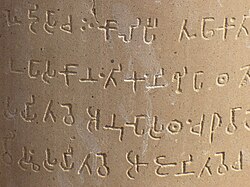


.jpg)


 Sva (Sa+Va)
 Sya (Sa+Ya)
 Hmī (Ha+Ma+i+i), as in the word "Brāhmī" (𑀩𑁆𑀭𑀸𑀳𑁆𑀫𑀻).
_conjunct_consonant.jpg)
.jpg)
.jpg)
.jpg)


.jpg)


![Early/Middle Brahmi legend on the coinage of Chastana: RAJNO MAHAKSHATRAPASA GHSAMOTIKAPUTRASA CHASHTANASA "Of the Rajah, the Great Satrap, son of Ghsamotika, Chashtana". 1st–2nd century CE.[194]](//upload.wikimedia.org/wikipedia/commons/thumb/b/ba/Coinage_of_Chastana_with_reverse_Brahmi_legend.jpg/250px-Coinage_of_Chastana_with_reverse_Brahmi_legend.jpg)
![Inscribed Kushan statue of Western Satraps King Chastana, with inscription "Shastana" in Middle Brahmi script of the Kushan period ( Ṣa-sta-na).[195] Here, sta is the conjunct consonant of sa and ta , vertically combined. Circa 100 CE.](//upload.wikimedia.org/wikipedia/commons/thumb/9/91/Shastana_inscription.jpg/250px-Shastana_inscription.jpg) Inscribed Kushan statue of Western Satraps King Chastana, with inscription "Shastana" in Middle Brahmi script of the Kushan period (
Inscribed Kushan statue of Western Satraps King Chastana, with inscription "Shastana" in Middle Brahmi script of the Kushan period (

 Ṣa-sta-na).[195]
 and ta
  , vertically combined. Circa 100 CE.
![The rulers of the Western Satraps were called Mahākhatapa ("Great Satrap") in their Brahmi script inscriptions, as here in a dedicatory inscription by Prime Minister Ayama in the name of his ruler Nahapana, Manmodi Caves, c. 100 CE.[196]](//upload.wikimedia.org/wikipedia/commons/thumb/c/cd/Mahakhatapa.jpg/250px-Mahakhatapa.jpg) The rulers of the Western Satraps were called Mahākhatapa ("Great Satrap") in their Brahmi script inscriptions, as here in a dedicatory inscription by Prime Minister Ayama in the name of his ruler Nahapana, Manmodi Caves, c. 100 CE.[196]
The rulers of the Western Satraps were called Mahākhatapa ("Great Satrap") in their Brahmi script inscriptions, as here in a dedicatory inscription by Prime Minister Ayama in the name of his ruler Nahapana, Manmodi Caves, c. 100 CE.[196] Nasik Cave inscription No.10. of Nahapana, Cave No.10.
![Early/Middle Brahmi legend on the coinage of Chastana: RAJNO MAHAKSHATRAPASA GHSAMOTIKAPUTRASA CHASHTANASA "Of the Rajah, the Great Satrap, son of Ghsamotika, Chashtana". 1st–2nd century CE.[194]](https://en.wikipedia.org/wiki/File:Coinage_of_Chastana_with_reverse_Brahmi_legend.jpg)
![Inscribed Kushan statue of Western Satraps King Chastana, with inscription "Shastana" in Middle Brahmi script of the Kushan period ( Ṣa-sta-na).[195] Here, sta is the conjunct consonant of sa and ta , vertically combined. Circa 100 CE.](https://en.wikipedia.org/wiki/File:Shastana_inscription.jpg)

![The rulers of the Western Satraps were called Mahākhatapa ("Great Satrap") in their Brahmi script inscriptions, as here in a dedicatory inscription by Prime Minister Ayama in the name of his ruler Nahapana, Manmodi Caves, c. 100 CE.[196]](https://en.wikipedia.org/wiki/File:Mahakhatapa.jpg)


 Gupta script on stone Kanheri Caves, one of the earliest descendants of Brahmi
 The Gopika Cave Inscription of Anantavarman, in the Sanskrit language and using the Gupta script. Barabar Caves, Bihar, or 6th century CE.
![Coin of Alchon Huns ruler Mihirakula. Obv: Bust of king, with legend in Gupta script (),[199] (Ja)yatu Mihirakula ("Let there be victory to Mihirakula").[200][201][202]](//upload.wikimedia.org/wikipedia/commons/thumb/7/72/Mihirakula_of_the_Alchon_Huns.jpg/250px-Mihirakula_of_the_Alchon_Huns.jpg) Coin of Alchon Huns ruler Mihirakula. Obv: Bust of king, with legend in Gupta script (
Coin of Alchon Huns ruler Mihirakula. Obv: Bust of king, with legend in Gupta script ( )
)


 ,[199] (Ja)yatu Mihirakula ("Let there be victory to Mihirakula").[200][201][202]


![Coin of Alchon Huns ruler Mihirakula. Obv: Bust of king, with legend in Gupta script (),[199] (Ja)yatu Mihirakula ("Let there be victory to Mihirakula").[200][201][202]](https://en.wikipedia.org/wiki/File:Mihirakula_of_the_Alchon_Huns.jpg)


 (cha) from qoph. "M.L." indicates that the letter was used as a mater lectionis in some phase of Phoenician or Aramaic. The matres lectionis functioned as occasional vowel markers to indicate medial and final vowels in the otherwise consonant-only script. Aleph 𐤀 and particularly ʿayin 𐤏 only developed this function in later phases of Phoenician and related scripts, though 𐤀 also sometimes functioned to mark an initial prosthetic (or prothetic) vowel from a very early period.[62]

 rather than "Li"
  ).
).


 ) is an early variant of the Gupta script
