



Community hub
Recent from talks
Contribute something to knowledge base
Content stats: 0 posts, 0 articles, 1 media, 0 notes
Members stats: 0 subscribers, 0 contributors, 0 moderators, 0 supporters
Subscribers
Supporters
Contributors
Moderators
Hub AI
Nahe (Rhine) AI simulator
(@Nahe (Rhine)_simulator)
Hub AI
Nahe (Rhine) AI simulator
(@Nahe (Rhine)_simulator)
Nahe (Rhine)
The Nahe (German pronunciation: [ˈnaːə] ⓘ) is a river in Rhineland-Palatinate and Saarland, Germany, a left tributary to the Rhine. It has also given name to the wine region Nahe situated around it.
The name Nahe is derived from the Latin word Nava, which is supposed to be based upon the Celtic origin for the wild river. The Nahe separates the northern part of the Palatinate from the Hunsrück.
It rises in the area of Nohfelden (Saarland) at the district of Selbach, flowing through Rhineland-Palatinate and joining the Rhine in Bingen. Its length is 125 kilometres (78 mi). Towns along the Nahe include Idar-Oberstein, Kirn, Bad Kreuznach and Bingen.
The drainage basin of the river covers an area of 4,067 square kilometres (1,570 sq mi). Due to this relatively large area compared to the river's length high floods can occur along its middle and lower course within only a few hours, however flowing off also quickly. In 1993 and 1995 in Bad Kreuznach a flow of more than 1,000 cubic metres per second (35,000 cu ft/s) was measured and more than 1,300 cubic metres per second (46,000 cu ft/s) at its mouth into the Rhine.
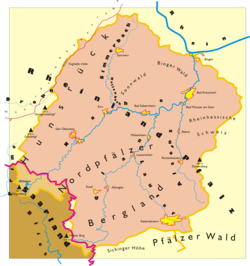
The dimensions of the drainage basin are shown in the map. Its boundaries clock-wise, beginning in the East:
The rocks in the Nahe region are predominantly of Cisuralian (early Permian) age and part of the Rotliegendes. At that time, an impetuous volcanism appeared in the region. Huge deposits of the reddish volcanic rock Rhyolite and of the more alkaline volcanic rock Andesite were left. The valleys of the Nahe and its tributaries have been being formed since 2.6 million years ago during the Quaternary, the geologically latest period, as a result of ground heaving of the surrounding mountains of Hunsrück and North Palatine Uplands. This led to a steep decline of all waters and hence to strong erosion activities. Particularly strong erosion occurred in warmer melting periods during the ice ages, when tundra climate reigned, and the soil was not protected by a dense cover of vegetation. Depending on the underground, narrow gorges with cliffy precipices arose in areas with hard volcanic rocks or wide gentle valleys with flood plains in areas with soft sedimentary deposits. The frequent change between both forms is charming along the Nahe.
In the Nahe valley, a huge number of thermophile species appear which usually can only be found in the mediterranean region or Eurasian steppe habitats. Characteristical species of plants are e. g. Alyssum montanum, Aster linosyris ("Goldilocks Aster"), Dictamnus albus ("White Dittany"), Dianthus grationopolitanus ("Cheddar Pink"), Gagea bohemica subsp. saxatilis ("Early-Star-of-Bethlehem"), Galium glaucum ("Glaucous Bedstraw"), Oxytropis pilosa or Stipa tirsa. These plants immigrated in a postglacial warm period to Europe but became extinct in most regions when the climate changed again to significantly cooler and more humid conditions. They only survived in small but still warm and dry places due to special geographic situations. In the Nahe valley and its tributaries these are mostly rocky precipices towards South or South-East, furthermore sunny slopes with shrubs, bushes and dry broad-leaved forests. On hot summer days the soil temperatures in these places can reach 60 °C/140 °F and above with truly steppe-like circumstances. A characteristical thermophile animal species is the insulated population of the dice snake (Natrix tessellata) that exists along the Nahe. The snake is very addicted to water and captures small fishes.
Places of botanical and/or zoological significance are classified as nature protection areas and accompany the course of the Nahe. For instance can be mentioned the "Hellberg" near Kirn, the "Flachsberg" near Martinstein, the "Heimberg" near Waldböckelheim, the "Gangelsberg" near Duchroth and the "Rotenfels" as well as the "Rheingrafenstein" near Bad Münster am Stein.
Nahe (Rhine)
The Nahe (German pronunciation: [ˈnaːə] ⓘ) is a river in Rhineland-Palatinate and Saarland, Germany, a left tributary to the Rhine. It has also given name to the wine region Nahe situated around it.
The name Nahe is derived from the Latin word Nava, which is supposed to be based upon the Celtic origin for the wild river. The Nahe separates the northern part of the Palatinate from the Hunsrück.
It rises in the area of Nohfelden (Saarland) at the district of Selbach, flowing through Rhineland-Palatinate and joining the Rhine in Bingen. Its length is 125 kilometres (78 mi). Towns along the Nahe include Idar-Oberstein, Kirn, Bad Kreuznach and Bingen.
The drainage basin of the river covers an area of 4,067 square kilometres (1,570 sq mi). Due to this relatively large area compared to the river's length high floods can occur along its middle and lower course within only a few hours, however flowing off also quickly. In 1993 and 1995 in Bad Kreuznach a flow of more than 1,000 cubic metres per second (35,000 cu ft/s) was measured and more than 1,300 cubic metres per second (46,000 cu ft/s) at its mouth into the Rhine.
The dimensions of the drainage basin are shown in the map. Its boundaries clock-wise, beginning in the East:
The rocks in the Nahe region are predominantly of Cisuralian (early Permian) age and part of the Rotliegendes. At that time, an impetuous volcanism appeared in the region. Huge deposits of the reddish volcanic rock Rhyolite and of the more alkaline volcanic rock Andesite were left. The valleys of the Nahe and its tributaries have been being formed since 2.6 million years ago during the Quaternary, the geologically latest period, as a result of ground heaving of the surrounding mountains of Hunsrück and North Palatine Uplands. This led to a steep decline of all waters and hence to strong erosion activities. Particularly strong erosion occurred in warmer melting periods during the ice ages, when tundra climate reigned, and the soil was not protected by a dense cover of vegetation. Depending on the underground, narrow gorges with cliffy precipices arose in areas with hard volcanic rocks or wide gentle valleys with flood plains in areas with soft sedimentary deposits. The frequent change between both forms is charming along the Nahe.
In the Nahe valley, a huge number of thermophile species appear which usually can only be found in the mediterranean region or Eurasian steppe habitats. Characteristical species of plants are e. g. Alyssum montanum, Aster linosyris ("Goldilocks Aster"), Dictamnus albus ("White Dittany"), Dianthus grationopolitanus ("Cheddar Pink"), Gagea bohemica subsp. saxatilis ("Early-Star-of-Bethlehem"), Galium glaucum ("Glaucous Bedstraw"), Oxytropis pilosa or Stipa tirsa. These plants immigrated in a postglacial warm period to Europe but became extinct in most regions when the climate changed again to significantly cooler and more humid conditions. They only survived in small but still warm and dry places due to special geographic situations. In the Nahe valley and its tributaries these are mostly rocky precipices towards South or South-East, furthermore sunny slopes with shrubs, bushes and dry broad-leaved forests. On hot summer days the soil temperatures in these places can reach 60 °C/140 °F and above with truly steppe-like circumstances. A characteristical thermophile animal species is the insulated population of the dice snake (Natrix tessellata) that exists along the Nahe. The snake is very addicted to water and captures small fishes.
Places of botanical and/or zoological significance are classified as nature protection areas and accompany the course of the Nahe. For instance can be mentioned the "Hellberg" near Kirn, the "Flachsberg" near Martinstein, the "Heimberg" near Waldböckelheim, the "Gangelsberg" near Duchroth and the "Rotenfels" as well as the "Rheingrafenstein" near Bad Münster am Stein.
Recent media
Recent media