
Recent from talks
Bingen am Rhein
Knowledge base stats:
Talk channels stats:
Members stats:
Bingen am Rhein
Bingen am Rhein (German pronunciation: [ˈbɪŋən ʔam ˈʁaɪn], lit. 'Bingen on the Rhine') is a town in the Mainz-Bingen district in Rhineland-Palatinate, Germany.
The settlement's original name was Bingium, a Celtic word that may have meant "hole in the rock",[citation needed] a description of the shoal behind the Mouse Tower (German: Mäuseturm), known as the Binger Loch. Bingen was the starting point for the Via Ausonia, a Roman military road that linked the town with Trier. Bingen is well known for, among other things, the legend about the Mouse Tower, in which Hatto II, the Archbishop of Mainz, was allegedly eaten by mice. Since the 19th century, the legend has increasingly been attributed to Hatto I, a predecessor of Hatto II. Saint Hildegard von Bingen, an important polymath, abbess, mystic and musician, one of the most influential medieval composers and one of the earliest Western composers whose music is widely preserved and performed, was born 40 km away from Bingen, in Bermersheim vor der Höhe. A new museum on the riverside is largely devoted to her and the romance of the Rhine Gorge. Bingen am Rhein was also the birthplace of the poet Stefan George, along with many other influential figures.
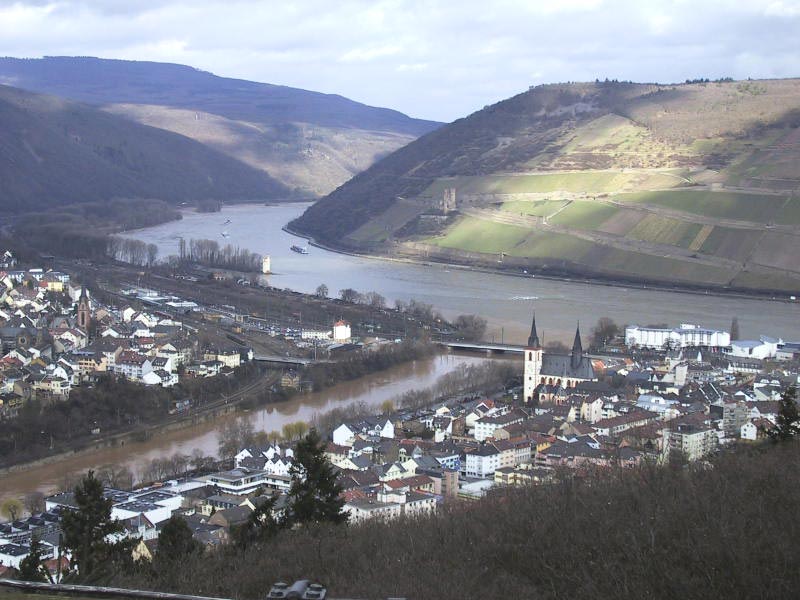
Bingen is situated just southeast of the Rhine knee by the Bingen Forest (Binger Wald – actually a low mountain range), which rises west of the town. Rising to the north on the other side of the Rhine is the Rheingau range, the Taunus's southwesternmost outcrop. In Bingen the river Nahe empties into the Rhine Gorge. Bingen forms the southern limit of the UNESCO Rhine Gorge World Heritage Site. The Rochusberg hill and park are nearly surrounded by the town, its castle now a hotel.
(each time at 31 December)
Even before the Romans came, people lived here, because the location favoured transport, being at the confluence of the Nahe and Rhine Rivers, and the Rhine's entry into the gorge. The first settlement seems to have been a Celtic (Gaulish) settlement by the name of Binge – meaning "rift". In the early first century AD, Roman troops were stationed in Bingen on the Rhine Valley Road, and rendered the local name as Bingium in Latin. There the Romans erected a wooden bridge across the Nahe and constructed a bridgehead castrum. A Roman Mithraic monument, which included a mutilated sculpture representing the nativity of Mithra from a rock, was discovered in Bingen; one of its inscriptions is dated 236.
The presbyter Aetherius of Bingen founded sometime between 335 and 360 a firmly Christian community. Bearing witness to this time is Aetherius's gravestone, which can still be seen in Saint Martin's Basilica. After the fall of the Limes, the town became a Frankish royal estate and passed in 983 by the Donation of Verona from Otto II to Archbishop Willigis of Mainz. Under Otto III the Binger Kammerforst (forest) came into being. Under Willigis, some way up the river Nahe, the stone Drususbrücke (bridge) was built.
The inhabitants of Bingen strove time and again for independence, which led in 1165 through disputes between the Archbishop of Mainz and the Emperor to destruction. In the 13th century, Bingen was a member of the Rhenish League of Towns. The building of Klopp Castle (Burg Klopp) in the mid 13th century could well be seen as being tied in with this development. A last attempt was the town's unsuccessful participation in the German Peasants' War in 1525. From the Archbishop the Cathedral Chapter of Mainz acquired the town in two halves in 1424 and 1438. Until the late 18th century Bingen remained under its administration. Like many towns in the valley, Bingen suffered several town fires and wars.
From 1792 to 1813, the town was, as part of the département of Mont-Tonnerre (or Donnersberg – both names meaning "Thunder Mountain"), French after French Revolutionary troops had occupied the Rhine's left bank. In 1816, after the Congress of Vienna, the town passed to the Grand Duchy of Hesse-Darmstadt while today's outlying centre of Bingerbrück went to Prussia's Rhine Province, making Bingen a border town until 1871, when the German Empire was founded.
Hub AI
Bingen am Rhein AI simulator
(@Bingen am Rhein_simulator)
Bingen am Rhein
Bingen am Rhein (German pronunciation: [ˈbɪŋən ʔam ˈʁaɪn], lit. 'Bingen on the Rhine') is a town in the Mainz-Bingen district in Rhineland-Palatinate, Germany.
The settlement's original name was Bingium, a Celtic word that may have meant "hole in the rock",[citation needed] a description of the shoal behind the Mouse Tower (German: Mäuseturm), known as the Binger Loch. Bingen was the starting point for the Via Ausonia, a Roman military road that linked the town with Trier. Bingen is well known for, among other things, the legend about the Mouse Tower, in which Hatto II, the Archbishop of Mainz, was allegedly eaten by mice. Since the 19th century, the legend has increasingly been attributed to Hatto I, a predecessor of Hatto II. Saint Hildegard von Bingen, an important polymath, abbess, mystic and musician, one of the most influential medieval composers and one of the earliest Western composers whose music is widely preserved and performed, was born 40 km away from Bingen, in Bermersheim vor der Höhe. A new museum on the riverside is largely devoted to her and the romance of the Rhine Gorge. Bingen am Rhein was also the birthplace of the poet Stefan George, along with many other influential figures.
Bingen is situated just southeast of the Rhine knee by the Bingen Forest (Binger Wald – actually a low mountain range), which rises west of the town. Rising to the north on the other side of the Rhine is the Rheingau range, the Taunus's southwesternmost outcrop. In Bingen the river Nahe empties into the Rhine Gorge. Bingen forms the southern limit of the UNESCO Rhine Gorge World Heritage Site. The Rochusberg hill and park are nearly surrounded by the town, its castle now a hotel.
(each time at 31 December)
Even before the Romans came, people lived here, because the location favoured transport, being at the confluence of the Nahe and Rhine Rivers, and the Rhine's entry into the gorge. The first settlement seems to have been a Celtic (Gaulish) settlement by the name of Binge – meaning "rift". In the early first century AD, Roman troops were stationed in Bingen on the Rhine Valley Road, and rendered the local name as Bingium in Latin. There the Romans erected a wooden bridge across the Nahe and constructed a bridgehead castrum. A Roman Mithraic monument, which included a mutilated sculpture representing the nativity of Mithra from a rock, was discovered in Bingen; one of its inscriptions is dated 236.
The presbyter Aetherius of Bingen founded sometime between 335 and 360 a firmly Christian community. Bearing witness to this time is Aetherius's gravestone, which can still be seen in Saint Martin's Basilica. After the fall of the Limes, the town became a Frankish royal estate and passed in 983 by the Donation of Verona from Otto II to Archbishop Willigis of Mainz. Under Otto III the Binger Kammerforst (forest) came into being. Under Willigis, some way up the river Nahe, the stone Drususbrücke (bridge) was built.
The inhabitants of Bingen strove time and again for independence, which led in 1165 through disputes between the Archbishop of Mainz and the Emperor to destruction. In the 13th century, Bingen was a member of the Rhenish League of Towns. The building of Klopp Castle (Burg Klopp) in the mid 13th century could well be seen as being tied in with this development. A last attempt was the town's unsuccessful participation in the German Peasants' War in 1525. From the Archbishop the Cathedral Chapter of Mainz acquired the town in two halves in 1424 and 1438. Until the late 18th century Bingen remained under its administration. Like many towns in the valley, Bingen suffered several town fires and wars.
From 1792 to 1813, the town was, as part of the département of Mont-Tonnerre (or Donnersberg – both names meaning "Thunder Mountain"), French after French Revolutionary troops had occupied the Rhine's left bank. In 1816, after the Congress of Vienna, the town passed to the Grand Duchy of Hesse-Darmstadt while today's outlying centre of Bingerbrück went to Prussia's Rhine Province, making Bingen a border town until 1871, when the German Empire was founded.
Recent media