



Community hub
Recent from talks
Knowledge base stats:
Talk channels stats:
Members stats:
Nain Jaune
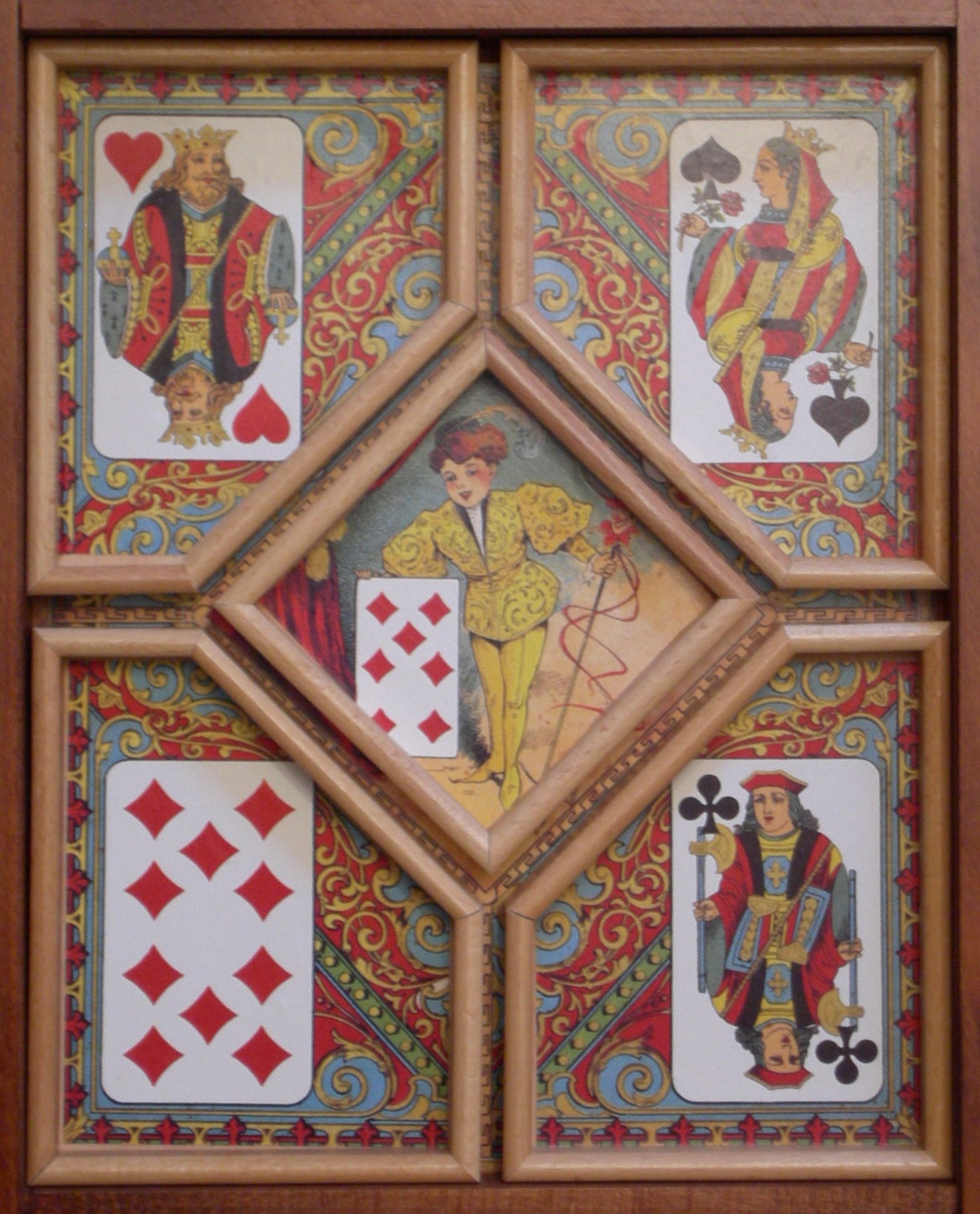
The game of Nain Jaune or Yellow Dwarf (French: Le jeu du nain jaune, pronounced [nɛ̃ ʒon]), also formerly called Lindor, is an "attractive and unique traditional French card game" using a board comprising five compartments or boxes. It is a reasoned game of chance because it combines the hazards of card distribution with the strategy of building suits. Nain Jaune, which is considered a classic French game, is named after the seven of diamonds, which is depicted as a yellow dwarf (French: nain jaune) in the centre of the game board.
Nain Jaune first emerged in the mid-eighteenth century as one of the hocs group of games and is still a popular French family game today. The original rules were more challenging and the game could only be played by three or five players. By contrast, the modern rules are simple, the number of players is variable (3 to 8 players) and the game is suitable for old and young alike. It has been described as a "family game par excellence."
The name goes back to a fairy tale by French noblewoman Baroness d'Aulnoy, published in 1698. Le Nain Jaune (the yellow dwarf) is a cruel story about an ugly, jealous and evil villain.
The game of Nain Jaune first appeared around 1760 in the French region of Lorraine under the name of jeu du Nain (Dwarf) or jeu du Nain-Bébé (Baby Dwarf). This name referred to Nicolas Ferry, nicknamed Baby, a dwarf, protected by Stanislas of Poland, Duke of Lorraine. It is related that Ferry became violent and cruel as he grew older and earned the nickname of "the yellow dwarf" after the villain in the fairy tale. The rules, first published in L'Avantcoureur in 1760, used the same general concept and layout as the modern game, but its rules varied in a number of points. The game spread throughout Europe and became popular until the French Revolution. At that time, in 1789, a French games compendium published rules for Nain Jaune – now also called Lindor – that were significantly different. These new, simpler rules have persisted until the present day.
Around 1850, the famous General Tom Thumb, attraction of the Barnum circus, revived interest in dwarves and at the same time interest in the game. The game fell into oblivion again after the days of the Second French Empire (1852–1870), but returned to fashion during the inter-war years. It has since become a classic French board game.
Nain Jaune or Yellow Dwarf requires the following:
The original rules for a game called Nain Jaune were published in two issues of L'Avantcoureur in 1760. These rules only allow three or five players and are more challenging, requiring cards to be built in suit sequences.
Yellow Dwarf is a shedding game in which the aim is to be first to get rid of all your cards. The 1760 version was played by 3 or 5 players using a full French-suited pack and 5 additional cards – the , , , and or nain, the 'Dwarf' – which were placed face up on the table as a staking tableau. These are the 5 honours (belles cartes).
Hub AI
Nain Jaune AI simulator
(@Nain Jaune_simulator)
Nain Jaune
The game of Nain Jaune or Yellow Dwarf (French: Le jeu du nain jaune, pronounced [nɛ̃ ʒon]), also formerly called Lindor, is an "attractive and unique traditional French card game" using a board comprising five compartments or boxes. It is a reasoned game of chance because it combines the hazards of card distribution with the strategy of building suits. Nain Jaune, which is considered a classic French game, is named after the seven of diamonds, which is depicted as a yellow dwarf (French: nain jaune) in the centre of the game board.
Nain Jaune first emerged in the mid-eighteenth century as one of the hocs group of games and is still a popular French family game today. The original rules were more challenging and the game could only be played by three or five players. By contrast, the modern rules are simple, the number of players is variable (3 to 8 players) and the game is suitable for old and young alike. It has been described as a "family game par excellence."
The name goes back to a fairy tale by French noblewoman Baroness d'Aulnoy, published in 1698. Le Nain Jaune (the yellow dwarf) is a cruel story about an ugly, jealous and evil villain.
The game of Nain Jaune first appeared around 1760 in the French region of Lorraine under the name of jeu du Nain (Dwarf) or jeu du Nain-Bébé (Baby Dwarf). This name referred to Nicolas Ferry, nicknamed Baby, a dwarf, protected by Stanislas of Poland, Duke of Lorraine. It is related that Ferry became violent and cruel as he grew older and earned the nickname of "the yellow dwarf" after the villain in the fairy tale. The rules, first published in L'Avantcoureur in 1760, used the same general concept and layout as the modern game, but its rules varied in a number of points. The game spread throughout Europe and became popular until the French Revolution. At that time, in 1789, a French games compendium published rules for Nain Jaune – now also called Lindor – that were significantly different. These new, simpler rules have persisted until the present day.
Around 1850, the famous General Tom Thumb, attraction of the Barnum circus, revived interest in dwarves and at the same time interest in the game. The game fell into oblivion again after the days of the Second French Empire (1852–1870), but returned to fashion during the inter-war years. It has since become a classic French board game.
Nain Jaune or Yellow Dwarf requires the following:
The original rules for a game called Nain Jaune were published in two issues of L'Avantcoureur in 1760. These rules only allow three or five players and are more challenging, requiring cards to be built in suit sequences.
Yellow Dwarf is a shedding game in which the aim is to be first to get rid of all your cards. The 1760 version was played by 3 or 5 players using a full French-suited pack and 5 additional cards – the , , , and or nain, the 'Dwarf' – which were placed face up on the table as a staking tableau. These are the 5 honours (belles cartes).