Hubbry Logo
Names of BeijingNames of BeijingMain
Open search
Names of Beijing
Community hub
Names of Beijing
logo
8 pages, 0 posts
0 subscribers
Be the first to start a discussion here.
Names of Beijing
Names of Beijing
from Wikipedia

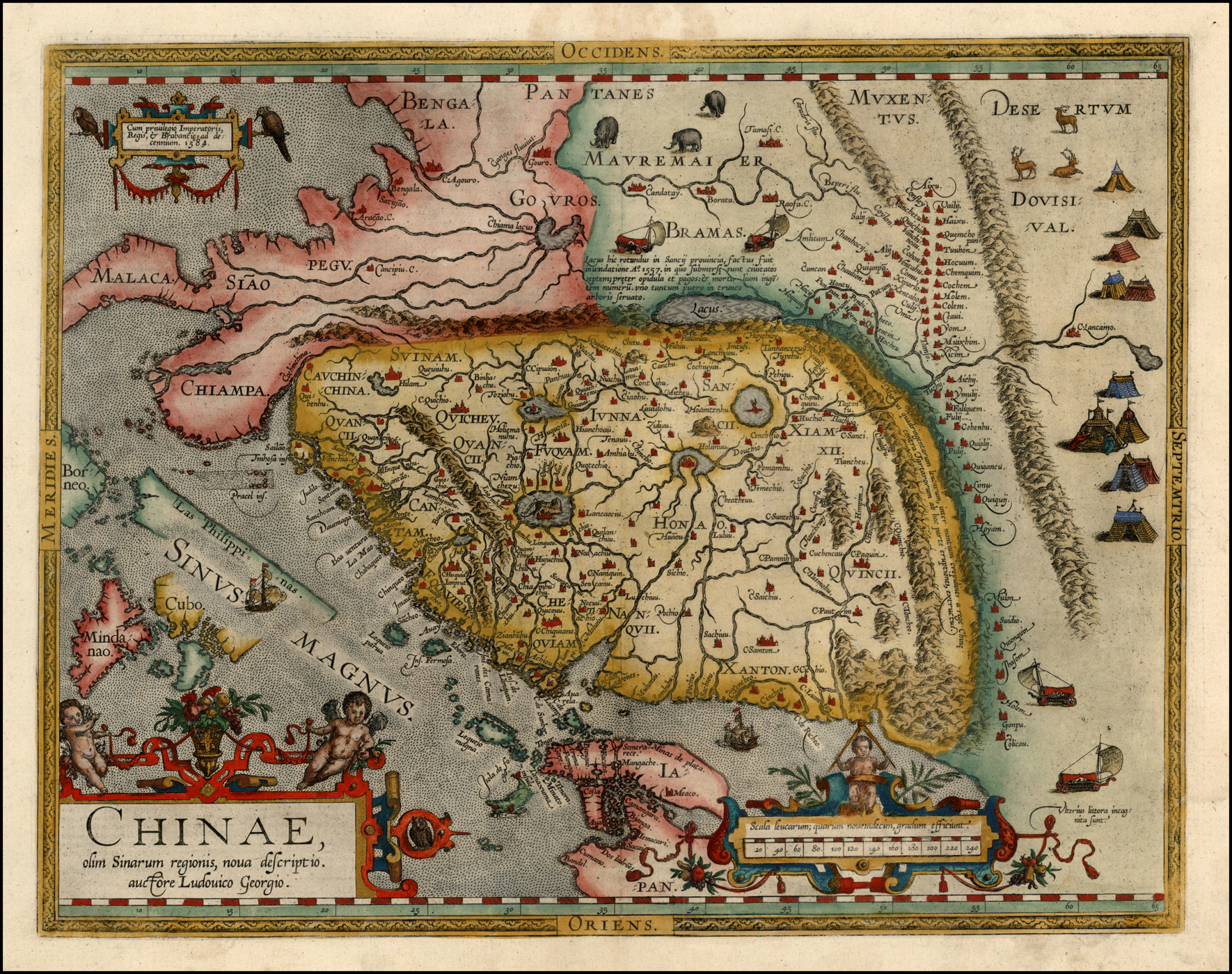
A 1584 map of China by Abraham Ortelius (based on a manuscript map by Luiz Jorge de Barbuda (Ludovicus Georgius), with Beijing marked as C[ivitas] Paquin (to the right which is north on the map)

"Beijing" is from pinyin Běijīng, which is romanized from 北京, the Chinese name for this city. The pinyin system of transliteration was approved by the Chinese government in 1958, but little used until 1979. It was gradually adopted by various news organizations, governments, and international agencies over the next decade.[1]

Etymology

[edit]

The Chinese characters ("north") and ("capital") together mean the "Northern Capital". The name was first used during the reign of the Ming dynasty's Yongle Emperor, who made his northern fief a second capital, along with Nanjing (南京, the "Southern Capital"), in 1403 after successfully dethroning his nephew during the Jingnan Campaign. The name was restored in 1949 at the founding of the People's Republic of China.

Peking

[edit]

Portugal was the first European country to contact China in modern times. In Portuguese, the city is called Pequim. This name appeared in the letters of Francis Xavier in 1552.[2] It transferred to English as "Pekin"[3] and to French as Pékin.

Jesuit missionary Martino Martini used "Peking" in De bello Tartarico historia (The Tartary [Manchu] War) (1654) and Novus Atlas Sinensis (New Atlas of China) (1655).[4] In 1665, Martini's work was reissued as part of Atlas Maior (great atlas), a much-praised atlas by Dutch publisher Joan Blaeu.

In English, both "Pekin" and "Peking" remained common until the 1890s, when the Imperial Post Office adopted Peking.[5]

Beginning in 1979, the PRC government encouraged use of pinyin. The New York Times adopted "Beijing" in November 1986.[6] The Associated Press and United Press International, which provided most world news coverage in American media, jointly agreed to adopt the "Beijing" spelling beginning on 1 March 1987.[7] Elsewhere in the Anglosphere, the BBC switched in 1990.[8] "Peking" is still employed in terms such as "Pekingese", "Peking duck", "Peking Man" and various others, as well as being retained in the name of Peking University.

Historical names of Beijing

[edit]
Historical Names of Beijing
Year City Name Dynasty Notes
c. 1045
BC
City of Ji 薊城 Zhou,
Warring States
[Note 1]
221 BC Qin [Note 2]
106 BC -
318 AD
City of Ji
Youzhou 幽州
Han, Wei, Western Jin (晉) [Note 3]
319 Later Zhao [Note 4]
350 Eastern Jin (晉) [Note 5]
352–57 Former Yan [Note 6]
370 Former Qin [Note 7]
385 Later Yan [Note 8]
397 Northern Dynasties [Note 9]
607 Zhuojun 涿郡 Sui [Note 10]
616 Youzhou Tang [Note 11]
742 Fanyang 範陽
759 Yanjing 燕京
765 Youzhou
907 Later Liang
911 Yan (Five Dynasties)
913 Later Liang
923 Later Tang
936 Later Jin
938 Nanjing 南京 Liao [Note 12]
1122 Northern Liao
Yanjing Jin (金)
1122
1123 Yanshan 燕山 Song
1125 Yanjing Jin (金)
1151 Zhongdu 中都 [Note 13]
1215 Yanjing Yuan
1271 Dadu 大都
1368 Beiping 北平 Ming [Note 14]
1403 Shuntian 順天
1421
1644 Qing
1912 Republic of China
1914 Jingzhao 京兆地方
1928 Peiping
1937 Peking Provisional Government (Japanese occupation) [Note 15]
1940 Wang regime (Japanese occupation)
1945 Peiping Republic of China
1949–
present
Beijing People's Republic of China
  Capital of regional dynasty or kingdom
  Capital of China
Entrance to the Beiping Municipal Government office, 1935

The city has had many other names. The chronological list below sets out both the names of the city itself, and, in earlier times, the names of the administrative entities covering the city today.

Abbreviation

[edit]

In Chinese, the abbreviation of Beijing is its second character ("Capital"). This is employed, for example, as the prefix on all Beijing-issued license plates.

In the Latin alphabet, the official abbreviation are the two initials of the region's characters: BJ.[25]

Beijing Capital International Airport's IATA code is PEK, based on the previous romanization, Peking. The new airport, Beijing Daxing International Airport, uses PKX as its code.

Similarly named cities

[edit]

In addition to Nanjing, several other East Asian and Southeast Asian cities have similar names in Chinese characters despite appearing dissimilar in English transliteration. The most prominent is Tokyo, Japan, whose Han script name is written 東京 (Dongjing, or "Eastern Capital"). 東京 was also a former name of Hanoi (as Đông Kinh or "Tonkin") in Vietnam during the Later Lê dynasty. A former name of Seoul in South Korea was Gyeongseong, written in Han script as 京城 or "Capital City". Kyoto in Japan still bears the similar-meaning characters 京都: the character "都", du in Chinese, can also mean "capital".

The history of China since the Tang dynasty has also been full of secondary capitals with directional names. Under the Tang, these were Beidu ("north capital", at Taiyuan in Shanxi); Nandu ("south capital", first, Chengdu in Sichuan and, later, Jiangling in Hubei); Dongdu ("east capital", Luoyang in Henan); and Xidu ("west capital", Fengxiang in Shaanxi).[26]

There were two previous Beijings: one, the northern capital of the Northern Song at modern Daming in Hebei;[27] the other, the northern capital of the Jurchen Jin located at Ningcheng in Inner Mongolia.[28]

The Nanjing of the Northern Song was located at Shangqiu in Henan.[27] The Jurchen Jin located theirs at Kaifeng,[28]) which had been the Northern Song's "Dongjing".[27] The Jurchen Jin also had a Dongjing ("Eastern Capital"), which was, however, located at Liaoyang in Liaoning.[28] Apart from these, there were two Xijings (西, "Western Capital"): one was the "Western Capital" of the Northern Song dynasty, located at Luoyang;[27] the other was held by the Liao[29] and Jurchen Jin[28] at Datong. Liaoyang was the Zhongjing (中京, "Central Capital") of the Liao dynasty[29] and, finally, another Zhongdu ("Central Capital") was planned but never completed. It was the proposed capital of the Ming dynasty mooted by the Hongwu Emperor in the 14th century, to be located on the site of his destroyed childhood village of Zhongli (鍾離), now Fengyang in Anhui.[30]

Notes

[edit]

References

[edit]
Revisions and contributorsEdit on WikipediaRead on Wikipedia
from Grokipedia
Beijing (北京; Běijīng), meaning "northern capital," denotes both the modern official name of China's capital city and the series of historical Chinese designations applied to its site over more than two millennia, primarily reflecting shifts in imperial capitals and administrative centers. The urban core traces to ancient Ji (蓟), seat of the Yan state during the Warring States period, evolving into Yanjing (燕京) under the Liao dynasty in the 10th century, Zhongdu (中都; "central capital") as the Jin dynasty's base in the 12th century, and Dadu (大都; "great capital")—also rendered Khanbaliq in Mongol—as the Yuan dynasty's primary seat founded by Kublai Khan in the late 13th century. Following the Ming conquest of Dadu in 1368, the city was demoted and renamed Beiping (北平; "northern peace") as a regional stronghold subordinate to , but Emperor Yongle (Zhu Di) elevated it to in 1403 upon usurping the throne and relocating the capital northward for strategic defense against Mongol remnants, a status it retained through the and into the present . In European cartography and diplomacy from the 16th to 20th centuries, Beijing was transliterated as Peking via Wade-Giles and postal systems, diverging from the pinyin-based Beijing standardized internationally after China's 1958 adoption of Hanyu for , though the underlying Chinese name remained unchanged. These nomenclature shifts underscore Beijing's recurrent centrality in Chinese , with the city serving as capital for the Jin, Yuan, Ming, Qing, and modern eras, amassing imperial infrastructure like the atop Yuan foundations.

Modern Name and Etymology

Meaning and Linguistic Origin of 北京

The Chinese name 北京 (Běijīng) is composed of two characters: (běi), denoting "north," and (jīng), denoting "capital" or "." These combine to form a literal meaning of "Northern Capital," reflecting the city's role as the primary administrative center in northern , in contrast to southern counterparts like ("Southern Capital"). The character originates from ancient Chinese pictographs, evolving from depictions of two human figures standing back-to-back to symbolize opposition or the northern direction, aligned with early cosmological associations of north with cold and centrality in directional systems. , attested in oracle bone inscriptions from the (c. 1600–1046 BCE), initially referred to high structures or bells before denoting imperial capitals, as in the Zhou dynasty's (1046–256 BCE) use for the royal domain around modern . This semantic shift underscores 's longstanding connotation of political centrality in . Linguistically, 北京 is pronounced in modern Standard Mandarin as approximately [pèɪ̯.tɕíŋ], with the tonal pattern falling-rising on and high-level on , reflecting evolutions through phonetic shifts in northern dialects standardized post-1950s. The name's structure exemplifies disyllabic common in Chinese toponyms, where directional prefixes like distinguish regional variants of core terms like .

Historical Context of Naming as Northern Capital

In 1368, following the Ming Dynasty's conquest of the Yuan capital Dadu, the renamed the city Beiping (北平), meaning "Northern Peace," as a demotion from its prior imperial status. This reflected the Ming's initial focus on as the primary capital in the south. The shift to Beijing (北京), literally "Northern Capital," occurred in 1403 under the (r. 1402–1424), who elevated Beiping to co-capital status alongside (南京, "Southern Capital"). This renaming symbolized the city's role as the northern counterpart to , facilitating dual governance amid ongoing threats from Mongol remnants in the north. The , having seized power in a civil war centered in the north, prioritized Beijing's strategic location for military consolidation and administrative control. By 1421, upon completion of the Forbidden City's construction, Yongle formally relocated the primary capital to , solidifying its name and preeminence. The nomenclature persisted through the (1644–1912), which retained Beijing as the undivided capital without altering the title. This pairing of Bei- and Nan-jing underscored a historical pattern in Chinese imperial naming, where directional capitals balanced geographic and political imperatives, though Beijing's northern designation emphasized defense against steppe nomads over southern economic cores.

Historical Names Before the Modern Era

Ancient and Warring States Period Names

The region encompassing modern was first established as a significant settlement known as Ji (蓟; Jì), which served as the capital of the ancient state of Ji during the dynasty (c. 1046–771 BCE). This polity occupied the southwestern area of present-day , near Guang'anmen, and represented an early urban center in the northern frontier of Zhou influence. Archaeological evidence, including rammed-earth walls and bronze artifacts, corroborates the site's development as a fortified capital by the late second millennium BCE, though textual records from the period are sparse and primarily retrospective. By the (770–476 BCE), the state of Ji had been absorbed into the larger state of Yan (燕), one of the regional powers originating from Zhou enfeoffments in the north. Yan relocated its capital to Ji, renaming or emphasizing it as the core of its domain, which facilitated Yan's expansion amid interstate conflicts. During the subsequent (475–221 BCE), Ji—often designated as Jicheng (蓟城)—remained Yan's primary political and military hub, supporting campaigns against rivals like and Zhao while defending against nomadic incursions from the steppes. The city's strategic location near mountain passes and rivers enabled Yan to control key trade routes and agricultural plains, contributing to its status among the seven dominant states outlined in classical histories such as the Shiji. No alternative contemporaneous names for the settlement are attested in reliable pre-Qin sources; Ji persisted as the toponym until the Qin conquest in 222 BCE, after which the area was reorganized under imperial commanderies.

Imperial Names Under Jin, Yuan, and Early Ming Dynasties

During the Jurchen Jin dynasty (1115–1234), the city—previously known as Yanjing—became the imperial capital in 1153 when Emperor Hailing relocated the court from Huining Prefecture, renaming it Zhongdu (中都), meaning "Central Capital." This name reflected its central position in the Jin empire's governance, with the walled city spanning approximately 25 square kilometers and featuring an early version of Beijing's central axis. Zhongdu functioned as the primary capital for 62 years until Mongol forces under sacked and largely destroyed it in 1215, after which the Jin temporarily shifted southward to . Archaeological remnants, including city gates and walls, confirm the site's extent and strategic water access from local rivers. Under the Mongol (1271–1368), rebuilt and expanded the ruined city starting in the 1260s, formally designating it Dadu (大都), or "Great Capital," in 1272 as the empire's primary administrative center. Known to as Khanbaliq ("Khan's City"), Dadu symbolized the Yuan's adaptation of Chinese while incorporating nomadic elements, such as separate palace complexes for Mongol elites. The name emphasized its status as the "great" seat surpassing secondary capitals like , with construction involving forced labor from across the empire to create a grid layout influencing later designs. Dadu remained the Yuan capital until the dynasty's collapse in 1368. In the early Ming dynasty (1368–1644), following the expulsion of the Yuan, the Hongwu Emperor (r. 1368–1398) captured Dadu in 1368 and renamed it Beiping (北平), meaning "Northern Peace" or "Northern Flatland," reducing it to a regional military commandery under the Prince of Yan while establishing Nanjing as the primary capital. This demotion aligned with Ming policies favoring southern Han heartlands for legitimacy. However, after usurping the throne in 1402, the Yongle Emperor (r. 1402–1424)—operating from Beiping as his base—renamed it Beijing (北京), "Northern Capital," in 1403 to signify its elevation as a co-capital, initiating massive reconstructions including the Forbidden City and Temple of Heaven starting in 1406. Beijing was officially proclaimed the supreme capital in 1421 upon completion of these projects, marking the first use of its enduring name to denote its northern imperial role complementary to Nanjing.

Name Changes in the 20th Century

Renaming to Beiping in 1928

In June 1928, following the Kuomintang's (KMT) that unified much of under Nationalist control, KMT forces occupied , ending the Beijing-based Beiyang government's authority. The , led by , then relocated the national capital southward to to align with the party's revolutionary origins in the south and to symbolically distance itself from the imperial legacy centered in . This shift rendered the term Beijing ("northern capital") obsolete, as the city no longer served as the political heart of the Republic of . The renaming to Beiping (北平; Bĕipíng, romanized at the time as Peiping) was enacted shortly thereafter, with the name evoking "northern peace" or "pacified north," signifying the KMT's claimed stabilization of the region after defeating northern . This nomenclature deliberately reused a historical precedent from the early , when the city had similarly been demoted upon the capital's move to and renamed Beiping to denote pacification of northern threats. The change underscored the Nationalists' intent to reorient China's away from the Manchu-Qing imperial core, promoting as the legitimate republican center while reducing Beijing's symbolic preeminence. Under the Beiping designation, the city's administrative functions were curtailed, with key institutions like the relocated or restructured; for instance, the former Metropolitan Library was renamed the National Peiping Library in July 1928 and moved to new premises. The renaming also influenced local governance, as evidenced by municipal bodies operating under the Beiping title through the , reflecting the city's transitioned role as a cultural and educational hub rather than a political capital. This period marked a deliberate de-emphasis on the city's dynastic heritage, aligning with the KMT's modernization agenda, though Beiping retained its status as a major urban center with over 1.5 million residents by the early . The change persisted until , when the Communist victory prompted a reversion to Beijing.

Restoration to Beijing in 1949

On January 31, 1949, Beiping was peacefully handed over to forces led by Communist general , marking the end of Nationalist control without significant fighting after negotiations. This event positioned the city as a strategic political center for the amid the concluding phases of the . The First Plenary Session of the (CPPCC) assembled in Beiping from September 21 to 30, 1949, convening 662 representatives from various political parties, mass organizations, and regions under Communist leadership. On September 27, the session passed a specific resolution declaring Beiping the capital of the forthcoming (PRC) and renaming it effective that day, with the text stating: "It is unanimously adopted that Beiping shall be the capital of the and shall be renamed beginning from today." This decision, part of broader preparatory measures including the adoption of the PRC's provisional constitution known as the Common Program on September 29, reflected the intent to restore the city's imperial-era designation as the "Northern Capital" (Běi jīng), emphasizing historical legitimacy and northern centrality over the Nationalist preference for . The name change took formal effect alongside the PRC's founding proclamation. On October 1, 1949, announced the establishment of the from atop Tiananmen Gate in the renamed , solidifying its role as the national capital. The restoration reversed the 1928 renaming to Beiping ("Northern Peace") by the , which had downgraded the city after relocating the capital southward to . Administrative adjustments followed swiftly, with the Beiping Municipal Government reorganized as the Municipal People's Government to align with the new political structure. This shift not only reinstated the traditional name but also integrated into the PRC's centralized governance, where it has remained the capital continuously since.

Romanization Systems and Variants

Origins and Characteristics of Peking (Wade-Giles)

The romanization system, which rendered the name of as "Pei-ching" (with tone marks as Pei³-ching¹), originated in the mid-19th century amid efforts by Western sinologists to transcribe phonetically for linguistic and diplomatic purposes. , a British diplomat and scholar who served in from 1842 to 1859, devised the initial framework during this period, publishing it in his 1867 textbook A Progressive Course Designed to Train the Scholar in the Reading, Writing and Speaking of the . Wade's system drew from the , diverging from earlier romanizations based on the , to better align with the emerging standard Mandarin pronunciation used in the imperial court. Herbert Allen Giles, a British diplomat and professor, revised and expanded it in his 1892 Chinese-English Dictionary and subsequent works up to 1912, introducing refinements such as superscript tone numbers and standardized consonant pairings. Although the conventional English spelling "Peking" predates —tracing to 17th- and 18th-century French missionary transcriptions and "Pechim"—it became closely associated with the through its adoption in official contexts like the Chinese Imperial Postal Service's conventions in the early , which adapted principles while retaining established forms for place names. In strict application, 北京 (Běijīng in modern ) is transcribed as Pei-ching, where "Pei" represents the unaspirated bilabial stop /p/ (equivalent to 's /b/) followed by the /eɪ/, and "ching" captures the /t͡ɕʰiŋ/ with aspiration unmarked in finals but distinguished in initials via the 's rules. This rendering prioritized phonetic accuracy over earlier dialectal biases, facilitating its widespread use in English-language scholarship, , and until the mid-. Key characteristics of Wade–Giles include its use of apostrophes to denote aspiration in stops and affricates—e.g., p' for aspirated /pʰ/ (Pinyin p), versus p for unaspirated /p/ (Pinyin b)—and to separate syllables, as in T'ai-p'ing rather than ambiguous Taiping. Tones are indicated by superscript numerals: ¹ for high level, ² for rising, ³ for falling-rising (dipping), and ⁴ for falling, with the neutral tone often unmarked; this contrasts with 's diacritical marks and reflects Wade's aim for typographic simplicity in print. The system merges certain palatal and retroflex initials (both as "ch" for /t͡ɕ/ and /t͡ʂ/), uses "hs" for /ɕ/, and employs vowel combinations like "-ieh" or "-üeh" for finals involving /j/ or /ɨ/, leading to spellings less intuitive for English speakers but precise for Beijing-dialect phonology. Despite these strengths in distinguishing aspiration—a feature closer to International Phonetic Alphabet principles—Wade–Giles fell out of favor post-1979 with China's promotion of Hanyu , though it persisted in and older Western texts due to entrenched usage.

Adoption of Hanyu Pinyin and Beijing

The Hanyu Pinyin system, officially known as the Chinese Phonetic Alphabet Scheme, was adopted by the of the on February 11, 1958, as the standard romanization for Modern Standard Mandarin. This system uses the Latin alphabet with diacritical marks to indicate tones, aiming to promote literacy, standardize , and facilitate international communication by replacing fragmented earlier romanizations such as Wade-Giles. Under Hanyu Pinyin, the name 北京 (Běijīng, meaning "Northern Capital") is rendered as , reflecting a phonetic approximation closer to the Beijing dialect's pronunciation than the Wade-Giles form "Peking," which emphasized postal conventions and aspirated sounds differently. Domestically, the Chinese government mandated for , official documents, and place names starting in 1958, leading to the immediate shift to "" in internal usage, though legacy systems persisted in some contexts until full implementation. Internationally, the transition was gradual; the began advocating for abroad in 1979, coinciding with diplomatic openings, which prompted entities like airlines and publishers to adopt "" over "Peking" by the early 1980s. The formalized Hanyu as ISO 7098:1982, providing a global benchmark that accelerated its use for Chinese place names, including , in maps, , and media. This adoption addressed inconsistencies in prior systems, where "Peking" derived from 19th-century postal romanization tailored for telegraphy and foreign correspondence, often diverging from spoken Mandarin. By standardizing on Pinyin, China aimed to align romanized names with phonetic reality, reducing confusion; for instance, Beijing's Pinyin form better conveys the unaspirated "b" sound (/peɪtʃɪŋ/ in Wade-Giles vs. /beɪdʒɪŋ/ in Pinyin approximations). Despite the official shift, "Peking" lingered in Western contexts, such as the Peking University legacy or culinary terms like Peking duck, due to entrenched usage rather than phonetic preference. In 2023, China issued guidelines further enforcing Pinyin standardization for place names to preserve cultural elements while ensuring consistency.

Debates on Transition and Persistent Usage of Peking

The transition from "Peking" to "" in English-language usage primarily followed the People's Republic of China's official adoption of Hanyu as its romanization standard on February 11, 1958, which sought to align transliterations more closely with modern standard Mandarin pronunciation derived from the , superseding the earlier Wade-Giles system that had rendered the name as "Peking" since the . Internationally, the shift accelerated after diplomatic normalization with the PRC in the late 1970s; for instance, China's urged global media to adopt Pinyin in 1979, and the U.S. Board on Geographic Names approved it for PRC place names in 1981, with the formalizing its use in 1986. This change was framed by PRC advocates as promoting phonetic accuracy and facilitating language learning, contrasting with Wade-Giles' inconsistencies, such as its failure to distinguish certain tones and initials in a way intuitive for alphabetic scripts. Persistent usage of "Peking" endures in specific institutional and cultural contexts, notably , which has retained its English name since its founding in 1898 to preserve international brand recognition and historical continuity, despite internal adoption of equivalents. Similarly, terms like "" and "" remain entrenched in English due to pre-Pinyin establishment in Western lexicon, where altering them could erode familiarity or market value—, for example, traces to 19th-century transliterations and continues in global cuisine branding for its evocative, non-phonetic appeal. These holdovers reflect practical inertia rather than outright rejection of , as full standardization might disrupt entrenched references without proportional benefits in comprehension. Debates over the transition highlight tensions between linguistic standardization and entrenched ; PRC officials have expressed irritation at "Peking's" survival, viewing it as a vestige of outdated or colonial-era systems like Wade-Giles, which some linguists criticize for deriving partly from non-Beijing dialects and yielding anglicized distortions (e.g., silent 'k' in "Peking"). Proponents of persistence, including some academics and institutions, argue that abrupt changes ignore English's adaptive history—where names evolve organically—and risk alienating non-specialist audiences, as evidenced by slower adoption in non-official contexts like or compared to formal geography. In , resistance stemmed from 's association with PRC ideology, leading to prolonged use of alternatives like Wade-Giles or until mandatory Hanyu adoption in 2009, which sparked domestic over cultural sovereignty despite international precedents. Overall, while has achieved dominance in formal and media settings for its utility in teaching and diplomacy, "Peking's" niche survival underscores that debates prioritize functional equivalence over ideological uniformity, with no of significant comprehension barriers from dual usage.

Abbreviations, Nicknames, and Short Forms

Official Abbreviation 京 (Jīng)

The single-character abbreviation for is 京 (Jīng), derived from the second syllable and character of its full name 北京 (Běijīng Shì), literally meaning "Northern Capital." This usage reflects 京's longstanding semantic role in Chinese as a term for a capital or major , a traceable to ancient texts where it signified a high-walled city or administrative center of significant scale. As the official shorthand for China's capital municipality, 京 appears on vehicle registration plates issued by Beijing authorities, prefixed before letters (e.g., 京A for certain passenger cars, 京B for others) and numbers to denote registration details and categories like private, commercial, or diplomatic use. This system, standardized under national regulations since the , distinguishes Beijing-registered vehicles from those in other provinces, with 京 emphasizing municipal sovereignty over transportation administration. Beyond licensing, 京 serves in official compound abbreviations for and connectivity, such as 京沪 (Jīng-Hù) for the Beijing-Shanghai corridor, including highways and lines operational since 2008 and 2011, respectively. These forms facilitate concise referencing in maps, signage, and government documents while maintaining clarity in a logographic script where single characters encode geographic and political identity.

Informal Nicknames and Cultural References

Yanjing (燕京; pinyin: Yānjīng), referencing the ancient State of Yan during the (1046–256 BCE), serves as a longstanding informal name for in literary and cultural contexts. This epithet persisted through the (907–1125 CE), when the Khitans restored it officially before it transitioned to informal usage. In modern times, Yanjing appears in commercial branding, such as Yanjing Brewery, established in 1915 as one of China's oldest beer producers, which leverages the name to evoke historical prestige. Culturally, it features in the "Eight Great Yanjing Sights" (燕京八景), a set of scenic landmarks curated during the ; in 1751, Emperor Qianlong commissioned stone tablets inscribed with these sites, including views of the and precursors, to highlight Beijing's aesthetic heritage. Contemporary informal references include Dìdū (帝都; "Imperial Capital"), a slang term popularized in online media and animation communities since the early 2010s to denote Beijing's political centrality, often with ironic undertones critiquing bureaucratic remnants. This nickname contrasts with Shanghai's Módū ("Magic City") and appears in social commentary, such as 2013 microblog posts during air quality alerts referring to curfew-like restrictions in the "imperial capital." Its usage reflects netizen humor rather than official endorsement, distinguishing it from formal designations.

Similarly Named Places

Parallel Names in Chinese History and Geography

In Chinese imperial administration, multiple capitals bearing directional names with the character jing (京, denoting "capital") were established to manage expansive territories, reflecting strategic, military, and cultural priorities; Beijing's designation as the northern capital parallels such historical usages as (southern capital), Dongjing (eastern capital), Xijing (western capital), Zhongjing (central capital), and Shangjing (supreme or upper capital). This facilitated over diverse regions, with names assigned based on orientation relative to the primary seat of power. The Liao dynasty (907–1125 CE) exemplified this system through its five-circuit structure, each anchored by a designated capital to administer Han Chinese settled areas alongside nomadic steppe domains. Shangjing, located at Linhuangfu in modern Baarin Left Banner, Inner Mongolia (established 907 CE), served as the supreme capital for core Khitan interests; Zhongjing at Dadingfu in present-day Ningcheng County, Inner Mongolia (founded around 926 CE), handled central administration; Dongjing at Liaoyang in Liaoning Province (dating to 938 CE) oversaw eastern frontiers; Nanjing at Yanjing (contemporary Beijing, formalized 938 CE) managed southern Han territories; and Xijing at Datong in Shanxi Province (established 938 CE) controlled western passes. This pentagonal arrangement, sustained until the dynasty's fall in 1125 CE, optimized resource allocation and military responsiveness across approximately 2.5 million square kilometers. Subsequent Jurchen-led Jin dynasty (1115–1234 CE) adapted similar conventions after conquering Liao territories, relocating its capital to Zhongdu (中都, middle capital) at the site of modern Beijing in 1153 CE under Emperor Hailingwang, positioning it centrally between northern strongholds and southern conquests. Zhongdu, fortified with walls spanning 28 kilometers and housing over 900,000 residents by 1215 CE, paralleled secondary centers like the former Song capital Kaifeng, occasionally styled as Nanjing, underscoring the Jin's emphasis on a balanced imperial axis amid ongoing conflicts with the Southern Song. The city's destruction by Mongol forces in 1215 CE marked the end of this phase, but the naming precedent influenced later Yuan reconstructions as Dadu. In the (1368–1644 CE), explicitly functioned as the auxiliary southern capital from 1368 CE until the permanent shift north in 1421 CE, when assumed primacy as the northern counterpart, retaining 's role for administrative continuity and as a Ming imperial tomb site. Such pairings, rooted in geographic duality—northern defense against threats versus southern economic vitality—extended into geography, where sites like occasionally bore Xijing titles under earlier regimes like the (535–556 CE), evoking western imperial legacies tied to . These parallel designations, often transient and context-dependent, reveal causal patterns in Chinese statecraft: capitals proliferated during fragmentation or conquest to mitigate risks, with names signaling hierarchy rather than permanence.

Distinctions from International Homonyms

, , derives its name from the 19th-century English spelling "Pekin" for the Chinese capital, adopted around 1830 by early settler Ann Eliza Cromwell, who reportedly chose it under the misconception that the site was antipodal to the Asian city—though it actually lies nearly opposite the . In contrast to Beijing's role as China's political, cultural, and economic hub with millennia of imperial history dating to the in 1272, Pekin, Illinois, emerged as a 19th-century settlement focused on river trade along the Illinois River, evolving into a manufacturing center in Tazewell County without national administrative functions or ancient fortifications. A smaller unincorporated community called Pekin in Brown Township, Carroll County, eastern , shares the same nominal origin, likely inspired by the contemporaneous "Pekin" rendering of the Chinese capital during early U.S. settlement patterns that occasionally borrowed exotic place names for novelty. This Ohio locality lacks the scale, infrastructure, or historical depth of , serving instead as a rural amid agricultural lands, with no pretensions to metropolitan or capital status. No major international locales bear the modern "" romanization, reflecting its adoption via Hanyu Pinyin standardization in the mid-20th century primarily for the Chinese city; variant "Peking" usages elsewhere remain tied to pre-1958 Western conventions and denote unrelated, diminutive settlements devoid of Beijing's geopolitical centrality or demographic magnitude exceeding 20 million in its metropolitan area.

References

Add your contribution
Related Hubs
User Avatar
No comments yet.