



Community hub
Nano Memory
View on Wikipedia
Nano Memory (NM) is a proprietary memory card format developed by Huawei in 2018.[1]
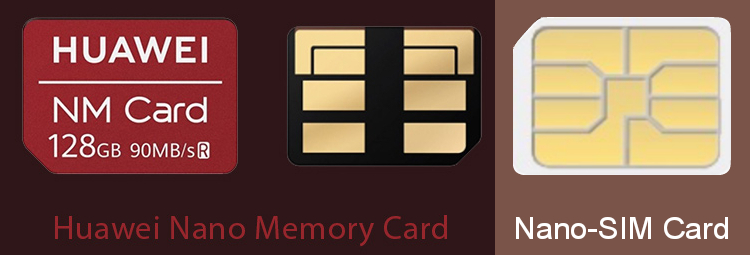
NM cards are the same size as a nano SIM card, so they can be used in the same slots as nano SIMs.[2] They are smaller than micro SD cards, freeing up space and reducing weight in smartphone designs.[3]
NM cards utilize the eMMC 4.5 protocol[4] and operate with read speeds of 90 MB/second.[2]
As of 2021, the cards were only supported by Huawei phones, however they are also manufactured by Lexar. Available sizes are 64 GB, 128 GB, 256 GB, and 512 GB.[5] They are more expensive than SD cards.[6][7]
Devices with Nano Memory support
[edit]As on February 2025, the following devices support Nano Memory cards:
- Huawei Mate 20/Pro/RS/X/X (5G)[1]
- Huawei Mate 30 Series
- Huawei Mate 40 Series
- Huawei Mate 50 Series
- Huawei Mate 60 Series
- Huawei MatePad Pro
- Huawei MatePad Pro (2021)
- Huawei Nova 5/Pro/5i/5i Pro/5z
- Huawei Nova 6 SE
- Huawei Nova 7 SE 5G/SE 5G Youth/7i
- Huawei P30/Pro/Pro New Edition[1]
- Huawei P40/4G/Pro/Pro+/lite/lite 5G
- Huawei P50 Series
- Huawei P60 Series
References
[edit]
- ^ a b c "What is Nano Memory and where is it headed?". Android Authority. 29 March 2019. Retrieved 3 September 2021.
- ^ a b "Huawei's Nano Memory Cards are replacing microSD on its latest phones". The Verge. 16 October 2018. Retrieved 3 September 2021.
- ^ "Huawei reveals new Nano Memory card". Camera Jabber. 18 October 2018. Archived from the original on 24 April 2024. Retrieved 3 September 2021.
- ^ "Huawei's Nano Memory Card Reportedly Benchmarked". NDTV Gadgets 360. 22 January 2019. Retrieved 2021-11-11.
- ^ Yordan. "Lexar launches 512 GB NM card for Huawei phones". GSMArena.com. Retrieved 2024-10-21.
- ^ "What is a Nano Memory (NM) card used in Huawei phones?". Pocket-lint. 28 July 2021. Retrieved 3 September 2021.
- ^ "Lexar unveils Nano Memory card for Huawei smartphones, retails for $28". GizChina. 22 March 2020. Retrieved 3 September 2021.
| Smart devices |
|  | ||||||||||||||||||||||||||||||
|---|---|---|---|---|---|---|---|---|---|---|---|---|---|---|---|---|---|---|---|---|---|---|---|---|---|---|---|---|---|---|---|---|
| Communication infrastructure | ||||||||||||||||||||||||||||||||
| Services | ||||||||||||||||||||||||||||||||
| People |
| |||||||||||||||||||||||||||||||
| Other |
| |||||||||||||||||||||||||||||||

| Main articles | .svg) | |
|---|---|---|
| Types |
| |
 | This computer-storage-related article is a stub. You can help Wikipedia by expanding it. |
Nano Memory
View on GrokipediaOverview
Definition and Development
Nano Memory (NM) is a proprietary flash memory card format developed by Huawei for expandable storage in mobile devices, featuring physical dimensions identical to a nano-SIM card, measuring approximately 12.3 mm × 8.8 mm.[10] This design enables simultaneous use of a nano-SIM for cellular connectivity and an NM card for storage within the same device tray, reducing overall footprint compared to traditional microSD cards, which are 45% larger.[11] NM cards utilize a custom controller and interface, supporting sequential read speeds up to 90 MB/s, though actual performance averages 70-80 MB/s in tests.[12] Huawei announced Nano Memory on October 16, 2018, alongside the Mate 20 smartphone series, positioning it as a space-efficient alternative to microSDXC cards to accommodate dual-SIM functionality without compromising storage expandability.[10] Initial capacities launched at 128 GB and 256 GB, with the format relying on licensed manufacturing partners like Lexar for production.[13] Development focused on integrating high-density NAND flash within the constrained nano-SIM form factor, achieving compatibility primarily with Huawei's Kirin chipset-equipped devices.[14] Despite claims of superior compactness, the proprietary nature limited broader ecosystem adoption, confining NM cards to select Huawei models like the Mate 20, P30, and P40 series.[15] By 2022, Huawei expanded NM support to capacities up to 256 GB, but the format saw minimal evolution beyond initial specifications, overshadowed by entrenched microSD standards and Huawei's restricted market access due to U.S. trade restrictions.[16] Independent benchmarks confirmed NM cards' performance parity with entry-level microSD cards but highlighted compatibility barriers outside Huawei's ecosystem, underscoring the format's niche role in device miniaturization efforts.[2]Physical and Form Factor Characteristics
The Nano Memory (NM) card utilizes the exact physical form factor of a nano SIM card, measuring 12.3 mm in length, 8.8 mm in width, and 0.67 mm in thickness.[10][14] This design enables seamless integration into the SIM tray of compatible Huawei devices, allowing for simultaneous use with a nano SIM card in a shared slot without requiring additional space.[10] Compared to the microSD card, which measures 15 mm × 11 mm × 1.0 mm, the NM card is approximately 45% smaller by volume, facilitating more compact device designs by reducing the footprint needed for expandable storage.[5][3] The card's construction mirrors that of a nano SIM, featuring a durable plastic body with gold-plated contacts aligned for proprietary interfacing, though specific material compositions beyond standard flash card norms are not publicly detailed by Huawei.[14]| Form Factor | Length (mm) | Width (mm) | Thickness (mm) | Relative Size to microSD |
|---|---|---|---|---|
| Nano Memory | 12.3 | 8.8 | 0.67 | ~45% smaller volume |
| Nano SIM | 12.3 | 8.8 | 0.67 | ~45% smaller volume |
| microSD | 15 | 11 | 1.0 | Baseline |
Technical Specifications
Storage Protocol and Performance Metrics
Nano Memory (NM) cards utilize the embedded MultiMediaCard (eMMC) 4.5 protocol, adapted for removable storage, which contrasts with the Secure Digital (SD) protocol employed by microSD cards.[17] [15] This eMMC-based interface prioritizes compact integration over the higher bandwidth potential of SD interfaces, limiting peak theoretical throughputs but ensuring reliability in shared SIM tray slots. Later variants, such as those from third-party manufacturers like Lexar, incorporate eMMC 5.1 for marginally improved efficiency, though core performance remains constrained by the form factor's electrical and mechanical design.[7] Performance metrics for NM cards center on sequential read speeds of up to 90 MB/s, enabling adequate handling of high-resolution photos and 4K video playback in compatible Huawei devices like the Mate 20 series launched in October 2018.[17] [4] Write speeds vary by capacity and manufacturer; official Huawei specifications cite peaks around 70 MB/s, while benchmarks indicate sustained writes as low as 30 MB/s under continuous loads such as video recording, aligning with a UHS-I U3 speed class equivalent for minimum 30 MB/s writes.[17] [4] Independent tests, including those on 256 GB models, report effective write rates up to 83 MB/s in burst scenarios, but real-world throughput often falls short of premium microSD cards due to the eMMC protocol's half-duplex operation and lower command queue depth.[18]| Metric | Typical Value | Notes |
|---|---|---|
| Sequential Read Speed | Up to 90 MB/s | Peak under optimal conditions; supports 4K video decoding.[17] [13] |
| Sequential Write Speed | 30–85 MB/s | Sustained at 30 MB/s for UHS-I U3 compliance; peaks vary by model.[17] [13] |
| Random IOPS | Not publicly benchmarked | eMMC limitations imply lower than NVMe or UHS-II SD.[15] |
| Endurance | Standard NAND flash | Suitable for consumer media storage, not enterprise workloads.[19] |
Capacity Options and Data Transfer Rates
Nano Memory (NM) cards are available in capacities of 64 GB, 128 GB, and 256 GB.[5][4] These options were introduced alongside Huawei's Mate 20 series in October 2018, with the 256 GB variant demonstrated at launch.[20] Higher capacities beyond 256 GB have not been officially standardized for NM cards, limiting expandability compared to microSD formats that support up to terabytes.[13] Data transfer rates for NM cards utilize the eMMC protocol, achieving sequential read speeds of up to 90 MB/s. Write speeds vary by implementation but typically reach 70–85 MB/s under optimal conditions.[13][18] These rates enable efficient transfer of media files, such as hundreds of photos per minute, though real-world performance averages 70–80 MB/s due to factors like device integration and file fragmentation.[21][22] The eMMC 5.1 standard in some variants supports these speeds but falls short of UFS-based internal storage in modern smartphones, prioritizing compactness over peak throughput.[23]| Capacity | Read Speed (Max) | Write Speed (Typical Max) |
|---|---|---|
| 64 GB | 90 MB/s | 70–85 MB/s |
| 128 GB | 90 MB/s | 70–85 MB/s |
| 256 GB | 90 MB/s | 70–85 MB/s |
Compatibility and Adoption
Supported Devices and Ecosystem
Nano Memory (NM) cards are supported exclusively within Huawei's device ecosystem, with compatibility limited to select smartphones, tablets, and other hardware from the company and its former sub-brand Honor. Initial support began with the Huawei Mate 20 series (including Mate 20, Mate 20 Pro, Mate 20 X, and Mate 20 RS Porsche Design) and P30 series (P30 and P30 Pro), launched in 2018 and 2019, respectively. These devices utilize a dedicated slot in the SIM tray for NM cards, allowing dual-SIM functionality alongside expandable storage.[24] Subsequent Huawei models expanded compatibility, encompassing the Mate 30, 40, 50, and 60 series; P40, P50, and P60 series; select Nova models like Nova 7 SE; and foldables such as Mate X5. Certain Honor devices, including Honor X10 Max, Honor X10, Honor Play4T Pro, and Honor 30 Pro, also integrate NM card support. Huawei tablets in the MatePad series further extend usability beyond smartphones.[13][25] The ecosystem's proprietary nature restricts NM cards to Huawei hardware, precluding adoption by competitors like Samsung or Apple, which favor microSD or internal storage solutions. Third-party manufacturers, notably Lexar, produce NM cards compatible with these devices, offering capacities up to 1 TB as of 2024, though performance and reliability vary by vendor. No standard adapters enable broad cross-compatibility with non-Huawei systems.[13][25]Integration with Smartphone Designs
Nano Memory (NM) cards integrate into smartphone designs by matching the exact dimensions of a nano-SIM card, measuring 8.8 mm by 12.3 mm, allowing them to occupy the same hybrid tray slots traditionally used for SIM cards. This eliminates the need for a dedicated microSD card slot, which requires additional internal space and a separate ejection mechanism, thereby enabling slimmer chassis and more efficient use of internal volume in devices like the Huawei Mate 20 series introduced on October 16, 2018.[26][11][27] In Huawei's implementation, the SIM tray features two slots: one fixed for the primary nano-SIM and a second hybrid slot that accepts either a secondary nano-SIM or an NM card for storage expansion, supporting capacities up to 256 GB at launch with read speeds of 90 MB/s. This configuration preserves dual-SIM capability while providing expandable storage, a feature increasingly rare in flagship smartphones due to space constraints from larger batteries and cameras; the NM card's 45% smaller footprint compared to microSD cards further reduces overall device thickness and weight.[26][11][3] The integration supports advanced design goals, such as full-screen displays and improved ingress protection ratings, by minimizing tray size and simplifying the mechanical assembly, as seen in subsequent models like the P30 and Mate 30 series. However, this proprietary format confines compatibility to Huawei devices, limiting its influence on broader industry design trends toward soldered storage in non-expandable flagships.[27][21]Advantages and Limitations
Key Benefits Over Traditional Formats
Nano Memory (NM) cards offer a significantly reduced form factor compared to traditional microSD cards, measuring approximately 45% smaller in volume and matching the dimensions of a nano-SIM card at 12.3 mm × 11 mm × 0.7–1.0 mm.[11][3] This compactness allows integration into the SIM tray without requiring a dedicated expansion slot, enabling devices to support dual nano-SIM cards alongside expandable storage in a single tray mechanism.[14][28] The space-saving design frees up internal real estate within slim smartphone chassis, potentially contributing to thinner profiles or allocation of volume to other components like larger batteries or advanced cameras.[29] Unlike microSD slots, which often necessitate hybrid trays that compromise on dual-SIM functionality or device thinness, NM cards maintain full compatibility with nano-SIM infrastructure, addressing a key limitation in compact mobile designs.[30][13] Performance metrics of NM cards, utilizing the eMMC 4.5 interface with UHS-I U3 ratings, deliver read speeds up to 90 MB/s and write speeds around 70–85 MB/s, aligning closely with high-end microSD cards without introducing superior throughput but ensuring reliable operation for 4K video recording and large file transfers.[17][31] Available capacities range from 64 GB to 512 GB, providing comparable storage scalability to traditional formats while leveraging the proprietary ecosystem for seamless Huawei device integration.[30][13]Drawbacks and Technical Constraints
The Nano Memory (NM) card format, introduced by Huawei in October 2018 alongside the Mate 20 series, imposes significant compatibility constraints due to its proprietary design, limiting support to select Huawei smartphones such as the Mate 20, P30, P40, and certain later models like the Mate 50 and P60 series.[15][8] Unlike the standardized microSD format, NM cards lack universal device interoperability and require dedicated hybrid SIM trays without available adapters for non-Huawei hardware, effectively locking users into Huawei's ecosystem and reducing flexibility for device upgrades or multi-platform use.[32] Performance metrics of NM cards are constrained by the eMMC 4.5 protocol, delivering peak read speeds of 90 MB/s and sustained write speeds of around 30 MB/s, which align with entry-level UHS-I microSD cards but fall short of advanced UHS-II or UHS-III variants offering over 200 MB/s.[17] Capacity options remain limited to 64 GB, 128 GB, and 256 GB for most commercially available NM cards, trailing microSD's progression to 1 TB and beyond, which restricts storage scalability for high-volume data needs like 4K video or large app libraries.[5] User reports highlight reliability challenges, including intermittent card detection failures, data corruption, and storage vanishing after software updates on compatible devices, potentially stemming from firmware incompatibilities or manufacturing variances in third-party NM cards. These issues, while not universally documented in official testing, underscore a lack of robust ecosystem-wide validation compared to the mature microSD standard, compounded by reduced availability amid Huawei's supply chain disruptions from U.S. trade restrictions since 2019.[33] Initial pricing for NM cards has also exceeded equivalent microSD options, with 128 GB models often retailing higher due to limited production scale.[34]Reception and Controversies
Market Reception and Commercial Viability
Huawei introduced the Nano Memory (NM) card in October 2018 alongside its Mate 20 smartphone series, positioning it as a compact alternative to microSD cards that matches the size of a nano-SIM, enabling hybrid dual-SIM and expandable storage configurations in thinner devices.[35] Initial reception highlighted its innovation in form factor, with transfer speeds rated up to 90 MB/s under UHS-I U3 specifications, comparable to entry-level microSD cards at the time.[36] However, the format's proprietary design, lacking support from the SD Association, confined its utility to Huawei and select Honor devices, limiting broader appeal among consumers accustomed to universal microSD compatibility.[37] Commercial viability has remained constrained by ecosystem exclusivity and geopolitical factors impacting Huawei's global market share. By 2023, third-party manufacturer Lexar expanded capacity options to 512 GB for NM cards targeted at Huawei smartphones, yet availability was primarily through specialized channels, with no evidence of widespread retail penetration or sales dominance.[38] The format has not achieved industry standardization, failing to displace microSD in non-Huawei ecosystems, and production appears niche, with capacities ranging from 64 GB to 512 GB but no reported volume shipments rivaling established standards.[14] Analysts note that proprietary storage solutions historically struggle against open formats, as evidenced by the NM card's stagnant adoption outside Huawei's domestic Chinese market, where the company's smartphone sales persist despite international sanctions.[26] Despite technical merits in miniaturization, the NM card's commercial prospects hinge on Huawei's device ecosystem growth, which has been hampered by U.S. trade restrictions since 2019, curtailing access to advanced chipsets and global distribution. No public sales figures indicate significant revenue generation, and the format's viability is undermined by consumer preference for interchangeable, vendor-agnostic storage, rendering it a specialized rather than scalable solution.[11] Ongoing support from Huawei suggests continued relevance in its flagship models, but without cross-manufacturer endorsement, long-term market expansion remains improbable.[21]Security and Geopolitical Concerns
The suspension of Huawei's membership in the SD Association in May 2019, prompted by its placement on the U.S. Entity List, prohibited the company from incorporating official microSD card support in future devices, citing compliance with U.S. export restrictions aimed at addressing national security risks.[39][40] This restriction accelerated Huawei's reliance on its proprietary Nano Memory (NM) format, originally introduced in October 2018 for devices like the Mate 20 series, as a compact alternative designed to fit alongside Nano-SIM trays without licensing dependencies on Western standards bodies.[41] Huawei's broader designation as a national security threat by the U.S. government, due to alleged ties to the Chinese Communist Party and potential for espionage through embedded hardware or software backdoors, has cast similar scrutiny on NM cards integrated into its ecosystem.[42] U.S. intelligence assessments have highlighted risks of undetected data exfiltration in Huawei equipment, including consumer devices, prompting warnings from agencies like the FBI against their use in sensitive environments.[43] Although no verified exploits specific to NM cards have been publicly disclosed, their proprietary controllers—often sourced from Chinese suppliers—raise concerns about supply chain vulnerabilities, echoing documented cases of state-linked tampering in Chinese tech components.[44] Geopolitically, NM represents China's strategy for technological self-sufficiency amid U.S.-led decoupling efforts, bypassing international standards like those from the SD Association to insulate Huawei from sanctions that have curtailed access to advanced semiconductors and software ecosystems.[45] This has confined NM adoption primarily to Huawei markets in China and select regions, with bans or advisories in the U.S., UK, and allies limiting global viability and fostering parallel tech silos that exacerbate supply chain fragmentation.[42] The format's limited interoperability outside Huawei devices underscores how national security-driven export controls can reshape hardware standards, prioritizing ecosystem control over universal compatibility.[46]Future Prospects
Potential Expansions and Alternatives
Huawei has indicated potential for NM cards to support capacities up to 1 TB, as demonstrated by early prototypes and announcements, though commercial availability has primarily reached 512 GB from partners like Lexar as of 2023.[21] Further expansions could involve enhanced transfer speeds exceeding the current 90 MB/s read rates, aligning with broader NAND flash advancements, but no specific roadmap has been publicly detailed beyond compatibility with newer Huawei flagships like the Mate 50 and P60 series.[13] Adoption in non-smartphone devices, such as wearables and IoT gadgets, represents another avenue, leveraging the form factor's compactness for slim designs where microSD proves infeasible.[47] Alternatives to NM cards include reverting to microSDXC formats, which offer wider ecosystem support and capacities up to 2 TB with UHS-I/UHS-II speeds often surpassing NM in practice, provided regulatory barriers like U.S. export restrictions on Huawei are alleviated.[48] Embedded Universal Flash Storage (UFS) solutions, standard in modern smartphones from competitors like Samsung and Google, eliminate the need for removable media altogether by integrating high-speed NAND directly onto the motherboard, achieving read/write performance of 2-4 GB/s in UFS 4.0 implementations as of 2024.[15] These alternatives prioritize seamless integration and reliability over expandability, reflecting an industry trend toward fixed high-capacity internal storage amid declining removable card usage.[49]Comparative Position in Storage Technology Landscape
Nano Memory (NM) cards occupy a niche within the removable flash storage segment, primarily serving as a proprietary alternative to microSD cards in select Huawei smartphones. Developed to enable slimmer device designs by integrating expandable storage alongside dual Nano SIM slots in a compact hybrid tray, NM cards measure approximately 12.3 mm × 8.8 mm, rendering them about 45% smaller in volume than standard microSD cards, which are 15 mm × 11 mm × 1 mm. This size advantage facilitates reduced internal space requirements in handsets, contrasting with the bulkier microSD format that often necessitates dedicated trays compromising on multi-SIM support or battery volume. However, NM's ecosystem exclusivity limits its interoperability, requiring Huawei-specific readers or adapters for data access outside native devices.[10][11] In terms of performance, NM cards leverage the eMMC 4.5 interface, delivering sequential read speeds of up to 90 MB/s and equivalent UHS-I U3-class write capabilities, aligning closely with entry-to-midrange microSD cards rather than surpassing them. Benchmarks indicate NM cards achieve throughput comparable to similarly specced microSD counterparts, such as sustained transfers around 80-90 MB/s in real-world tests on Huawei Mate 20 series devices. This positions NM below high-end removable options like UHS-II microSD cards (up to 312 MB/s theoretical) and far behind embedded storage standards like UFS 3.1 or 4.0, which offer 1,000-4,000 MB/s in modern smartphones for internal apps and OS. Capacities range from 128 GB to 256 GB, with potential for higher densities akin to microSD's evolution to 1 TB+, though NM's proprietary nature has constrained third-party manufacturing scale.[17][15]| Aspect | Nano Memory (NM) | microSD (UHS-I U3) | UFS 3.1 (Embedded) |
|---|---|---|---|
| Form Factor | Nano SIM-sized (12.3×8.8 mm) | 15×11×1 mm | Soldered, no removable form |
| Max Read Speed | ~90 MB/s | ~100 MB/s | ~2,100 MB/s |
| Compatibility | Huawei devices only | Universal (SD standard) | Device-specific embedded |
| Primary Use | Removable expansion in Huawei | Broad removable expansion | Internal OS/app storage |