Hubbry Logo
Narrow-body aircraftNarrow-body aircraftMain
Open search
Narrow-body aircraft
Community hub
Narrow-body aircraft
logo
8 pages, 0 posts
0 subscribers
Be the first to start a discussion here.
Narrow-body aircraft
from Wikipedia
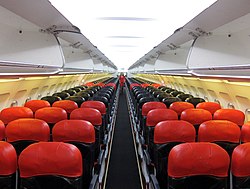
Four-abreast cross-section
Narrow-body Airbus A320 operated by British Airways in front of a Boeing 777-300ER wide-body operated by Air Canada in June 2010
Narrow-body Boeing 737-900 operated by United Airlines in October 2010
Narrow-body Airbus A319 operated by Delta Airlines in February 2014

A narrow-body aircraft or single-aisle aircraft is an airliner arranged along a single aisle, permitting up to 6-abreast seating in a cabin less than 4 metres (13 ft) in width. In contrast, a wide-body aircraft is a larger airliner usually configured with multiple aisles and a fuselage diameter of more than 5 metres (16 ft), allowing at least seven-abreast seating and often more travel classes.

Market

[edit]

Historically, beginning in the late 1960s and continuing through the 1990s, twin engine narrow-body aircraft, such as the Boeing 737 Classic, McDonnell-Douglas MD-80 and Airbus A320 were primarily employed in short to medium-haul markets requiring neither the range nor the passenger-carrying capacity of that period's wide-body aircraft.[1][failed verification]

The re-engined Boeing 737 MAX and Airbus A320neo jets offer 500 miles more range, allowing them to operate the 3,000 miles transatlantic flights between the eastern U.S. and Western Europe, previously dominated by wide-body aircraft. Norwegian Air Shuttle, JetBlue and TAP Portugal will open up direct routes bypassing airline hubs for lower fares between cheaper, smaller airports. The Boeing 737NG 3,300-mile range is insufficient for fully laden operations and operates at reduced capacity like the Airbus A318, while the Airbus A321LR could replace the less fuel efficient Boeing 757s used since their production ended in 2004.[2] Boeing will face competition and pricing pressure from the Embraer E-Jet E2 family, Airbus A220 (formerly Bombardier CSeries) and Comac C919.[3]

Between 2016 and 2035, FlightGlobal expects 26,860 single-aisles to be delivered for almost $1380 billion, 45% Airbus A320 family ceo and neo and 43% Boeing 737 NG and max.[4] By June 2018, there were 10,572 Airbus A320neo and Boeing 737 MAX orders: 6,068 Airbuses (57%, 2,295 with CFMs, 1,623 with PWs and 2,150 with not yet decided engines) and 4,504 Boeings (43%); 3,446 in Asia-Pacific (33%), 2,349 in Europe (22%), 1,926 in North America (18%), 912 in Latin America (9%), 654 in Middle East (6%), 72 in Africa (1%) and 1,213 not yet bounded (11%).[5]

Many airlines have shown interest in the Airbus A321LR or its A321XLR derivative, and other extended-range models, for thin transatlantic and Asia-Pacific routes.[6]

Examples

[edit]

Six-abreast cabin

[edit]
Type Country Production Fuselage width Cabin width Max. seats Engines seat
width[a]
Hawker Siddeley Trident[b] UK 1962–1978 344 cm (135 in)[8] 180 3 turbofan[c]
Bristol Britannia UK 1952–1960 366 cm (144 in)[9] 350 cm (139 in)[10] 139 4×turboprop
Douglas DC-8[11] US 1958–1972 373 cm (147 in) 351.2 cm (138 in) 269 4×turbojet/fan
Ilyushin Il-62[12] USSR/Russia 1963–1995 380 cm (150 in) 356 cm (140 in) 186 4×turbofan
Vickers VC10[13] UK 1962–1970 375 cm (148 in) 351 cm (138 in)[14] 151 4×turbofan
Boeing 707/Boeing 720[15] US 1958–1979 376 cm (148 in) 354 cm (139 in) 219 4×turbojet/fan 17"
Boeing 737[16] US 1966–present 220 2×turbofan 17"
Boeing 757[17] US 1981–2004 295 2×turbofan 17"
Boeing 727[18] US 1963–1984 356 cm (140 in) 189 3×turbofan 16.9"
Tupolev Tu-154[19] USSR/Russia 1968–2013 380 cm (150 in) 356 cm (140 in) 180 3×turbofan
Tupolev Tu-204[20] Russia 1990–present[d] 357 cm (141 in) 215 2×turbofan
Tupolev Tu-334 Russia 1999–2009 102 2×turbofan
Yakovlev Yak-42 USSR/Russia 1977–2003 360 cm (142 in) 120 3×turbofan
Dassault Mercure France 1971–1975 366 cm (144 in)[21] 162 2×turbofan
Airbus A320 family[22] Multi 1986–present 395 cm (156 in) 370 cm (146 in) 244 2×turbofan 18"[23]
Comac C919 China 2016–present 396 cm (156 in)[24] 390 cm (154 in)[25] 192 2×turbofan
Yakovlev MC-21[26] Russia 2017–present 406 cm (160 in) 381 cm (150 in) 230 2×turbofan
Tupolev Tu-114[e] USSR 1958–1963 420 cm (165 in) 406 cm (160 in)[14] 220 4×turboprop

Five-abreast cabin

[edit]
Type Country Production Fuselage width Cabin width Max. seats Engines Seat
width
de Havilland Comet UK 1949–1964 292 cm (115 in)[28] 81 4×turbojet
Douglas DC-4/DC-6/DC-7 US 1942–1958 301 cm (118.5 in)[29] 95 4×piston engine
Sud Aviation Caravelle France 1958–1972 301 cm (118.5 in)[30] 80 2×turbojet
Vickers Viscount UK 1948–1963 305 cm (120 in)[31] 75 4×turboprop
Fokker F28/Fokker 70/Fokker 100 Netherlands 1967–1997 330 cm (130 in) 310 cm (122 in)[32] 122 2×turbofan
Tupolev Tu-144[33] USSR 1963–1983 330 cm (130 in)[f][34] 140 4×turbojet
McDonnell Douglas DC-9/MD-80/MD-90/Boeing 717[35] US 1965–2006 334.3 cm (131.6 in) 311.2 cm (122.5 in) 172 2×turbofan 17.9"
Antonov An-148/An-158 Ukraine 2002–present 335 cm (132 in) 313 cm (123 in)[36] 99 2×turbofan
Comac ARJ21[37] China 2007–present 336 cm (132 in) 314.3 cm (123.7 in) 105 2×turbofan
Boeing 377 Stratocruiser US 1947–1963 335 cm (132 in)[38] 315 cm (124 in)[39] 114 4×piston engine
Tupolev Tu-104 USSR 1955–1960 350 cm (137.7 in) 320 cm (126 in) 115 2×turbojet
Ilyushin Il-18 USSR 1957–1985 351 cm (138 in)[40] 315 cm (124 in)[14] 120 4×turboprop
BAC One-Eleven UK 1963–1989 315 cm (124 in)[32] 119 2×turbofan
Sukhoi Superjet 100 Russia 2007–present 345 cm (136 in)[41]: 451  323.6 cm (127 in)[42] 108 2×turbofan
Convair 880 US 1959–1962 325 cm (128 in)[14] 110 4×turbojet
Convair 990 US 1961–1963 325 cm (128 in)[14] 149 4×turbofan
Lockheed L-188 Electra US 1957–1961 325 cm (128 in)[14] 98 4×turboprop
Lockheed Constellation US 1943–1958 328 cm (129 in)[14] 109 4×piston engine
Airbus A220 Canada/Multi 2012–present 350 cm (138 in)[43] 328 cm (129 in) 160 2×turbofan 18.6"
British Aerospace 146[44][g] UK 1987–2001 350 cm (138 in) 324 cm (128 in) 112 4×turbofan

Four-abreast cabin

[edit]
Type Country Production Fuselage width Cabin width Max. seats Engines Seat
width
Yakovlev Yak-40 USSR 1966–1981 240 cm (94 in) 215 cm (85 in) 40 3×turbofan
Douglas DC-3[47] US 1936–1942, 1950 250 cm (98 in) 27 2×piston engine
De Havilland Dash 8[48] Canada 1983–present 269 cm (106 in) 251 cm (99 in) 90 2×turboprop 17.3"
Fokker 27/Fokker 50 Netherlands 1987–1997 254 cm (100 in)[32] 58 2×turboprop
Bombardier CRJ[49] Canada 1991–2020 269 cm (106.1 in) 255 cm (100.5 in) 104 2×turbofan 17.3"
ATR 42/ATR 72[50] France/Italy 1984–present 273 cm (107 in) 257 cm (101 in) 78 2×turboprop 18"
Concorde France/UK 1965–1979 262 cm (103 in)[32] 128 4×turbojet
Convair CV-240 US 1947–1954 271 cm (106.5 in)[39] 40 2×piston engine
Tupolev Tu-124/Tu-134[51] USSR 1956–1984 290 cm (114 in) 261 cm (103 in)[52] 56-84 2×turbofan
Ilyushin Il-114 USSR/Russia 1997–2012 264 cm (104 in) 228 cm (90 in) 64 2×turboprop
Embraer E-Jet/E-Jet E2[53] Brazil 2001–present 301 cm (119 in) 274 cm (108 in) 146 2×turbofan 18"
Antonov An-24 USSR 1959–1979 277 cm (109 in)[32] 50 2×turboprop

Three-abreast cabin

[edit]
Type Country Production Fuselage width Cabin width Max. seats Engines Seat
width
de Havilland Canada DHC-6 Twin Otter[54] Canada 1965–1988, 2008–present 175 cm (69 in) 161 cm (63.2 in) 19 2×turboprop
BAe Jetstream 31/41 UK 1982–1997 185 cm (73 in)[55] 30 2×turboprop
Short 360 UK 1981–1991 193 cm (76 in)[56] 36 2×turboprop
Embraer EMB 120[57] Brazil 1983–2001 228 cm (90 in) 210 cm (83 in) 30 2×turboprop 17.3"
Embraer ERJ 145 family[58] Brazil 1989–2020 228 cm (90 in) 210 cm (83 in) 50 2×turbofan 17.3"
Saab 340/Saab 2000[59] Sweden 1983–1999 231 cm (91 in) 216 cm (85 in) 50 2×turboprop 18.1"
Dornier 328 Germany 1991–2000 217.2 cm (85.5 in) 32 2×turboprop 18.1"
Cessna 408 SkyCourier[60] USA 2023–present 188 cm (74 in) 19 2×turboprop

Two-abreast cabin

[edit]
Type Country Production Fuselage width Cabin width Max. seats Engines
Beechcraft 1900 US 1982–2002 1.37m 19 2×turboprop
Beechcraft Model 18 US 1937–1970 6 2×piston engine
Beechcraft Model 99 US 1968–1986 15 2×piston engine
Boeing 247 US 1933–1937 10 2×piston engine
Britten-Norman Islander UK 1965–present 9 2×piston engine
Britten-Norman Trislander UK 1970–1982 16 3×piston engine
de Havilland Dove UK 1946–1947 8–11 2×piston engine
de Havilland Heron UK 1950–1963 14–17 4×piston engine
Dornier 228 Germany 1981–1998, 2009–present 19 2×turboprop
Douglas DC-1 US 1933 12 2×piston engine
Douglas DC-2 US 1934–1939 14 2×piston engine
Embraer EMB-110 Bandeirante Brazil 1968–1990 18 2×turboprop
Evektor EV-55 Outback Czech Republic 2011–present 9–14 2×turboprop
Fairchild Swearingen Metroliner US 1968–2001 19 2×turboprop
Ford Trimotor US 1925–1933 11 3×piston engine
GAF Nomad Australia 1975–1985 12–16 2×turboprop
Junkers Ju 52 Germany 1930–1952 17 3×piston engine
Lockheed Model 10 Electra US 1934–1937 10 2×piston engine
Lockheed Model 14 Super Electra US 1937–1946 12-14 2×piston engine
Tecnam P2012 Traveller Italy 2016–Present 11 2×piston engine
[edit]

See also

[edit]

Notes

[edit]

References

[edit]
Revisions and contributorsEdit on WikipediaRead on Wikipedia
from Grokipedia
A narrow-body aircraft, also known as a single-aisle aircraft, is a type of commercial jet airliner with a fuselage diameter of less than 4 meters (13 feet), featuring a single central aisle in the passenger cabin that accommodates seating for four to six passengers per row in a typical 2+2 or 3+3 configuration. These aircraft are optimized for efficiency on short- to medium-haul routes, generally carrying 100 to 220 passengers, with maximum ranges extending up to 6,500 kilometers (4,000 miles), and they represent the most common category in global commercial aviation due to their lower operating costs per seat compared to wider variants. The development of narrow-body aircraft traces its roots to the mid-20th century, evolving from early jet transports to become the dominant segment of the airline industry. In 1965, Boeing announced the 737 program as a short- to medium-range twinjet to succeed the trijet 727, with the first 737 prototype achieving its maiden flight on April 9, 1967, and entering commercial service in 1968. This marked the beginning of the single-aisle jet era, followed by competitors like the McDonnell Douglas DC-9, which first flew in 1965. The segment expanded significantly in the 1980s with Airbus's A320 family, launched in 1984 and making its debut flight on February 22, 1987, introducing advanced fly-by-wire controls and composite materials that set new standards for fuel efficiency and reliability; the A320 entered service in 1988; as of October 2025, the A320 family has surpassed the Boeing 737 as the most-delivered narrow-body aircraft in history. Today, narrow-body aircraft dominate the global fleet, comprising approximately 60% of active commercial jets (around 18,500 units as of mid-2025), with the Boeing 737 and Airbus A320 families accounting for over 90% of all such planes in operation due to their versatility, high utilization rates (averaging 1,390 km per flight), and adaptability to routes from regional hops to transcontinental services. Major manufacturers include Boeing and Airbus as the primary players, alongside regional producers like Embraer (e.g., E-Jet series) and Bombardier (e.g., CRJ series) for smaller variants with capacities up to 100 seats. Ongoing innovations, such as the fuel-efficient 737 MAX and A320neo variants powered by advanced engines from CFM International, continue to drive demand, with projections estimating over 33,000 new single-aisle deliveries needed from 2025 to 2044 to meet rising air travel needs.

Definition and Classification

Fuselage and Seating Standards

Narrow-body aircraft are defined as single-aisle commercial jet airliners featuring a fuselage external diameter typically ranging from 3.5 to 4.0 meters (approximately 138 to 157 inches), with larger models like the Boeing 737 and Airbus A320 at 3.7-3.95 meters (146 to 156 inches) and smaller ones like the Airbus A220 at 3.5 meters, which supports efficient 2+2 or 3+3 seating configurations abreast without requiring a central pair of aisles. This design contrasts with wider fuselages that enable twin-aisle layouts, prioritizing operational efficiency for medium- to short-haul routes. This classification aligns with FAA FAR Part 25 standards for transport category aircraft, where single-aisle designs under 4 meters facilitate efficient evacuation and operations. The corresponding internal cabin widths generally fall between 3.1 and 3.7 meters, allowing for streamlined passenger flow via a single central aisle while optimizing space for economy-class accommodations. These dimensions enable typical seating capacities of 100 to 150 passengers in standard short-haul configurations, extending to 200 or more in high-density economy setups for longer routes. For instance, the Boeing 737 is certified for a maximum of 220 passengers in its highest-capacity variant. Such capacities balance passenger volume with the aircraft's overall size, supporting economical operations on routes with moderate demand. Industry practices have standardized fuselage cross-sections to promote interchangeability in maintenance and parts across models, a convention that evolved from early jetliner designs in the mid-20th century. The fuselage width directly influences aircraft weight, aerodynamic drag, and fuel efficiency; narrower profiles reduce structural mass and wetted surface area, contributing 25-30% to total drag. In particular, the drag coefficient CdC_d is affected by the fuselage fineness ratio (length-to-diameter), with optimal ratios around 6 minimizing wave and skin friction drag for better overall efficiency.

Comparison to Other Aircraft Types

Narrow-body aircraft are primarily differentiated from wide-body variants by their single-aisle configuration, which supports up to six-abreast seating within a fuselage width generally under 4 meters, enabling efficient operations for 100 to 240 passengers. In contrast, wide-body aircraft employ a twin-aisle design for capacities exceeding 250 passengers, with fuselage widths ranging from 5 to 6 meters to accommodate broader cabin layouts and enhanced passenger flow. This structural difference positions narrow-bodies for medium-density routes, while wide-bodies prioritize high-volume, long-distance travel. Relative to regional jets, narrow-body aircraft offer greater capacity and reach, typically seating 100 or more passengers with operational ranges of 2,000 to 5,000 kilometers, compared to regional jets' 50 to 100 seats and routes limited to under 2,000 kilometers. These attributes make narrow-bodies suitable for trunk-line services connecting major hubs, whereas regional jets focus on feeder operations to smaller airports with lower demand. In terms of operations, narrow-body aircraft are tailored for high-frequency, medium-haul flights of 1 to 4 hours, delivering lower per-seat operating costs on such segments through quicker turnaround times and reduced crew requirements, in opposition to wide-bodies' emphasis on long-haul transoceanic routes that demand extended endurance and larger support infrastructures. Certain hybrid variants, known as "stretched" narrow-bodies, extend the fuselage to add 20 to 30 seats while preserving the single-aisle format—for instance, models like the Airbus A321 or Boeing 737-900—yet they remain certified under FAR Part 25 as transport category airplanes, ensuring compliance with standards for larger commercial operations without reclassifying as wide-bodies. Economically, narrow-body aircraft present trade-offs with significantly lower acquisition costs than wide-bodies (typically 60-70% lower, list prices as of 2025), often in the $50 to $120 million range per unit, but they exhibit higher costs per seat-mile on extended routes due to proportionally greater fuel consumption relative to passenger load compared to the economies of scale achieved by wide-bodies on similar paths.

Historical Development

Early Jetliners

The transition from propeller-driven airliners to jet-powered aircraft in the post-World War II era marked a pivotal shift in commercial aviation, with the de Havilland Comet emerging as the first narrow-body jetliner to enter service in 1952. Designed with a fuselage external diameter of approximately 3.05 meters and an internal width supporting 36 to 81 passengers in a single-aisle configuration, the Comet offered unprecedented speeds of up to 800 km/h and a range of approximately 2,800 km suitable for medium-haul routes, revolutionizing travel times. However, early operations were marred by structural failures attributed to metal fatigue around square window corners, leading to two fatal crashes in 1954 and the subsequent grounding of the fleet by the UK Civil Aviation Authority; extensive water-tank testing revealed cracks after just 3,000 to 16,000 pressurization cycles, far below the anticipated 16,000, prompting redesigns with oval windows and reinforced fuselages for later variants like the Comet 4. The Boeing 707, entering service in 1958, built on military-derived technology from the KC-135 tanker and solidified the narrow-body jet paradigm for civilian use, featuring a single-aisle layout with 3+3 abreast seating that became the industry standard for efficiency. With variants offering ranges up to approximately 5,200 km on early models like the 707-120, it accommodated 110 to 189 passengers and powered the rapid expansion of global routes, influencing subsequent designs by demonstrating reliable four-engine turbofan performance under FAA type certification achieved in October 1958. European efforts complemented this with the Sud Aviation Caravelle, a pioneering twin-engine narrow-body that first flew in 1955 and entered service in 1959, boasting a fuselage width of about 3.08 meters and seating for 80 to 110 passengers; certified by French authorities and later the FAA, it emphasized rear-mounted engines for quieter cabins and contributed to over 282 units produced through 1972. Early narrow-body jets faced significant challenges, including ongoing concerns over metal fatigue that informed stricter FAA certification requirements for damage tolerance under 14 CFR Part 25, as seen in the Comet's lessons applied to the 707 and later types. Engine reliability was another hurdle, exemplified by the Pratt & Whitney JT8D turbofan's initial iterations delivering 14,000 lbf of thrust but experiencing issues like compressor stalls and hot-section durability in high-cycle operations on aircraft such as the Boeing 727. In the 1960s, regulatory milestones like the FAA's 60-minute diversion rule for twin-engine operations enabled limited overwater flights for models like the Caravelle, paving the way for extended twin-jet viability. The 1970s oil crises further accelerated efficiency innovations, with the Boeing 737—debuting in 1967 with FAA certification in December 1967 and initial seating for 85 to 130 passengers—evolving through variants optimized for lower fuel burn amid rising costs. Production of these foundational models underscored their impact, with over 1,000 Boeing 707s built from 1958 to 1994, highlighting American dominance alongside European contributions from the Caravelle.

Evolution in the Jet Age

The 1980s marked a pivotal shift in narrow-body aircraft design toward advanced digital controls and lightweight materials, exemplified by the Airbus A320, which entered service in 1988 as the first commercial jet with fully digital fly-by-wire technology and sidestick controls. This innovation replaced traditional mechanical linkages with electronic signals, enhancing precision, reducing pilot workload, and enabling envelope protection features that prevent stalls or excessive maneuvers. The A320, configured for around 150 passengers, also incorporated extensive composite materials, including carbon fiber in the tail and floor structures, achieving significant weight savings compared to all-metal predecessors. In the 1990s and 2000s, fuel efficiency became a primary focus amid rising oil prices and environmental pressures, driving engine advancements like the CFM International CFM56 series, which powered the Boeing 737 Next Generation (NG) variants introduced in 1997. These high-bypass turbofan engines, delivering 25,000 to 30,000 pounds of thrust with a bypass ratio of approximately 5.1:1, enabled the 737NG to achieve about 15% better fuel burn per seat than earlier models through improved propulsive efficiency and reduced drag. Key regulatory milestones further expanded operational flexibility, including FAA extensions of ETOPS (Extended-range Twin-engine Operational Performance Standards) to 330 minutes in 2003 for qualifying twin-engine aircraft, allowing longer overwater routes previously reserved for four-engine jets. The 2010s saw re-engining initiatives, such as the Boeing 737 MAX certified in 2017 with CFM LEAP-1B engines, which provided a 15% improvement in specific fuel consumption over the CFM56 via higher bypass ratios and advanced materials. Post-1978 U.S. airline deregulation spurred the rise of low-cost carriers, prompting manufacturers to develop high-density seating variants of narrow-body aircraft to maximize load factors and route profitability. Examples include configurations seating up to 189 passengers on the 737-800, tailored for carriers like Southwest Airlines, which optimized quick turnarounds and point-to-point networks. This era has seen over 20,000 narrow-body aircraft delivered globally since 1980, reflecting sustained demand for efficient single-aisle jets in short- to medium-haul operations. Recent innovations explore beyond conventional subsonic designs, including supersonic concepts like Boom Supersonic's Overture, a 60- to 80-seat prototype demonstrator (XB-1 subscale model flown in 2024) aiming for Mach 1.7 speeds on transatlantic routes. Parallel efforts in hybrid-electric propulsion, such as NASA and GE Aerospace's HyTEC program, target 20-30% emission reductions by 2030 through integrated electric motors and batteries augmenting turbofans in narrow-body applications.

Design and Technical Features

Structural and Aerodynamic Elements

Narrow-body aircraft fuselages are primarily constructed from aluminum alloys, such as 2024-T3, which provide high strength, fatigue resistance, and durability through riveted skin panels attached to stringers and frames. This semi-monocoque design distributes loads across the skin and internal structure, enabling efficient pressurization and lightweight construction suitable for single-aisle configurations. In modern iterations, composites account for 10–20% of the airframe by weight, particularly in tail sections, fairings, and portions of the fuselage, yielding 10–20% structural weight reductions compared to all-aluminum builds. For instance, the Airbus A320 incorporates approximately 15% composites overall, enhancing fuel efficiency through lower empty weight without compromising structural integrity. Wing designs for narrow-body aircraft emphasize high-aspect-ratio swept wings, typically with aspect ratios of 9–10, to optimize cruise efficiency by minimizing induced drag during long-range operations. The sweep angle, often 25–35 degrees, delays transonic drag rise while the elongated span improves lift-to-drag ratios at subsonic speeds. Wingspans are constrained to under 36 meters to ensure compatibility with standard airport gates under ICAO Code C classifications, balancing aerodynamic performance with operational accessibility. The Boeing 737 MAX, for example, features a wingspan of 35.9 meters and an aspect ratio of approximately 10.2, exemplifying this design approach for efficient medium-haul flights. Aerodynamic features in narrow-body designs incorporate leading-edge slats and trailing-edge flaps to promote laminar flow over the wing, particularly during takeoff and landing, thereby reducing induced drag and enhancing low-speed performance. These high-lift devices increase the wing's effective camber and delay flow separation, allowing higher angles of attack without stall. The fundamental lift generation follows the equation L=12ρv2SCLL = \frac{1}{2} \rho v^2 S C_L where LL is lift, ρ\rho is air density, vv is velocity, SS is wing area, and CLC_L is the lift coefficient, with maximum values (CLmaxC_{L_{max}}) around 2.5 achieved via deployed slats and flaps in typical narrow-body configurations. The tail assembly consists of a conventional empennage, including a horizontal stabilizer with elevators for pitch control and a vertical stabilizer with rudder for yaw stability, complemented by ailerons on the wings for roll authority. These control surfaces are sized to maintain static and dynamic stability across the flight envelope, particularly at cruise Mach numbers of 0.78–0.82, where compressibility effects are managed without excessive trim drag. Certification under FAR Part 25 requires rigorous stress analysis of the airframe to withstand gust loads, with limit load factors up to 2.5g in vertical maneuvers and turbulence, ensuring structural margins against fatigue and ultimate failure. Additionally, single-aisle designs must demonstrate passenger evacuation within 90 seconds using half the exits available, emphasizing rapid egress paths and fire-resistant materials to meet emergency requirements.

Propulsion and Performance Specifications

Narrow-body aircraft predominantly employ high-bypass turbofan engines to optimize fuel efficiency and performance for medium-haul operations. The CFM International LEAP series, a joint venture between GE Aviation and Safran Aircraft Engines, powers aircraft such as the Boeing 737 MAX and Airbus A320neo family, offering thrust ratings from 23,000 to 35,000 lbf (102 to 156 kN) across variants. Similarly, the Pratt & Whitney PW1000G (Geared Turbofan, or GTF) family, used on the Airbus A320neo, A220, and Embraer E-Jets E2, provides thrust in the 19,000 to 33,000 lbf (85 to 147 kN) range. These engines feature high bypass ratios of 9:1 to 12:1, which direct a larger proportion of airflow around the core for improved propulsive efficiency, achieving 15–20% fuel savings compared to previous-generation engines like the CFM56 or IAE V2500. Modern engines are designed for compatibility with up to 50% sustainable aviation fuels as of 2025, supporting net-zero goals. Performance specifications for narrow-body aircraft emphasize balanced operations suitable for regional to transcontinental routes. Typical cruise speeds range from Mach 0.78 to 0.82 (approximately 460–490 knots or 850–950 km/h at altitude), enabling efficient high-altitude flight while minimizing drag. Maximum ranges vary by variant and loading, generally spanning 3,000–7,000 km (1,620–3,780 nautical miles), as seen in the Boeing 737 MAX 8's capability of up to 7,040 km with full passengers. Takeoff field lengths at maximum takeoff weight (MTOW) of 70–100 tons (e.g., 82.2 tons for the 737 MAX 8) typically require 1,500–2,500 m under standard sea-level conditions, influenced by engine thrust and aircraft configuration. Fuel efficiency is a critical metric, quantified by thrust-specific fuel consumption (TSFC), which measures fuel flow per unit of thrust produced. Modern high-bypass turbofans achieve TSFC values of 0.5–0.6 lb/lbf·h (14.3–17.1 g/kN·s) during cruise, reflecting advancements in core design and materials that reduce energy losses. This efficiency is governed by the fundamental equation: TSFC=m˙fF\text{TSFC} = \frac{\dot{m}_f}{F} where m˙f\dot{m}_f is the fuel mass flow rate and FF is the thrust output, highlighting how optimizations in bypass ratio and compressor efficiency lower overall consumption. The twin-engine configuration is standard for narrow-body aircraft, providing redundancy essential for Extended-range Twin-engine Operational Performance Standards (ETOPS) certification, which allows flights over remote areas with up to 180–330 minutes to an alternate airport. These engines deliver thrust-to-weight ratios of 0.25–0.30 at MTOW, supporting initial climb rates of 2,500–3,000 ft/min (13–15 m/s) to quickly reach optimal altitudes. Noise and emissions compliance is integral to propulsion design, with narrow-body engines meeting ICAO Annex 16 Chapter 14 standards, which impose cumulative noise limits 7 EPNdB (effective perceived noise decibels) more stringent than Chapter 4. Since the early 2000s, technologies such as chevron nozzles on exhaust streams and acoustic liners in engine nacelles have contributed to overall noise reductions of 10–15 EPNdB compared to pre-Chapter 4 engines, mitigating community impact while maintaining performance.

Cabin Configurations

Multi-Abreast Seating Options

Narrow-body aircraft cabins typically accommodate multi-abreast seating arrangements ranging from two to six seats per row, constrained by an internal fuselage width of approximately 3 to 4 meters, which limits configurations to a single central aisle for efficient passenger flow and regulatory compliance. These arrangements prioritize a balance between passenger capacity, comfort, and safety standards, such as minimum aisle widths of 15 inches (38.1 cm) below 25 inches (63.5 cm) above the floor and 20 inches (50.8 cm) at or above 25 inches (63.5 cm) above the floor for cabins with 20 or more passenger seats, as mandated by the Federal Aviation Administration (FAA) under 14 CFR § 25.815, to facilitate movement and evacuation. Similar standards apply under the European Union Aviation Safety Agency (EASA) CS-25, ensuring global harmonization for safety. Six-abreast seating, arranged in a 3-3 configuration across the single aisle, represents the high-density economy option for narrow-body aircraft, particularly in stretched variants designed for higher passenger volumes of 180 to 210 seats. This layout features narrow seats typically measuring 18 inches in width with a seat pitch of 29 to 31 inches, maximizing cabin utilization while adhering to FAA aisle width minima to ensure unobstructed access. Such configurations enhance operational efficiency on medium- to long-haul routes by increasing available seat kilometers without expanding the fuselage cross-section. Five-abreast seating, often in a 2-3 layout, provides a mixed configuration that balances density with enhanced comfort, accommodating 150 to 180 passengers in premium economy or hybrid cabins. This arrangement is prevalent among Asian carriers, such as Korean Air, which employs it in narrow-body fleets to optimize space on regional and international flights while offering wider effective seating through staggered or offset designs. The setup allows for greater legroom in select rows, supporting higher passenger satisfaction without exceeding the spatial limits of a single-aisle cabin. Four-abreast seating in a standard 2-2 configuration serves as the baseline for many narrow-body aircraft, supporting 100 to 130 passengers and emphasizing evacuation efficiency under FAA regulations in 14 CFR § 25.803. This rule mandates that aircraft with more than 44 seats demonstrate through full-scale testing that the maximum certified seating capacity—up to 440 passengers—can be evacuated within 90 seconds under simulated emergency conditions, a threshold readily met by the 2-2 layout's proximity to the aisle for all occupants. The symmetric design minimizes bottlenecks during egress, making it ideal for shorter-range operations where rapid boarding and deplaning are critical. Three-abreast and two-abreast configurations are uncommon in mainline commercial narrow-body operations due to their low density but are employed in specialized applications such as VIP interiors or freighter passenger compartments, where internal cabin widths remain under 2.5 meters to prioritize luxury or cargo flexibility over volume. These rare setups, often customized for private charters, reduce overall capacity to under 100 seats while providing expansive personal space, aligning with non-standard regulatory approvals for limited operations. Seating density in narrow-body aircraft directly influences passenger load factors, with higher-abreast arrangements enabling load factors of 80-85% by optimizing cabin volume utilization. A key metric for this efficiency is calculated as (number of seats × average seat pitch) / cabin length, yielding typical values of 70-85% that reflect the trade-off between capacity and spatial constraints in single-aisle designs. Increased density from multi-abreast options supports revenue maximization, as evidenced by post-pandemic trends where airlines achieved load factors above 84% through tighter configurations without compromising core safety standards.

Interior Layouts and Passenger Amenities

Narrow-body aircraft cabins are segmented into functional zones that prioritize passenger flow, service access, and comfort. The forward zone generally accommodates premium configurations, such as business or first class, with 8 to 20 seats featuring pitches of 36 to 60 inches for enhanced legroom and recline. The central mid-cabin houses the bulk of economy seating, while the aft zone includes galleys for meal preparation and lavatories for hygiene needs. Cabin lengths typically range from 25 to 40 meters across models, exemplified by the Airbus A320neo's 27.51-meter passenger area. Passenger amenities focus on entertainment and connectivity to mitigate the constraints of single-aisle layouts. In-flight entertainment systems like Panasonic Avionics' eX1, introduced in the 2010s, equip seats with 10- to 15-inch full HD screens supporting 1080p video and audio content tailored for narrow-body operations. Satellite-based Wi-Fi complements these, delivering speeds of 10 to 50 Mbps for browsing, streaming, and productivity, though emerging low-Earth orbit systems like Starlink are elevating averages to over 100 Mbps on equipped fleets. Accessibility provisions ensure inclusive travel under regulatory mandates. The FAA requires a minimum of one wheelchair securement location on aircraft seating over 100 passengers, often integrated into economy rows, alongside onboard or airport lift devices for boarding assistance. Ventilation systems deliver at least 0.55 pounds of fresh air per occupant per minute, targeting humidity levels around 20% to reduce dehydration risks, while general cabin illumination maintains 500 to 1,000 lux for task visibility and safety. Customization allows airlines to tailor interiors for competitive differentiation while adhering to certification standards. Qatar Airways, for example, has modified select A320neo aircraft with modular business-class upgrades, including lie-flat seats, privacy dividers, and enhanced personal screens to create a more secluded premium experience. Safety elements are embedded throughout the cabin to support rapid response in emergencies. Overhead bins, designed for carry-on storage, are certified to withstand loads sufficient to prevent shifting during turbulence, with operational limits typically around 10 kg per bag. Emergency lighting activates to illuminate floor-level paths at a minimum of 0.03 foot-candles (approximately 0.32 lux) for at least 10 minutes after emergency power activation, guiding evacuations per FAA criteria in 14 CFR § 25.812. Smoke detectors in galleys and lavatories connect to cockpit warnings and tie into overall evacuation planning, ensuring coordinated exits aligned with zoning layouts.

Market and Operations

Since the introduction of the first jet-powered narrow-body aircraft in the 1950s, global production has exceeded 25,000 units, with Boeing and Airbus accounting for the vast majority as the dominant manufacturers holding approximately 89% of the market share in recent years. Annual production rates in the 2020s have typically ranged from 900 to 1,200 units, reflecting recovery from pandemic disruptions; for instance, in 2024, Airbus delivered 677 narrow-body aircraft (602 A320 family + 75 A220) while Boeing delivered around 263 737 MAX variants, contributing to a combined total of roughly 940 units. Sales trends have been characterized by substantial order backlogs, which reached over 13,000 unfilled commercial aircraft orders for Boeing and Airbus combined by the end of 2018, equivalent to about seven to eight years of production at the time; backlogs have since grown to record levels exceeding 16,000 as of 2025. List prices for modern narrow-body models, such as the Airbus A320neo and Boeing 737 MAX 8, range from $110 million to $130 million per unit, though bulk purchases by low-cost carriers often secure discounts of 40% to 60%, reducing effective costs to as low as 50% of list price. Post-2010 production has shifted markedly toward re-engined variants like the A320neo family and 737 MAX, driven by demands for improved fuel efficiency amid volatile oil prices averaging $100 to $150 per barrel in the 2010s. By September 2023, the A320neo family had amassed over 9,700 orders, with these models offering approximately 15% better fuel efficiency than predecessors, influencing airline fleet modernization strategies. Supply chain dynamics have supported this ramp-up, with key suppliers such as Spirit AeroSystems providing fuselages for Boeing's 737 program; production surges during economic booms, including the 2000s when Asia-Pacific demand growth contributed nearly 40% to global increases, necessitated expanded supplier capacity to meet rising orders. In 2025, deliveries have accelerated, with Airbus on track for approximately 820 total aircraft (majority narrow-body) and Boeing for around 590; notably, the A320 family reached 12,260 deliveries in October 2025, surpassing the Boeing 737's prior historical total. Economic viability for narrow-body programs hinges on break-even analyses, typically requiring 400 to 600 units sold to recover development costs estimated at $10 billion to $15 billion per derivative program, factoring in amortized research, certification, and production setup expenses. These thresholds underscore the high financial barriers to entry, emphasizing the duopoly's stability through sustained high-volume sales.

Commercial and Regional Applications

Narrow-body aircraft dominate mainline commercial operations, accounting for nearly 60% of the global active commercial fleet and serving primarily short- and medium-haul routes under 4,000 km. These aircraft handle the majority of intra-continental flights, such as those within Europe, where they operate on 1- to 2-hour sectors with typical passenger loads of around 150 to 171 seats per flight. Their versatility and lower unit operating costs make them ideal for high-frequency hub-and-spoke networks, contributing close to 60% of global available seat kilometers (ASK) in these segments. In regional applications, narrow-body aircraft support 20-30% of spoke routes ranging from 500 to 2,000 km, often through wet-leased configurations that enhance operational flexibility for airlines. These deployments achieve high utilization rates, with narrow-bodies averaging up to 6 flights per day and over 10 block hours in dense regional networks. About 85% of such regional services focus on routes shorter than 1,000 km, complementing turboprops and regional jets in feeder operations. Fleet strategies vary by airline model, with low-cost carriers (LCCs) relying on narrow-bodies for 80% or more of their operations to maximize efficiency on point-to-point routes. For instance, Ryanair operates over 600 narrow-body Boeing 737 aircraft, forming the core of its fleet for high-density, short-haul services. In contrast, full-service carriers allocate 30-40% of their narrow-body fleets to feeder routes, integrating them with wide-bodies for network connectivity while prioritizing multi-type flexibility. Operational challenges include airport compatibility, where gate designs often limit wingspans to around 35 meters for narrow-bodies, restricting access at older or congested facilities. Post-COVID recovery from 2020 to 2022 involved significant capacity reductions, with global airline traffic declining by up to 60% in 2020 alone due to demand drops and restrictions. Many retired narrow-body aircraft—estimated at 10-15% of those taken out of passenger service—are converted for cargo use, enabling payloads of about 20-28 tons and extending operational life by 10-20 years.

Notable Examples

Boeing Models

The Boeing 737 series, Boeing's flagship narrow-body aircraft, first flew in 1967 and entered commercial service in 1968, becoming the best-selling commercial jet airliner in history with over 12,000 units delivered as of October 2025. Designed initially for short-haul routes, the 737 has evolved through multiple generations to accommodate growing demand for efficient single-aisle aircraft, maintaining a high degree of type commonality to reduce operator training and maintenance costs. Key variants include the 737 Classic series, introduced in the 1980s with models like the 737-300, -400, and -500, offering seating for 110 to 149 passengers and featuring updated CFM56 engines for improved performance over the originals. The Next Generation (NG) series, launched in 1997, introduced advanced avionics, a two-pilot glass cockpit, and variants such as the 737-700, -800, and -900, with the -800 and -900 stretched to seat 160 to 189 passengers and a typical range of approximately 7,000 kilometers. The 737 MAX, certified in 2017, incorporates new CFM LEAP-1B engines, advanced winglets, and aerodynamic enhancements for a 20% fuel efficiency improvement over the NG, though its Maneuvering Characteristics Augmentation System (MCAS) was implicated in safety controversies following the 2018 Lion Air Flight 610 and 2019 Ethiopian Airlines Flight 302 crashes, leading to a global grounding from March 2019 to November 2020. Boeing also produced the 717 from 1999 to 2006, a regional narrow-body derived from the McDonnell Douglas MD-95 design, featuring twin-engine propulsion and seating for up to 155 passengers in a high-density configuration suited for short- to medium-haul routes. Only 156 units were built, primarily for airlines like AirTran and Midwest, before production ended due to market shifts toward larger narrow-bodies. Distinctive to Boeing's narrow-body designs is the emphasis on fleet commonality, with approximately 85% parts interchangeability across 737 variants to streamline operations for airlines. Blended winglets, introduced on NG and refined on MAX models, reduce drag and improve fuel efficiency by 3-5%, extending range and payload capabilities without major structural changes. Stretched variants like the 737-800 and -900 exemplify this evolutionary approach, balancing capacity increases with the original fuselage cross-section for cost-effective scaling. Production of the 737 family occurs primarily at Boeing's Renton factory in Washington, where output stabilized at 38 aircraft per month through October 2025, with FAA approval to increase to 42 per month. The program has amassed over 17,000 total orders as of October 2025, reflecting sustained demand from low-cost carriers and major airlines. Retirement trends show older Classic models being phased out in favor of more efficient NG and MAX equivalents, with over 10,000 737s active globally as of 2025.

Airbus and Other Manufacturers' Models

Airbus has established itself as a leading producer of narrow-body aircraft through its A320 family, which includes the A318, A319, A320, and A321 variants, all designed as single-aisle jets for short- to medium-haul routes. These models offer seating capacities ranging from 107 to 244 passengers in high-density configurations, with the A320neo and A321neo incorporating new engine options that reduce fuel consumption and CO2 emissions by up to 20% per seat compared to previous generations. The A321XLR variant extends the family's range to 4,700 nautical miles, enabling longer transatlantic and transpacific operations while maintaining the efficiency of the core design. This versatility has made the A320 family the best-selling narrow-body aircraft line globally, with over 19,000 orders as of April 2025. Complementing the A320 family, Airbus's A220 series—comprising the A220-100 and A220-300—targets the smaller end of the narrow-body market, seating 100 to 160 passengers in a five-abreast layout that emphasizes wide seats and large windows for enhanced passenger comfort. The A220-100 achieves a range of up to 3,600 nautical miles with 25% lower fuel burn per seat than competitors in its class, thanks to advanced aerodynamics and Pratt & Whitney geared turbofan engines. The A220-300 extends this to 3,400 nautical miles, supporting regional and intercontinental routes, and features the largest overhead bins in its segment for improved cabin efficiency. Acquired from Bombardier in 2018 and rebranded, the A220 has secured over 940 firm orders as of October 2025, positioning it as a key player in high-frequency, low-capacity networks. Beyond Airbus, Embraer offers the E-Jets family, including the E175, E190, and E195 models, which are four-abreast narrow-body jets optimized for regional operations with capacities of 70 to 150 passengers. The second-generation E-Jets E2 variants, introduced in 2018, deliver up to 25% better fuel efficiency and a range of up to 3,000 nautical miles for the E195-E2, achieved through Pratt & Whitney PW1000G engines and refined winglets that reduce drag. These aircraft boast a 99.9% dispatch reliability rate and have been ordered by over 80 operators worldwide, with more than 1,900 deliveries by September 2025, making them a staple for efficient short-haul connectivity in challenging airport environments. In China, the Commercial Aircraft Corporation of China (COMAC) has developed the C919 as its entry into the narrow-body market, a twin-engine jet seating 158 to 192 passengers in a six-abreast configuration to rival the A320 and Boeing 737 families. Powered by CFM International LEAP-1C engines, the C919 offers a range of approximately 4,075 kilometers and entered commercial service in 2023 with China Eastern Airlines, marking China's first independently developed trunkliner compliant with international airworthiness standards. By November 2025, COMAC had delivered 26 aircraft to domestic carriers, though production has faced challenges including supply chain constraints on engines that reduced 2025 delivery targets from 75 to 25. The C919 incorporates composite materials for 12% weight savings and focuses on cost-effective operations for Asia-Pacific routes.

References

Add your contribution
Related Hubs
User Avatar
No comments yet.