Hubbry Logo
Nasu no YoichiNasu no YoichiMain
Open search
Nasu no Yoichi
Community hub
Nasu no Yoichi
logo
8 pages, 0 posts
0 subscribers
Be the first to start a discussion here.
Nasu no Yoichi
Nasu no Yoichi
from Wikipedia

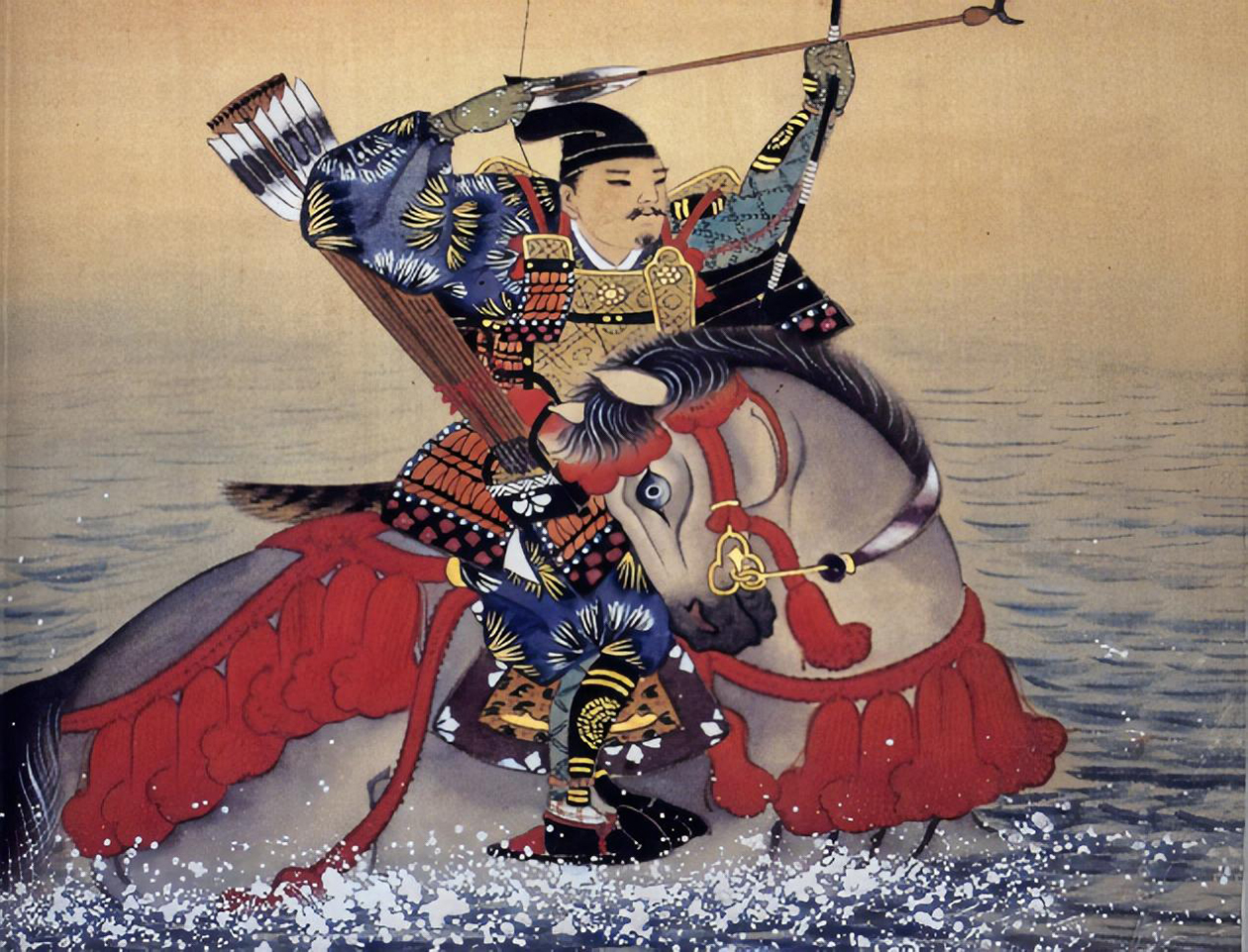
Nasu no Yoichi (那須 与一, Nasu no Yoichi) (c. 1169 – c. 1232) was a samurai who fought alongside the Minamoto clan in the Genpei War. He is particularly famous for his actions at the Battle of Yashima in 1185. According to the Heike Monogatari, the enemy Taira placed a fan atop a pole on one of their ships, daring the Minamoto warriors to shoot it off. Sitting atop his mount in the waves, his target atop the ship rocking as well, Nasu nevertheless shot it down with only one shot.[1][2]

Key Information

After the Genpei War, he was made shugo of Tottori Castle, but he lost this position to Kajiwara Kagetoki after being defeated in a hunting competition. He left Echigo Province and—following the death of Minamoto no Yoritomo—Nasu became a Buddhist monk in the Jōdo Shinshū sect. Eventually, he formed a temple, which has since been passed down to the oldest son of the Nasu family. For administrative purposes, detailed records were kept regarding who was to inherit the temple. As a result of this, it was possible to trace the Nasu lineage right up to the destruction of the temple during World War II.

There is another legend that his death in 1189 (or 1190) was disguised to facilitate his escape from Yoritomo's purge, and that the reason for his becoming a priest was that his complexion had changed due to Hansen's disease. Meanwhile, according to Yoshisada Nasu, Yoichi was pardoned and returned to Nasu after Yoritomo's death, became a priest in order to enter the Jodo-shu sect and died from paralysis in 1232 in Settsu Province, after a journey of about 30 years mourning those who had died in the Battle of Gempei-Kassen. [3]

Name

[edit]

Yoichi is a common name which denotes the tenth or eleventh son. Sanada Yoshitada and Asari Yoshito were contemporaries who also called themselves Yoichi. They and Nasu no Yoichi are collectively called the 'three Yoichi of Genji.'

Biography

[edit]
Nasu no Yoichi firing his famous shot at a fan atop the mast of a Taira ship. From a hanging scroll, Watanabe Museum, Tottori Prefecture, Japan.

Since the name of Nasu no Yoichi is not seen in historical materials of the same period such as Azuma Kagami (The Mirror of the East), Yoichi's achievements are mostly handed down in the war chronicles The Tale of the Heike and Genpei Seisuiki.

According to the description of the Tale of the Heike, he was born as a child of Nasu no Suketaka around the first year of Kao (1169), the first year of Eiman / the first year of Nin'an (1166), and the third year of Nin'an (1168). It is often assumed that the place of birth was Kanda-jo Castle (present Nakagawa-machi, Nasu County, Tochigi Prefecture) where the Nasu clan lived at that time.

In the Genpei War, he took the side of Minamoto no Yoritomo along with his brother Juro Tametaka, and joined the army of his younger brother, Yoshitsune. In the Battle of Yashima, he famously shot down the target of a fan on the Taira clan's warship, and was granted a shoen (manor in medieval Japan) over five provinces by Yoritomo.

His nine older brothers, except Tametaka, supported the Taira clan. Tametaka was later punished, and therefore, Yoichi gained the family estate of the Nasu clan, although he was the eleventh son. Yoichi pardoned his older brothers who had escaped to various places such as Shinano, gave them territory, and laid the foundation for the development of the Nasu clan in Shimotsuke Province.

Hearsay and folklore

[edit]

There is a local legend that states he was good at archery since he was a child, and showed his skill in front of his brothers and surprised his father Suketaka. There is also a legend that, when practicing archery at Mount Nasu in 1180, Suketaka met Yoshitsune who came to Nasu Onsen-jinja Shrine to pray for certain victory and exchanged an agreement with his older brother Juro Tametaka to let Yoichi join the Minamoto clan.

In addition, there are several temples and shrines which Yoichi founded. In the Heike Monogatari, the story of shooting a target of a fan is very famous.

There is also Bitchu Ebara no Sho, one of the manors which is said to have been obtained by the achievement of shooting a fan target. It is not known whether this legend is true or not, but it is recorded that at least in the middle of the Kamakura period, the Nasu clan (Ebara Nasu clan and Bitchu Nasu clan) ruled the area.

It is said that the length of the arm changed on the right and left sides because he had too much training to improve the arm of the bow.

Grave

[edit]

His grave is in Sokujo-in Temple in Kyoto City, Kyoto Prefecture, where his older brother Sukeno built a temple called Kosho-in Temple and buried a part of the bone, and although it was once abolished in 1514, Sukekage NASU rebuilt it as the family temple, Genjo-ji Temple (Otawara City, Tochigi Prefecture) of the Nasu clan in 1590 and the Nasu clan regarded it as his main grave.

Also, in Sosho-in Temple of Hekiun-ji Temple in Suma Ward, Kobe City, Hyogo Prefecture, there is a tomb of Yoichi called NASU no Yoichi Munetaka Gobo. There is a legend that if you visit this grave, you will not be able to take care of your age. In the vicinity are Kitamuki Hachiman-jinja Shrine, which is said to have been worshipped by Yoichi, and Nasu-jinja Shrine, which is enshrined by local people.

In front of Kokuzo Bosatsu-do Hall located to the northwest of Saren-ji Temple in 5-chome, Yonezawa City, Yamagata Prefecture, there is a three-storied stone pagoda approximately 4.2 meters in height with the name of Nasu no Yoichi inscribed. This is considered to be a memorial tower for Yoichi, and the tower has the inscription of 'Nasu no Yoichi Soryu no ko' and 'Chisaka Tsushima no kami Kagechika' and the inscription 'Construction of May 13, 1349' on the back. Kagechika Chisaka was a senior vassal of Uesugi Kenshin, but the Chisaka clan had a marital relationship with the Nasu clan, and it is said that the statue of kokuzo Bosatsu (the statue of kokuzo Bosatsu) of Yoichi was passed down.

Also, there is a five-ring memorial tower for Yoichi in the mountains of Bicchu Ebara-so, one of the manors he acquired across the country for the merit of shooting at a fan target.

The graves of the Nasu family are located in the Tokugawa family cemetery (Kan'eiji Temple), which is now under the management of Yosuin, but in 2014 the gravestones of the 20th to 26th generations were taken away for eternal use. The headstones of the 27th through 33rd generations are now in place. They are as follows:

Saemon Daisuke 1516 Moved to Kaminosho in the 13th year of the Heishi Era, August 4, 1999. 

Masasuke Nasu Yoichi, 21st governor of Iki (1546), died on July 23, 1592

22nd Nasu Yoichi Takasuke, Repairer, Buddhist name: Tensei Osun, 1551, died on January 23, Tenbun 20, 1551

The 23rd Nasu Yoichi Suketane, Repairer, legal name: Egetsuin Ashigiri Genseki Daizen Sadamon, 1583, died on February 11, Tensho 11.

24th Nasu Yoichi Sukeharu, repairer, legal name: Fuwakuin-dono Kyuuzan Keikaku Daizenjyakumon, 1609, graduated on December 7, Keicho 14

25th Nasu Yoichi Sukekage, Sakyo-taio, legal name: Suminein-dono Tsukiyama Tochi-daishi, died on December 7, 1656, Keicho 14

26th Nasu Yoichi Sukeshige, Governor of Mino, Buddhist priest, Jikyoin-dono Shingensei-daiei, died in 1642, July 25, Kan'ei 19.

Seen in 2014

27th Nasu Yoichi Sukeshige (Air, Wind, Fire, Water, Earth, Central) Name: Rendaiin Kōkoku Seishin Daiin 1687, June 25, Jōkyō 4, Graduated

28th Nasu Yoichi Sukenori, left side, Dharma name: Seikoin-dono Gekimine Joshin-daiei, graduated June 25, 1708   29th generation Nasu Yoichi Shokutoku, right side, Buddhist priest, Jukko Tokun Dai-i-sensei, Hoikein-dono, graduated on June 8, 1718. 

The 30th Nasu Yoichi Sukinao, tiger "Sukinao", Buddhist name: Shinzenin-dono Tokujun Ryoyoshi, grand master, 1783, graduated on July 4, 1783

Akira, the 31st Nasu Yoichikushi, Buddhist priest, born in 1832, graduated on January 5, 1828.   The 32nd generation, Nasu Yoichi Shikire, Buddhist name: Choshoin-dono Ichimu Genku Dai-in 1861, graduated on September 5, 1861

The 33rd Nasu Yoichi Sukeyo, Dharma name: Daitatsuin-dono Enjodo-hon, graduated on July 8, 1870.

14 other women, 1 child 

Impact on future generations

[edit]

The common name of the head of the Nasu clan has been "Nasu Taro" for generations with a few exceptions (Nasu Yoshitaka, Nasu Mitsuyoshi, etc.), but since the Edo period, successive heads of the Nasu clan, such as Nasu Sukekage, have used the common name "Nasu Yoichi.

[edit]

The character of Nasu no Yoichi is played by the elder brother of Non-chan in Ishii Momoko's Nonchan kumo ni noru (ノンちゃん雲に乗る).[4]

Nasu no Yoichi is one of the main characters in the manga/anime Drifters, where he appears as a young man under the age of 19 and is voiced by Mitsuki Saiga.

The story of Nasu shooting the fan off of the rocking boat was briefly re-enacted in the Studio Ghibli film, Pom Poko, when old Yashima no Hage-tanuki shapeshifts into it.

In High School Inari Tamamo-chan manga, the story was twisted; Nasu no Yoichi was Tenko Fushimi, as her bow skills were legendary, but the fact that she was a fox guardian was concealed.

In the Final Fantasy franchise, a recurring weapon known as the Yoichi Bow is often shown as a powerful bow - if not the most powerful one - in the game it appears in.

In Doodle Champion Island Games, Captain Yoichi is the champion to beat in an archery contest involving fans.

In the 2005 Taiga Drama Yoshitsune, he was portrayed by the actor Tsubasa Imai.

References

[edit]
Revisions and contributorsEdit on WikipediaRead on Wikipedia
from Grokipedia
Nasu no Yoichi (那須 与一, c. 1169 – c. 1232) was a Japanese samurai of the Nasu clan who served the Minamoto forces during the (1180–1185), a pivotal conflict between the Minamoto and Taira clans that marked the rise of the . He is primarily remembered as a legendary archer for his daring feat at the in 1185, where, mounted on horseback amid rough seas, he successfully shot an arrow to knock down a fan target displayed on a Taira clan's ship approximately 100 meters away, boosting Minamoto morale during a storm. This episode, central to Nasu no Yoichi's fame, originates from the medieval epic Heike Monogatari (Tale of the Heike), a 13th-century narrative chronicle of the that blends historical events with heroic legend, portraying him as a young warrior of exceptional skill and resolve under the command of . While his existence is not corroborated in contemporary records like the Azuma Kagami (the official chronicle of the ), he is depicted as the 11th son of Nasu no Suketaka, born in what is now , with the nickname "Yoichi" denoting his birth order. Post-war, accounts in later traditions describe him receiving estates from for his service, including a brief appointment as (military governor) of Tottori, though he later lost this position in a dispute involving a hunting contest with rival Kajiwara Kagetoki. In his later years, Nasu no Yoichi is said to have renounced worldly life after Yoritomo's death in 1199, becoming a monk in the sect of and founding a temple that served as a lineage record for the Nasu family until its destruction in . His death is traditionally placed around 1232 at age 64, during a memorial ceremony for the in , though some sources suggest an earlier demise around 1189 at age 20, highlighting the blend of history and in his . Nasu no Yoichi's legacy endures as a symbol of valor and mastery, inspiring numerous woodblock prints, plays, and modern depictions in Japanese art and culture, such as ukiyo-e illustrations of his Yashima shot.

Background and Early Life

Name and Identity

Nasu no Yoichi is the standard historical reference for the 12th-century , with "Yoichi" (与一) serving as his childhood or , often denoting the tenth or eleventh child in traditional Japanese naming conventions. His full formal name is recorded as Nasu Munetaka (那須宗高) in clan records and later historical accounts, reflecting the patrilineal structure of samurai nomenclature where the family name "Nasu" precedes personal identifiers. The surname "Nasu" originates from the Nasu District in Shimotsuke Province (modern-day ), a locational name tied to the geographic and administrative region where the Nasu clan held influence during the . This etymology underscores the clan's territorial roots, with "Nasu" potentially evoking local agricultural features, such as cultivation in the area, though primarily denoting place-based identity. In key historical texts, variations of his name appear consistently as "Nasu no Yoichi," as seen in (Heike Monogatari), a 13th-century epic chronicle of the , where he is depicted without additional qualifiers. This form became the enduring identifier in medieval and oral traditions. Birth records for Nasu no Yoichi are not precisely dated in contemporary documents, but clan genealogies and narrative descriptions in the Tale of the Heike approximate his birth to circa 1169, during the Kaō era. Scholars note minor debates over the exact year, ranging from 1166 to 1169, stemming from inconsistencies in later Nasu clan compilations that rely on retrospective accounts rather than direct evidence.

Family and Clan Origins

Nasu no Yoichi, formally known as Nasu Munetaka, was born around 1166–1169 as the tenth or eleventh son of Nasu no Suketaka, the head of the Nasu clan during the late Heian period. As the youngest of many siblings, Yoichi's position in the family likely positioned him as a warrior reliant on personal prowess rather than inheritance, a common dynamic among large samurai households of the era. The Nasu clan emerged as part of the landowning warrior aristocracy in the late , establishing their base in the Nasu District of Shimotsuke Province, corresponding to the modern Nasu region of . Tracing their lineage to the influential family, the clan's name derived from Suketaka's generation, with an ancestor—Sukeie, great-grandson of the prominent —relocating to the area and solidifying their local power through land management and military service. This rural stronghold in Shimotsuke fostered a warrior culture tied to provincial defense and imperial loyalties, distinguishing the Nasu from more urban-based clans in . In the lead-up to and during the (1180–1185), the Nasu family was divided in its allegiances, with most of Suketaka's sons supporting the ; however, Yoichi and his brother Tametaka joined the Minamoto forces under Minamoto no Yoritomo's campaign against the Taira. This personal allegiance reflected the broader realignment of some provincial warrior families toward the rising Minamoto leadership, securing Yoichi's future influence in the emerging order. Yoichi's early years in the Nasu countryside immersed him in a upbringing suited to the region's rugged and traditions, where was a core skill for local defense and hunting. From childhood, he underwent rigorous training in bowmanship, developing the exceptional abilities that would define his reputation, amid a family environment that prioritized combat readiness over scholarly pursuits.

Military Career

Participation in the Genpei War

Nasu no Yoichi, born circa 1169 as the son of Nasu no Suketaka, is said to have joined 's forces around 1180 as part of the Nasu clan's allegiance during the early stages of the , driven by regional power struggles and the Minamoto's call for eastern allies against the . The Nasu clan from Shimotsuke Province (modern-day ) provided military support to Yoritomo's rising shogunate, reflecting broader clan politics in the Kanto region where local lords sought to counter Taira dominance. According to later traditions, including the medieval epic Heike Monogatari, Yoichi served under in campaigns from 1183 to 1185, contributing scouting and skills to Minamoto advances. However, his existence and specific exploits are not corroborated in contemporary records such as the Azuma Kagami, which documents the Nasu clan's general reliability to the shogunate but provides no details on Yoichi personally. After the Minamoto victory in 1185, Yoichi is described in later accounts as remaining active in the Kamakura shogunate's efforts to consolidate power, serving as a loyal retainer in administrative and military capacities until his death around 1232. Specific details on his later activities remain sparse.

The Battle of Yashima

The Battle of Yashima, fought on March 22, 1185, marked a pivotal Minamoto clan victory over the Taira during the closing stages of the Genpei War (1180–1185), as the rival clans vied for dominance in Japan. The Taira, having retreated to their stronghold on Yashima Island in Sanuki Province (modern-day Kagawa Prefecture) after earlier defeats at Ichi-no-tani, anchored their fleet in the Seto Inland Sea, using the island as a fortified base with ships serving as mobile command centers. Minamoto no Yoshitsune, commanding a small force including approximately 50 to 80 horsemen and supporting vessels, launched a daring assault despite the risks of naval combat in the region. A violent storm arose on the eve of the engagement, damaging Taira ships and forcing the Minamoto fleet to delay its approach while repairs were made, creating a tense standoff amid high winds and rough seas. According to the Tale of the Heike, Nasu no Yoichi, a warrior from the Nasu clan serving under Yoshitsune, participated in long-range archery efforts from Minamoto positions to disrupt Taira morale (see Legends and Folklore for details on his famed feat). His demonstrated accuracy under adverse conditions, as depicted in the epic, exemplified Minamoto marksmanship and contributed to the psychological pressure on the Taira. The Minamoto's strategic use of fireships and coordinated archery barrages routed the Taira forces, compelling them to abandon Yashima and flee westward toward . This defeat fragmented the remnants of the , paving the way for their annihilation in the subsequent on April 25, 1185, and solidifying Minamoto control that culminated in the establishment of the in 1192. Historical narratives of the highlight the battle's role in the Minamoto's ascendancy, though Yoichi's involvement is legendary.

Legends and Folklore

The Fan-Shooting Tale

The fan-shooting tale, one of the most renowned legends surrounding Nasu no Yoichi, originates from the Heike Monogatari, a 13th-century epic chronicle of the . During the on February 19, 1185, amid a fierce storm that favored the Taira clan's naval position, a beautiful lady aboard a Taira ship—described as about 18 or 19 years old, clad in a red divided skirt over five white robes with green linings—emerged to taunt the Minamoto forces. She affixed a red fan bearing a golden sun motif to a pole on the ship's prow, roughly 50 paces offshore, and challenged the Genji warriors to shoot it down, declaring that a successful hit would signal Taira defeat and Minamoto victory. Minamoto no Yoshitsune, recognizing the symbolic stakes, summoned Yoichi, renowned for his archery skill, to attempt the impossible shot. Mounting his black horse on a small, rocking tossed by the waves, Yoichi first offered a fervent to , the god of war, and the local deities of the region, beseeching divine aid for unerring accuracy: "Hachiman the Great I revere, Enlightener of the East, if it be thy will that the Genji cause prevail, grant that this arrow fly true to the target." He then drew his bow and released the arrow, which pierced the fan's exact center, severing it from the pole and sending it fluttering into the sea. The feat was seen as miraculous, with the storm's wind briefly subsiding to steady his aim, interpreted as intervention from the sea god or the spirit of his bow. Symbolically, the fan embodied Taira , representing their presumed invincibility under the storm's cover and their provocative disdain for the land-bound Minamoto; its gilded sun evoked imperial prestige, elevating the challenge to a test of cosmic favor. Yoichi's success not only boosted Genji morale but also highlighted his unyielding loyalty to Yoshitsune, portraying as a divine that rewarded and . Preserved in various 13th-century recensions of the Heike Monogatari, the tale evolved through oral and textual traditions to emphasize these motifs of martial devotion and supernatural endorsement, transforming a battlefield anecdote into a cornerstone of that celebrated the transcendent power of the bow.

Other Archery Feats and Myths

In addition to his renowned feat at the , Nasu no Yoichi is celebrated in regional for demonstrating prodigious skills from childhood, with legends recounting his rigorous training and earning fame for his mastery of the bow around age 15. These tales, preserved in local chronicles of the Nasu clan from , emphasize his early dedication to . In Tochigi regional , Nasu no Yoichi is venerated as a protector spirit tied to local like Nasu Yuzen , where he reportedly prayed before battles. These elements appear in 14th-century and Kyogen plays, such as "Yashima" and "The Tale of Yoichi of Nasu," which amplify his legendary precision through dramatic reenactments of his unerring shots under impossible conditions.

Legacy and Cultural Impact

Graves and Memorial Sites

The primary grave of Nasu no Yoichi is located at Genshoji Temple (玄性寺), a Soto Zen temple in the Fukuhara district of Otawara City, Tochigi Prefecture, where he is said to have practiced horseback riding in his youth. This site houses a cluster of stone stupas (供養塔) dedicated to Yoichi and his Nasu clan ancestors, built during the late Edo period under the patronage of later Nasu clan lords such as Nasu Sukehiro (1792–1861) to honor their forebears. The tombs, arranged in a row and enclosed by stone walls, are designated as a historic site (史跡) by Otawara City, reflecting the deep ties between the temple and the Nasu family, whose origins trace back to the region. Adjacent to these burial grounds, Nasu Jinja Shrine (那須神社) in southern Kanemaru, Otawara City, serves as a key memorial site tied to Yoichi's legacy, having been rebuilt under his auspices during the late as a clan shrine. The shrine's main hall and two-story gate, reconstructed in 1577, are registered as Important Cultural Properties of , underscoring their architectural and historical value from the Sengoku era onward. Annual festivals at the shrine, including (流鏑馬) horseback archery rituals during the grand autumn event, reenact Yoichi's renowned skills and draw participants in traditional warrior attire to shoot at targets along the shrine approach, preserving martial traditions linked to his feats. Secondary memorials include the grounds of Yashima-ji Temple (屋島寺) in Takamatsu City, , on , the historic site of the 1185 where Yoichi famously shot down a fan from horseback amid stormy seas. The temple complex, part of the , features interpretive markers and legends commemorating his archery prowess, though no personal grave exists there; instead, it honors the battle's participants through stone monuments and temple lore. Additional Nasu clan tombs are scattered across sites like those in the former clan territories, but they primarily serve familial rather than individual memorials to Yoichi. Archaeological examinations of the Genshoji tombs reveal Edo-period inscriptions on the stupas identifying Yoichi (often as "Nasu no Yoichi Suketaka" or similar) and clan members, with some traditions linking his death to around 1232 based on later monk ordination legends, though primary historical accounts favor an earlier date circa 1189–1190 following the . These markers, while not directly from the , align with clan records confirming Yoichi's burial in his Tochigi homeland, supported by local and temple documents. The Otawara Yoichi , held annually in early , further animates these sites with parades featuring Yoichi reenactments, emphasizing their ongoing cultural role. Debates persist over the exact burial location due to attributing graves to multiple sites, such as Sokujō-in Temple in or the Munetaka Kogobosho tomb site in , stemming from legends of Yoichi's post-war wanderings as a to evade political purges; however, Otawara's Genshoji remains the consensus primary site, validated by Nasu clan genealogy and regional archaeology tying it to his Tochigi birthplace.

Influence on Samurai Tradition and Archery

Nasu no Yoichi's legendary feat of shooting a fan target during the has been idealized in Japanese historical narratives as embodying the virtues of unwavering loyalty to one's and unparalleled precision in , serving as a paradigmatic example of principles that emphasized disciplined resolve under pressure. This portrayal influenced the philosophical underpinnings of kyudo during the , where archery manuals and treatises, such as those outlining the spiritual and technical aspects of the art, referenced ancient archers like Yoichi to illustrate the integration of mental focus and prowess. The Nasu clan's historical records and descendant lineages have long attributed their renowned heritage to Yoichi's exploits, particularly in mounted shooting techniques that became central to training and ceremonial practices like . Clan genealogies preserved through the and later periods highlight his style of horseback —characterized by rapid, accurate shots amid dynamic conditions—as a foundational model, with Nasu family members maintaining traditions of bowmanship that echoed his precision into the feudal era. In the 19th and 20th centuries, Yoichi's story was invoked in nationalist discourses during the and subsequent periods to symbolize Heian-era heroism and Japanese martial superiority, often featured in educational sermons and wartime memoirs to foster national pride and moral fortitude. For instance, Protestant sermons in the drew on the fan-shooting tale to equate personal sacrifice with imperial loyalty, reinforcing narratives of cultural resilience amid modernization. Scholarly analyses of Yoichi's legacy underscore the legend's role in shaping perceptions of continuity, noting how post- accounts in texts like perpetuated his image as an archetype of excellence, though historical records on his later life remain sparse compared to his mythic feats. Nasu no Yoichi has been a recurring figure in traditional Japanese theater, particularly in and performances that dramatize his legendary skills from the . In , he is the central character in plays like "Nasu no Yoichi," where actors portray his daring feats, such as the fan-shooting episode at the , often emphasizing dramatic tension and heroic resolve; for instance, a 19th-century woodblock print by depicts Ichikawa Danjūrō IX as Nasu no Yoichi in a scene from this production, highlighting the theatrical tradition's focus on visual spectacle and emotional intensity. Similarly, the play "Yashima" incorporates his story as a pivotal narrative element, staging the fan-shooting tale during intermissions or as a standalone segment in modern revivals, underscoring his role as a symbol of precision and bravery in classical . In 20th- and 21st-century media, Nasu no Yoichi's legend has been adapted into , video games, and historical dramas, often romanticizing his prowess in fantastical or action-oriented contexts. The 2016 adaptation of Kouta Hirano's Drifters features him as one of the three main protagonists—a 19-year-old effeminate archer summoned to a parallel world—voiced by , where his skills are central to battles against supernatural foes, blending historical reverence with over-the-top fantasy elements. In video games, he appears as a formidable boss enemy in (2020), a PlayStation title by , embodying his historical reputation as a archer through challenging ranged combat mechanics that test player reflexes. Likewise, in (2017), another action RPG, he serves as a Spirit-type , granting players enhancements inspired by his feats, allowing customization of warrior builds with historical flair. Nasu no Yoichi also features in Japanese historical television, notably in NHK's taiga dramas that explore the era. In the 2005 series Yoshitsune, he is portrayed by actor Tsubasa Imai as a loyal young warrior under , with key scenes highlighting his fan-shooting triumph to boost Minamoto morale during naval confrontations. These adaptations, along with his appearances in and games, have sustained his image as an iconic archer in contemporary Japanese pop culture, frequently referenced in discussions of heroism and precision marksmanship.

References

Add your contribution
Related Hubs
User Avatar
No comments yet.