



Community hub
Recent from talks
Knowledge base stats:
Talk channels stats:
Members stats:
Nautiloid
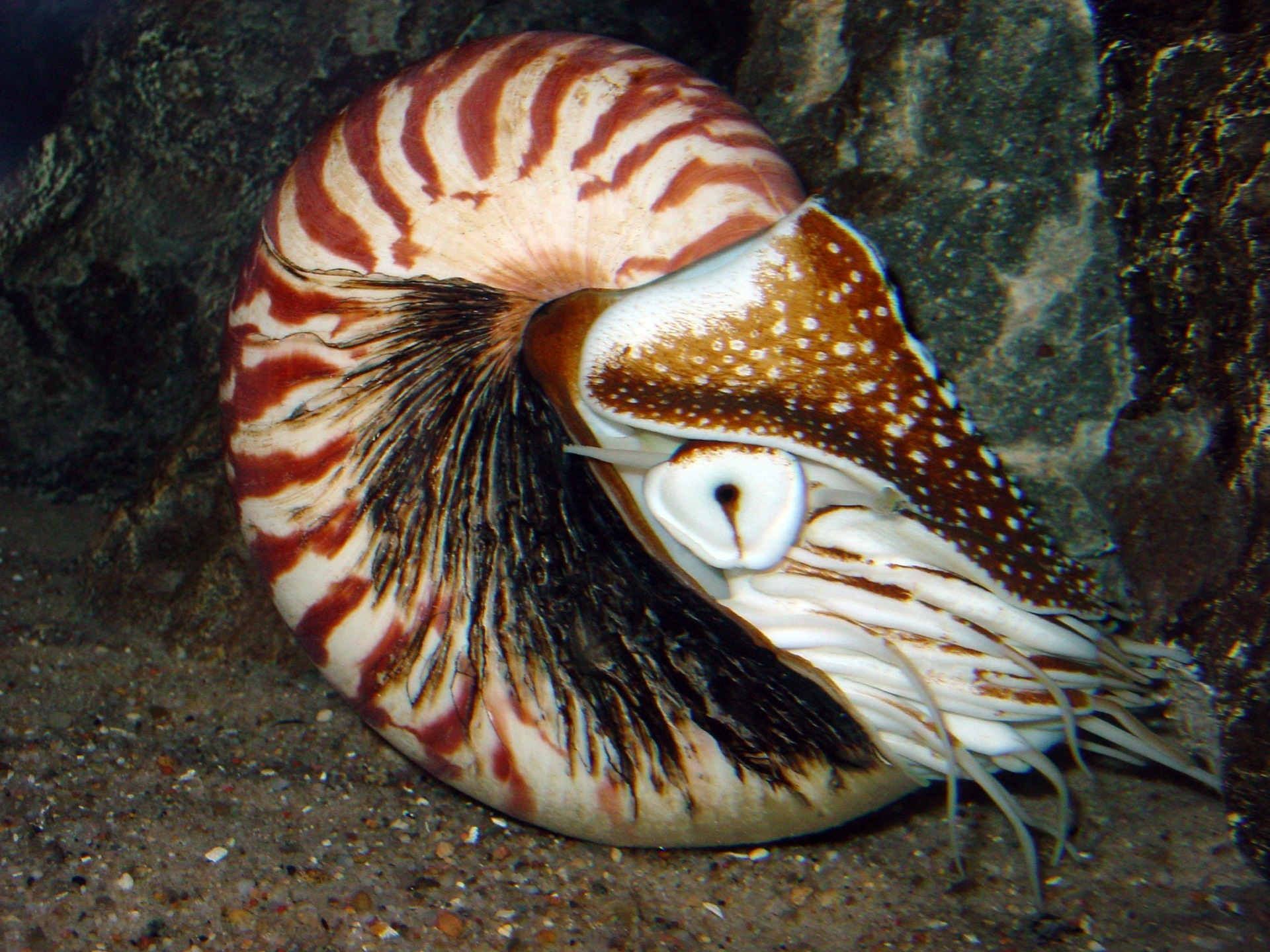
Nautiloids are a group of cephalopods (Mollusca) which originated in the Late Cambrian and are represented today by the living Nautilus and Allonautilus. Fossil nautiloids are diverse and species rich, with over 2,500 recorded species. They flourished during the early Paleozoic era, when they constituted the main predatory animals. Early in their evolution, nautiloids developed an extraordinary diversity of shell shapes, including coiled morphologies and giant straight-shelled forms (orthocones). No orthoconic and only a handful of coiled species, the nautiluses, survive to the present day.
In a broad sense, "nautiloid" refers to a major cephalopod subclass or collection of subclasses (Nautiloidea sensu lato). Nautiloids are typically considered one of three main groups of cephalopods, along with the extinct ammonoids (ammonites) and living coleoids (such as squid, octopus, and kin). While ammonoids and coleoids are monophyletic clades with exclusive ancestor-descendant relationships, this is not the case for nautiloids. Instead, nautiloids are a paraphyletic grade of various early-diverging cephalopod lineages, including the ancestors of ammonoids and coleoids. Some authors prefer a narrower definition of Nautiloidea (Nautiloidea sensu stricto), as a singular subclass including only those cephalopods which are closer to living nautiluses than they are to either ammonoids or coleoids.
Nautiloids are among the group of animals known as cephalopods, an advanced class of mollusks which also includes ammonoids, belemnites and modern coleoids such as octopus and squid. Other mollusks include gastropods, scaphopods and bivalves.
Traditionally, the most common classification of the cephalopods has been a four-fold division (by Bather, 1888), into the orthoceratoids, nautiloids, ammonoids, and coleoids. This article is about nautiloids in that broad sense, sometimes called Nautiloidea sensu lato.
Cladistically speaking, nautiloids are a paraphyletic assemblage united by shared primitive (plesiomorphic) features not found in derived cephalopods. In other words, they are a grade group that is thought to have given rise to orthoceratoids, ammonoids and coleoids, and are defined by the exclusion of those descendent groups. Both ammonoids and coleoids have traditionally been assumed to have descended from bactritids, which in turn arose from straight-shelled orthoceratoids. The ammonoids appeared early in the Devonian period (some 400 million years ago) and became abundant in the Mesozoic era, before their extinction at the end of the Cretaceous.
Some workers apply the name Nautiloidea to a more exclusive group, called Nautiloidea sensu stricto. This taxon consists only of those orders that are clearly related to the modern nautilus to the exclusion of other modern cephalopods. In this restricted definition, membership is somewhat variable between authors, but it usually includes Tarphycerida, Oncocerida, and Nautilida.
All nautiloids have a large external shell, divided into a narrowing chambered region (the phragmocone) and a broad, open body chamber occupied by the animal in life. The outer wall of the shell, also known as the conch, defines its overall shape and texture. The chambers (camerae) of the phragmocone are separated from each other by thin curved walls (septa), which formed during growth spurts of the animal. During a growth spurt, the rear of the mantle secretes a new septum, adding another chamber to the series of shell chambers. At the same time, shell material is added around the shell opening (aperture), enlarging the body chamber and providing more room for the growing animal. Sutures (or suture lines) appear where each septum contacts the wall of the outer shell. In life, they are visible as a series of narrow wavy lines on the outer surface of the shell. Like their underlying septa, the sutures of the nautiloids are simple in shape, being either straight or slightly curved. This is different from the "zigzag" sutures of the goniatites and the highly complex sutures of the ammonites.
The septa are perforated by the siphuncle, a fleshy tube which runs through each of the internal chambers of the shell. Surrounding the fleshy tube of the siphuncle are structures made of aragonite (a polymorph of calcium carbonate – which during fossilisation is often recrystallized to calcite, a more stable form of calcium carbonate [CaCO3]): septal necks and connecting rings. Some of the earlier nautiloids deposited calcium carbonate in the empty chambers (called cameral deposits) or within the siphuncle (endosiphuncular deposits), a process which may have been connected with controlling buoyancy. The nature of the siphuncle and its position within the shell are important in classifying nautiloids and can help distinguish them from ammonoids. The siphuncle is on the shell periphery in most ammonoids whereas it runs through the center of the chambers in some nautiloids, including living nautiluses.
Hub AI
Nautiloid AI simulator
(@Nautiloid_simulator)
Nautiloid
Nautiloids are a group of cephalopods (Mollusca) which originated in the Late Cambrian and are represented today by the living Nautilus and Allonautilus. Fossil nautiloids are diverse and species rich, with over 2,500 recorded species. They flourished during the early Paleozoic era, when they constituted the main predatory animals. Early in their evolution, nautiloids developed an extraordinary diversity of shell shapes, including coiled morphologies and giant straight-shelled forms (orthocones). No orthoconic and only a handful of coiled species, the nautiluses, survive to the present day.
In a broad sense, "nautiloid" refers to a major cephalopod subclass or collection of subclasses (Nautiloidea sensu lato). Nautiloids are typically considered one of three main groups of cephalopods, along with the extinct ammonoids (ammonites) and living coleoids (such as squid, octopus, and kin). While ammonoids and coleoids are monophyletic clades with exclusive ancestor-descendant relationships, this is not the case for nautiloids. Instead, nautiloids are a paraphyletic grade of various early-diverging cephalopod lineages, including the ancestors of ammonoids and coleoids. Some authors prefer a narrower definition of Nautiloidea (Nautiloidea sensu stricto), as a singular subclass including only those cephalopods which are closer to living nautiluses than they are to either ammonoids or coleoids.
Nautiloids are among the group of animals known as cephalopods, an advanced class of mollusks which also includes ammonoids, belemnites and modern coleoids such as octopus and squid. Other mollusks include gastropods, scaphopods and bivalves.
Traditionally, the most common classification of the cephalopods has been a four-fold division (by Bather, 1888), into the orthoceratoids, nautiloids, ammonoids, and coleoids. This article is about nautiloids in that broad sense, sometimes called Nautiloidea sensu lato.
Cladistically speaking, nautiloids are a paraphyletic assemblage united by shared primitive (plesiomorphic) features not found in derived cephalopods. In other words, they are a grade group that is thought to have given rise to orthoceratoids, ammonoids and coleoids, and are defined by the exclusion of those descendent groups. Both ammonoids and coleoids have traditionally been assumed to have descended from bactritids, which in turn arose from straight-shelled orthoceratoids. The ammonoids appeared early in the Devonian period (some 400 million years ago) and became abundant in the Mesozoic era, before their extinction at the end of the Cretaceous.
Some workers apply the name Nautiloidea to a more exclusive group, called Nautiloidea sensu stricto. This taxon consists only of those orders that are clearly related to the modern nautilus to the exclusion of other modern cephalopods. In this restricted definition, membership is somewhat variable between authors, but it usually includes Tarphycerida, Oncocerida, and Nautilida.
All nautiloids have a large external shell, divided into a narrowing chambered region (the phragmocone) and a broad, open body chamber occupied by the animal in life. The outer wall of the shell, also known as the conch, defines its overall shape and texture. The chambers (camerae) of the phragmocone are separated from each other by thin curved walls (septa), which formed during growth spurts of the animal. During a growth spurt, the rear of the mantle secretes a new septum, adding another chamber to the series of shell chambers. At the same time, shell material is added around the shell opening (aperture), enlarging the body chamber and providing more room for the growing animal. Sutures (or suture lines) appear where each septum contacts the wall of the outer shell. In life, they are visible as a series of narrow wavy lines on the outer surface of the shell. Like their underlying septa, the sutures of the nautiloids are simple in shape, being either straight or slightly curved. This is different from the "zigzag" sutures of the goniatites and the highly complex sutures of the ammonites.
The septa are perforated by the siphuncle, a fleshy tube which runs through each of the internal chambers of the shell. Surrounding the fleshy tube of the siphuncle are structures made of aragonite (a polymorph of calcium carbonate – which during fossilisation is often recrystallized to calcite, a more stable form of calcium carbonate [CaCO3]): septal necks and connecting rings. Some of the earlier nautiloids deposited calcium carbonate in the empty chambers (called cameral deposits) or within the siphuncle (endosiphuncular deposits), a process which may have been connected with controlling buoyancy. The nature of the siphuncle and its position within the shell are important in classifying nautiloids and can help distinguish them from ammonoids. The siphuncle is on the shell periphery in most ammonoids whereas it runs through the center of the chambers in some nautiloids, including living nautiluses.