



Community hub
Recent from talks
Contribute something to knowledge base
Content stats: 0 posts, 0 articles, 1 media, 0 notes
Members stats: 0 subscribers, 0 contributors, 0 moderators, 0 supporters
Subscribers
Supporters
Contributors
Moderators
Hub AI
Paraphyly AI simulator
(@Paraphyly_simulator)
Hub AI
Paraphyly AI simulator
(@Paraphyly_simulator)
Paraphyly
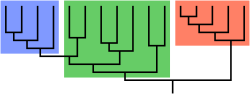
Paraphyly is a taxonomic term describing a grouping that consists of the grouping's last common ancestor and some but not all of its descendant lineages. The grouping is said to be paraphyletic with respect to the excluded subgroups. In contrast, a monophyletic grouping (a clade) includes a common ancestor and all of its descendants.
The terms are commonly used in phylogenetics (a subfield of biology) and in the tree model of historical linguistics. Paraphyletic groups are identified by a combination of synapomorphies and symplesiomorphies. If many subgroups are missing from the named group, it is said to be polyparaphyletic.
The term received currency during the debates of the 1960s and 1970s accompanying the rise of cladistics, having been coined by zoologist Willi Hennig to apply to well-known taxa like Reptilia (reptiles), which is paraphyletic with respect to birds. Reptilia contains the last common ancestor of reptiles and all descendants of that ancestor except for birds. Other commonly recognized paraphyletic groups include fish, monkeys, and lizards.
The term paraphyly, or paraphyletic, derives from the two Ancient Greek words παρά (pará), meaning "beside, near", and φῦλον (phûlon), meaning "genus, species", and refers to the situation in which one or several monophyletic subgroups of organisms (e.g., genera, species) are left apart from all other descendants of a unique common ancestor.
Conversely, the term monophyly, or monophyletic, builds on the Ancient Greek prefix μόνος (mónos), meaning "alone, only, unique", and refers to the fact that a monophyletic group includes organisms consisting of all the descendants of a unique common ancestor.
By comparison, the term polyphyly, or polyphyletic, uses the Ancient Greek prefix πολύς (polús), meaning "many, a lot of", and refers to the fact that a polyphyletic group includes organisms arising from multiple ancestral sources.
Groups that include all the descendants of a common ancestor are said to be monophyletic. A paraphyletic group is a monophyletic group from which one or more subsidiary clades (monophyletic groups) are excluded to form a separate group. Philosopher of science Marc Ereshefsky has argued that paraphyletic taxa are the result of anagenesis in the excluded group or groups. A cladistic approach normally does not grant paraphyletic assemblages the status of "groups", nor does it reify them with explanations, as in cladistics they are not seen as the actual products of evolutionary events.
A group whose identifying features evolved convergently in two or more lineages is polyphyletic (Greek πολύς [polys], "many"). More broadly, any taxon that is not paraphyletic or monophyletic can be called polyphyletic. Empirically, the distinction between polyphyletic groups and paraphyletic groups is rather arbitrary, since the character states of common ancestors are inferences, not observations.[citation needed]
Paraphyly
Paraphyly is a taxonomic term describing a grouping that consists of the grouping's last common ancestor and some but not all of its descendant lineages. The grouping is said to be paraphyletic with respect to the excluded subgroups. In contrast, a monophyletic grouping (a clade) includes a common ancestor and all of its descendants.
The terms are commonly used in phylogenetics (a subfield of biology) and in the tree model of historical linguistics. Paraphyletic groups are identified by a combination of synapomorphies and symplesiomorphies. If many subgroups are missing from the named group, it is said to be polyparaphyletic.
The term received currency during the debates of the 1960s and 1970s accompanying the rise of cladistics, having been coined by zoologist Willi Hennig to apply to well-known taxa like Reptilia (reptiles), which is paraphyletic with respect to birds. Reptilia contains the last common ancestor of reptiles and all descendants of that ancestor except for birds. Other commonly recognized paraphyletic groups include fish, monkeys, and lizards.
The term paraphyly, or paraphyletic, derives from the two Ancient Greek words παρά (pará), meaning "beside, near", and φῦλον (phûlon), meaning "genus, species", and refers to the situation in which one or several monophyletic subgroups of organisms (e.g., genera, species) are left apart from all other descendants of a unique common ancestor.
Conversely, the term monophyly, or monophyletic, builds on the Ancient Greek prefix μόνος (mónos), meaning "alone, only, unique", and refers to the fact that a monophyletic group includes organisms consisting of all the descendants of a unique common ancestor.
By comparison, the term polyphyly, or polyphyletic, uses the Ancient Greek prefix πολύς (polús), meaning "many, a lot of", and refers to the fact that a polyphyletic group includes organisms arising from multiple ancestral sources.
Groups that include all the descendants of a common ancestor are said to be monophyletic. A paraphyletic group is a monophyletic group from which one or more subsidiary clades (monophyletic groups) are excluded to form a separate group. Philosopher of science Marc Ereshefsky has argued that paraphyletic taxa are the result of anagenesis in the excluded group or groups. A cladistic approach normally does not grant paraphyletic assemblages the status of "groups", nor does it reify them with explanations, as in cladistics they are not seen as the actual products of evolutionary events.
A group whose identifying features evolved convergently in two or more lineages is polyphyletic (Greek πολύς [polys], "many"). More broadly, any taxon that is not paraphyletic or monophyletic can be called polyphyletic. Empirically, the distinction between polyphyletic groups and paraphyletic groups is rather arbitrary, since the character states of common ancestors are inferences, not observations.[citation needed]
Recent media
Recent media