Hubbry Logo
NautiloidNautiloidMain
Open search
Nautiloid
Community hub
Nautiloid
logo
8 pages, 0 posts
0 subscribers
Be the first to start a discussion here.
Nautiloid
Nautiloid
from Wikipedia

Nautiloids
Temporal range: 495–0 Ma Late Cambrian – Recent
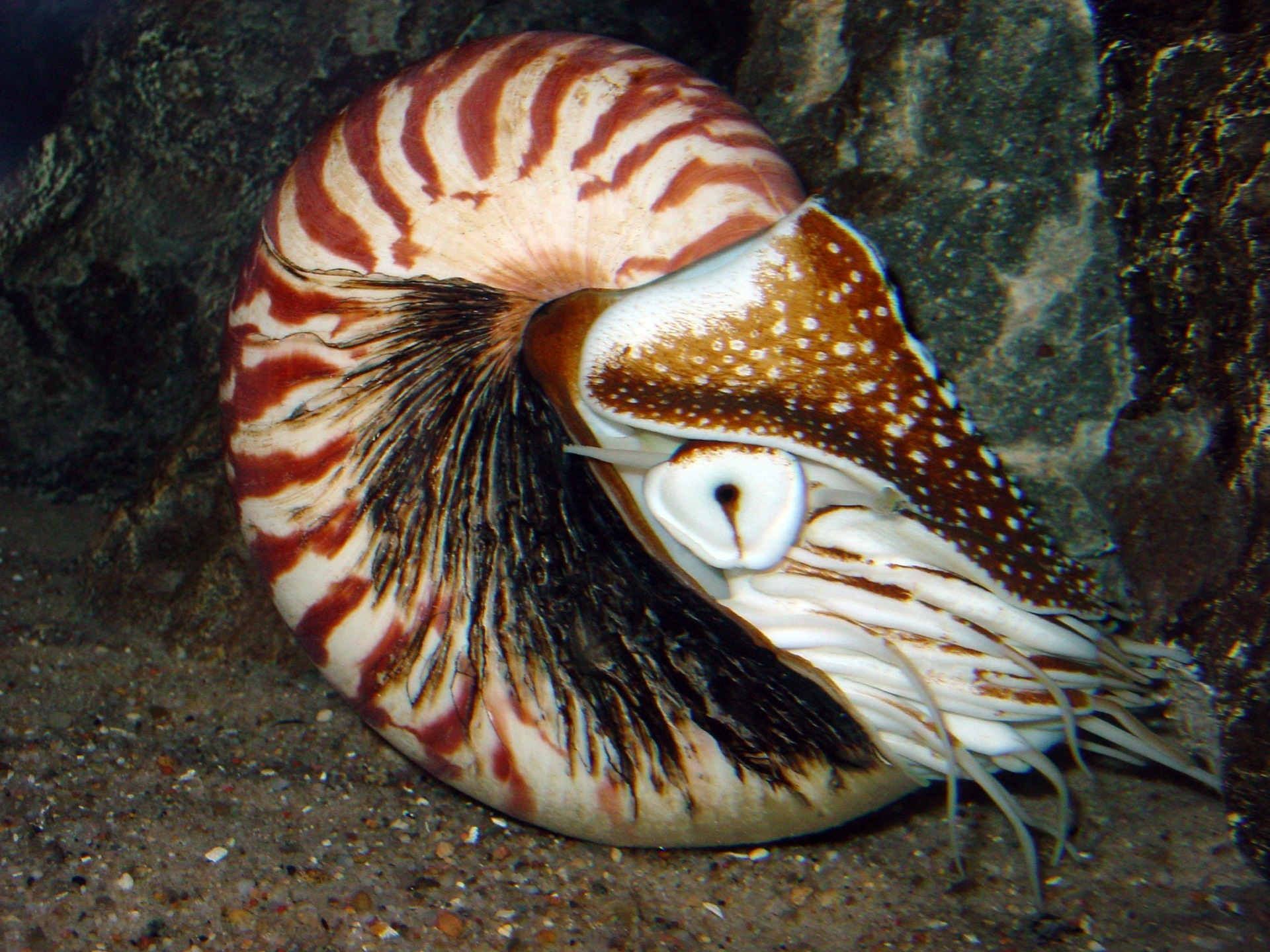
Nautilus pompilius
The endocerid Cameroceras, shown feeding on the tarphycerid Aphetoceras, while a quartet of ellesmerocerid Cyclostomiceras swim by.
Scientific classification Edit this classification
Kingdom: Animalia
Phylum: Mollusca
Class: Cephalopoda
Subclass: Nautiloidea
Agassiz, 1847
Major subdivisions

Nautiloids are a group of cephalopods (Mollusca) which originated in the Late Cambrian and are represented today by the living Nautilus and Allonautilus. Fossil nautiloids are diverse and species rich, with over 2,500 recorded species. They flourished during the early Paleozoic era, when they constituted the main predatory animals. Early in their evolution, nautiloids developed an extraordinary diversity of shell shapes, including coiled morphologies and giant straight-shelled forms (orthocones). No orthoconic and only a handful of coiled species, the nautiluses, survive to the present day.

In a broad sense, "nautiloid" refers to a major cephalopod subclass or collection of subclasses (Nautiloidea sensu lato). Nautiloids are typically considered one of three main groups of cephalopods, along with the extinct ammonoids (ammonites) and living coleoids (such as squid, octopus, and kin). While ammonoids and coleoids are monophyletic clades with exclusive ancestor-descendant relationships, this is not the case for nautiloids. Instead, nautiloids are a paraphyletic grade of various early-diverging cephalopod lineages, including the ancestors of ammonoids and coleoids. Some authors prefer a narrower definition of Nautiloidea (Nautiloidea sensu stricto), as a singular subclass including only those cephalopods which are closer to living nautiluses than they are to either ammonoids or coleoids.

Taxonomic relationships

[edit]

Nautiloids are among the group of animals known as cephalopods, an advanced class of mollusks which also includes ammonoids, belemnites and modern coleoids such as octopus and squid. Other mollusks include gastropods, scaphopods and bivalves.

Traditionally, the most common classification of the cephalopods has been a four-fold division (by Bather, 1888), into the orthoceratoids, nautiloids, ammonoids, and coleoids. This article is about nautiloids in that broad sense, sometimes called Nautiloidea sensu lato.

Cladistically speaking, nautiloids are a paraphyletic assemblage united by shared primitive (plesiomorphic) features not found in derived cephalopods. In other words, they are a grade group that is thought to have given rise to orthoceratoids, ammonoids and coleoids, and are defined by the exclusion of those descendent groups. Both ammonoids and coleoids have traditionally been assumed to have descended from bactritids, which in turn arose from straight-shelled orthoceratoids. The ammonoids appeared early in the Devonian period (some 400 million years ago) and became abundant in the Mesozoic era, before their extinction at the end of the Cretaceous.

Some workers apply the name Nautiloidea to a more exclusive group, called Nautiloidea sensu stricto. This taxon consists only of those orders that are clearly related to the modern nautilus to the exclusion of other modern cephalopods. In this restricted definition, membership is somewhat variable between authors, but it usually includes Tarphycerida, Oncocerida, and Nautilida.

Shell

[edit]
A cross-section of a Nautilus pompilius shell, showing the large body chamber, shrinking camerae, concave septa, and septal necks (partial siphuncle supports)

All nautiloids have a large external shell, divided into a narrowing chambered region (the phragmocone) and a broad, open body chamber occupied by the animal in life. The outer wall of the shell, also known as the conch, defines its overall shape and texture. The chambers (camerae) of the phragmocone are separated from each other by thin curved walls (septa), which formed during growth spurts of the animal. During a growth spurt, the rear of the mantle secretes a new septum, adding another chamber to the series of shell chambers. At the same time, shell material is added around the shell opening (aperture), enlarging the body chamber and providing more room for the growing animal. Sutures (or suture lines) appear where each septum contacts the wall of the outer shell. In life, they are visible as a series of narrow wavy lines on the outer surface of the shell. Like their underlying septa, the sutures of the nautiloids are simple in shape, being either straight or slightly curved. This is different from the "zigzag" sutures of the goniatites and the highly complex sutures of the ammonites.

The septa are perforated by the siphuncle, a fleshy tube which runs through each of the internal chambers of the shell. Surrounding the fleshy tube of the siphuncle are structures made of aragonite (a polymorph of calcium carbonate – which during fossilisation is often recrystallized to calcite, a more stable form of calcium carbonate [CaCO3]): septal necks and connecting rings. Some of the earlier nautiloids deposited calcium carbonate in the empty chambers (called cameral deposits) or within the siphuncle (endosiphuncular deposits), a process which may have been connected with controlling buoyancy. The nature of the siphuncle and its position within the shell are important in classifying nautiloids and can help distinguish them from ammonoids. The siphuncle is on the shell periphery in most ammonoids whereas it runs through the center of the chambers in some nautiloids, including living nautiluses.[1]

The subclass Nautiloidea, in its broader definition, is distinguished from other cephalopods by two main characteristics: the septa are smoothly concave in the forward direction, producing external sutures which are generally simple and smooth. The siphuncle is supported by septal necks which point to the rear (i.e. retrosiphonate) throughout the ontogeny of the animal.

Modern nautiluses have deeply coiled shells which are involute, meaning that the larger and more recent whorls overlap and obscure older whorls. The shells of fossil nautiloids may be either straight (i.e., orthoconic as in Orthoceras and Rayonnoceras), curved (as in Cyrtoceras) coiled (as in Cenoceras), or rarely a helical coil (as in Lorieroceras). Some species' shells—especially in the late Paleozoic and early Mesozoic—are ornamented with spines and ribs, but most have a smooth shell. The shells are formed of aragonite, although the cameral deposits may consist of primary calcite.[2] The coloration of the shell of the modern nautilus is quite prominent, and, although somewhat rarely, the shell coloration has been known to be preserved in fossil nautiloids. They often show color patterns only on the dorsal side, suggesting that the living animals swam horizontally.

Modern nautiloids

[edit]
Nautilus belauensis

Much of what is known about the extinct nautiloids is based on what we know about modern nautiluses, such as the chambered nautilus, which is found in the southwest Pacific Ocean from Samoa to the Philippines, and in the Indian Ocean off the coast of Australia. It is not usually found in waters less than 100 meters (328 feet) deep and may be found as far down as 500 to 700 meters (1,640 to 2,300 feet).

Nautili are free swimming animals that possess a head with two simple lens-free eyes and arms (or tentacles). They have a smooth shell over a large body chamber, which is divided into subchambers filled with an inert gas (similar to the composition of atmospheric air, but with more nitrogen and less oxygen) making the animal neutrally buoyant in the water. As many as 90 tentacles are arranged in two circles around the mouth. The animal is predatory, and has jaws which are horny and beak-like, allowing it to feed on crustaceans.

Empty nautilus shells may drift a considerable distance and have been reported from Japan, India and Africa. Undoubtedly the same applies to the shells of fossil nautiloids, the gas inside the shell keeping it buoyant for some time after the animal's death, allowing the empty shell to be carried some distance from where the animal lived before finally sinking to the seafloor.

Nautili propel themselves by jet propulsion, expelling water from an elongated funnel called the hyponome, which can be pointed in different directions to control their movement. Unlike the belemnites and other cephalopods, modern nautili do not have an ink sac, and there is no evidence to suggest that the extinct forms possessed one either. Furthermore, unlike the extinct ammonoids, the modern nautilus lacks an aptychus, a biomineralized plate which is proposed to act as an operculum which closes the shell to protect the body. However, aptychus-like plates are known from some extinct nautiloids, and they may be homologous to the fleshy hood of a modern nautilus.[3]

Fossil record

[edit]
Fossil nautiloid Trilacinoceras from the Ordovician of China.
Fossil orthoconic nautiloid from the Ordovician of Kentucky; an internal mold showing siphuncle and half-filled camerae, both encrusted.
Cross-section of an Orthoceras nautiloid from the Siluro-Devonian of Erfoud, Morocco.

Nautiloids are often found as fossils in early Palaeozoic rocks (less so in more recent strata).

The rocks of the Ordovician period in the Baltic coast and parts of the United States contain a variety of nautiloid fossils, and specimens such as Discitoceras and Rayonnoceras may be found in the limestones of the Carboniferous period in Ireland. The marine rocks of the Jurassic period in Britain often yield specimens of Cenoceras, and nautiloids such as Eutrephoceras are also found in the Pierre Shale formation of the Cretaceous period in the north-central United States.

Specimens of the Ordovician nautiloid Endoceras have been recorded measuring up to 5.7 meters (19 feet) in shell length, and there is a description of a specimen estimated to have reached 9.1 meters (30 feet), although that specimen is reported as destroyed.[4] These large nautiloids would have been formidable predators of other marine animals at the time they lived.

In some localities, such as Scandinavia and Morocco, the fossils of orthoconic nautiloids accumulated in such large numbers that they form limestones composed of nonspecific assemblages known as cephalopod beds, cephalopod limestones, nautiloid limestones, or Orthoceras limestones in the geological literature. Although the term Orthoceras now only refers to a Baltic coast Ordovician genus, in prior times it was employed as a general name given to all straight-shelled nautiloids that lived from the Ordovician to the Triassic periods (but were most common in the early Paleozoic era).

Evolutionary history

[edit]

Nautiloids are first known from the late Cambrian Fengshan Formation of northeastern China, where they seem to have been quite diverse (at the time this was a warm shallow sea rich in marine life). However, although four orders have been proposed from the 131 species named, there is no certainty that all of these are valid, and indeed it is likely that these taxa are seriously oversplit.

Reconstruction of Cyrtoceras sp
Gyronaedyceras eryx, an oncocerid from the Middle Devonian of Wisconsin
Acleistoceras whitfieldi, an oncocerid from the Middle Devonian of Wisconsin
Trocholites, an tarphycerid from the Upper Ordovician of Wisconsin

Most of these early forms died out, but a single family, the Ellesmeroceratidae, survived to the early Ordovician, where it ultimately gave rise to all subsequent cephalopods. In the Early and Middle Ordovician the nautiloids underwent an evolutionary radiation.[5][6] Some eight new orders appeared at this time, covering a great diversity of shell types and structure, and ecological lifestyles.

Nautiloids remained at the height of their range of adaptations and variety of forms throughout the Ordovician, Silurian, and Devonian periods, with various straight, curved and coiled shell forms coexisting at the same time. Several of the early orders became extinct over that interval, but others rose to prominence.

Nautiloids began to decline in the Devonian, perhaps due to competition with their descendants and relatives the Ammonoids and Coleoids, with only the Nautilida holding their own (and indeed increasing in diversity). Their shells became increasingly tightly coiled, while both numbers and variety of non-nautilid species continued to decrease throughout the Carboniferous and Permian.

The massive extinctions at the end of the Permian were less damaging to nautiloids than to other taxa and a few groups survived into the early Mesozoic, including pseudorthocerids, bactritids, nautilids and possibly orthocerids. The last straight-shelled forms were long thought to have disappeared at the end of the Triassic, but a possible orthocerid has been found in Cretaceous rocks. Apart from this exception, only a single nautiloid suborder, the Nautilina, continued throughout the Mesozoic, where they co-existed quite happily with their more specialised ammonoid cousins. Most of these forms differed only slightly from the modern nautilus. They had a brief resurgence in the early Cenezoic (perhaps filling the niches vacated by the ammonoids in the end Cretaceous extinction), and maintained a worldwide distribution up until the middle of the Cenozoic Era. With the global cooling of the Miocene and Pliocene, their geographic distribution shrank and these hardy and long-lived animals declined in diversity again. Today there are only six living species, all belonging to two genera, Nautilus (the pearly nautilus), and Allonautilus.

The recent decrease in the once worldwide distribution of nautiloids is now believed to have been caused by the spread of pinnipeds.[7] From the Oligocene onward, the appearance of pinnipeds in the geological record of a region coincides with the disappearance of nautiloids from that region.[8] As a result, nautiloids are now limited to their current distribution in the tropical Indo-Pacific Ocean, where pinnipeds are absent.[7] The genus Aturia seem to have temporarily survive regions where pinnipeds were present through adaptations to fast and agile swimming, but eventually went extinct as well.[8] Predation by short-snouted whales and the development of OMZs, preventing nautiloids from retreating into deeper water, are also cited as other potential causes of extinction.[8]

Timeline of orders

[edit]
CenozoicMesozoic EraPaleozoic EraQuaternaryNeogenePaleogeneCretaceousJurassicTriassicPermianCarboniferousDevonianSilurianOrdovicianCambrianNautilidaDiscosoridaOncoceridaTarphyceridaEndoceridaActinoceridaEllesmeroceridaPlectronoceridaCenozoicMesozoic EraPaleozoic EraQuaternaryNeogenePaleogeneCretaceousJurassicTriassicPermianCarboniferousDevonianSilurianOrdovicianCambrian

Classification

[edit]

Older classification systems

[edit]

A consensus on nautiloid classification has traditionally been elusive and subject to change, as different workers emphasize different fundamental traits when reconstructing evolutionary events. The largest and most widely cited publication on nautiloid taxonomy is the Treatise on Invertebrate Paleontology Part K by Teichert et al. 1964, though new information has rendered this volume outdated and in need of revision. Treatise Part K was based on previous classification schemes by Flower & Kummel (1950) and the Russian Osnovy Paleontologii Vol. 5 (1962) textbook.

Other comprehensive taxonomic schemes have been devised by Wade (1988), Teichert (1988), and Shevyrev (2006). Wade (1988) divided the subclass Nautiloidea (sensu lato) into 6 superorders, incorporating orders that are phylogenetically related. They are:

Three of these superorders were established for orders of uncertain placement: Endocerida, Actinocerida, and Discosorida. The other three unite related orders which share a common ancestor and form a branch of the nautiloid taxonomic tree: Plectronoceratoidea, which consists mostly of small Cambrian forms that include the ancestors of subsequent stocks; Orthoceratoidea, which unites different primarily orthoconic orders (including the ancestors for Bacritida and Ammonoidea); and Nautilitoidea, which includes the first coiled cephalopods, Tarphycerida, as well as Nautilida, which includes the recent Nautilus. Another order, Bactritida, which is derived from Orthocerida, is sometimes included with Nautiloidea, sometimes with Ammonoidea, and sometimes placed in a subclass of its own, Bactritoidea.

Recently some workers in the field have come to recognize Dissidocerida as a distinct order, along with Pseudorthocerida, both previously included in Orthocerida as subtaxa.

Early cladistic efforts

[edit]

Cladistic approaches are rare in nautiloid systematics. Many nautiloid orders (not to mention the group as a whole) are not monophyletic clades, but rather paraphyletic grades. This means that they include some descendant taxa while excluding others. For example, the paraphyletic order Orthocerida includes numerous orthocerids stretching through the Paleozoic, but it excludes colloids, despite colloids having a well-established ancestry among the orthocerids. Interpretations by Engeser (1996–1998) suggests that nautiloids, and indeed cephalopods in general, should be split into two main clades: Palcephalopoda (including all the nautiloids except Orthocerida and Ascocerida) and Neocephalopoda (the rest of the cephalopods). Palcephalopoda is meant to correspond to groups which are closer to living nautilus, while Neocephalopoda is meant to correspond to groups closer to living coleoids. One issue which this scheme is the necessity of establishing a firm ancestry for nautilus, to contextualize which cephalopods are closer to which of the two living end members. On the basis of morphological traits, Nautilida is most similar to coiled early nautiloids such as the Tarphycerida and Oncocerida. However, these orders diverged from coleoid ancestors in the early Ordovician at the latest, while genetic divergence estimates suggest that Nautilida diverged in the Silurian or Devonian.[9]

A more recent phylogenetic study by Lindgren et al. (2004), which supports the monophyly of cephalopods, does not bear on the Palcephalopod/Neocephalopod question, since the only cephalopods included were Nautilus and coleoids.[10]

Recent revisions

[edit]

For an in-process revision of Treatise Part K, King & Evans (2019) reclassified nautiloids sensu lato into five subclasses. Major groups were primarily defined by variation in their muscle attachment types. Other traits referenced during this reclassification include protoconch morphology, connecting ring structure, and the extent of cameral and endosiphuncular deposits. While most previous studies referred to subclasses with the suffix '-oidea', these authors instead opted for the suffix '-ia', to prevent confusion between group levels. For example, Nautiloidea sensu stricto was renamed to Nautilia, to differentiate it from the informal broader definition of "nautiloid". In addition, they used the unsimplified names for orders, with the suffix '-atida' rather than the common simplified form, '-ida'.[11]

Nautiloid relationships and body types according to Pohle et al. (2022)

Traditional nautiloid classification schemes emphasize certain character traits over others, potentially involving personal bias as to which traits are worth emphasizing according to different authors. This issue may be resolved by sampling all morphological traits equally through bayesian phylogenetic inference. The first cephalopod-focused paper to use this technique was published by Pohle et al. (2022). They recovered several previously hypothesized groups, though many orders were determined to be paraphyletic. The study was focused on early cephalopod diversification in the Late Cambrian and Ordovician, and did not discuss in detail the origin of post-Ordovician groups. The following is a simplified version of their cladogram, showing early cephalopod relationships to the order level (although various isolated families also originated during this diversification event):[9]

Cephalopoda

Plectronocerida

Yanhecerida

Ellesmerocerida (paraphyletic to Endoceratoidea, Multiceratoidea, and Orthoceratoidea)

Endoceratoidea
Multiceratoidea

Cyrtocerinida

Tarphycerida (possibly paraphyletic to Nautilida)

Oncocerida (paraphyletic to Ascocerida and Discosorida)

Orthoceratoidea

Riocerida (possibly paraphyletic to later orthoceratoids)

Dissidocerida (paraphyletic to later orthoceratoids)

[edit]

See also

[edit]

References

[edit]

Further reading

[edit]
[edit]
Revisions and contributorsEdit on WikipediaRead on Wikipedia
from Grokipedia
Nautiloids are a major group of cephalopods, a class of marine mollusks distinguished by their external, chambered shells that provide through a gas-filled connecting the chambers. Originating in the Late approximately 500 million years ago, they represent the earliest known cephalopods, initially appearing in shallow, neritic environments before expanding into pelagic habitats by the Early . Today, nautiloids are exemplified by the living genera and , which inhabit deep waters and retain primitive traits such as numerous arms without suckers and scavenging diets. Throughout their evolutionary history, nautiloids diversified into thousands of across diverse shell morphologies, including straight orthoconic forms, curved cyrtocones, and tightly coiled nautilicones, adapting as active predators or vertical migrants in ancient oceans. Their peak diversity occurred during the early , particularly in the , when they dominated marine ecosystems, but major declines followed the end-Permian mass extinction, from which they never fully recovered. Recent classifications recognize nautiloids as a paraphyletic assemblage encompassing at least five subclasses, such as Plectronoceratia and Orthoceratia, based on muscle attachment scars, siphuncular structures, and septal features, highlighting their role as ancestral stock for ammonoids and coleoids. Modern nautiloids, with only about seven to ten extant , face threats from overharvesting for their iridescent shells, leading to international protections under since 2017, underscoring their vulnerability despite a 500-million-year lineage. These "living fossils" exhibit slow growth, long lifespans up to 20 years, and brooding reproduction via large eggs, contrasting with the dynamic behaviors of more derived cephalopods like octopuses and squids.

Overview and Taxonomy

Definition and Characteristics

Nautiloids belong to the subclass Nautiloidea within the class , a group of marine mollusks that includes both living and extinct species distinguished by their external chambered shells. These shells serve as a defining feature, providing protection and buoyancy control, and set nautiloids apart from other cephalopods like squids and octopuses, which lack external shells in their modern forms. The subclass encompasses a diverse array of forms that have persisted through geological time, with only a few species surviving to the present day. Key characteristics of nautiloids include their coiled (planispiral) or straight (orthoconic) shells, which are divided into gas-filled chambers connected by a —a tubular structure that allows regulation of by adjusting fluid and gas levels. This buoyant system enables them to inhabit a range of depths, functioning similarly to a submarine's . As predators, nautiloids employ numerous tentacles—often more than 90 in living species—for grasping prey such as crustaceans and , complemented by a sharp, horny for tearing food. The basic body plan of nautiloids consists of a head region bearing large eyes, a ring of tentacles, and a funnel for jet propulsion via water expulsion, with the soft visceral mass and reproductive organs housed within the largest chamber of the shell. This arrangement supports their active, mobile lifestyle in marine environments. Nautiloids are often regarded as "living fossils" due to their ancient lineage, which traces back to the Late Cambrian period approximately 500 million years ago, representing one of the earliest radiations of cephalopods.

Taxonomic Relationships

Nautiloids occupy a distinct position within the animal kingdom, classified under the phylum , class , and subclass Nautiloidea. This placement reflects their status as shelled cephalopods, a group that diverged early in the evolutionary history of mollusks and persists today with living representatives in the genera Nautilus and . The subclass Nautiloidea encompasses both extant and extinct forms characterized by external, chambered shells, distinguishing them from other molluscan lineages such as gastropods or bivalves. Within , nautiloids are considered ancestral to both ammonoids and coleoids (including extinct belemnites), all of which evolved from a common shelled during the period, rendering Nautiloidea paraphyletic. Ammonoids, known for their complex septal sutures, and coleoids, with reduced or internal shells like the phragmocone in belemnites, arose from within early nautiloid lineages based on shared shell morphology and siphuncular structures, though nautiloids uniquely retain a fully external shell throughout their body. In contrast, nautiloids are distinguished from the subclass —which includes modern , octopuses, and —by their persistent external shell, whereas coleoids have internalized or reduced shells like the or , reflecting a that occurred in the Paleozoic era. Nautiloids exhibit several key traits shared with other cephalopods, underscoring their common ancestry, including a highly advanced with a centralized that supports complex sensory integration and learning capabilities. They possess camera-type eyes, which provide sharp vision adapted to low-light marine environments, evolving convergently with vertebrate eyes but featuring a single lens and . Additionally, like other cephalopods, nautiloids are active predators, employing via a siphuncle-derived funnel and tentacles equipped with adhesive structures to capture prey such as crustaceans and . The of Nautiloidea has been a subject of debate in cephalopod , with morphological data from shell structures, muscle attachment scars, and siphuncular features providing strong support for it as a natural, cohesive group. Recent classifications recognize multiple orders and subclasses within Nautiloidea, such as Orthoceratia and Nautilia, based on consistent anatomical characters like connecting ring morphology and cameral deposits. Molecular from mitochondrial and nuclear loci further bolsters this view by aligning living nautiloids with fossil-inclusive trees that affirm their distinct lineage separate from coleoids, though some analyses incorporating early fossil taxa suggest potential requiring further resolution.

Anatomy and Morphology

Shell Structure

The nautiloid shell is an external, structure composed primarily of , typically forming a coiled or straight that houses the soft body in the outermost chamber while earlier portions are divided into gas-filled chambers by curved . These attach to the shell wall via sutures, creating a phragmocone that occupies much of the shell's length and enables regulation as the animal grows and adds new chambers. The shell wall consists of three main layers: an outer organic periostracum that provides initial sites for mineralization and aids in muscle attachment; a middle prismatic or porcellaneous layer of aligned prisms that offers resistance and ; and an inner nacreous layer of stacked platelets interlaminated with organic conchiolin sheets, which imparts , flexibility, and the bulk of the shell's thickness for overall strength. The porcellaneous layer exhibits higher (Vickers values of 246–310) compared to the nacreous layer (126–166), enhancing durability against environmental wear. The , a vascularized strand of tissue running through the , connects all chambers and regulates by controlling the exchange of liquid and gas within them, allowing the animal to adjust its density relative to . In most nautiloids, including modern forms, the siphuncle occupies a ventral position near the shell's periphery, though early orthoconic species often featured a more central or even dorsal placement, influencing hydrostatic stability. Shell variations include planispiral in the majority of , which compacts the phragmocone efficiently for horizontal orientation, while orthoconic forms from early nautiloid lineages exhibit straight, elongated shells suited to vertical migration. is present in shell size and proportions. Mechanically, the multi-layered shell provides robust against predation through its composite , where the hard outer prisms resist penetration and the tough nacreous inner layer absorbs impact energy. Buoyancy is maintained via the gas-filled chambers, following , where the upward buoyant force approximates the animal's weight: Vchambers×(ρseawaterρgas)mbody+mshellV_{\text{chambers}} \times (\rho_{\text{seawater}} - \rho_{\text{gas}}) \approx m_{\text{body}} + m_{\text{shell}}, with chamber volume (VchambersV_{\text{chambers}}) and low gas density (ρgas0.001g/cm3\rho_{\text{gas}} \approx 0.001 \, \text{g/cm}^3) nearly negligible compared to density (ρseawater1.025g/cm3\rho_{\text{seawater}} \approx 1.025 \, \text{g/cm}^3) counterbalancing the soft body and shell mass (typically requiring 60–70% gas occupancy for in orthoconic forms).

Internal Anatomy

The visceral mass of nautiloids houses the primary soft organs, including the digestive and reproductive systems. The digestive system features a that serves as a storage pouch for ingested food, followed by a lined with a thick for mechanical and initial enzymatic breakdown. A caecum adjacent to the facilitates absorption through its lamellated , which increases surface area and aids in filtering undigested particles, while digestive glands secrete enzymes for further assimilation. Reproductive organs are sexually dimorphic, with females possessing ovaries and oviducts that produce large eggs (up to 25 mm in diameter) laid singly and attached to substrates, requiring 9–12 months for development; males have testes that generate spermatophores stored in for transfer via a modified (hectocotylus). Unlike the open circulatory systems of most other mollusks, nautiloids possess a closed circulatory system that enhances oxygen delivery efficiency. This system includes two branchial hearts that pump deoxygenated blood through the gills for oxygenation and a central systemic heart that propels the oxygenated blood to the rest of the body via arteries. Blood, containing haemocyanin as the oxygen carrier, appears blue and flows through a network of vessels. The nervous system of nautiloids is centralized and relatively advanced among mollusks, featuring a large brain encapsulated in cartilaginous tissue with approximately 37–38 lobes dedicated to sensory processing and motor control. Specific lobes handle visual information and support learning capabilities, such as maze navigation, while brachial nerve cords extend to innervate the tentacles for tactile and manipulative functions. This distributed neural architecture allows for coordinated responses to environmental stimuli, differing from the more ganglion-based systems in other invertebrates. Sensory structures in nautiloids emphasize chemoreception and basic vision adapted to low-light deep-sea habitats. The eyes are pinhole cameras lacking lenses or corneas, relying on a fluid-filled chamber and for image formation, which provides low-resolution but functional vision. Numerous tentacles (cirri), numbering 50 to over 90 and arranged in two concentric circles around the , bear chemosensory papillae for detecting and mates via and smell, while the mantle cavity contains paired gills (ctenidia) that facilitate during respiration. These adaptations support survival in oxygen-poor waters. Locomotion in nautiloids relies on a formed by the fluid-filled mantle cavity, enabling controlled and movement. is achieved through rhythmic contractions of mantle muscles that expel water via the muscular (hyponome), generating for backward at speeds up to 0.3 m/s over short bursts. Tentacles and subtle shell adjustments aid in and fine maneuvering, complementing the primary propulsive mechanism.

Modern Nautiloids

Species Diversity

The extant nautiloids comprise a small number of species confined to two genera within the family Nautilidae: Nautilus, which includes six recognized species (N. pompilius, N. belauensis, N. stenoporus, N. macromphalus, N. vitiensis, N. samoaensis, and N. vanuatuensis), and Allonautilus, which includes two species (A. perforatus and A. scrobiculatus). These species represent the sole surviving members of the subclass Nautiloidea, a group that once exhibited far greater diversity during the Paleozoic era. All living nautiloids are distributed exclusively in the tropical , ranging from the and eastward to , , and the , with populations associated with coral reefs, rocky slopes, and fore-reefs at depths typically between 100 and 700 meters. The three newly described Nautilus species (N. vitiensis from , N. samoaensis from , and N. vanuatuensis from ) extend the known range in the South Pacific. No populations occur in the Atlantic Ocean or other regions, likely due to historical barriers such as deep-water trenches and the absence of suitable habitats. Morphologically, these species differ in shell characteristics, with maximum diameters reaching up to 20 cm in N. pompilius; coloration varies from white with brown stripes in N. pompilius to more mottled or pitted patterns in species, adaptations that enhance on reef substrates. Populations of all extant nautiloid species are considered vulnerable owing to intense exploitation for their iridescent shells used in jewelry and decorative items, as well as for consumption in local fisheries, leading to documented declines across their range. The International Union for Conservation of Nature (IUCN) has assessed several species as of 2025, with N. belauensis classified as Near Threatened, while N. pompilius is , and N. macromphalus, A. perforatus, and A. scrobiculatus are owing to limited data on population sizes; the newly described species and N. stenoporus are also or not yet assessed. Global trade regulations under Appendix II, implemented since 2017, monitor international commerce to mitigate further declines. Genetic analyses indicate low levels of variability across nautiloid populations, consistent with historical bottleneck events that reduced diversity, as evidenced by studies showing minimal diversity even among isolated groups in the and . This limited genetic diversity heightens susceptibility to environmental changes and exploitation, underscoring the need for enhanced conservation measures to preserve these ancient lineages.

Ecology and Behavior

Living nautiloids primarily inhabit the fore-reef slopes and deep environments of the tropical , from the western Pacific to the eastern Indian Oceans, at depths typically ranging from 300 to 400 meters during the day, with an upper temperature limit of 25°C and a maximum depth tolerance of approximately 800 meters limited by shell implosion risks. These nektobenthic cephalopods remain close to the ocean floor to minimize predation risks and undertake daily vertical migrations, ascending to shallower waters around 70 to 100 meters at night to and occasionally deposit eggs. This nocturnal behavior aligns with their low-light visual capabilities and reliance on chemosensory detection in dim conditions. Nautiloids are opportunistic and occasional predators, subsisting mainly on carrion such as dead crustaceans (including hermit crabs and their molts), remains, nematodes, and echinoids, though they have been observed preying on live . They locate prey through chemosensory tracking of plumes from distances up to 10 , employing a " of search" posture with tentacles extended in a sweeping motion and following sinusoidal paths toward the source. The 60 to 94 tentacles, lacking suckers but equipped with ridges or pads via sticky epithelial secretions and cilia, grasp and manipulate food items, passing them to the central where a chitinous crushes and tears the material for ingestion; they can also dig into to unearth buried prey using tentacles and the hyponome. Reproduction in nautiloids is sexual with separate sexes, featuring where males transfer spermatophores using a modified called the spadix. Females are K-selected, reaching at 12 to 15 years and producing low numbers of large eggs (0 to 10 annually), laid individually or in small batches within leathery capsules attached to hard substrates like rocks or . Embryonic development is protracted, lasting about 1 year, which contributes to slow recovery rates. Nautiloids exhibit solitary lifestyles, with limited social interactions beyond , and navigate their environment primarily through chemosensory means, using olfactory cues for , homing, and obstacle avoidance in low-visibility depths. Experimental studies demonstrate basic associative learning, including and route learning in tasks, with retention lasting up to 21 days, as well as the ability to switch between and route-based strategies. The primary anthropogenic threats to living nautiloids include incidental capture as in deep-slope fisheries targeting other , as well as direct through unregulated trap fisheries for the international shell trade, which has led to population declines in key areas like the and . Additionally, reduces available carbonate ions, hindering shell formation and potentially compromising growth, buoyancy regulation, and survival, particularly in vulnerable early life stages.

Paleontology

Fossil Record

Nautiloids first appear in the fossil record during the Late period, approximately 488 million years ago, with the earliest known specimens from the Fengshan Formation in northeastern , where they exhibit early diversity in form and structure. Their abundance increased rapidly through the , reaching peak diversity during the and periods, when they dominated marine assemblages before declining in the . Over 2,500 nautiloid have been described from fossils, though validity varies; the vast majority preserve only external shells, with rare instances of soft tissue impressions providing glimpses into internal . Fossils are most commonly preserved as calcified shells in marine limestones and shales, reflecting depositional environments like shallow seas and reefs where nautiloids thrived. Exceptional preservation occurs in Konservat-Lagerstätten, such as the Late Beecher's Bed in New York, where pyritization has captured delicate details including adjacent nautiloid shells alongside soft-bodied trilobites. preservation remains exceedingly rare overall, limited to phosphatized or carbonized traces in select anoxic settings that inhibit decay. The geographic distribution of nautiloid fossils is worldwide, spanning to rocks, but with notable concentrations in Ordovician-Silurian deposits of (modern ) and (modern ), where diverse assemblages occur in platform carbonates. Significant sites include the Middle Ordovician limestones of the Cincinnati Arch in the United States and Silurian shales of the Welsh Borderland in the . Cambrian Lagerstätten of have yielded additional early nautiloid shells, enhancing understanding of their initial radiation.

Key Fossil Genera

The earliest known nautiloid genus, , appeared in the Late Cambrian period, approximately 488 million years ago, and is characterized by a small, straight (orthoconic) shell typically measuring around 1-2 cm in length, with a simple, bulbous positioned marginally along the interior ventral wall. This primitive structure suggests Plectronoceras was a slow-moving, benthic predator or , relying on basic control through gas-filled chambers in the phragmocone. Fossils from sites in and indicate it represents the foundational form of shelled cephalopods, with no evidence of complex coiling or advanced siphuncular adaptations. During the era, nautiloid diversity expanded dramatically, exemplified by giant orthoconic forms like Endoceras from the period (about 470-443 million years ago), which could reach lengths of up to 6 meters, making it one of the largest known of its time. This genus, part of the order, featured a long, straight shell with a central filled with endosiphuncular deposits that aided in regulation, allowing the animal to maintain despite its massive size. In contrast, coiled morphologies emerged in genera such as Tarphyceras from the Early to (roughly 485-419 million years ago), with planispiral shells up to 10 cm in diameter and a wide, marginal that shifted position during , enabling more efficient horizontal swimming compared to straight-shelled relatives. These forms highlight the of nautiloids in shallow marine environments, where coiled shells likely improved maneuverability for predation. In the and eras, nautiloid genera like Aturia (Paleocene to Miocene, spanning about 66-5 million years ago) displayed planispiral shells with broad, depressed whorls up to 15 cm across, differing from the more rounded coils of modern . This genus, found in deposits from , , and , adapted to deeper waters, with its flattened shell possibly enhancing stability during descent. Following the Cretaceous-Paleogene mass extinction, nautiloid diversity declined sharply, with most lineages vanishing and only the Nautilida order persisting into the present, likely due to competition from rising marine mammals like pinnipeds and cetaceans that occupied similar predatory niches. Paleobiological insights into extinct nautiloids derive from trace fossils, such as bite marks on shells of genera like Cibolonautilus, attributed to predation, indicating these cephalopods were active predators or targeting and smaller with beak-like jaws. For giant forms like , buoyancy calculations based on shell volume (estimated via cross-sectional area and length) versus weight (accounting for density and gas-filled chambers) reveal that the siphuncle's liquid-to-gas ratio allowed only when the animal was oriented horizontally, suggesting a lifestyle limited to slow, near-bottom cruising rather than active swimming. Recent discoveries have enhanced understanding of nautiloid soft anatomy, including a 2021 report of exceptionally preserved soft tissues in (mid-Cretaceous, ~95 million years ago) nautilids from Lebanese lagerstätten, revealing details of the digestive tract, , eyes, and mantle outside the shell, preserved through phosphatization in anoxic conditions.

Evolutionary History

Origins and Early Diversification

Nautiloids trace their origins to early monoplacophoran-like mollusks, such as the small-shelled helcionellids, which exhibited primitive conical or limpet-shaped shells and are considered stem-group cephalopods based on shared features like a dorsal shell position and potential precursors. These ancestors likely lacked the advanced chambered shells of later forms but represented a transition from creeping, soft-bodied mollusks to more mobile cephalopods. The first true nautiloids, characterized by chambered phragmocones and functional for control, appeared in the Late , with cambria from the Fengshan Formation in serving as the earliest definitive example around 490 million years ago. This emergence coincided with the initial diversification of shelled cephalopods in shallow marine environments of and . Early diversification accelerated in the Early , marked by a shift from predominantly straight-shelled (orthoconic) forms to coiled morphologies, which provided structural strength, improved hydrodynamic efficiency, and enhanced maneuverability against rising predation pressures from contemporary euarthropods and early vertebrates. This transition is evident in genera like Tarphyceras, which exhibited loosely coiled shells, allowing for better protection of the soft body while maintaining predatory capabilities through . The Ordovician radiation of nautiloids, involving the appearance of major groups like the Endoceratoidea and Orthoceratoidea, aligned closely with the around 470 million years ago, a global surge in marine diversity driven by cooling climates, oxygenation, and ecological tiering that favored nektonic predators. Key adaptations during this phase included refinements to the , a tubular structure connecting shell chambers, which enabled more efficient and liquid removal for rapid buoyancy adjustments and faster swimming speeds, positioning nautiloids as dominant mid-level predators in oceans. Giant orthoconic forms like , reaching lengths over 9 meters, exemplified this predatory niche dominance through enhanced thrust from the hyponome and siphuncle-mediated depth control. Nautiloids experienced minor diversity losses during the Late Devonian extinction events, such as the Kellwasser and Hangenberg crises around 372 million years ago, primarily due to competition from emerging ammonoids and coleoids rather than direct mass die-offs, allowing several lineages to persist. Remarkably, unlike many ammonoid groups that suffered severe losses, nautiloids survived the end-Permian mass extinction at 252 million years ago—the most severe biotic crisis in Earth's history—with resilient genera like ancestors enduring the associated anoxia and through low metabolic rates and deep-water refugia. This survival set the stage for their continued, albeit reduced, presence through the and .

Timeline of Major Orders

The timeline of major nautiloid orders reflects a pattern of rapid early diversification followed by prolonged decline, shaped by evolutionary innovations and mass extinctions. Nautiloids first appeared in the Late with primitive orders like Plectronoceratia and early Multiceratia, characterized by simple siphuncular structures and uncoiled or slightly curved shells. By the Early , diversification accelerated, with the emergence of Orthoceratia (including ) and Tarphyceratia, marking a transition from predominantly uncoiled forms to the first coiled morphologies in Tarphycerida. This period saw uncoiled straight-shelled (orthoconic) forms dominate, as exemplified by , which ranged from the Early to the Late and featured simple, straight shells adapted for nektonic lifestyles. Diversity peaked during the , with over 10 orders coexisting, including Oncocerida, Discosorida, Actinocerida, and Barrandeocerida, alongside persisting groups like Ellesmerocerida and Tarphycerida. This era represented the height of nautiloid morphological variety, with coiled and curved shells becoming more prevalent, though straight-shelled forms remained common. Species-level diversity was substantial, with the Database recording more than 3,000 species alone, extending into high Silurian counts before a gradual decline. Short-lived orders, such as Cyrtocerinida (restricted to the ) and Rioceratida (Early to Late ), highlight episodic radiations within this burst. The introduced Nautilida, a coiled order that persists to the present and now represents the sole surviving nautiloid lineage, with tightly coiled shells enabling buoyancy control. Post-Paleozoic, diversity plummeted to 2–3 orders by the , primarily Nautilida and lingering Orthocerida remnants. Major transitions included the shift to coiled forms by the Late Ordovician, enhancing hydrodynamics, and a bottleneck following the end-Triassic extinction that greatly reduced nautiloid diversity. Recent studies suggest that more nautilid genera survived the end-Triassic extinction than previously estimated. Mass extinctions, notably the end-Permian and end-Triassic events, decimated uncoiled orders like and Discosorida, favoring resilient coiled survivors.
OrderTemporal RangeKey Characteristics
Early Ordovician – Late Straight shells, dorsomyarian muscles
Early – PresentCoiled shells, pleuromyarian muscles
Cyrtocerinida (short-lived)Curved shells, low diversity

Classification

Traditional Systems

Traditional classification systems for nautiloids were largely morphology-based, focusing on external and internal shell features to establish taxonomic groups, with efforts spanning from descriptive cataloging in the 18th and early 19th centuries to more synthetic schemes by the mid-20th century. Early systems applied the Linnaean to nautiloids in the , grouping them primarily by shell shape, such as straight-shelled orthocones and coiled forms. Early 19th-century classifications grouped nautiloids by shell shape, such as straight-shelled orthocones and coiled forms, with later refinements distinguishing variations like longicones, brevicones, and gyrocones to organize species. In the 19th and early 20th centuries, Alpheus Hyatt advanced these efforts by developing evolutionary sequences for nautiloids, emphasizing the position of the relative to the shell venter and dorsum to infer phylogenetic lineages. Hyatt's approach, detailed in works like Genera of Fossil Cephalopods (1884), led to the establishment of orders such as the Ammonitida, which were initially included among nautiloids but later recognized as a separate group of extinct cephalopods. Key contributions included A.H. Foord's comprehensive 1897–1901 on nautiloid s from the of , which cataloged and illustrated numerous genera based on shell ornamentation, septal sutures, and siphuncular characteristics. Similarly, Otto H. Schindewolf's syntheses in the mid-20th century highlighted the role of shell septa and their complexity in distinguishing taxa, including nautiloids, integrating septal lobe patterns with overall morphology to refine ordinal boundaries. These traditional systems suffered from limitations, including the formation of paraphyletic groupings that did not reflect true evolutionary relationships, a disregard for soft-part due to the fossil record's toward hard parts, and an overemphasis on shell coiling patterns as primary diagnostic traits. Prior to the , classifications relied heavily on phenetic similarity rather than cladistic analysis, leading to convergent forms being artificially clustered together.

Modern Cladistic Approaches

Modern cladistic approaches to nautiloid phylogeny apply parsimony analysis to construct evolutionary trees that minimize the number of character state changes, emphasizing shared derived traits (synapomorphies) such as the position and structure of the and the complexity of septal sutures. These methodologies prioritize morphological data from and extant forms to infer relationships, contrasting with earlier phenetic or evolutionary classifications by focusing on branching hierarchies rather than linear sequences. A foundational study is Dzik's 1984 analysis, which developed a character matrix incorporating dozens of morphological traits from nautiloid orders, including siphuncular deposits and septal features, to reconstruct early diversification patterns. In the 1990s and early , initial efforts integrated molecular data from living nautiloids, such as 12S and 16S rRNA sequences from species, to calibrate phylogenetic trees and test morphological hypotheses against genetic divergence. These combined approaches often yield phylogenies depicting Nautiloidea as a paraphyletic assemblage, with as the surviving monophyletic group sister to , with internal structure positioning as basal to more derived groups like . Phylogenetic software like PAUP (Phylogenetic Analysis Using Parsimony) has facilitated tree construction by processing character matrices with over 50 coded morphological traits, enabling heuristic searches for optimal topologies. Challenges in these analyses include significant , especially in shell coiling patterns that evolved convergently across nautiloid lineages, which is mitigated through weighted parsimony techniques that reduce the influence of highly homoplastic characters.

Recent Revisions and Debates

In the 2010s, molecular clock analyses provided new estimates for the divergence of Nautiloidea from Coleoidea, placing it between 415 and 453 million years ago based on hemocyanin gene sequences. These estimates, calibrated against fossil divergences such as the Gastropoda-Cephalopoda split around 550 Ma, refined timelines for early cephalopod radiation but highlighted discrepancies with older fossil-based dates exceeding 500 Ma. Concurrently, genomic studies on living Nautilus species began integrating molecular data into nautiloid phylogenetics, revealing conserved traits like biomineralization genes that inform ancestral reconstructions. The 2020s brought further revisions through advanced phylogenetic methods, including a 2022 Bayesian analysis of Cambrian-Ordovician cephalopods that recovered three monophyletic clades—Endoceratoidea, Multiceratoidea, and Orthoceratoidea—using an expanded morphological matrix of over 200 characters from 80 taxa. This study reclassified several early groups, such as placing certain endocerids as stem nautiloids based on siphuncle and shell features visualized via CT scanning of fossils, challenging prior paraphyletic arrangements. Debates persist over the inclusion of ammonoids (Ammonoidea) within broader nautiloid frameworks, with some analyses suggesting close relations to orthoceroids but rejecting full integration into Endoceratoidea due to distinct septal and soft-tissue traits. Ongoing controversies include the of Nautilida and relationships with early orders like Tarphycerida, based on muscle scar positions and shell coiling patterns. A 2025 revision of and Permian Nautilida provides updated family classifications and stratigraphic ranges, refining the understanding of late coiled nautiloid evolution. in shell morphology, such as orthoconical forms in unrelated lineages, complicates cladistic resolution, as evidenced by in siphuncular structures across Endoceratoidea and Orthoceratoidea. Efforts to extract from subfossil Nautilus shells have yielded limited success, with degradation preventing full genomic recovery, though stable isotope analyses from historical specimens provide proxy data on habitat shifts. Emerging tools like AI-assisted trait analysis have accelerated fossil interpretations; for instance, machine learning models trained on image datasets achieved 90% accuracy in classifying cephalopod fragments by 2022, aiding re-evaluations of disputed genera. As of 2025, the consensus recognizes approximately 18 nautiloid orders within five subclasses, with Endoceratoidea encompassing early straight-shelled forms and serving as a basal linking to ammonoid origins.

References

Add your contribution
Related Hubs
User Avatar
No comments yet.