
Recent from talks
Naval Act of 1794
Knowledge base stats:
Talk channels stats:
Members stats:
Naval Act of 1794
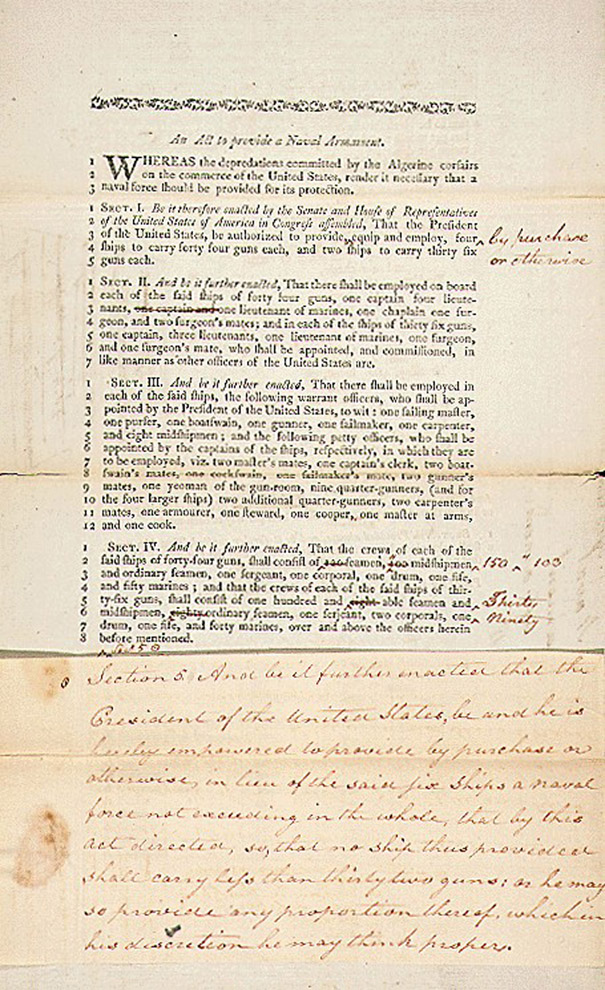
The Act to Provide a Naval Armament (Sess. 1, ch. 12, 1 Stat. 350), also known as the Naval Act of 1794, or simply, the Naval Act, was passed by the 3rd United States Congress on March 27, 1794, and signed into law by President George Washington. The act authorized the construction of six frigates at a total cost of $688,888.82. These ships were the first ships of what became the United States Navy.
In August 1785, after the Revolutionary War drew to a close, Congress had sold Alliance, the last ship remaining in the Continental Navy, due to a lack of funds to maintain the ship. From 1785 until 1797, the United States' only armed maritime service was the Revenue Marine, founded in 1790 at the prompting of Secretary of the Treasury Alexander Hamilton to enforce the nation's new export duties.
In 1785, two American merchant ships had been captured by the Muslim state of Algiers, and Minister to France Thomas Jefferson decided that an American naval force was needed to protect the passage of American vessels through the Mediterranean. Jefferson's recommendations were initially met with indifference and even hostility from a Congress that feared both the expense and the political dominance of a powerful naval establishment. The House of Representatives in 1786, and the Senate in 1791, discussed various proposals for a naval force, including estimates of costs for building frigates, but none were acted upon. Only in 1793, when Muslim pirates from Algiers had captured eleven additional merchant ships, was a proposal finally taken seriously.
A bill was presented to the House of Representatives on January 20, 1794, providing for the construction of four ships to carry 44 guns each, and two ships to carry 36 guns each – by purchase or otherwise. The bill also provided pay and sustenance for naval officers, Marine officers, petty officers, sailors, and marines, and outlined how each ship should be crewed in order to operate them. Opposition to the bill was strong and a clause was added that should peace be established with Algiers the construction of the ships was to cease.
Piracy had not been a problem when the American colonies were a part of the British Empire; the Royal Navy protected American vessels, since they belonged to subjects of the British Crown. After the American Revolutionary War, however, that protection was lost, and many foreign powers found that they could harass American merchant ships with impunity. Indeed, once the French Revolution started, Great Britain also started interdicting American merchant ships and there was little the fledgling American government could do about it. This was a major philosophical shift for the young Republic, many of whose leaders felt that a Navy would be too expensive to raise and maintain, and would unnecessarily provoke the European powers, in particular Great Britain. In the end, however, it was felt necessary to protect American interests at sea.[citation needed]
In March 1796, as construction of the frigates slowly progressed, a peace accord was announced between the United States and Algiers. In accordance with clause nine of the Naval Act of 1794, a clause that specifically directed that construction of the frigates be discontinued if peace was established, construction on all six ships was halted. After some debate and prompting by President Washington, Congress passed an act on 20 April 1796, allowing the construction and funding to continue only on the three ships nearest to completion: United States, Constellation and Constitution.
By late 1798 however, France began to seize American merchant vessels and the attempt at a diplomatic resolution had resulted in the XYZ Affair, prompting Congress to approve funds for completion of the remaining three frigates: President, Congress and Chesapeake.
Source:
Hub AI
Naval Act of 1794 AI simulator
(@Naval Act of 1794_simulator)
Naval Act of 1794
The Act to Provide a Naval Armament (Sess. 1, ch. 12, 1 Stat. 350), also known as the Naval Act of 1794, or simply, the Naval Act, was passed by the 3rd United States Congress on March 27, 1794, and signed into law by President George Washington. The act authorized the construction of six frigates at a total cost of $688,888.82. These ships were the first ships of what became the United States Navy.
In August 1785, after the Revolutionary War drew to a close, Congress had sold Alliance, the last ship remaining in the Continental Navy, due to a lack of funds to maintain the ship. From 1785 until 1797, the United States' only armed maritime service was the Revenue Marine, founded in 1790 at the prompting of Secretary of the Treasury Alexander Hamilton to enforce the nation's new export duties.
In 1785, two American merchant ships had been captured by the Muslim state of Algiers, and Minister to France Thomas Jefferson decided that an American naval force was needed to protect the passage of American vessels through the Mediterranean. Jefferson's recommendations were initially met with indifference and even hostility from a Congress that feared both the expense and the political dominance of a powerful naval establishment. The House of Representatives in 1786, and the Senate in 1791, discussed various proposals for a naval force, including estimates of costs for building frigates, but none were acted upon. Only in 1793, when Muslim pirates from Algiers had captured eleven additional merchant ships, was a proposal finally taken seriously.
A bill was presented to the House of Representatives on January 20, 1794, providing for the construction of four ships to carry 44 guns each, and two ships to carry 36 guns each – by purchase or otherwise. The bill also provided pay and sustenance for naval officers, Marine officers, petty officers, sailors, and marines, and outlined how each ship should be crewed in order to operate them. Opposition to the bill was strong and a clause was added that should peace be established with Algiers the construction of the ships was to cease.
Piracy had not been a problem when the American colonies were a part of the British Empire; the Royal Navy protected American vessels, since they belonged to subjects of the British Crown. After the American Revolutionary War, however, that protection was lost, and many foreign powers found that they could harass American merchant ships with impunity. Indeed, once the French Revolution started, Great Britain also started interdicting American merchant ships and there was little the fledgling American government could do about it. This was a major philosophical shift for the young Republic, many of whose leaders felt that a Navy would be too expensive to raise and maintain, and would unnecessarily provoke the European powers, in particular Great Britain. In the end, however, it was felt necessary to protect American interests at sea.[citation needed]
In March 1796, as construction of the frigates slowly progressed, a peace accord was announced between the United States and Algiers. In accordance with clause nine of the Naval Act of 1794, a clause that specifically directed that construction of the frigates be discontinued if peace was established, construction on all six ships was halted. After some debate and prompting by President Washington, Congress passed an act on 20 April 1796, allowing the construction and funding to continue only on the three ships nearest to completion: United States, Constellation and Constitution.
By late 1798 however, France began to seize American merchant vessels and the attempt at a diplomatic resolution had resulted in the XYZ Affair, prompting Congress to approve funds for completion of the remaining three frigates: President, Congress and Chesapeake.
Source:
Recent media